Balatongyörök Travel Guide: The Complete Lakeside, Lookout, History, Beach, Hiking & Food Guide for Your Upcoming Trip
Balatongyörök is one of those Lake Balaton villages that rewards travelers who arrive already knowing they want something quieter, greener, and more panoramic than the larger resort towns. Set on the north shore of Lake Balaton in Zala County, Hungary, it combines a family-friendly beach, a small village center, historic churches and crosses, Roman heritage, vineyard hillsides, forest trails, boat connections, and some of the most famous views in the western Balaton region.
If you have already booked your trip, this guide is designed to help you understand the place before you arrive: what to prioritize, where to walk, how the village feels in different seasons, what is free, what is ticketed, which restaurants have strong or weak review signals, and how to connect Balatongyörök with the surrounding western Balaton landscape.
Balatongyörök’s identity is built around three main elements:
- The lake — swimming, strolling, boating, sunset watching, and family holidays.
- The views — especially from Szépkilátó, Batsányi Viewing Tower, and nearby lookout points.
- Deep historical layers — prehistoric settlement, Roman baths and spring, medieval village life, Festetics estate history, 19th-century church heritage, and 20th-century resort development.
It is not a nightlife hub. It is not a big city. It is not a place of endless museums. Its pleasures are slower: morning coffee, swimming, forest paths, spring water, vineyard walks, hilltop chapels, pier sunsets, and the feeling that Lake Balaton is opening in front of you like a wide inland sea.
1. Essential Orientation: What Kind of Place Is Balatongyörök?
Balatongyörök is a small scenic lakeside village on the northwestern side of Lake Balaton, backed by the wooded slopes of the Keszthely Hills and facing the broad western basin of the lake. It has a quieter, more contemplative atmosphere than the larger and more nightlife-oriented resort areas on Balaton’s southern shore.
Travelers most often come here for:
- Szépkilátó, the famous “Beautiful Lookout”
- Balatongyöröki strand, the municipal beach by the pier and railway station
- Forest hikes to lookout towers
- Római forrás, the Roman Spring below Szépkilátó
- Boat trips to or from Balatonmáriafürdő, Szigliget, Badacsony, and Keszthely
- Wine and vineyard landscapes, especially around Becehegy
- Quiet guesthouse holidays
- Views of Badacsony, Szigliget Castle, and the Tapolca Basin witness hills
The atmosphere is often described as:
- Quiet
- Scenic
- Family-friendly
- Nostalgic
- Green and park-like
- More about walking and views than nightlife
- Modestly commercial rather than overbuilt
- A place to “feel better” rather than rush through attractions
In summer, the village becomes busier with Hungarian families, regional travelers, cyclists, and visitors from Central Europe. Outside summer, the beach and waterfront shift into a peaceful promenade mood: closed kiosks, quiet lake sounds, empty benches, and a reflective sense of off-season Balaton.
2. Quick Attraction Map: Major Places Mentioned in Local Research
The following places surfaced as notable attractions, restaurants, cafés, viewpoints, caves, and nearby excursion points.
| Place | Type | Rating / Review Signal Mentioned | Location Notes |
|---|---|---|---|
| Szépkilátó | Viewpoint / park | 4.8, 7,587 Google ratings; Tripadvisor #1 of 5 with 4.8/5 from 38 reviews | Balatongyörök, Eötvös Károly u.; around 46.7702904, 17.362072 |
| Batsányi Viewing Tower / Batsányi Kilátó | Lookout tower | 4.9, 713 Google ratings; Tripadvisor 4.8/5 from 4 reviews | Above Balatongyörök; around 46.7771731, 17.357045 |
| Római forrás | Roman Spring | 4.3, 186 Google ratings | Below Szépkilátó; around 46.7699022, 17.3631512 |
| Bél Mátyás Viewing Tower | Lookout tower | 4.9, 496 Google ratings | Balatongyörök; around 46.7685089, 17.3522625 |
| Road Wanderers megálló pont | Stop / viewpoint-related point | 4.7, 3 ratings | Near Szépkilátó |
| Fotópont | Photo point | 4.8, 20 ratings | Balatongyörök; around 46.7489203, 17.352217 |
| Csodabogyós Cave, Balatonederics | Cave / adventure | 4.9, 508 ratings | Nearby Balatonederics |
| Csodabogyós-barlang | Cave listing | 5.0, 17 ratings | Balatonederics |
| Festetics Viewing Tower / Festetics kilátó | Nearby lookout | 4.8, 1,005 ratings | Gyenesdiás |
| Borriviéra Kilátó-pont | Viewpoint | 5.0, 2 ratings | Balatongyörök area |
| Promenád Kávéház | Café | 4.6, 1,634 Google ratings; Tripadvisor 4.2/5 from 45 reviews | Füredi út 50 |
| Nemesvitai kilátó | Nearby lookout | 4.8, 266 ratings | Nemesvita |
| Szobakű-barlang | Cave | 4.5, 2 ratings | Balatongyörök area |
| Wielkie Pole / Nagymező area | Nearby recreation area | 4.8, 631 ratings | Gyenesdiás |
| Kicsi Csóka Bisztró | Bistro | 4.7, 410 Google ratings; limited Tripadvisor signal | Takács József u. |
| Party Csóka Étterem és Kávézó | Restaurant / café | 4.6, 1,620 Google ratings | Strand utca area |
| Balatonederics-Fotópont | Photo point | 4.8, 123 ratings | Near Balatonederics |
| Festetics Állatpark | Animal park | 4.5, 1,732 ratings | Gyenesdiás, Dornyai Béla út 4 |
| APáholy Étterem | Restaurant / bar | 4.7, 1,135 Google ratings | Eötvös Károly u. 153 |
| Darnay Pince | Wine cellar / hospitality | 5.0, 24 ratings | Gyenesdiás |
Other places covered in depth in this guide include:
- Roman Catholic Parish Church / Szent Mihály-templom / “Szent Agyas templom” reference
- 1848 stone cross
- Old cemetery gravestones
- Becehegy press houses and Szentháromság Chapel
- Pele apó tanösvénye, the Balaton-felvidék National Park educational trail
- Balatongyörök Boat Station
- Balatongyörök railway stop
- Bertha Bulcsu Cultural House and Library
- Mikus Gyula sétány, clarified as being in Keszthely, not Balatongyörök
- Szent Mihály Chapel, nearby between Balatongyörök and Vonyarcvashegy
- Golf Club Imperial / minigolf-style leisure
- Nearby restaurants with review signals, including Magyaros Csárda, Fehér Vitorlás, Bambusz Büfé, Varga Vendéglő, Móló Bisztró, and Lángos Buci
3. The Story of Balatongyörök: From Stone Age Settlement to Balaton Resort
Balatongyörök may feel like a quiet lakeside village today, but its history is remarkably layered. It has been inhabited from prehistoric times through the Roman period, the Middle Ages, the Habsburg era, and the modern age of Lake Balaton tourism.
Prehistoric Settlement
Archaeological finds show that the Balatongyörök area has been inhabited since the Stone Age / Neolithic period. Finds include:
- A stone hatchet from the Stone Age
- A copper axe from the 3rd century BC
These objects point to long-term human presence along the northern shore of Balaton. The area would have offered valuable advantages: water, fish, mild microclimate, cultivable slopes, and access to routes along the lake.
Roman Balatongyörök: Lacus Pelso and the Bath Complex
In Roman times, Lake Balaton was known as Lacus Pelso, and the region formed part of the province of Pannonia.
Near present-day Balatongyörök, at the foot of the hill now famous as Szépkilátó, archaeologists uncovered the remains of a Roman settlement and bath complex, generally dated to the 3rd century AD. Some research notes also refer to a 2nd-century Roman villa and bath.
Important Roman heritage points include:
- A villa rustica, or rural Roman estate
- A small Roman bath
- A water system connected to the Római forrás, the Roman Spring
- Traces of a hot-water bath
- Water led from the spring into the bath and several rooms of the villa
The ruins were rediscovered or excavated around 1938, with further work in the 1940s. Some sources say the remains were identified in the 1940s, while others say excavation began in 1938. The baths were later renovated in 2001, although the villa and bath remains are now inside the Györöki Ifjúsági tábor / Zala County Children and Youth Camp area and are not generally presented as a regular visitor attraction.
For visitors, the accessible reminder of this Roman layer is the Római forrás, the Roman Spring below Szépkilátó.
Early Medieval Continuity
After Roman rule declined, the region passed through complex early medieval transitions. Research notes mention communities including Christian groups descended from the Eastern Goths, who first built on existing Roman ruins and later shifted settlement westward.
This is one of the most fascinating aspects of Balatongyörök’s history: the medieval village did not emerge in isolation but developed directly on or near the remains of the Roman settlement. The Roman site became the substrate of later Christian village life.
First Written Mention: 1121
Balatongyörök is first mentioned in writing in 1121, in the founding charter of the Almádi Abbey, today associated with Monostorapáti.
The name Györök is likely connected to Gyürk, son of II. Atyus, the voivode or regional noble associated with nearby Szigliget. This reflects the feudal property relationships of 12th-century Hungary.
Medieval and Ottoman Periods
Throughout the late Middle Ages, Balatongyörök remained a small rural village connected to local castles, church institutions, and the broader system of Balaton-side settlements.
During the Ottoman / Turkish era of the 16th and 17th centuries, nearby fortifications on the north shore of Balaton helped protect the village from major destruction. Sources say Balatongyörök remained relatively safe compared to more exposed areas and was not abandoned.
This continuity mattered: because the village survived, it could develop further in the 18th and 19th centuries rather than be rebuilt from nothing.
Festetics Era: 18th-Century Estate Life
A decisive shift came when the prominent Festetics family acquired village lands in 1732–1734. Balatongyörök became part of the Festetics estate system, whose best-known center was the baroque Festetics Palace in nearby Keszthely.
Under Festetics ownership, Balatongyörök gained:
- Economic stability
- Estate administration
- Stronger regional trade links
- Rural social consolidation
- Church building and renewal
In the mid-18th century, Kristóf Festetics commissioned a baroque Roman Catholic church, whose sanctuary and nave were built on the foundations of an older medieval church. This again shows architectural continuity: medieval foundations beneath later religious buildings.
By the late 18th century, Balatongyörök was described as a more significant settlement, no longer merely a tiny hamlet.
19th Century: Scenic Reputation Begins
In the 19th century, the village remained largely agricultural but increasingly became valued for its landscape.
The most symbolic moment came in 1855, when writer and statesman Károly Eötvös reportedly named the hilltop viewpoint Szépkilátó, meaning “Beautiful Lookout,” inspired by the panorama over the lake and the Tapolca Basin.
By the turn of the 20th century, early bath tourists were appearing along the lakeside, especially around what became Balaton Street and the resort zone. The artistic and cultural atmosphere of Lake Balaton also reached Balatongyörök: in the late 19th and early 20th centuries, it became a favored place for artists and prominent figures.
One trace of this villa culture is Petőfi Sándor utca, a linden-lined avenue laid out around 1910.
Railway, Beach, and Resort Transformation
The early 20th century transformed Balatongyörök into a proper holiday village.
Key developments:
- 1902–1903: Railway line built through the village
- Around 1907: Spa / bathing beach completed, partly on land donated by the Festetics family
- 1920: The bath camp was formally recognized as a holiday resort
- 1932–1938: Balatongyörök pier constructed
- 1936: Balatongyörök boat station put into service
- 1938: Roman baths rediscovered
- Interwar period: Villas, guesthouses, tourism economy expanded
The railway was especially important. It linked the village to regional and national transport networks and made regular bathing tourism possible. The beach and pier then turned Balatongyörök into a recognizably modern Balaton resort.
Late 20th Century and Contemporary Identity
In 1990, Balatongyörök received the European Village Prix d’Honneur, recognizing its beauty, environment, and attractive village character.
Today, Balatongyörök’s historical landscape includes:
- Prehistoric settlement traces
- Roman villa and bath heritage
- The Római forrás
- Medieval village continuity
- Festetics estate influences
- Classicist parish church
- 1848 stone cross
- 19th-century gravestones
- Becehegy press houses
- 20th-century railway, beach, pier, and resort infrastructure
Its identity is not Moorish, urban-industrial, or big-city monumental. It is Central European, rural, lakeside, Roman, Christian, estate-based, and resort-shaped.
4. Top Experiences in Balatongyörök
4.1 Szépkilátó: The View That Defines Balatongyörök
Szépkilátó is the signature sight of Balatongyörök. If you do only one thing beyond the beach, make it this.
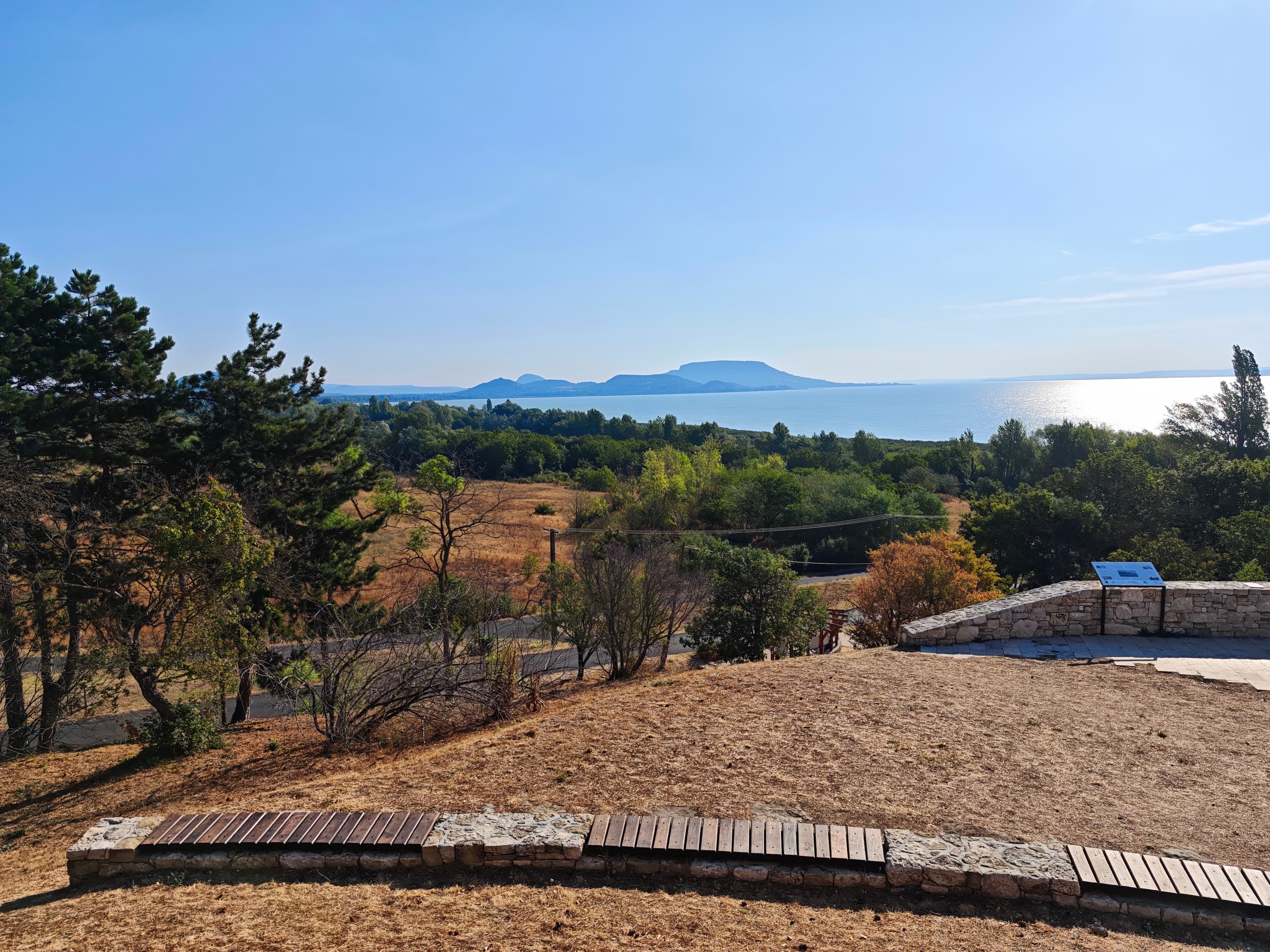
It is not a tower but a view terrace / lookout area on the hill formerly known as Kápolna-domb, or Chapel Hill. It stands around 140 meters above sea level, near Route 71, on the eastern edge of Balatongyörök.
From here, you see:
- Lake Balaton’s western basin
- The Tapolca Basin
- Badacsony
- Szent György-hegy
- Szigliget
- Other volcanic witness hills
- The southern shore in soft distance
Some lists of visible hills include:
- Badacsony
- Szent György-hegy
- Csobánc
- Gulács
- Tóti-hegy
- Haláp
- Somló-hegy
- Kis-Somló
- Ság-hegy
The view is broad and emotional. On clear days, the lake shimmers pale blue-green below, textured with ripples like brushstrokes. The air carries dry grass, warm pine, roadside dust, and in summer sometimes food smells from nearby kiosks.
Historical Significance
The hill was once called Kápolna-domb because of an earlier chapel and a Dominican monastery associated with the area. The name Szépkilátó was reportedly given by Károly Eötvös in 1855, after he was impressed by the panorama. A commemorative board at the site quotes him.
Local accounts also connect the landscape with the Festetics family: Lady Mary Victoria Douglas-Hamilton, wife of Prince Tasziló Festetics, is said to have planted black pines on the hill.
Practical Details
- Admission: Free for the viewpoint / park area
- Opening: Effectively open all year, generally accessible 24/7
- Best time: Sunrise, sunset, clear late afternoon, or after rain when visibility improves
- Access: By car, bicycle, or on foot; parking nearby along Road 71
- Nearby: Római forrás below the stairs; Takács József utca viewpoint area; Kicsi Csóka Bisztró and other hospitality nearby
Review Reality
Reviews strongly support Szépkilátó as Balatongyörök’s top attraction. It has:
- Google rating around 4.8 with thousands of ratings
- Tripadvisor signal: #1 of 5 things to do, 4.8/5 from 38 reviews
The main caution: it is a short scenic stop, not a full-day attraction. If you expect museums, complex facilities, or a long activity, you may find it simple. But as a view, it delivers.
4.2 Kápolnadomb and the Takács József Street Viewpoint
The terms Kápolnadomb, Szépkilátó, and the Takács József utcai kilátópont overlap in local usage around the same hill and viewpoint zone.
The Takács József utca end viewpoint is essentially connected to the Szépkilátó experience: a free, year-round panorama stop with views across Balaton and the Tapolca Basin. It is described as easy to reach, with:
- Parking
- Benches
- A short walk of roughly 100 meters from parking
- Bus stop nearby
- Good access by car, bicycle, and on foot
Why Go?
This is ideal if you want:
- A quick photo stop
- A low-effort panorama
- A place accessible for older travelers or families
- A sunset stop before dinner
- A view without hiking to a tower
Practical Details
- Admission: Free
- Opening: Open year-round, no ticket office
- Best visited: Daylight, sunrise, sunset
- Weekday/weekend difference: None documented
4.3 Római forrás: The Roman Spring Below the Lookout
The Római forrás, or Roman Spring, is one of Balatongyörök’s most atmospheric small sites.
It lies directly below Szépkilátó. From the viewpoint area, a stone stairway descends through trees to the spring. The walk is short but somewhat steep and usually manageable for families.
Historical Importance
The spring once supplied water to a Roman villa and bath complex. Archaeological research discovered:
- Roman villa remains
- A small bath building
- A water supply system
- Evidence of warm bathing facilities
The spring was also later known as Kápolna-kút, or Chapel Well, linking it to the later Christian history of Kápolna-domb.
The spring area was renovated in 2001 by the Balatongyöröki Ifjúságért Egyesület, the Youth Association of Balatongyörök.
What It Feels Like
The vibe is completely different from the open panorama above.
At Szépkilátó, the world is wide: sky, lake, wind, hills. At the Roman Spring, everything becomes intimate: trickling water, wet stone, shade, moss, and cool air.
The water is repeatedly described as:
- Crystal clear
- Gently murmuring
- Drinkable
- Refreshing
- Flowing into a small pool
Visitors often fill bottles, rinse hands, or simply pause in the shade. Some local and travel writing gives the spring a healing undertone, suggesting people have valued its water since ancient times.
Facilities
The site includes:
- Stone spring structure / kőkút
- Small pool
- Benches
- Tables
- Picnic area
- Designated szalonnasütő, a bacon-roasting / grilling place
- Informational boards about the Roman villa and spring
- Shade from mature trees
Kneipp Water-Treading Facility
In recent years the Római forrás has also been adapted as a Kneipp-taposó, or Kneipp water-treading facility.
Visitors walk through cold water over stones for circulation and wellness benefits. Local instructions recommend a stork-like gait — “gólya-járás” — lifting each foot out of the water slowly and consciously.
Bring:
- A small towel
- Shoes you can remove easily
- Patience if other visitors are using the water
Practical Details
- Admission: Free, 0 HUF
- Opening: Open all year, effectively 24/7 as an outdoor site
- Best time: Summer for shade and cool water; spring/autumn for quiet
- Access: From Szépkilátó via stone steps
- Caution: Short but steep descent; can be slippery after rain
4.4 Balatongyöröki Strand: The Main Municipal Beach
The Balatongyöröki strand is the village’s main beach and one of its central summer spaces. It is located in the village center near the pier and opposite the railway station.
It has more than 100 years of bathing tradition, rooted in the early 20th-century development of Balaton tourism. The municipal beach has passed through several eras of improvement, with a stated local goal of improving quality rather than simply increasing traffic.
It is known as:
- Family-friendly
- Award-winning
- Part of the Kék Hullám Zászló / Blue Wave Flag beach quality system
- A key summer gathering place
- A beach with strong views toward Badacsony and Szigliget
Layout and Atmosphere
Expect:
- Grassy sunbathing areas
- Shallow, gradually deepening water
- Family-friendly swimming
- Changing rooms and sanitary facilities
- Entrance gates and ticket office in season
- Adjacent pier
- Nearby food kiosks, cafés, and restaurants
- Green, park-like setting rather than dense concrete development
The soundscape in summer is classic Balaton:
- Children splashing
- Hungarian, German, and other Central European languages
- Cutlery and plates from buffets
- Pop music from bars
- Small waves slapping the shore
- Bicycle bells and sandals on paths
The smell is equally classic:
- Sunscreen
- Lángos
- Grilled sausage
- Fried dough
- Warm freshwater
- Grass and shade trees
Outside season or outside paid hours, the beach becomes quieter: dog walkers, couples, empty benches, ducks, darker water, and the melancholic beauty of off-season Balaton.
Opening Season and Hours
Typical main season:
- June to September
- Daily: 08:00–19:00 for official supervised / ticketed operation
Some sources mention 08:00–18:00, likely reflecting specific years, ticket office hours, or related beach data.
Important access rule:
- Outside official hours, the beach can be free to use
- It is closed for cleaning and maintenance roughly 06:00–08:00
- Security closes gates around:
- 24:00 Sunday–Thursday
- 01:00 Friday–Saturday
Ticket Prices
2024 documented prices
- Adult weekday: 1,300 Ft
- Adult weekend / public holiday: 1,600 Ft
- Child 4–18 weekday: 600 Ft
- Child 4–18 weekend: 700 Ft
- Family ticket, 2 adults + 2 children weekday: 3,200 Ft
- Family ticket weekend: 3,800 Ft
- Adult swimming ticket from 17:00: 1,000 Ft
- Children under 4 are typically free
2025 likely / Blue Wave update
- Adult weekday: 1,500 Ft
- Adult weekend / holiday: 1,800 Ft
- Adult 3-day: 3,400 Ft
- Adult weekly: 7,500 Ft
- Adult season pass: 35,000 Ft
- Child 4–18 weekday: 700 Ft
- Child weekend / holiday: 800 Ft
- Child 3-day: 1,500 Ft
- Child weekly: 3,500 Ft
- Child season pass: 15,000 Ft
- Family daily, 2 adults + 2 children: 3,700 Ft
- Swimming ticket from 17:00: adult 1,100 Ft, child 500 Ft
- Cabin ticket / kabinjegy: 40,000 Ft, likely season rental
Always confirm current prices locally, because beach tariffs can change by year.
Review Reality
The strand is central to Balatongyörök’s summer reputation. It is best for:
- Swimming
- Families
- Relaxing
- Lake atmosphere
- Pairing beach time with casual food
Cautions:
- Summer crowding is real
- Lakefront food may be priced for location
- Adjacent food quality can vary
- Do not expect a hidden, empty beach in peak season
4.5 Szépkilátó Beach: Separate Note
Some sources refer to Szépkilátó Strand, a beach connected with the Szépkilátó area rather than the central municipal beach by the pier. Local pages indicate that from 20 June 2025, the adjacent Szépkilátó Beach requires an entrance ticket, while before that it functioned as a free public area.
Reported main-season hours for Szépkilátó Beach:
- Daily: 08:00–18:00
Outside seasonal beach operation, the surrounding area functions as a public promenade and green park.
Important: Do not confuse:
- Balatongyöröki strand — central municipal beach by pier / railway
- Szépkilátó beach / strand — related to Szépkilátó area and separate seasonal information
4.6 Batsányi Viewing Tower / Batsányi Kilátó
The Batsányi Kilátó is one of Balatongyörök’s best hiking rewards.
It is a lookout tower in the hills above the village, connected with trails from Szépkilátó and the surrounding Keszthely Hills. Some sources describe it as standing on Garga Hill, around 221 meters above the lake, originally built in 1972 and redesigned in 2013. Other detailed hiking sources describe the Batsányi-kilátó as being on Pap-hegy, on Boncsostető, at 448 m above sea level, rebuilt in 2014 with a wood-metal structure.
Because the research sources preserve both descriptions, travelers should understand that local naming, route descriptions, and elevation references can vary. What is consistent is that it is a major lookout above Balatongyörök and a highly rated scenic hiking destination.
The Hike
From the Szépkilátó parking area, the hike is often described as around 3 km through hilly terrain, with:
- Medium difficulty
- Some steep stretches
- Forest paths
- Possible connections to the Pele apó tanösvénye
- Routes marked toward the tower, including links with red triangle markings in some descriptions
The walk itself is part of the experience: cicadas, birds, dry leaves, pine resin, damp earth after rain, and the sound of your own footsteps replacing the beach noise below.
The View
From the tower, expect views over:
- Western Balaton basin
- Tapolca Basin
- Badacsony
- Szigliget
- Szent György Hill
- Keszthely Bay
- Forested hills
- Villages and vineyards
Practical Details
- Admission: Free
- Opening: Listed by one source as 0–24, effectively open all the time
- Best time: Clear mornings, late afternoons, sunset if you can descend safely
- Caution: Weather matters; haze or clouds reduce the value significantly
- Bring: Water, proper shoes, sun protection, and a charged phone
Review Reality
Review signals are strong but limited:
- Google: 4.9 with hundreds of ratings
- Tripadvisor: 4.8/5 from 4 reviews, ranked #2 of 5 things to do
Verdict: excellent if you enjoy viewpoints and hiking; less essential if you only have time for one panorama, in which case choose Szépkilátó.
4.7 Bél Mátyás Viewing Tower
The Bél Mátyás Viewing Tower is another highly rated viewpoint in the Balatongyörök area.
Research data:
- Rating: 4.9
- Reviews: 496
- Location: Balatongyörök, Bél Mátyás kilátó
- Approximate coordinates: 46.7685089, 17.3522625
While the detailed historical report focused more on Szépkilátó and Batsányi, the Geo data clearly identifies Bél Mátyás Viewing Tower as one of the top local attractions. If you are planning multiple lookout hikes, this should be considered part of the broader western Balaton viewpoint network.
Expect the same fundamental appeal:
- Forested access
- Lake panoramas
- Volcanic hills in the distance
- A quieter alternative or complement to the more famous Szépkilátó
4.8 Balaton-felvidéki National Park Educational Trail: Pele apó tanösvénye
One of the best family-friendly nature experiences near Balatongyörök is Pele apó tanösvénye, the educational trail created by the Balaton-felvidéki National Park Directorate.
It runs in the Keszthely Hills between Balatongyörök and Balatonederics.
Key Facts
- Length: about 8.5 km
- Stations: 38 thematic stations
- Designed especially for: children and families
- Languages: Hungarian and English information boards
- Structure: several shorter and longer loops, not just one linear trail
- Approximate creation: around 2005, based on a 2024 report saying it was built nearly 19 years earlier
- 2024: trail boards were being renewed by the municipality and the national park
Themes
The trail introduces:
- Forest habitats
- Local plants and animals
- Keszthely Hills geology
- Landscape forms
- Cultural history
- Local wine-growing and forestry traditions
- Child-friendly learning through the figure of “Pele apó”
Access Points
Possible access points include:
- Szépkilátó
- Africa Museum near Balatonederics
- Balatongyörök Bélap Valley
- Balatonederics
- Trails connecting toward Batsányi-kilátó
Practical Details
- Admission: Free, 0 Ft
- Opening: Freely accessible; best from sunrise to sunset
- Guided tours: May be available through the National Park and may require a fee
- Difficulty: Family-friendly but includes forest paths and elevation changes
- Night hiking: Not recommended, even if not specifically forbidden
Best For
- Families with curious children
- Hikers who want interpretation, not just exercise
- Travelers staying several days
- Off-beach half-day activity
4.9 Becehegy: Press Houses, Vineyard Atmosphere and Szentháromság Chapel
Becehegy is one of the most beautiful historical vineyard hills in the Balaton Uplands, belonging to Balatongyörök. It combines:
- 19th-century press houses
- Wine cellars
- Mandulafák / almond trees
- Views toward Badacsony, Szigliget, and the southern shore
- The Szentháromság Chapel
- A calm, old wine-hill atmosphere
Historic Press Houses
Specific historic press houses mentioned include:
- Ádám-pince, 1819
- Major-féle présház, 1854
- Szántai-présház, 1860
- Sáfrán-féle “hordós” présház, 1860
- Rédey-présház, 1862
- Klein Böske-féle présház
These represent traditional Balaton Uplands vineyard architecture: often stone or brick, sometimes with thatched roofs, arranged along vineyard lanes.
Hegyre járás Tradition
One old local tradition was hegyrejárás. On Shrove Monday, women went up to the wine hill with:
- Doughnuts
- Ham
- Pogácsa
- Food and drink
They danced and celebrated among the cellars. This detail gives Becehegy a living cultural texture beyond architecture.
Szentháromság Chapel
The chapel is described as the “jewel” of Becehegy.
Key historical details:
- Present chapel built by Becehegy winegrowers in 1907
- Dedicated to the Holy Trinity
- A previous chapel from 1766 may have existed or been incorporated into the chapel’s history
- Protected as a monument
- Renovated in 2001
- Renovated collectively by winegrowers of Nemesvita and Balatonederics in 2007
- Altar restored in 2010
- Still used for common services, especially the Szentháromság búcsú
2025 Chapel Mass Times Mentioned
- June 15, 2025, Trinity Sunday: 17:00, chapel feast
- July 20, 2025: 17:00
- August 17, 2025: 17:00
Other parish-style mass listings also mention:
- Saturday: 15:15
- Sunday: 8:15
- Red-letter holidays: 8:15
- Church holidays on working days: 15:15
Because chapel schedules can vary, confirm locally if attending a service.
Access
You can reach Becehegy:
- From Szépkilátó, about 2 km via Felső út and Panoráma utca
- From Balatongyörök or Becehegy railway halt
- Via Kápolna út near the Africa Museum direction
- Via Paphegyi út and Felső út
Practical Details
- Admission to hill / exterior views: Free
- Press houses: Mostly private; view exteriors respectfully
- Chapel exterior: Freely viewable in daylight
- Chapel interior: Usually available during services or by arrangement
- Best time: Spring almond blossoms, summer evenings, harvest season, sunset
4.10 Roman Catholic Parish Church / Szent Mihály Church / “Szent Agyas templom” Reference
The main Roman Catholic parish church in the center of Balatongyörök is one of the village’s key monuments. It is sometimes referred to in research as the Római katolikus templom, the Szent Mihály parish church, and in one prompt section as “Szent Agyas templom”, though the detailed descriptions indicate this refers to the same central parish church rather than a separate building.
Basic Facts
- Built: 1831–1833
- Style: Classicist
- Patron: St. Michael the Archangel
- Status: Protected historic monument / műemlék
- Location: village center, Kossuth utca
- Address mentioned for church/cross: 8313 Balatongyörök, Kossuth u. 1
Architecture
The church is described as:
- East-oriented
- Single-nave
- Semicircular sanctuary
- Western façade tower
- Hipped gable roof over the nave
- Square-plan sacristy on the north side of the sanctuary
- Sacristy with lean-to roof
- Freestanding on a slightly elevated site supported by low retaining walls
- Simple, restrained classicist proportions
The classicist style means symmetry, balanced massing, restrained decoration, and a calm interior rather than ornate baroque excess.
Historic Features Around the Church
In the church garden:
- Old 19th-century gravestones
- Hand-carved stones
- The 1848 stone cross
These make the churchyard one of Balatongyörök’s most important small historical ensembles.
Feast Day
The church feast is tied to St. Michael’s Day, September 29.
Mass Times Mentioned
One source lists:
- Saturday: 15:15
- Sunday: 8:15
- Red-letter holidays: 8:15
- Church holidays on working days: 15:15
Another regional source gives seasonal times:
Summer:
- Saturday: 18:15
- Sunday: 8:15
Winter:
- Saturday: 17:30
- Sunday: 8:15
A Balaton-area note says summer mass schedules often apply only from early July to around August 20, so always check locally.
Visiting Practicalities
- Admission: No ticket mentioned; expected free, donation welcome
- Interior access: Most reliable before or after mass
- Outside mass: May be locked; ask locally or at parish/municipality for access
- Exterior and churchyard: Easy to view respectfully in daylight
- Do not confuse with:
- Szent Mihály Chapel on the hill between Balatongyörök and Vonyarcvashegy
- Szentháromság Chapel at Becehegy
4.11 The 1848 Stone Cross
The 1848-as kőkereszt stands in front of the Roman Catholic church and is one of Balatongyörök’s central 19th-century memorial objects.
Significance
It was erected in 1848 and is associated with:
- The church’s historic garden
- The 19th-century village community
- Local religious life
- The memory of the 1848–49 Hungarian Revolution and War of Independence
- The broader local memorial network of Kossuth, Petőfi, and 48er heroes
Balatongyörök holds March 15 commemorations, including wreath-laying and memorial events; the cross belongs to this broader memory culture.
What to Look For
Because detailed art-historical descriptions are limited, examine on site:
- The carved stone form
- The pedestal
- Any inscription
- Year marking
- Possible Christ figure or saintly motifs
- Relationship to the church façade and old gravestones
Practical Details
- Admission: Free
- Opening: Outdoor monument, visible at any time
- Best visited: Daylight, preferably while also visiting the churchyard
- Behavior: Treat as a sacred and memorial site
4.12 Old Cemetery Gravestones and Churchyard Stones
The old gravestones in and around the church garden and older cemetery parcels are small but meaningful reminders of 19th-century Balatongyörök.
What Makes Them Interesting
They include:
- 19th-century hand-carved gravestones
- Simple stone slabs
- Cross motifs
- Possibly rounded or heart-like forms in the broader Balaton funerary tradition
- Weathered Hungarian inscriptions
- Local spelling peculiarities and errors
- Evidence that local craftspeople, not only professional stonecutters, made some stones
These fit into the wider Balaton-region tradition of distinctive 19th-century cemetery stones, similar in spirit to the better-known heart-shaped gravestones of Balatonudvari.
Practical Details
- Admission: Free, 0 Ft expected
- Opening: Specific Balatongyörök cemetery hours not confirmed
- Typical Hungarian cemetery patterns elsewhere:
- Year-round, e.g. 06:00–20:00
- Or seasonal:
- Summer around 07:00–21:00
- Winter around 07:00–18:00
- Safest: visit in daylight, roughly 08:00–19:00
- Confirm exact signs at entrance or with municipality
Etiquette
- Speak quietly
- Do not climb on stones
- Avoid touching fragile inscriptions
- Remember it is an active resting place, not just an attraction
- Be especially respectful around funerals or visitors tending graves
4.13 Balatongyörök Boat Station and Pier
The Balatongyöröki hajóállomás is a small but historically important open-water pier on Lake Balaton.
History
- Type: single-pier, open-water harbor / egymólós, nyíltvízi kikötő
- Commissioned: 1936
- Connected to the interwar expansion of Balaton tourism
- Functions as a BAHART boat stop
It connects Balatongyörök with:
- Balatonmáriafürdő
- Badacsony
- Szigliget
- Keszthely
The pier also works well with land transport: studies note the harbor is only around 130–160 meters from the rail line and access routes, making train-boat trips possible.
What It Feels Like
The pier is one of the village’s threshold places: land ends, water begins.
Expect:
- Ropes creaking
- Metal rings clinking
- Hulls tapping waves
- Gulls and lake birds
- Wet wood or concrete smells
- Occasional fuel smell
- Sunset photographers
- Anglers in the morning
- Families waiting for boats
Boat Fares Mentioned
For the Balatonmáriafürdő – Balatongyörök section, 2024 summer fares:
- Adult: 1,950 Ft
- Child 4–14: 975 Ft
- Child 0–4: free
- Student 14+: 1,460 Ft
- Senior: 1,460 Ft
- Dog: 600 Ft, muzzle or carrier required
- Family I, 2 adults + 2 children: 5,265 Ft
- Family II, 2 adults + 3 children: 6,145 Ft
- Adult bicycle: 1,100 Ft
- Child bicycle 4–14: 550 Ft
For Balatonmáriafürdő – Szigliget:
- Adult: 2,200 Ft
- Child 4–14: 1,100 Ft
- Student 14+: 1,650 Ft
- Senior: 1,650 Ft
2025 fares were not separately detailed in the retrieved research, but 2024 fares are a reasonable planning estimate, with possible moderate changes.
Example 2025 High-Season Departures Mentioned
From Balatonmáriafürdő to Balatongyörök:
- 10:10
- 11:25
- 12:40
- 15:25
- 16:40
From Balatongyörök to Balatonmáriafürdő:
- 10:45
- 12:00
- 13:15
- 16:00
- 17:15
Additional services mentioned:
- Balatongyörök – Szigliget – Badacsony, e.g. 10:45
- Balatongyörök – Keszthely, e.g. 17:15
Practical Advice
- Boat operations are seasonal
- High season has multiple daily services
- Late season may shift to weekend-only excursion services
- Ticket office likely follows boat departure times
- Check BAHART immediately before travel for exact timetables, weather changes, and pricing
4.14 Balatongyörök Railway Stop
The Balatongyörök railway stop, officially a megállóhely, lies on MÁV line 26: Balatonszentgyörgy–Tapolca–Ukk.
Historical Importance
- Railway through the village built in 1902
- Keszthely–Tapolca section associated with 1903
- Crucial to the rise of Balatongyörök as a resort
- Supported early bath tourism and the 1907 beach development
- In 1930, the line gained a more main-line character
- Freight included wood from Festetics forests and basalt / gravel for roads
- Summer tourists increasingly arrived by train
- The Árpád railbus is mentioned in historic railway context
- Major reconstruction in 1987
- Ticket office abolished in 2010, after which the location functioned officially as a stop rather than a full station
- 2022: a railway memorial room opened in the building
Architecture
The original station building was a standard guardhouse type of the Keszthelyvidéki HÉV. Later, it received a more folk-style façade, evoking Balaton Uplands architecture with wood and plaster decorative elements.
Coordinates mentioned:
- N46.751969°, E17.354215°
Practical Details
- Still served by trains
- Summer ticket sales reportedly daily 08:00–18:00
- Outside season, buy online, via MÁV app, or other available channels
- Regular regional connections to Keszthely, Tapolca, Hévíz-related routes, Balatonszentgyörgy, and broader rail links
- Exact fares depend on distance, discounts, train type, and date
Approximate fare guidance:
- Short trips like Keszthely–Balatongyörök or Tapolca–Balatongyörök: usually several hundred forints
- Medium regional trips: often 1,000–3,000 Ft
- Budapest trips: several thousand forints, often with connections and possible IC seat reservation / supplement
Why It Matters for Travelers
The station is very practical if you are staying near the center or beach. It also adds historic charm: Balatongyörök’s resort identity is inseparable from the arrival of the railway.