Cartagena, Spain: The Massive “You’ve-Already-Booked-It” Travel Guide (Cartagena, Región de Murcia)
You’re going to Cartagena, Spain in the coming weeks or months—excellent. This guide is written specifically for travelers who have already booked and now want the kind of deep, practical, on-the-ground, “I don’t want to miss anything” brief that lets you arrive confident, oriented, and ready to enjoy the city’s layers.
Cartagena is a working Mediterranean port with a deep natural harbor, a major modern naval identity, and a city center where Punic, Roman, Byzantine, Islamic, medieval Christian, early-modern Bourbon military engineering, 19th-century upheaval, 20th-century bombardment scars, and early-1900s Modernista elegance sit astonishingly close together—sometimes on the same block. It’s also a place that doesn’t “perform” like Barcelona or Seville. Travelers repeatedly describe it as quietly intense—a city that rewards slowing down, walking circuits, and learning how the layers connect.
This article preserves every detail provided by all four research agents (Geo, Historian, Vibe, Critic). That includes practical information (hours, tickets, addresses, phone numbers, seasonal changes, free-entry policies), sensory and atmosphere notes, reviews and warnings, and every attraction mentioned by name—even when notes are contradictory or uncertain.
Table of Contents
- Introduction: What Cartagena Feels Like When You Arrive
- The Story of Cartagena, Spain (A Layer-by-Layer History)
- Top Experiences (Do These First—Narrative, Walkable, Connected)
- All Major Attractions from the Geo Agent (20 Stops, With Details)
- Hidden Gems & Lesser-Known Stops (Still Worth Your Time)
- Culture & Atmosphere: How Cartagena Sounds, Smells, and Moves
- Food & Local Experiences (Plus Tours, Tastings, and Nights Out)
- Practical Tips & Warnings (Tickets, Free Hours, Value Notes, Crowds, Pitfalls)
- Conclusion: How to Leave Feeling Like You “Got” Cartagena
Introduction: What Cartagena Feels Like When You Arrive
Cartagena (in Spain’s Region of Murcia, on the southeastern Mediterranean coast) is often introduced as a Roman-ruins destination—and yes, the Roman Theatre and Molinete Roman Forum Museum are headline acts. But travelers and writers also emphasize that Cartagena’s defining quality is its layered, maritime, quietly self-assured atmosphere: it is both historic and a working port with a continuing naval and industrial presence.
Expect contrast. In the pedestrian core you’ll walk past polished Modernista (Art Nouveau) façades and chipped walls, and you’ll notice Roman remains embedded into daily life. The city’s rhythm still bends around siesta and the sea. Travel writing repeatedly frames Cartagena as less showy than Barcelona or Seville—not a city that “poses” or “flirts”—but deeply atmospheric when you slow down and tune into its streets, harbor light, and the echoes of past empires.
Sensory first impressions (straight from vibe research)
- Smells: perfume from well-dressed locals and Spanish tourists; paella, frying oil, grilled seafood; occasional sharp whiff of sewage from older infrastructure; harbor salt, engine oil, fresh varnish, diesel, rope, sunscreen; sun-baked earth, pine, dry grass on hills.
- Sounds: café cutlery clinking, scooters buzzing, electric scooters’ whirr, street musicians, shutters closing for siesta, children shouting; seagulls crying constantly near the water; ship horns echoing off the surrounding hills; metallic clank of port machinery.
- Light & heat: Mediterranean brightness that can feel harsh when you step from a cool museum into open ruins; walls radiate stored heat on hot days; the harbor often turns silver at sunset.
The big traveler “reality check” (from critic review synthesis)
Cartagena’s strongest reputation comes from history-heavy sightseeing and walkable circuits. Reviews are very positive on the big Roman and museum experiences, but consistently note a common pattern:
- Some attractions are small or feel expensive relative to visit length.
- The city works best when you treat it as a connected walking route (Roman Theatre → old town → Molinete/Forum → viewpoints/castle → waterfront), not as a series of isolated “single-destination” stops.
- The most common “warning” is not major scams—it’s value mismatch (overpaying for short visits, paying separately when a combined ticket would help, or visiting a viewpoint expecting a sprawling castle complex).
The Story of Cartagena, Spain (A Layer-by-Layer History)
Cartagena is one of Europe’s oldest continuously inhabited urban sites, shaped over more than two millennia by its natural harbor and strategic location. Its history is a sequence of civilizations that used (and reused) the same geographical advantages: a sheltered port, fortifiable hills, and access to mineral wealth.
Before the city: deep time
Long before written history, the Cartagena area shows evidence of human presence dating back over a million years, reflecting a favorable environment of coastal plains, hills, and sheltered bays.
First millennium BCE: Iberian/Tartessian “Mastia”
In the first millennium BCE, an Iberian or Tartessian settlement known as Mastia (also rendered Massia/Martia) developed on the site, serving as a local center in contact with Mediterranean traders.
Carthaginian foundation: Qart Hadasht (c. 227–226 BCE)
Cartagena’s urban, strategically planned port identity begins with the Carthaginians. Around 227–226 BCE, the Carthaginian general Hasdrubal the Fair (Hasdrubal Barca) refounded the settlement as Qart Hadasht (“New City” in Punic). The name echoed Carthage itself and underscored its intended role as a major western Mediterranean base.
The site was chosen for:
- A deep, naturally defended harbor
- Surrounding hills that could be fortified
- Proximity to rich silver and other mineral deposits in southeastern Iberia
Qart Hadasht became the capital of Carthaginian power in southwest Spain, a key arsenal and staging point in the build-up to the Second Punic War. From here, the Barcid family—including Hannibal—launched campaigns into the peninsula’s interior.
Roman conquest and transformation: Carthago Nova (209 BCE onward)
In 209 BCE, during the Second Punic War, Publius Cornelius Scipio (Scipio Africanus) captured Qart Hadasht in a surprise amphibious and land assault, exploiting tides and incomplete defenses. After a short siege, the city fell—decisive for Rome’s Iberian campaign.
Under Rome, the city became Carthago Nova, later Urbs Iulia Nova Carthago after colonial status was granted. A Roman colony was formally founded in the 1st century BCE, associated with Cn. Statilius Libo acting on behalf of the triumvir Lepidus.
Colonial status triggered intense urban development:
- Forum and temples
- Theatre
- Baths
- Infrastructure and street grid
- Monumental building program culminating under Augustus
Administratively it belonged first to Hispania Citerior, later Tarraconensis, and by the late 3rd–4th century CE rose to capital status as the Roman province of Carthaginensis.
The port handled silver, lead, agricultural exports, integrating the region into Roman economic and cultural life.
Late Roman trouble and the Vandals (425 CE)
In 425 CE, the Vandals destroyed Cartagena, contributing to decline—without ending settlement continuity entirely.
Byzantine interlude: capital of Spania (6th century)
In the 6th century, the Eastern Roman (Byzantine) Empire intervened in Iberia. Cartagena became, briefly, the capital of the Byzantine province of Spania. Inscriptions praised the city’s fortifications and towers, reaffirming harbor-based strategic value.
Visigothic period
Control later passed to the Visigoths. Cartagena persisted as a provincial center, though diminished compared to Roman peak.
Islamic (Moorish) era (8th century onward)
After the early 8th-century Muslim conquest, Cartagena became part of al‑Andalus, integrated into Islamic Mediterranean networks. Sources emphasize a period of relative decline under Muslim rule; the city never fully regained Roman centrality, while other regional centers flourished. Still, Islamic fortifications and urban traces contributed to Cartagena’s layered identity.
Christian reconquest and medieval difficulty (13th century onward)
From the 13th century, Cartagena entered the Christian political sphere. The Kingdom of Castile reconquered the region during the Reconquista. After reconquest, Cartagena experienced a troubled medieval period with demographic instability and frontier insecurity; the harbor remained strategically valued but development lagged behind inland centers.
Early modern shift: Cartagena as a naval and military hub (16th–18th centuries)
From the 16th century, Spanish monarchy increasingly prioritized Cartagena’s harbor:
- Fortifications strengthened
- Military installations and arsenals grew
- Port infrastructure expanded
By the 18th century, Cartagena reached a military peak as capital of the Mediterranean Maritime Department of Spain, a principal naval district of the Bourbon monarchy.
The Muralla de Carlos III (1771–1792): the Enlightenment fortress city
A signature product of this era: the Muralla de Carlos III, an 18th-century defensive belt to protect the city and arsenal.
Key details preserved from research:
- Ordered by Carlos III
- Begun 3 June 1771, finished December 1792 (other sources cite ranges like 1771–1781 or 1771–1789, but all agree late 18th century)
- Engineers: Mateo Vodopich and Sebastián Feringán
- Length about 4.7–4.9 km
- Organized into 20 bastions, 18 curtain wall segments, and three monumental gates (Madrid, Santa Catalina, San José) later demolished 1891–1916
- “Muralla del Mar” sector is among the best preserved and served as coastal defense platform
19th century: the Cantonal Revolution and bombardment
Cartagena became a stronghold in the Cantonal Revolution (1870s), facing siege and heavy bombardment that damaged defenses and neighborhoods—an event that deeply marked local memory and urban landscape.
20th century: naval base + Civil War
Cartagena remained a key Spanish naval base, hosting shipyards and military installations. During the Spanish Civil War (1936–1939), the city endured aerial bombardment beginning October 1936, prompting major shelter construction—one shelter under Calle Gisbert had capacity for about 5,500 people.
21st century: archaeology, museums, and “Cartagena Puerto de Culturas”
A major contemporary story is the growth of archaeological excavation and museum development: Roman theatre, forum, walls, Punic remains—framed as a crossroads-of-civilizations narrative. Many headline sites are organized via Cartagena Puerto de Culturas, a municipal heritage network that standardizes ticketing, passes, and (importantly) recurring free-entry windows.
Top Experiences (Do These First—Narrative, Walkable, Connected)
Cartagena rewards a “circuit mindset.” Reviews repeatedly say the city is best experienced as a walking loop: major sites are clustered but need narrative connection to feel big. Below are the most powerful combined experiences—written in the narrative style travelers respond to—while embedding the practical details you’ll want.
1) The Roman Theatre + Museum Reveal (Your “Cartagena Moment”)
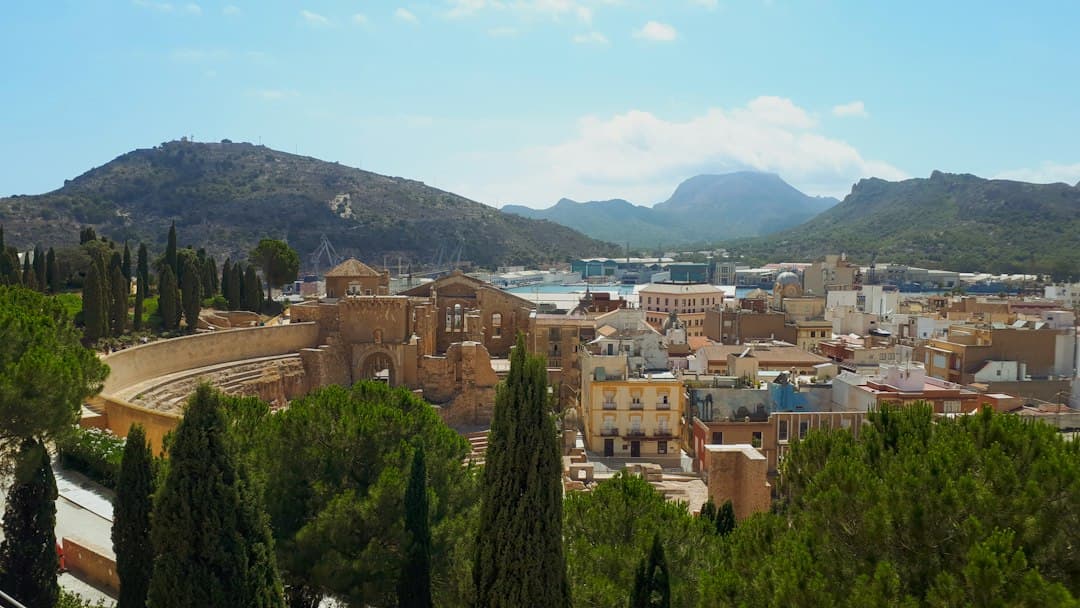
What it is: The Roman Theatre Museum (Museo del Teatro Romano) and the Teatro Romano de Cartagena—one of Spain’s most important archaeological complexes, and among the largest Roman theatres in Spain.
Why it hits: Vibe accounts describe the transition as physical: you move from tight streets into dim, cool galleries—stone and old plaster smell; footsteps echo; voices hush—then you emerge into a sun-flooded bowl of pale stone with seagulls rasping overhead. The reveal feels like Cartagena’s “layer cake” of history made tangible.
History & significance (dense but critical):
- Built late 1st century BC to early 1st century AD, during Augustus, possibly completed under Tiberius
- Capacity often cited around 7,000 spectators
- Over centuries it was covered and reused; the church of Santa María la Vieja was built over parts of it
- Rediscovered in late 20th century, restored, integrated into a modern museum complex (in the 2000s)
- Museum route designed by architect Rafael Moneo as a sequence through modern galleries → Santa María la Vieja → theatre
What to look for:
- Cavea sectors (ima, media, summa cavea) and radial stairways (five in ima cavea; seven in media/summa)
- Orchestra and stage façade fragments (columns, capitals, niches, statues) displayed in galleries and reconstructed elements
- How medieval layers literally sit on Roman foundations
Practical information (2024–2025):
- Location: near Plaza del Ayuntamiento (historic center)
- Opening hours:
- High season (1 May – 30 Sept and Easter): Tue–Sat 10:00–20:00; Sun 10:00–14:00; Mon closed
- Low season (1 Oct – 30 Apr): Tue–Sat 10:00–18:00; Sun 10:00–14:00; Mon closed
- Easter special: Mon and Sun 10:00–18:00, Tue–Sat 10:00–20:00
- Tickets:
- General €7
- Reduced €6 (under 12; students up to 25; youth card holders; unemployed; pensioners/retirees; disabilities/reduced mobility)
- Free: under 3; official tourist guides; “Carné Amigo del Museo Teatro Romano” + Puerto de Culturas Club Card holders
- Free-entry window: Tuesdays, last two hours before closing (BIC rule/free initiative; also echoed in multiple site policies)
Review reality (critic synthesis):
- One of the most reviewed and highest-rated attractions (Tripadvisor shows 3,000+ reviews and around 4.5/5)
- Can feel busy and compressed at peak times
- Best value when paired with other sites rather than treated as a standalone expensive day
2) The Hill of Concepción: Castle + Lift + Parque Torres (Best Panorama, Best Orientation)
What it is: Castillo de la Concepción on Monte de la Concepción (inside Parque Torres), accessed optionally by the Ascensor Panorámico on Calle Gisbert 10.
Why it matters: This is where you understand Cartagena’s geography: a deep natural harbor cupped by hills, modern cranes and navy vessels, rooftops and church towers, Roman ruins below. Vibe notes describe shifting sound pockets on the climb—scooters, dogs, then leaves rustling—and at the top, ship horns and seagulls dominate. Sunset is often described as moving: harbor silver, city scars and grandeur softened.
History & significance:
- Defensive hill used since antiquity by Roman, Islamic, Christian powers
- Current fortress built largely 13th century, shortly after Christian conquest by Alfonso X “el Sabio” in 1245
- Built over an earlier Arab alcazaba (12th–13th centuries); one source frames it as a 13th–14th-century fortress
- Now the Interpretation Centre of the History of Cartagena, part of Cartagena Puerto de Culturas
- Noted for 360° panoramic views
What to look for:
- Terraces and viewpoints over port, old town, and Roman Theatre
- Defensive structures, walls, towers, bastions
- Parque Torres paths and viewpoints surrounding the fortress
Practical information (2024–2025):
- Address: Parque Torres, 30202 Cartagena, Murcia, Spain
- Access: on foot via Parque Torres; or by Panoramic Lift at Calle Gisbert 10
- Phone (info): +34 968 500 093
- Tickets:
- Castle only: €5 general, €4 reduced
- Combined Castle + Lift: €6 general, €4.50 reduced
- Lift only: €2 general, €1 reduced
- Free: under 3; official guides
- Free-entry initiative (as of 23 July 2024): free entry last two opening hours every Tuesday for Castillo de la Concepción (and other main sites)
- Hours (seasonal):
- High season 1 Jul – 15 Sep: Mon–Sun 10:00–20:00 (note: first half of July sometimes listed Tue–Sun; official pattern says Mon–Sun for high season)
- Mid season 15 Mar – 30 Jun and 16 Sep – 1 Nov: Tue–Sun 10:00–19:00; Holy Week open Mon–Sun 10:00–19:00
- Low season 2 Nov – 14 Mar: Tue–Sun 10:00–17:30
- Closed all day: 1 Jan, 6 Jan, 25 Dec
- Afternoons closed: 5 Jan, 24 Dec, 31 Dec
Review reality (critic synthesis):
- More mixed reviews than the Roman museums; cited around 3.9/5
- Visitors love the views
- Some feel it’s “viewpoint first, attraction second”—small if you expected a huge castle complex
- Best as part of a walking circuit (and/or if you want the city’s best overview)
3) Punic Wall: A Quiet, Subterranean Time Shift (Carthaginian Cartagena)
What it is: The Punic Wall (Muralla Púnica) interpretation center at Calle San Diego, 25.
Why it’s special: This is one of the rare places in Spain where you can stand beside surviving Carthaginian defensive architecture tied to the era of the Second Punic War. The vibe account emphasizes the sensory shift: temperature drop, damp stone smell, controlled amber light on rough-cut blocks, hushed voices, the feeling of stepping under the modern city into a ghost city.
History & significance:
- Late 3rd century BCE Carthaginian fortification (Qart Hadasht)
- Linked to Barcid development of Cartagena and the Roman assault/capture in 209 BCE
- Interpretation center includes layered remains, including a late Roman/Byzantine funerary crypt, showing stratigraphy and changing urban use
What to look for:
- Wall section under glass, diagrams and reconstructions
- Byzantine-era funerary crypt with niches and burials
- Multimedia explaining Carthage vs Rome, ancient harbor topography
Practical information (2024–2025 estimates):
- Address: C. San Diego, 25, 30202 Cartagena
- Tickets: around €3.50–4.00 adult (official site lists €4, other tourism portals list €3.50); reduced around €3; some mention €2.50 for specific categories via platforms
- Free: under 3; official guides; Puerto de Culturas club members
- Free-entry hours: last two hours on Tuesdays (some exceptions such as Holy Week noted in sources)
- Hours (seasonal):
- High season (1 Jul – 15 Sep): Mon–Sun 10:00–20:00
- Medium season (15 Mar – 30 Jun & 16 Sep – 1 Nov): Tue–Sun 10:00–19:00, Mondays closed; Easter generally open daily
- Low season (2 Nov – 14 Mar): Tue–Sun 10:00–17:30, Mondays closed
- Closed all day: 1 Jan, 6 Jan, 25 Dec
- Afternoon closed: 5 Jan, 24 Dec, 31 Dec
4) Molinete Roman Forum Museum + Archaeological Park: Roman Cartagena in 3 Floors (and a King’s Inauguration)
What it is: Molinete Roman Forum Museum plus Arqueológico Cerro del Molinete Park—a combined museum-and-excavation complex on Cerro del Molinete.
Why it matters: This is where Roman Cartagena becomes a city, not a single monument. Review synthesis places it among the top attractions with strong ratings (often ~4.5/5). Vibe/research emphasize that it’s educational, layered, and best for people who like context and ruins.
History & significance:
- Preserves core of ancient Carthago Nova civic/religious center: public buildings, temples, baths, streets
- The museum project is part of a broader recovery of the Roman Forum, turning a once built-up neighborhood into an archaeological park
- King Felipe VI inaugurated the museum in May 2021 (Fundación Repsol report)
- One of the largest urban Roman forums excavated in Spain
What to look for:
- Museum across three floors
- Major wall paintings: Apollo and the Muses, a cornucopia, a hunter
- Roman street segments (decumanus alignment and other axes)
- “Barrio del Foro” remains: public buildings and sanctuaries
- Accessibility features: ramps, lifts, stairlifts, adapted toilets, audiovisual subtitles
Practical information (critical):
- Addresses shown in sources:
- C/ Adarve, 6, 30201 Cartagena
- Also referenced as C/ Gisbert, 10, 30202 (ticketing and access cluster; also Civil War shelter and lift share this address in multiple sources—expect this area to be a hub)
- Phone: +34 968 500 093
- Tickets: €7 general, €6 reduced (as per Puerto de Culturas 2026 tariff sheet used as best guide for 2024–2025–2026)
- Audio guide: about €2.50
- Free: under 3; official guides; club members
- Hours (seasonal):
- High season (1 Jul – 15 Sep): Mon–Sun 10:00–20:00 (some list first half of July Tue–Sun)
- Mid season (15 Mar – 30 Jun & 16 Sep – 1 Nov): Tue–Sun 10:00–19:00; Holy Week open daily
- Low season (2 Nov – 14 Mar): Tue–Sun 10:00–17:30
- Closed: 1 Jan, 6 Jan, 25 Dec; afternoons closed 5 Jan, 24 Dec, 31 Dec
5) ARQVA: Underwater Archaeology on the Waterfront (Shipwreck Stories + “Mercedes” Treasure Context)
What it is: The National Museum of Underwater Archaeology (ARQVA) on the Alfonso XII quay.
Why it’s different: It shifts your Cartagena story from land empires to submerged stories: Phoenician shipwrecks, maritime trade, navigation tech, and the ethics of shipwreck recovery. Vibe notes highlight cinematic museum lighting—treasure in darkness—and a dreamy, slightly eerie tone.
History & significance:
- Purpose-built HQ on Cartagena waterfront opened 26 November 2008
- Built 2002–2006; architect Guillermo Vázquez Consuegra
- Spain’s national reference center for underwater archaeology: research + conservation + public museum
- Exhibits include Phoenician wreck material and the frigate Nuestra Señora de las Mercedes treasure case, linked to legal/ethical debates around treasure hunting
What to look for:
- Underwater excavation methods and conservation
- Phoenician shipwreck materials
- “Mercedes” case: ship, battle context, cargo recovery and dispute
- Anchors, navigation instruments, ancient ports narrative
- Multilingual didactic panels; interactive displays
Practical information (2024/2025 working estimates):
- Address: P.º Alfonso XII, 22, 30202 Cartagena
- Tickets:
- General €3.00
- Reduced €1.50
- Annual ARQVA card €25
- Annual State Museum Card €36
- Free entry: widely cited as Saturdays from 15:00 and Sundays (wording varies slightly but consistently points to weekend free windows)
- Hours (two reported patterns):
- Seasonal pattern widely cited:
- 15 Apr – 15 Oct: Tue–Sat 10:00–21:00, Sun/holidays 10:00–15:00, Mon closed
- 16 Oct – 14 Apr: Tue–Sat 10:00–20:00 (some say 10:00–19:30), Sun/holidays 10:00–15:00, Mon closed
- State museum directory simpler listing:
- Tue–Sat 09:30–20:00
- Sun/holidays 10:00–15:00
- Mon closed
- Seasonal pattern widely cited:
- Closures: Mondays; plus 1 & 6 Jan, 1 May, and 24/25/31 Dec; some lists mention certain local holidays or March dates
All Major Attractions from the Geo Agent (20 Stops, With Details)
The Geo Agent “successfully found 20 attractions.” Below they are, all included with the exact details provided: type, ratings, review counts, and addresses/coordinates. Where the Historian/Vibe/Critic agents also provided context, it’s integrated; where they didn’t, you still get a useful traveler description and planning notes.
Important: Ratings and counts below come from the Geo Agent dataset (Google-style). The Critic Agent also provides Tripadvisor-style ratings for some major stops; both are included without filtering.
1) Castillo de la Concepción
- Type: castle
- Geo rating: 4.3
- User ratings total: 1860
- Location: Parque Torres, 30202 Cartagena, Murcia, Spain
- Coordinates: lat 37.6001873, lng -0.9821462
- Place ID: ChIJOwcWd4dBYw0Rj5cybF10J8Q
This is the hilltop fortress viewpoint and interpretation center described extensively above (history: 13th century post-1245 conquest; built over Arab alcazaba; used by Roman/Islamic/Christian defenses). Vibe emphasizes panoramic soundscape (seagulls, ship horns, metallic harbor clank) and sunset silver harbor. Critic reviews: popular but mixed; “viewpoint first.”
2) Teatro Romano de Cartagena
- Type: historical_landmark
- Geo rating: 4.6
- User ratings total: 24272
- Location/address as provided: “Palacio Pascual del Riquelme, Pl. Ayuntamiento, 9, 30202 Cartagena, Murcia, Spain”
- Coordinates: lat 37.5994943, lng -0.9841346
- Place ID: ChIJ75yEEylCYw0RCgIafZ_3Hvo
This is the city’s flagship Roman site: late 1st c. BC/early 1st c. AD, Augustan-era; museum route; layered with Santa María la Vieja; major “reveal” experience.
3) Barco Turístico
- Type: tourist_attraction
- Geo rating: 4.4
- User ratings total: 1152
- Address: P.º Alfonso XII, 30201 Cartagena, Murcia, Spain
- Coordinates: lat 37.5974058, lng -0.9852726
- Place ID: ChIJww9sXylCYw0RhG638UZReKM
A harbor boat experience fits Cartagena’s maritime identity: deep sheltered inlet, naval presence, and a waterfront promenade that’s central to the city experience. Combine with ARQVA and a waterfront walk for a “sea-level Cartagena” day.
4) Parque Torres
- Type: park
- Geo rating: 4.5
- User ratings total: 1609
- Address: C. Muralla del Mar, s/n, 30202 Cartagena, Murcia, Spain
- Coordinates: lat 37.5998321, lng -0.981955
- Place ID: ChIJlcXg1SlCYw0R04RhiwwNJqU
Vibe notes: dust, pine, trimmed grass; summer heat and resin scents; softened city noise; a “breathing space” to integrate the city’s layers. It surrounds/links with the castle area and viewpoints.
5) Molinete Roman Forum Museum
- Type: tourist_attraction
- Geo rating: 4.6
- User ratings total: 3387
- Address: C. Adarve, 6, 30201 Cartagena, Murcia, Spain
- Coordinates: lat 37.6027576, lng -0.9841454
- Place ID: ChIJAYLDs5RDYw0RnCQN3ikjaZQ
Extensively detailed above: Roman civic/religious complex; King Felipe VI inauguration in 2021; €7/€6; seasonal hours; wall paintings of Apollo and Muses, cornucopia, hunter.
6) National Museum of Underwater Archaeology (ARQVA)
- Type: tourist_attraction
- Geo rating: 4.4
- User ratings total: 4165
- Address: P.º Alfonso XII, 22, 30202 Cartagena, Murcia, Spain
- Coordinates: lat 37.5976656, lng -0.9802723
- Place ID: ChIJL7jcM4dBYw0RqSfFgDTlY0g
Extensively detailed above: €3; free Saturdays after 15:00 + Sundays (per sources); Monday closed; architecture by Guillermo Vázquez Consuegra; “Mercedes” treasure case.
7) Castle of La Atalaya
- Type: castle
- Geo rating: 4.6
- User ratings total: 560
- Address: Pasaje Cast Atalaya, 1, 30205 Cartagena, Murcia, Spain
- Coordinates: lat 37.602646, lng -1.0087802
- Place ID: ChIJCz7PfEVCYw0R-o3LBDyoF5A
A second castle viewpoint option outside the tightest core. With Cartagena’s geography—hills encircling a harbor—secondary viewpoints often give you a different angle on the port/industrial landscape that the Concepción viewpoint frames from the center.
8) Fuerte de Navidad
- Type: historical_landmark
- Geo rating: 4.4
- User ratings total: 877
- Address: Pasaje Faro Navidad, 2, 30394 Cartagena, Murcia, Spain
- Coordinates: lat 37.5855605, lng -0.985627
- Place ID: ChIJd6Njk9ZDYw0RVrG6y7UYMZU
A coastal defense landmark consistent with Cartagena’s “fortress port” identity. Pair with other military heritage like the Muralla de Carlos III and (from Critic Agent excursions) Batería de Castillitos.
9) Ascensor Panorámico
- Type: museum (as categorized in Geo data)
- Geo rating: 4.1
- User ratings total: 837
- Address: C. Gisbert, 10, 30202 Cartagena, Murcia, Spain
- Coordinates: lat 37.6001662, lng -0.9808251
- Place ID: ChIJ5_Sen4dBYw0R7iDy4WGwers
This is the lift that turns the Concepción hill into an easy visit. Historian data ties it directly into the castle ticketing structure: €2 general (€1 reduced) or combined with castle for €6.
10) Plaza de las Cartagenas en el Mundo
- Type: tourist_attraction
- Geo rating: 4.9
- User ratings total: 12
- Address: 30201 Cartagena, Murcia, Spain
- Coordinates: lat 37.5975792, lng -0.9838715
- Place ID: ChIJX624UwBDYw0RYQxB2vIMBO0
A small but highly rated point of interest in Geo data—likely best approached as a quick “stroll-by” moment on your old town circuit, especially if you enjoy themed civic spaces.
11) The Punic Wall
- Type: historical_landmark
- Geo rating: 4.4
- User ratings total: 1542
- Address: C. San Diego, 25, 30202 Cartagena, Murcia, Spain
- Coordinates: lat 37.604129, lng -0.9786499
- Place ID: ChIJHd_plIhBYw0RUWidlvGm-Pw
Extensively detailed above (3rd c. BCE wall, Byzantine crypt, seasonal hours, €3.50–4, Tuesday free last two hours).
12) House of Fortune (Casa de la Fortuna)
- Type: museum
- Geo rating: 4.4
- User ratings total: 1507
- Address: Pl. de Risueño, 14, 30202 Cartagena, Murcia, Spain
- Coordinates: lat 37.602224, lng -0.9820614
- Place ID: ChIJ4bGHAShCYw0Ry2f0UOcD3R8
Vibe describes it as intimate and humanizing: cool mineral air, faint cleaning product + old plaster scent, muffled street noise above, wooden walkways over original floors. Historian provides deep practical details: usually Tue–Sun 10:00–15:00; tickets €4 general, €3 reduced; under 3 free; guided visit about 30 minutes; reservations recommended; group size around 20; holiday closures (1/6 Jan, 25 Dec; shorter 5 Jan, 24/31 Dec).
13) Mural Ciudad Colonia «Julio Nova Cartago»
- Type: tourist_attraction
- Geo rating: 4.6
- User ratings total: 22
- Address: C. Cta. de la Baronesa, 2, 30202 Cartagena, Murcia, Spain
- Coordinates: lat 37.5996021, lng -0.9847616
- Place ID: ChIJWbcAma9DYw0ROim80boUBJM
A small art/interpretive mural stop that fits nicely between major sites in the historic core—especially if you like visual reminders of Roman identity (“Colonia,” “Nova Cartago”).
14) Arqueológico Cerro del Molinete Park
- Type: tourist_attraction
- Geo rating: 4.4
- User ratings total: 655
- Address: Cerro Del Molinete, C. Pólvora, s/n, 30203 Cartagena, Murcia, Spain
- Coordinates: lat 37.6029523, lng -0.9859505
- Place ID: ChIJ592bHiZCYw0RhrB8Q1paTQI
This is the outdoor archaeological park component of the Molinete complex. Expect hilltop openness and layered remains—best with the museum context.
15) Polifemo del Mar
- Type: tourist_attraction
- Geo rating: 5.0
- User ratings total: 8
- Address: C. Muralla del Mar, 32, 30202 Cartagena, Murcia, Spain
- Coordinates: lat 37.5988217, lng -0.9800667
- Place ID: ChIJNd3lTwBBYw0RfhEIsPDiyv4
A tiny, perfect-rating Geo find on Muralla del Mar—likely a sculpture/feature worth a quick stop while walking the waterfront defensive line.
16) Vía Verde Del Campo de Cartagena
- Type: hiking_area
- Geo rating: 4.1
- User ratings total: 286
- Address: C. el Puente, 30310 Cartagena, Murcia, Spain
- Coordinates: lat 37.6451518, lng -1.0047169
- Place ID: ChIJlQ1sNcNpYw0Rv1n1zvC4V8g
A non-urban experience for walkers/cyclists: a greenway route in the wider Campo de Cartagena area. Useful if you want a break from stone-and-museum density.
17) Palacio Consistorial de Cartagena (City Hall)
- Type: historical_landmark
- Geo rating: 4.7
- User ratings total: 1166
- Address: Pl. Ayuntamiento, 1, 30202 Cartagena, Murcia, Spain
- Coordinates: lat 37.5988944, lng -0.985911
- Place ID: ChIJN8QM8ihCYw0RogaCx8jWekw
Vibe section describes Plaza del Ayuntamiento as Cartagena’s polished civic “stage”: intensely bright stone paving, sea air + coffee aroma, seagulls overhead, guides pointing out domes and wrought iron. A key anchor between Roman Theatre area and waterfront.
18) Naval Museum Cartagena
- Type: tourist_attraction
- Geo rating: 4.6
- User ratings total: 4197
- Address: P.º Alfonso XII, s/n, 30201 Cartagena, Murcia, Spain
- Coordinates: lat 37.5978635, lng -0.9871012
- Place ID: ChIJr2-I1oIVYw0REZ4zkGcKfAk
Historian details: opened 8 July 1986; free entry with a requested €3 voluntary contribution; hours Tue–Fri 09:00–14:00; Sat 10:00–14:00; closed Sun/Mon; August Mon–Fri 09:00–14:00; closed weekends/holidays; closure days listed (2 & 6 Jan, Holy Thursday/Good Friday, 1 May, 9 Jun, 12 Oct, 1 Nov, 6/8/25 Dec). Vibe: smell of polished wood/metal/old textiles, and outside you may hear drills/horns.
19) OCIO CARTAGENA - MURCIA
- Type: tourist_attraction
- Geo rating: 4.4
- User ratings total: 7
- Address: Plaza Almirante Bastarreche, 30202 Cartagena, Murcia, Spain
- Coordinates: lat 37.6038523, lng -0.9777354
- Place ID: ChIJz-cLGSlCYw0RA98SRoeQb44
A small, low-review-count Geo listing. For travelers, treat it as a possible local leisure/activity touchpoint near Plaza Almirante Bastarreche.
20) Musa de Carthago Nova
- Type: tourist_attraction
- Geo rating: 4.5
- User ratings total: 2
- Address: 30205 Cartagena, Murcia, Spain
- Coordinates: lat 37.6100374, lng -0.9977274
- Place ID: ChIJA6SVEldDYw0R-FCPj9foauo
Another tiny-listing “micro-attraction.” The name suggests a sculpture or themed point related to Carthago Nova identity—good for completists and walkers.
Hidden Gems & Lesser-Known Stops (Still Worth Your Time)
This section gathers sites that are smaller, less reviewed, or often experienced incidentally—but that deepen your sense of Cartagena as a living palimpsest.
Plaza de las Cartagenas en el Mundo
Geo lists it with a near-perfect rating (4.9) but very few reviews (12). It’s the kind of spot you’ll appreciate if you like civic geography and the idea of “Cartagenas around the world.” Best as a short stop on a walking circuit.
Mural Ciudad Colonia «Julio Nova Cartago»
A small mural with strong rating (4.6). As a traveler, murals like this can become “memory anchors” between major ruins: a modern visual statement of Roman identity that echoes the city’s ancient names (Carthago Nova / Colonia).
Polifemo del Mar
Perfect 5.0 rating, tiny review count. Located on Muralla del Mar—pair it with a walk along surviving defensive lines and harbor views to connect mythic imagery (Polifemo/Cyclops) with maritime Cartagena.
Vía Verde del Campo de Cartagena
When you’ve done three museums and your brain is full, this greenway is a literal decompression valve—an option to shift from stones and interpretive panels to open-air movement.
Castle of La Atalaya
A second fortress viewpoint listed by Geo; excellent if you want to see how Cartagena’s hills define the harbor’s defensibility and why so many empires used this location.
Culture & Atmosphere: How Cartagena Sounds, Smells, and Moves
Cartagena’s culture is inseparable from its port identity, its siesta rhythm, and its multi-era physical fabric.
The pedestrian core: Calle Mayor and the slow-burn affection effect
Vibe accounts describe a common emotional arc: mild initial disappointment (Cartagena doesn’t “seduce”) followed by deepening affection once you notice:
- bullet scars and civil-war traces
- faded signage and chipped paint
- grand mansions beside worn buildings
- Roman ruins tucked into ordinary streets
Calle Mayor is a top-rated walking highlight (critic synthesis around 4.4/5). It’s not a single “attraction” so much as the connector that makes the city work. The sounds: café clink, sizzle of oil, shutters closing for siesta, scooters, street musicians. The smells: perfume, frying oil, grilled seafood—and occasionally sewage notes from older infrastructure.
Siesta: Cartagena’s daily mood swing
Midday, shops close and the city empties into a sleepy hush. Heat radiates from walls; the city’s metabolism slows. Then evening returns with stylish outfits, terrace life, social energy, and a nightlife oriented to locals rather than international tourism.
Harbor life: scenic and industrious
Cartagena’s harbor smells like salt, engine oil, varnish, diesel; you hear rigging clink, halyards slap masts, gulls cry, ship horns echo off hills, and port machinery clank.
Vibe notes emphasize the emotional effect: you feel relaxed, but aware of ongoing work—this is not a “stage set” marina. Sunset brings a distinctive silver water and reflections like brushstrokes.
The “scarred city” aesthetic
Cartagena shows visible scars—civil war bombardment marks, worn stone, mismatched repairs. Travel narratives call it “bombed, rebuilt, forgotten, and fiercely proud,” sometimes all on the same street. Many visitors feel this makes the city feel more honest than heavily sanitized historic centers.
Food & Local Experiences (Plus Tours, Tastings, and Nights Out)
The research agents didn’t provide a restaurant-by-restaurant list, but they did provide important, experience-based food and social-life guidance—especially from vibe and critic reviews.
Evening bar streets: a city that wakes up late
Evenings bring thickened aromas: grilling meat, frying fish, garlic, spilled beer, perfume, sometimes cigarette smoke. Sounds intensify: layered conversations, laughter, plates clattering, music (Spanish pop, rock classics, or live performers).
The emotional tone is sociable and grounded. You’re joining local patterns rather than being courted as a tourist.
Tapas walking tours (critic: worthwhile but choose carefully)
Tapas tours can be high value because they combine orientation + food discovery, but the critic synthesis emphasizes variability:
- Some tours get touristy stops
- Portion sizes vs cost can disappoint
- The experience can become logistics-heavy
Practical advice from critic: verify route, length, and language before booking. Know whether you’re buying food quantity, storytelling, or both.
Experiencia 43 (a signature tasting-style experience)
Critic notes Experiencia 43 as one of Cartagena’s better-known tasting/visitor experiences and highlights the expectation sensitivity:
- Works best when it provides storytelling and curated format
- Can feel overpriced if short or overly commercial relative to expectations
Approach it as a curated experience rather than a bargain meal.
Harbor boat experience: Barco Turístico
Geo lists Barco Turístico with strong rating and high review count. This fits perfectly with Cartagena’s identity; combine with ARQVA for a sea-story day.
Practical Tips & Warnings (Tickets, Free Hours, Value Notes, Crowds, Pitfalls)
This section consolidates the most actionable “show up smarter” guidance—especially around opening hours, closures, free-entry windows, and review-based value warnings.
1) Use the “Cartagena Puerto de Culturas” logic (and Tuesday free hours)
Many major sites (Roman Theatre Museum, Castillo de la Concepción, Punic Wall, Molinete Roman Forum Museum, Civil War Shelter Museum, Casa de la Fortuna) are integrated into the Cartagena Puerto de Culturas system.
Key recurring policy across sites:
- Free entry the last two hours every Tuesday is mentioned repeatedly (Roman Theatre, Castle, Punic Wall, etc.), tied to BIC law/free initiatives; one note says as of 23 July 2024 it was implemented broadly for Castillo de la Concepción and other main sites.
What this means for you:
If your schedule is flexible, plan “paid cluster” visits on Tuesday afternoons and check which sites honor the free window that week (some exceptions, e.g., Holy Tuesday excluded for Roman Theatre free entry; Holy Week may have different patterns).
2) Expect seasonal hours—and Monday closures are common
A repeated pattern:
- Many heritage sites are closed Mondays in low/mid seasons
- Some open Mondays only in high season (e.g., castle, Punic Wall, Molinete, Civil War shelter show Mon–Sun in summer)
ARQVA and some military museums also close Mondays consistently.
3) Review-based “value mismatch” warnings (the most common “trap”)
The critic synthesis is clear: Cartagena isn’t scam-heavy in the classic sense. The recurring issue is:
- A small site gets hyped; visit is short; price feels high.
- A viewpoint is treated as a major fortress; visitor expects more “castle substance.”
How to avoid it:
- Visit compact sites as part of a route rather than as a single paid detour.
- Prioritize the biggest “substantial” stops first: Roman Theatre, Molinete, ARQVA, and the castle for views.
- Use free hours and combined tickets when possible.
- Reset expectations: many of Cartagena’s best places are about context and layers, not size.
4) Crowds: where they concentrate
The Roman Theatre is the default must-see and can feel busy and compressed at peak times. Go early, late, or during free-entry windows if you can tolerate crowds then; otherwise aim for non-peak mornings.
5) Military museums: free entry, limited hours, and language reality
Two military museums have very “real world” constraints:
Naval Museum of Cartagena (free, donation requested)
- Entry free; voluntary €3 contribution requested
- Hours: Tue–Fri 09:00–14:00; Sat 10:00–14:00; closed Sun/Mon
- August: Mon–Fri 09:00–14:00; closed Sat/Sun/holidays
- Multiple closure holidays listed (2 & 6 Jan; Holy Thursday/Good Friday; 1 May; 9 Jun; 12 Oct; 1 Nov; 6, 8, 25 Dec)
Historical Military Museum of Cartagena (Spanish Army; free; mornings only)
- Address: Plaza Puerta de la Serreta / Plaza General López Pinto, s/n, 30201 Cartagena
- Hours: Mon–Sat 09:00–13:30; closed Sundays and public holidays
- Free admission; optional donations sometimes accepted
- Ground floor wheelchair friendly; upper floors may require stairs
- Spanish-heavy text; some guides/directories offer English/French summaries
If these matter to you, plan mornings and treat them as focused, compact visits.
6) Civil War Shelter Museum: emotionally heavy and physically atmospheric
The Museo-Refugio de la Guerra Civil is in a real tunnel shelter under Calle Gisbert, built after bombings began in Oct 1936. Capacity noted around 5,500. The vibe is immersive and somber; this is a “memory space,” not a light museum stop. Plan it when you have emotional bandwidth.
Tickets: €4 general, €3 reduced; audio guide ~€2
Hours: seasonal (Mon–Sun in summer; Tue–Sun in mid/low; closed certain holidays)
7) Don’t confuse Cartagena, Spain with Cartagena, Colombia
Critic agent explicitly flags a common confusion: Castillo de San Felipe de Barajas is in Cartagena, Colombia, not Spain. If you see it on a list, it’s the wrong Cartagena.
Additional Historian-Agent Sites (Beyond Geo’s 20)
The Historian Agent researched 15 historical sites in depth; several have already been covered above (Roman Theatre Museum, ARQVA, Naval Museum, Castillo de la Concepción, Municipal Archaeological Museum, Punic Wall, Molinete Roman Forum Museum, Civil War Shelter Museum, Historical Military Museum, Casa de la Fortuna, Muralla de Carlos III, Decumano Máximo, MURAM). Below are the remaining ones and the detailed practical points preserved.
Municipal Archaeological Museum of Cartagena (“Enrique Escudero de Castro”)
What it is: Cartagena’s main municipal repository for archaeological heritage, housed over the Roman-era San Antón necropolis—a museum built around an in-situ archaeological site.
History notes preserved:
- Earlier museum/collection existed; first museum created 1943 at Plaza de Juan XXIII (per local summaries)
- 1967 discovery of San Antón necropolis; director Pedro San Martín proposed building museum around it
- Present museum established 1982
- Named after Enrique Escudero de Castro
- Publishes scholarly journal Mastia
Address & contact:
- C/ Ramón y Cajal 45 (sometimes 47), Cartagena (30204/30205)
- Tel: +34 968 128 968 (sometimes also 968 128 967)
- Emails: informacionmuseo@ayto-cartagena.es and sometimes museoarqueologico@ayto-cartagena.es
- Bus stops include Plaza Ciudad de Mula and Plaza Reina María Cristina
Hours (variation preserved):
- Tue–Fri: 10:00–14:00 and 17:00–19:00 or 20:00 (some docs say 19:00; accessibility guide says 20:00)
- Sat–Sun: 11:00–14:00
- Closed: Mondays and public holidays
- A notice mentions a summer schedule (July/Aug) Tue–Sun 9:00–13:30 (possible seasonal/year variation)
Tickets: Free entry (entrada gratuita) per multiple sources.
Decumano Máximo (Roman main street)
What it is: Best-preserved stretch of the main east–west Roman street, ~6 m wide, with a major sewer beneath (2 m high, 80 cm wide). Linked to Vía Augusta, eastern gate, forum, and port.
Where/how to see it (two contexts preserved):
- As part of Molinete Roman Forum Museum ticket (general €7 / reduced €6)
- A specific stretch at Plaza de los Tres Reyes s/n (linked to Barrio del Foro Romano), sometimes requiring you to request access at reception so they open a gate.
Hours (two versions preserved):
- Molinete complex seasonal hours (10:00–20:00 summer etc.)
- Plaza de los Tres Reyes segment: Tue–Sun 10:00–14:30, request access at reception
Muralla de Carlos III (18th-century defensive belt)
What it is: Cartagena’s last major defensive ring; Bien de Interés Cultural; built to protect the naval arsenal and city during Cartagena’s peak as Mediterranean Maritime Department capital.
Key numbers preserved:
- Begun 1771, finished 1792 (other ranges exist but same era)
- ~4.7–4.9 km long; ~3–3.1 km preserved today; ~1.6 km missing/buried
- 20 bastions; 18 curtain segments; 3 monumental gates (later demolished)
- “Muralla del Mar” front is best preserved; also significant sector near arsenal toward Castillo de Galeras with original battlements
Practical reality preserved:
- No unified ticket or hours clearly documented in sources because it’s largely an open urban structure integrated into streets and promenades.
- Likely free to walk external sections; some associated interiors or batteries may have separate hours/tickets—verify case-by-case with official tourism sources.
MURAM (Museo Regional de Arte Moderno) in Palacio Aguirre
What it is: Regional modern art museum housed in Palacio Aguirre (Modernista mansion) plus a contemporary annex.
History notes preserved:
- Palacio built for Camilo Aguirre, completed 1901, architect Víctor Beltrí
- Building passed through Banco Hipotecario de España; later Falange ownership; adapted in 1970s
- Allocated to regional government in 2002 for MURAM + CEHIFORM
- Museum inaugurated 29 April 2009 with Rodin exhibition
- Annex designed by Martín Lejarraga
Address/phone:
- Plaza de la Merced 15–16, 30201 Cartagena
- Tel 968 501 607
Tickets: Free entry (entrada gratuita)
Hours (two slightly different official patterns preserved):
- Pattern A: Tue–Fri 10:00–14:00 & 17:00–19:00; Sat 11:00–14:00 & 17:00–20:00; Sun/holidays 11:00–14:00; Mon closed
- Pattern B: Tue–Sat 11:00–14:00 & 17:00–20:00; Sun/holidays 11:00–14:00
Closures: 25 Dec, 1 Jan, 6 Jan, Good Friday, and the local Cartagineses y Romanos festival day; reduced hours 24/31 Dec 11:00–14:00.
Critic Agent’s “Most Talked-About” Experiences (and Excursions)
In addition to the core Cartagena circuit, critic review synthesis highlights several popular excursions and experiences. These include places not listed in the Geo set but repeatedly mentioned in “best things to do” patterns.
Playa de Calblanque (Parque Regional de Calblanque / Playa de Calblanque)
- Critic: one of the best-rated outdoor experiences near Cartagena; less urban and less commercial than many beaches; “natural” means fewer conveniences—access, wind, heat, fewer services.
- Vibe: unspoiled coves, dunes, Mediterranean scrub; smells of salt, hot sand, resinous pine, wild herbs; soundscape minimal (waves, wind, birds). Emotion: cleansing and spacious.
Batería de Castillitos
- Critic: signature excursion; praised for dramatic coastal setting and views; logistics matter (distance, car access, weather/visibility). Can feel like a big detour if you don’t like scenic ruins.
Cala Cortina
- Critic: convenient local beach with mixed reputation; can be crowded; useful for a simple seaside stop, less compelling if you want pristine.
Monument to the Heroes of Cavite
- Critic: meaningful civic monument tied to naval identity; quick stop; best encountered naturally during a walk.
Cathedral ruins / Catedral Antiguo de Cartagena
- Critic: iconic image, usually bundled into walking tours; value is visual/atmospheric; can be a short visit relative to reputation.
Roman exploration walking tours
- Critic: among the best-value ways to connect scattered sites; quality depends on guide; verify language and route.
Conclusion: How to Leave Feeling Like You “Got” Cartagena
Cartagena gives you two things at once: a concentrated museum-and-ruins city break and a working port atmosphere that never becomes a theme park. If you approach it as a walkable circuit of layers—Punic wall to Roman theatre to forum streets to hilltop fortifications to waterfront ship stories—you’ll feel the city’s continuity in your body: the temperature drop underground, the harsh light in open ruins, the seagulls and horns in the harbor bowl, the siesta hush, then the nighttime hum of terraces.
Remember the key patterns preserved from research:
- Best-loved stops: Roman Theatre Museum, Molinete, ARQVA, and the city’s walking circuit.
- Best viewpoint: Castillo de la Concepción (go for panorama; don’t expect a huge castle interior).
- Most common pitfall: judging small sites as standalone “big attractions” and feeling value mismatch—bundle them into routes, use free Tuesday hours, and treat them as layers, not theme-park rides.
- Most distinctive “Cartagena feeling”: the city’s quiet intensity, civilization layers, and harbor-defined identity—a place that doesn’t need to brag because it has been strategically important for more than two thousand years.
If you want, tell me:
- your exact travel dates (or month),
- whether you have a car,
- your interests (Roman/modern art/military history/beaches/food), and I’ll build a day-by-day itinerary that uses the seasonal opening hours, Monday closures, and Tuesday free-entry windows included above—without filtering any of the details you’ve been given.