Comprehensive Travel Guide: Lecce
Lecce Travel Guide for Travelers Who Have Already Booked: The Complete, Practical, Atmosphere-Rich Guide to the “Florence of the South”
Lecce is not a city you simply “see.” It is a city you inhabit for a few days: slowly, on foot, with espresso in the morning, golden stone in your peripheral vision, church bells drifting through alleys, and the evening passeggiata carrying you from one piazza to another. If your trip is already booked, you are in an excellent position: Lecce rewards travelers who arrive ready not just to check off monuments, but to settle into its rhythm.
Often called the “Florence of the South,” Lecce sits in the Salento peninsula of Apulia, the heel of Italy’s boot. Its old town is compact, mostly walkable, and built from warm local pietra leccese, a soft limestone that seems to change color by the hour: pale cream in the morning, almost white at noon, honey-gold at sunset, and theatrical under evening lights. The city’s reputation is overwhelmingly positive among travelers: visitors praise its Baroque architecture, food, relaxed but lively atmosphere, and usefulness as a base for Salento day trips. The main drawbacks are predictable: summer heat, July–August crowds, confusing opening hours, ZTL/parking issues, and touristy pricing in the main squares, especially around Piazza Sant’Oronzo.
This guide combines history, practicalities, atmosphere, real-world reviews, warnings, and detailed attraction notes so you can arrive in Lecce prepared—and leave feeling you understood more than just the façades.
Quick Orientation: What Kind of Place Is Lecce?
Lecce’s historic center is a dense Baroque maze framed by old city gates and centered around two great urban spaces:
- Piazza Sant’Oronzo, the social and civic heart, with the Roman Amphitheatre, the column of the patron saint, cafés, shops, and constant movement.
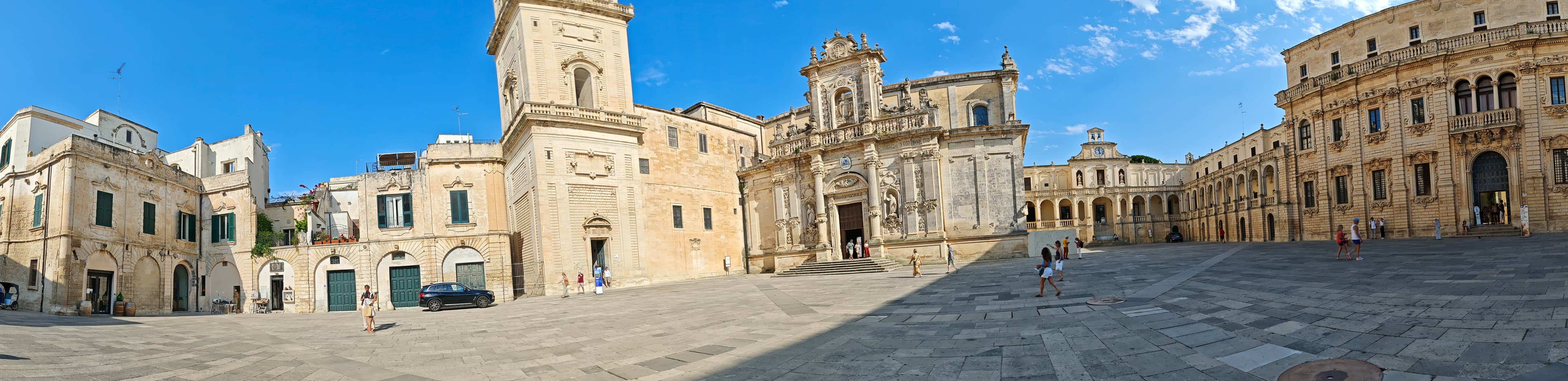
- Piazza del Duomo, the enclosed ecclesiastical heart, a semi-hidden theatrical courtyard surrounded by the cathedral, bell tower, bishop’s palace, and seminary.
Most major sights are within walking distance of each other. You can wander from Porta Napoli to Santa Croce, from Piazza Sant’Oronzo to Santa Chiara, from Porta San Biagio to Museo Faggiano, and from there to the Roman Theatre, often in minutes.
Lecce is also a city of layers:
- Messapian origins
- Greek cultural influence
- Roman Lupiae
- Byzantine and Saracen-era episodes
- Norman, Swabian, Angevin, Aragonese, Spanish, and Bourbon rule
- A spectacular 17th-century Baroque flowering
- Modern civic life, student energy, artisanship, food culture, and evening social rituals
The result is a place that feels both monumental and intimate.
Essential Lecce: At-a-Glance Attractions List
The following places appear across historical, review, vibe, and geographic research. Ratings and addresses are included where available from the Geo Agent data.
| Attraction | Type | Rating | Address / Location | Why It Matters |
|---|---|---|---|---|
| Basilica di Santa Croce | Church | 4.7 / 9,478 reviews | Via Umberto I, 1 | Masterpiece of Lecce Baroque |
| Charles V Castle of Lecce | Fortress / cultural venue | 4.3 / 5,695 | Via XXV Luglio, 52 | Renaissance military fortress, exhibitions |
| Museo Faggiano | Archaeological house museum | 4.8 / 1,461 | Via Ascanio Grandi, 56/58 | 2,000 years beneath a house |
| Roman Amphitheatre | Roman ruin | 4.6 / 6,716 | Piazza Sant’Oronzo | Central Roman arena, visible from square |
| Roman Theatre / Teatro Romano | Roman ruin / museum | 4.1 / 1,022 | Via Degli Ammirati, 5 | Smaller hidden Roman theatre |
| Jewish Museum Lecce | Museum | 4.7 / 215 | Via Umberto I, 9 | Medieval synagogue remains, guided visits |
| Cathedral of Saint Mary of the Assumption and Saint Orontius | Cathedral | 4.6 / 7,892 | Piazza del Duomo | Main church, Baroque cathedral |
| Campanile del Duomo | Bell tower | 4.2 / 258 | Piazza del Duomo | Panoramic tower, check access status |
| Church of Santa Chiara | Church | 4.6 / 876 | Piazzetta Vittorio Emanuele II | Baroque church, cartapesta ceiling |
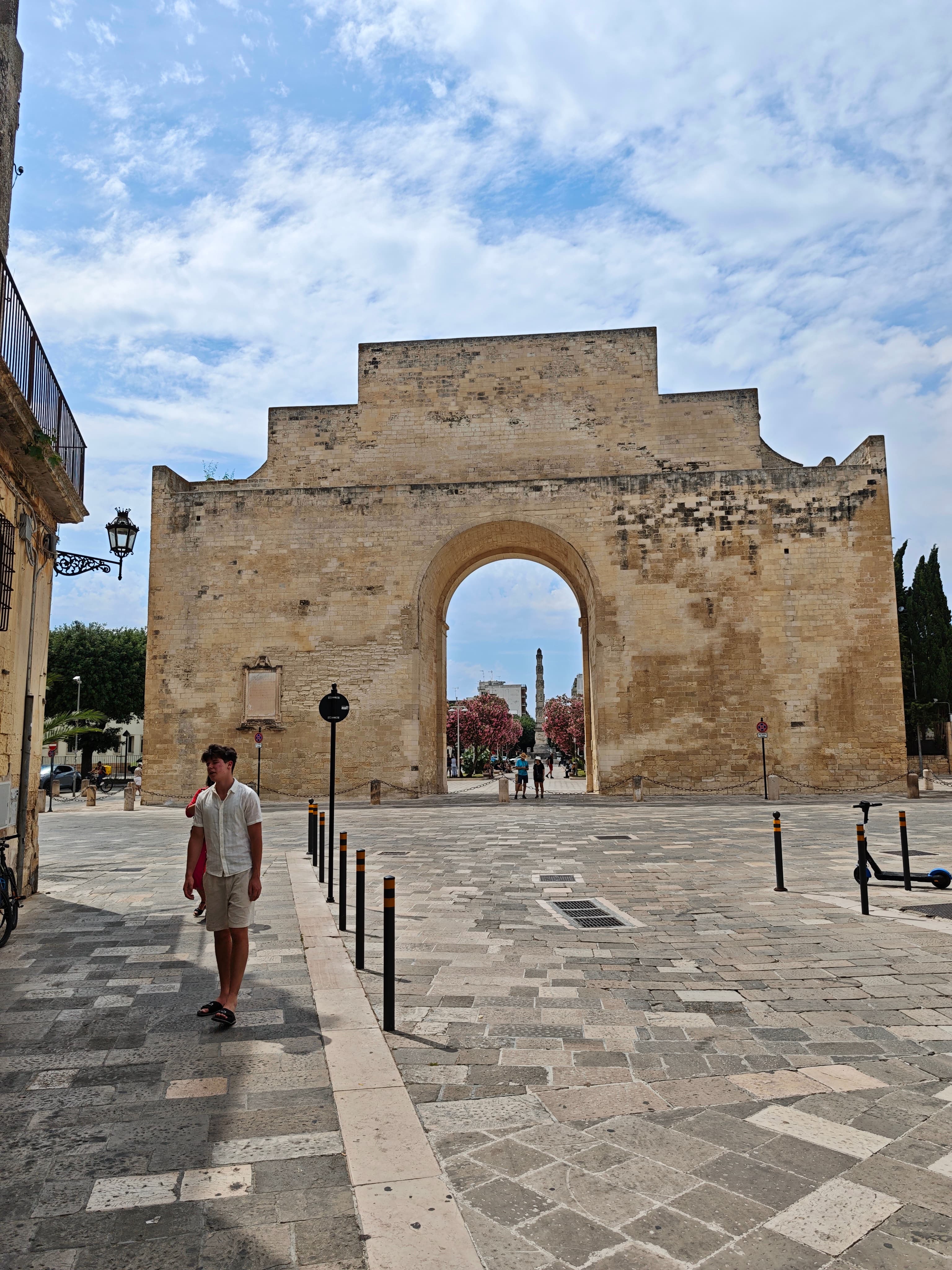
| Porta Napoli | City gate | 4.6 / 11,951 | Piazzetta Arco di Trionfo | Monumental triumphal arch |
| Porta Rudiae / Rudiae Gates | City gate | 4.6 / 6,343 | Via Giuseppe Libertini | Elaborate historic gate |
| Porta San Biagio | City gate | 4.6 / 5,803 | Piazza D’Italia | Southern gate near old town |
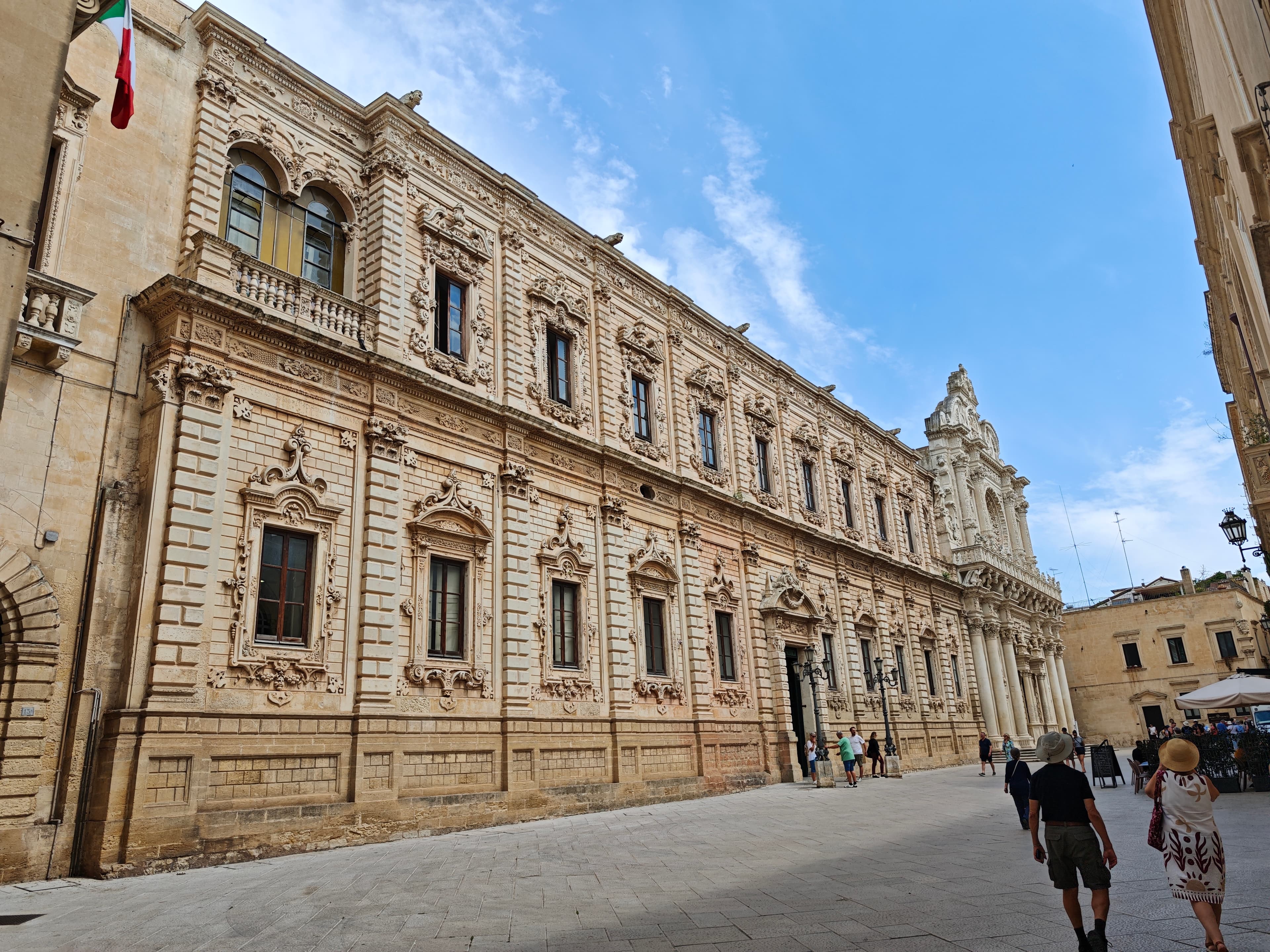
| Celestini Palace | Palace | 4.5 / 184 | Via Umberto I | Former Celestine convent, next to Santa Croce |
| Palazzo Tamborino Cezzi | Palace | 4.8 / 111 | Via Guglielmo Paladini, 50 | Historic palazzo and courtyard atmosphere |
| Torre di Belloluogo | Tower / historic site | 4.5 / 294 | Via Vecchia Surbo, 48 | Medieval tower north of center |
| Arco di Prato | Historic arch | 4.5 / 51 | Piazzetta Arco di Prato, 18 | Small architectural landmark |
| Church of Saint Mary of Grace | Church | 4.5 / 110 | Via Ernesto Alvino | Church near Piazza Sant’Oronzo |
| Museo dei Bambini – Lecce Children’s Museum | Children’s museum | 4.7 / 312 | Via Niccolò Foscarini, 24 | Family-friendly interactive stop |
| Casa Museo Spada – Antichi Strumenti Musicali | House museum / music | 4.9 / 63 | Via Lupinacci Sindaco, 11 | Antique musical instruments |
Also important: MUST – Museo Storico della Città di Lecce, Chiesa di San Matteo, Abbey of Santa Maria di Cerrate, cartapesta workshops, food streets, Via Palmieri area, Piazza Mazzini, hidden courtyards, and evening passeggiata routes.
The Story of Lecce: From Messapians to Baroque Splendor
Messapian Origins and Greek Influence
Lecce’s story begins long before its Baroque reputation. Archaeological and literary traditions trace the area to the Messapians, an Italic people who lived in the “land between the seas”—the Salento peninsula between the Adriatic and Ionian. Messapian settlements in the Lecce area date roughly to the 4th–3rd centuries BC.
Local legend links Lecce’s origins to a Salentine king named Malennio, said to have founded early towns including Lupiae and Rudiae after the Trojan War era. Whether legend or memory, the story signals how deeply the city’s identity is tied to ancient roots.
From the 8th century BC, Greek settlers arrived in Salento, interacting and sometimes conflicting with the Messapians. This left a lasting Greek cultural imprint in language, religion, trade, and the wider spiritual landscape of southern Apulia.
Roman Lupiae
In the 3rd century BC, Rome conquered the Messapian region. Lecce became known as Lupiae, an important Roman municipal center linking the heel of Italy with the broader peninsula.
Under Emperor Hadrian in the 2nd century AD, the city was fortified and reorganized. Sources refer to an urban shift or reorganization under names such as Licea or Litium, ancestors of modern Lecce. This was the age that produced Lecce’s major Roman monuments:
- The Roman Amphitheatre, still visible in Piazza Sant’Oronzo.
- The Roman Theatre, hidden in the old town.
- A road connection to Hadrian’s port at San Cataldo on the Adriatic.
Lecce also became an early Christian center. Tradition holds that Sant’Oronzo / Orontius of Lecce was the city’s first Christian bishop and is now its patron saint. In late antiquity, Lupiae prospered, particularly under emperors such as Marcus Aurelius, before facing the instability affecting the wider Roman world.
Late Antiquity, Byzantines, and Saracen Incursions
After the fall of the Western Roman Empire, Lecce was caught up in the Gothic Wars. It was sacked by Totila, king of the Ostrogoths, and restored to Eastern Roman, or Byzantine, control in 549.
For about five centuries, Lecce remained under Byzantine influence, though the region experienced incursions and temporary occupations by Saracens, Lombards, Hungarians, and Slavs. When some summaries refer to a “Moorish” phase in Lecce, they generally mean these Saracen raids and occupations rather than a long-lasting Islamic emirate like those in Sicily.
The Byzantine period contributed to Salento’s Greek-Byzantine religious and cultural layer, including Eastern Christian rites and Greek-speaking communities.
Normans, Swabians, Angevins, and the County of Lecce
In the 11th century, the Normans conquered Lecce and much of southern Italy, ending centuries of predominant Byzantine control. Lecce became the center of the County of Lecce, one of the most important fiefs in the Kingdom of Sicily.
Key points:
- The county was organized by Robert Guiscard.
- Tancred of Lecce, count of Lecce, became the last Norman King of Sicily.
- Religious and defensive structures were built between the 11th and 13th centuries, including early phases of the cathedral and churches such as Saints Niccolò and Cataldo.
After the Normans, Lecce passed through the Hohenstaufen / Swabian rulers, including Frederick II, and later the Angevins. For a time, Otranto overshadowed Lecce regionally, but from 1053 to 1463 the County of Lecce remained one of southern Italy’s largest and most important lordships.
In 1463, the county was absorbed into the crown under the Aragonese kings of Naples, who strengthened the city and prepared the way for its early modern rise.
Charles V, Fortifications, and Ottoman Threat
From the 15th century onward, Lecce became one of southern Italy’s important cities. Under Aragonese and later Spanish Habsburg domination of the Kingdom of Naples, Lecce was a strategic inland stronghold facing the Ottoman world across the Adriatic.
To counter the Ottoman threat, Emperor Charles V ordered a new defensive system in the first half of the 16th century:
- A new line of walls
- A powerful castle
- Reinforced city gates
- A wider Salento defensive network including coastal towers
The Castle of Charles V and Porta Napoli are two of the clearest surviving monuments of this phase.
The Baroque Golden Age
The 16th and especially 17th century transformed Lecce into the city you will recognize today. From around 1630, churches, palaces, façades, altars, convents, and civic buildings were rebuilt or adorned in the exuberant style known as barocco leccese.
This style depends heavily on pietra leccese, a soft golden limestone that allowed artisans to carve spectacular detail: cherubs, fruit, flowers, saints, grotesques, animals, caryatids, coats of arms, and swirling foliage. Lecce Baroque is often theatrical, devotional, playful, and almost excessive.
The Baroque age also brought hardship. In 1656, plague struck Lecce, killing about a thousand inhabitants. Local tradition says Sant’Oronzo protected Lecce and Salento from the worst of the plague; the city later dedicated Piazza Sant’Oronzo and erected his column in thanksgiving.
Under Bourbon rule in the 18th century, Lecce continued to flourish as an artistic and historic center.
From Italian Unification to Today
After the fall of the Bourbon Kingdom of the Two Sicilies, Lecce joined the new Kingdom of Italy in 1861. Public works and urban improvements integrated modern infrastructure with the historic core.
In 1927, Lecce became capital of its own province, separated from Taranto and Brindisi, cementing its role as administrative and cultural hub of Salento.
During World War II, Lecce had a strategic military role. In 1943, Italian fighter aircraft near Lecce tried to support isolated Italian garrisons in the Aegean. In 1944–45, the area hosted U.S. B-24 bomber groups flying missions over Italy, the Balkans, Austria, Germany, and France.
Today, Lecce is a major city of Apulia with around 95,000 inhabitants and a metropolitan role across the Salentine peninsula. Its old town remains the great draw, but the city is also a living regional capital with shops, students, modern neighborhoods, food culture, and easy access to Salento’s coasts.
The Vibe of Lecce: What It Feels Like to Be There
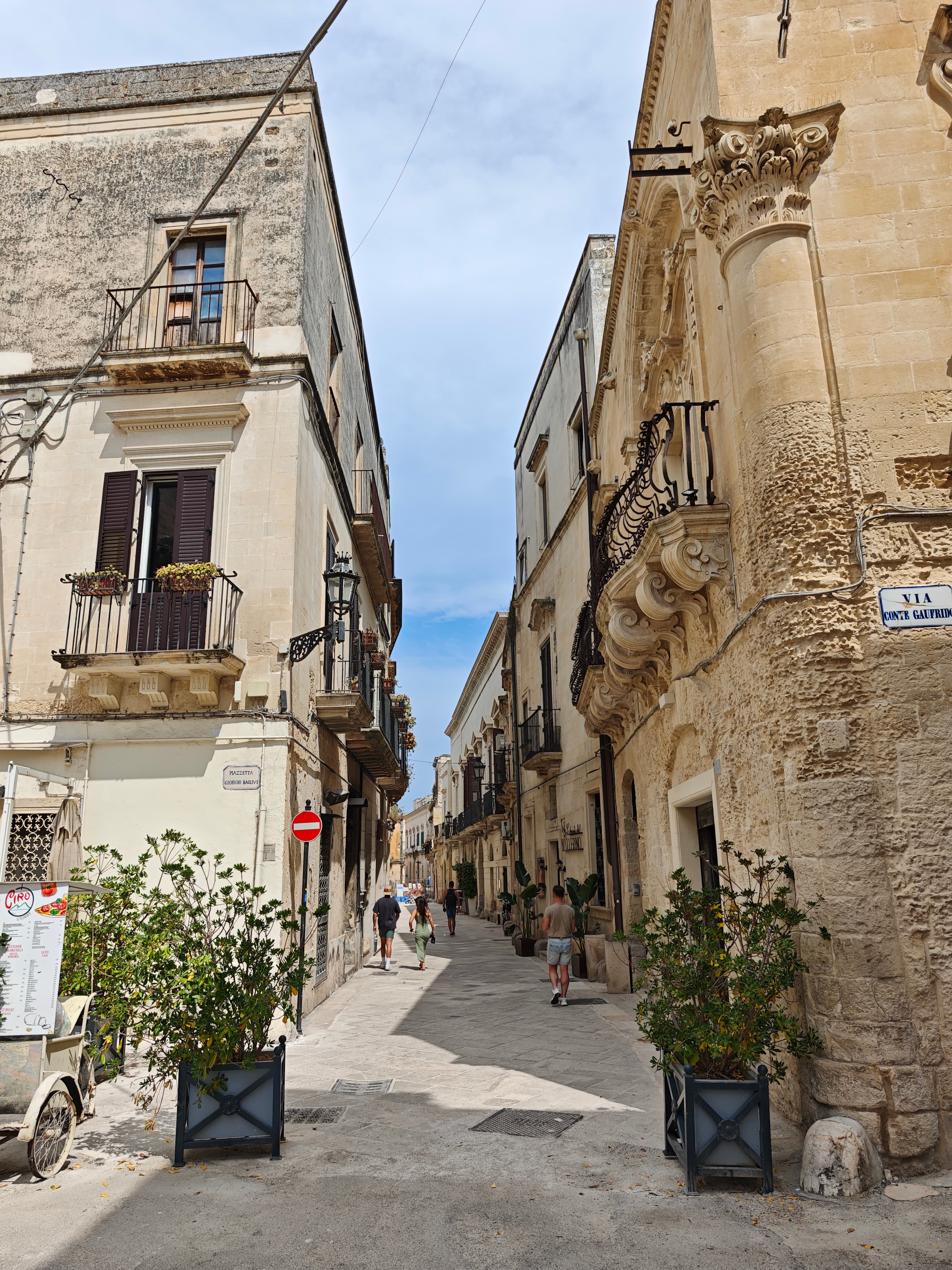
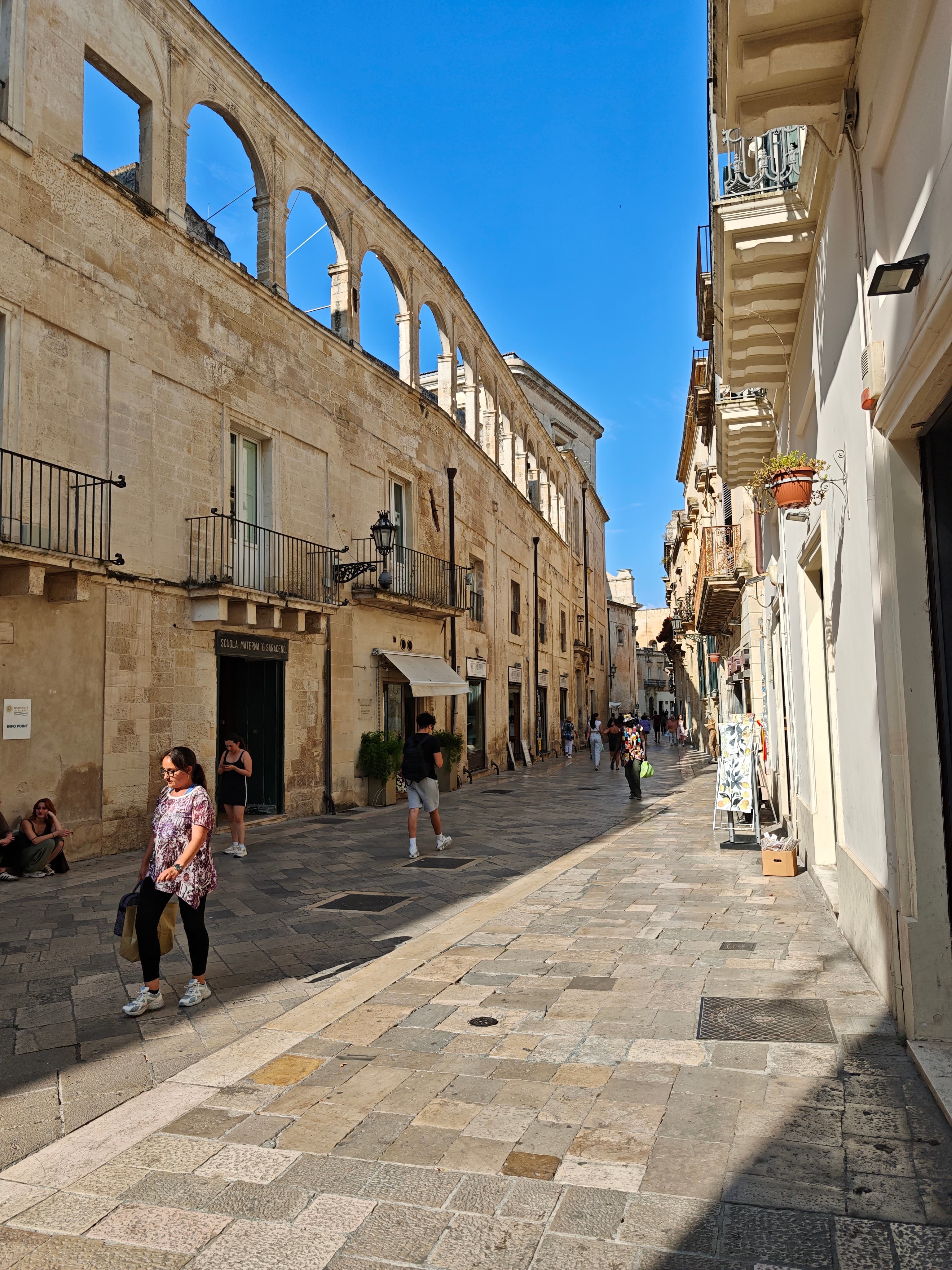
Lecce’s atmosphere is honey-gold, slow, intimate, and theatrical. The city has the visual drama of a Baroque stage set, but its pace is southern, social, and human-scaled.
In the morning, the old town smells of fresh bread, coffee, detergent, and damp night air. Shutters open, delivery carts rattle, sparrows call, and the pale stone looks almost fragile before the sun turns it gold.
By midday, especially in summer, the city can become hot and bright. The stone reflects heat; sightseeing is best early or late. This is when many travelers retreat for lunch, museums, churches, or rest.
In the evening, Lecce comes alive. The passeggiata turns the historic center into a slow-moving social stage. Locals stroll arm in arm, families gather, students talk around the amphitheatre, and small piazzas fill with wine, fried garlic, tomatoes, tobacco smoke, grilled fish, and laughter.
The soundscape is just as distinctive:
- Church bells echoing through enclosed squares
- Espresso machines hissing
- Cutlery and glasses clinking
- Buskers playing guitar, accordion, or violin
- Italian, Salentino dialect, English, French, and German mixing in the lanes
- Footsteps on smooth stone
- The muffled hum of scooters outside the pedestrian core
Emotionally, Lecce often produces a combination of joy and melancholy. Santa Croce is exuberant and almost playful; the Roman Amphitheatre is quiet and time-worn; the Jewish Museum is moving and memory-laden; hidden courtyards provoke curiosity; small churches offer cool, candlelit stillness.
The city is not just photogenic. It is sensory and bodily: warm stone underfoot, cool church interiors, narrow lanes that feel protective, courtyards smelling of soil and citrus, and food memories that become inseparable from place.
Top Experiences and Major Sights in Lecce
1. Piazza Sant’Oronzo: Lecce’s Main Living Room
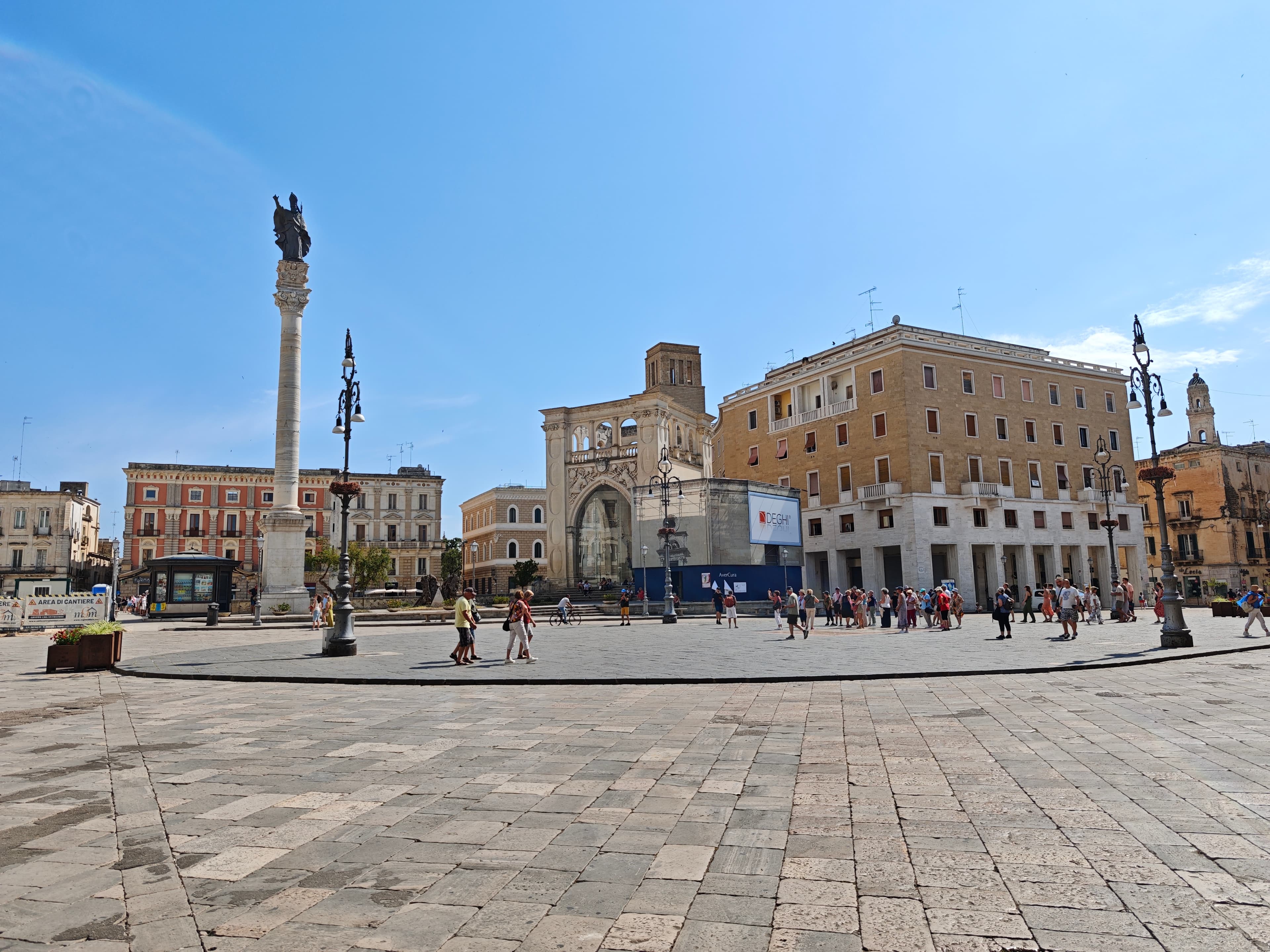
Piazza Sant’Oronzo is the civic heart of Lecce and the city’s main orientation point. It combines Roman ruins, Baroque and Renaissance-Gothic architecture, modern shops, cafés, street life, and the symbolic protection of the city’s patron saint.
What to See
Key features include:
- Roman Amphitheatre
- Column of Sant’Oronzo
- Palazzo del Seggio / Il Sedile
- Church of Santa Maria della Grazia
- Church of San Marco nearby
- Mosaic of the Lupa, Lecce’s wolf emblem
- Former Banca Commerciale Italiana building with the bronze-and-enamel “orologio delle meraviglie” by Francesco Barbieri
- Surrounding shops, cafés, and pedestrian streets
The square occupies the center of Roman Lupiae and was once known as Piazza dei Mercanti, the commercial heart of the city. The name Piazza Sant’Oronzo became official in 1871, though the saint’s importance dates back to the 1656 plague tradition.
Atmosphere
This is Lecce at its most extroverted. Smells include espresso, sugary pastries, hot pavement, roasted nuts, and sometimes festival food. Sounds include buskers, glasses, conversations, children, and café noise.
During the August feast of Sant’Oronzo, the square fills with lights, music, stalls, fried street food, and fireworks.
Reviews and Real-World Advice
Visitors love Piazza Sant’Oronzo as a central hub, but many also call it the most touristy part of Lecce. It is lively, unavoidable, and historically layered—but not necessarily the best place to eat.
Warnings:
- Restaurants and cafés here are often more expensive and sometimes lower quality.
- Check menu prices, coperto, service charges, bread/water charges.
- Expect crowds in summer evenings.
- Pushy trinket sellers may appear, though serious scams are not common.
Practical Information
- Access: Free
- Hours: Open 24/7
- Best time: Early morning for quiet photos; evening for atmosphere
- Budget: Only for cafés, events, or amphitheatre access if offered
2. Roman Amphitheatre of Lecce
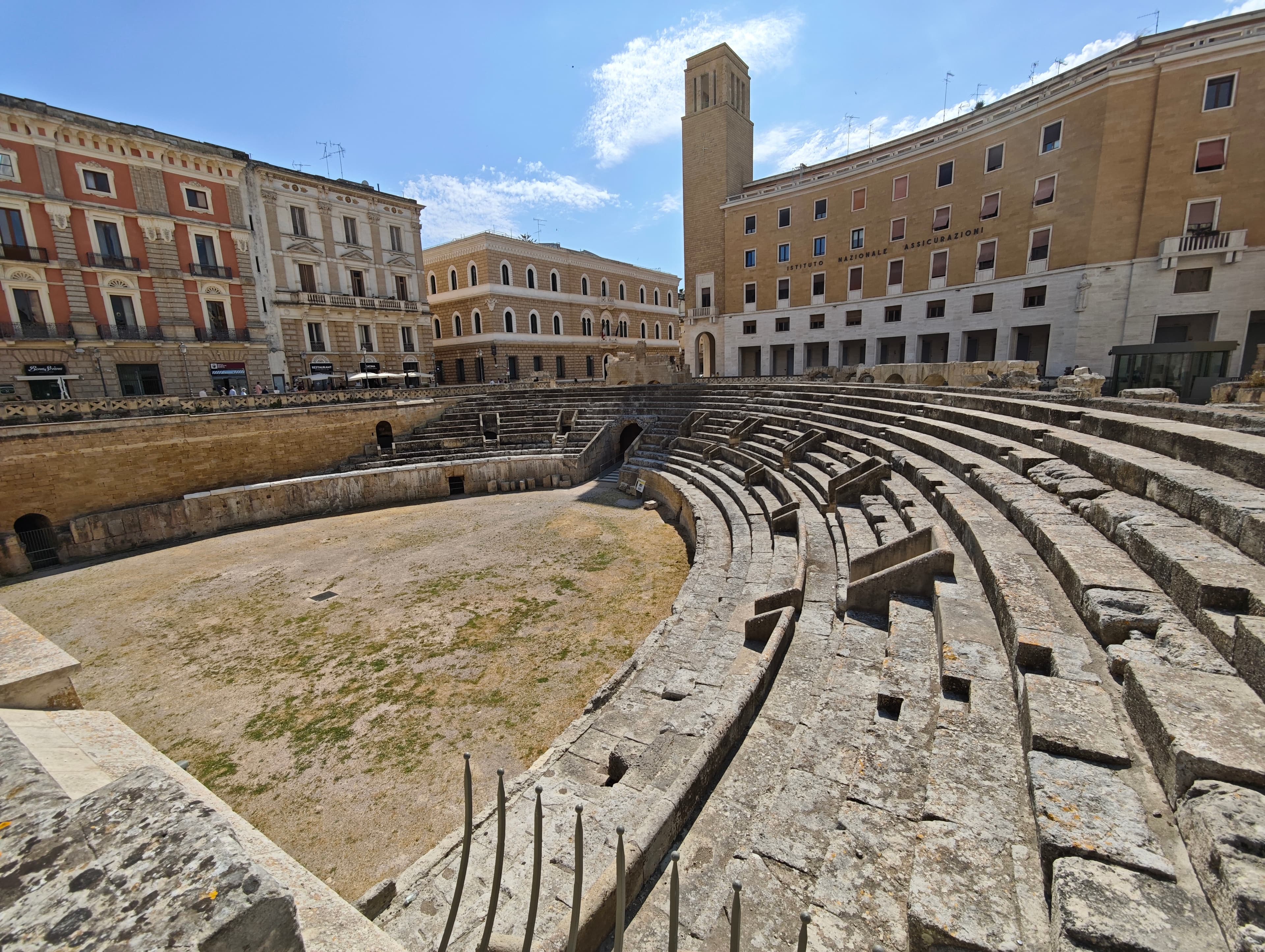
The Roman Amphitheatre, partly sunk into Piazza Sant’Oronzo, is one of Lecce’s strongest links to ancient Lupiae.
History and Significance
Built in the 2nd century CE, probably during Hadrian’s reign, the amphitheatre hosted public spectacles, possibly including gladiatorial games. It was buried for centuries and rediscovered in 1901 during construction work.
Its estimated capacity varies widely:
- 12,000–14,000 spectators
- Or possibly more than 25,000, depending on reconstruction assumptions
Either way, it proves Roman Lecce was a substantial urban center.
Architecture
The amphitheatre has an elliptical plan. Reported dimensions include:
- External footprint: about 102 x 83 meters
- Arena: around 53 x 34 meters
Only about one-third to half is visible today; the rest lies beneath later buildings. You can see:
- Stone seating tiers
- Arena floor
- Arched passages
- Substructures
- The contrast between Roman ruin and Baroque cityscape
Atmosphere
Stand at the railings early morning or late at night and the site feels contemplative: old stone, dust, weeds between blocks, pigeons, and echoes. During busy hours, it becomes part of the piazza’s movement.
Reviews
Most visitors consider it worth seeing but quick. It is more of a visual and orientation landmark than a deep archaeological visit unless paired with a guide.
Common complaints:
- Limited access
- Not enough explanatory panels
- Much of it is still buried
- Some expected to walk inside and could not
Practical Information
- Exterior view: Free from Piazza Sant’Oronzo
- Interior access: Variable; often limited to guided visits or events
- Ticket estimate: Free for exterior viewing; special access/events may cost around €3–€6, sometimes more depending on program
- Hours: Visible 24/7 from the square; interior schedules vary
3. Piazza del Duomo: The Enclosed Sacred Stage
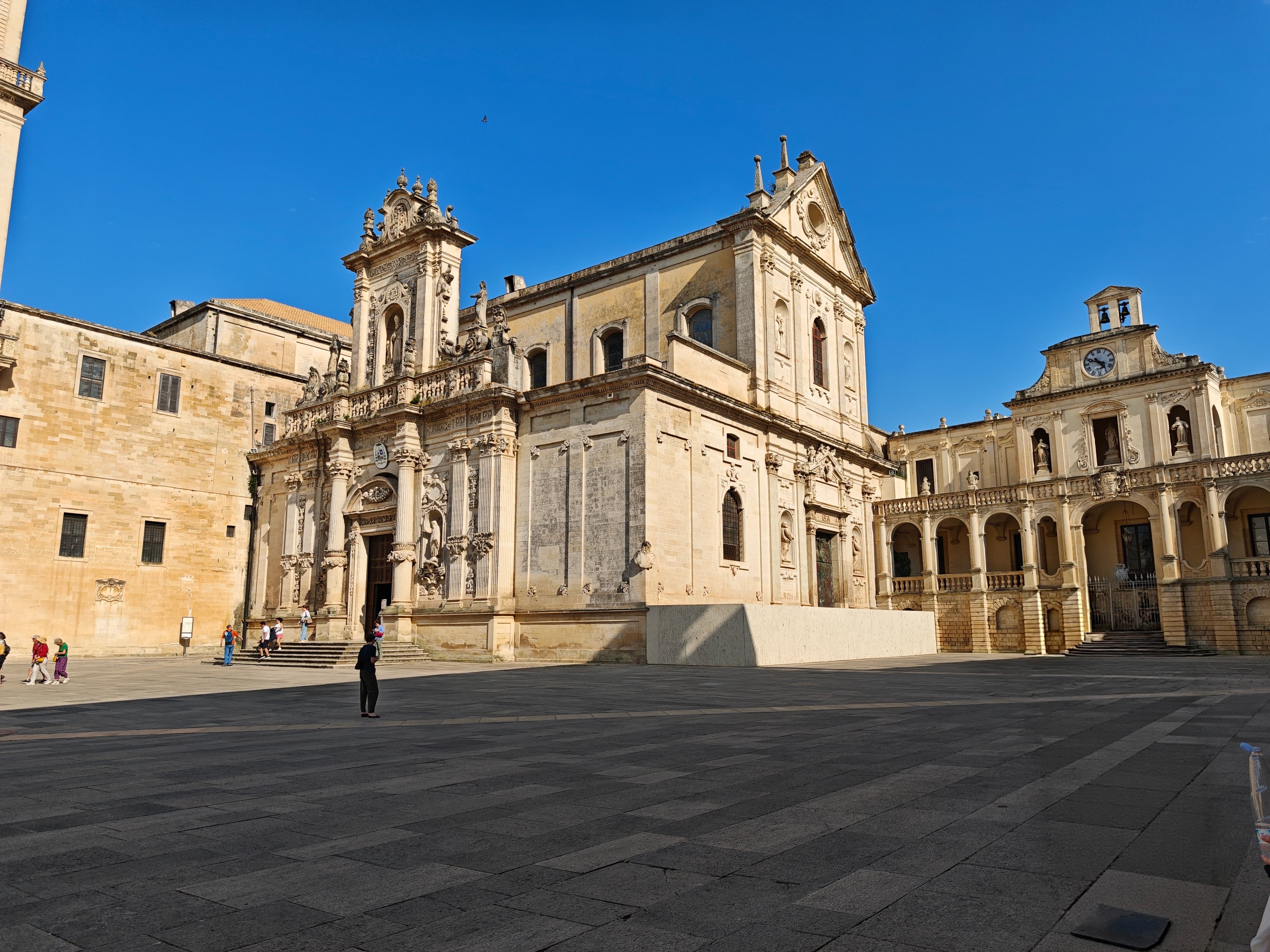
Piazza del Duomo is one of Italy’s most beautiful closed squares, or piazze chiuse. Unlike a broad municipal square, it feels like entering a sacred courtyard or theatre set.
History
The piazza corresponds to the central courtyard of the medieval episcopal citadel, historically called Corte del Vescovado. It was an autonomous ecclesiastical enclave where the bishop and clergy lived and exercised power. Unlike many Italian squares, it has belonged for centuries to the Curia, not the municipality.
Key phases:
- First cathedral documented in 1144
- Cathedral rebuilt in Baroque style in 1659
- Campanile completed by Giuseppe Zimbalo
- Seminary built between the late 17th and early 18th century
Historically, gates closed the square at night. The campanile also served as a kind of watchtower.
What to See
The square includes:
- Duomo / Lecce Cathedral
- Campanile del Duomo
- Episcopio / Bishop’s Palace
- Seminary Palace / Antico Seminario
- Diocesan Museum
- Baroque propylea and twin palazzi
The square’s single main entrance intensifies the sense of arrival.
Atmosphere
By day, the limestone is pale and bright. At golden hour, the square turns warm honey. At night, it glows like a dimly lit theatre set. It smells of warm stone, espresso, and occasional incense when the cathedral doors open.
Visitors often describe the square as protective and intimate, quieter and more magical than Piazza Sant’Oronzo.
Reviews
Travelers rank it among Lecce’s highlights and recommend seeing it both day and night. Complaints focus on:
- Ticketing confusion for church interiors
- Heat and limited shade midday
- Crowds during events or high season
Practical Information
- Piazza access: Free, open at all times
- From railway station: About 10 minutes on foot
- Driving: Avoid ZTL; park outside historic center and walk
LeccEcclesiae Ticketing
Access to the Duomo, Campanile, Seminary, and associated churches is organized through the LeccEcclesiae circuit.
Latest benchmark prices:
-
Standard LeccEcclesiae Pass:
- Full: €11
- Reduced: €5
- Includes Duomo, Campanile, Antico Seminario, and other basic circuit sites
-
Extended ticket:
- Full: €21
- Reduced: €13
- Includes wider set such as Santa Croce and Santa Chiara
Some sources also describe an €11 ticket including Ancient Seminary, Diocesan Museum, Museum of Sacred Art, Basilica of Santa Croce, Santa Chiara, San Matteo, and the Cathedral as part of the circuit. Others mention a broader pass around €20–€22, valid multiple days or about two weeks.
Opening Hours
For LeccEcclesiae monuments:
- April–September: daily 09:00–21:00
- October–March: daily 09:00–18:00
- Last entry: 15 minutes before closing
Masses, weddings, funerals, religious feasts, restoration works, or civic events can affect access.
4. Lecce Cathedral: Cattedrale di Santa Maria Assunta e Sant’Oronzo
The Duomo di Lecce is the city’s main church and the seat of the Archbishop.
History
- First cathedral built in 1144 by Bishop Formoso Lubelli
- Renovated in 1230 under Bishop Roberto Voltorico in Romanesque style
- Completely rebuilt in 1659 by Bishop Luigi Pappacoda
- Architect: Giuseppe Zimbalo, known as lo Zingarello
- Consecrated in 1670
- Dedicated to the Assumption of the Virgin Mary
- Contains links to Sant’Oronzo, patron of Lecce; Pappacoda’s remains are in the altar dedicated to him
Architecture
The cathedral stands at the southeast corner of Piazza del Duomo and unusually has two façades, with the lateral north façade treated as the main theatrical front facing the piazza.
Key exterior features:
- Triumph of carved Lecce stone
- Columns, statues, floral and figurative motifs
- Lower level with portal and statues of Saints Justus and Fortunatus
- Upper level as a decorative architectural screen
Interior
The interior is a three-aisled church with major 16th–17th century Salento artworks, Baroque altars, chapels, carved stone, polychrome materials, and richly decorated furnishings.
A highlight is the large crypt, built in the 16th century, reached by two staircases and supported by a striking forest of 92 columns.
Practical Information
- Ticket: Usually via church circuit, around €11–€12 standard; extended passes around €20–€22
- Winter hours: generally 09:00–18:00
- Summer hours: generally 09:00–21:00
- Restrictions: Mass, feasts, weddings, diocesan events
- Best time: Late morning to late afternoon for tourist access; evening for atmosphere
5. Campanile del Duomo
The Campanile del Duomo is one of Lecce’s most recognizable vertical landmarks.
History and Architecture
- Designed by Giuseppe Zimbalo
- Built between 1661 and 1682
- Commissioned by Bishop Luigi Pappacoda
- Replaced an earlier Norman bell tower that collapsed in the early 17th century
- Height: about 68–70 meters
- Structure: square, five levels, narrowing upward
- May have served both as bell tower and watchtower
- On clear days, local sources say you can see the Adriatic and even the Albanian coast
- Summit includes a dome with shining maiolica tiles
Access
Recent information indicates access by elevator to the third level, with four balconies at 43 meters offering 360-degree views. Other sources report that access has been suspended at times for restoration and consolidation, so verify before going.
Practical Information
- Ticket estimate:
- Full: €12
- Reduced: €9 for residents of diocesan municipalities, disabled visitors, children 6–10
- Free up to age 5
- Summer hours: daily 10:00–21:00
- Winter hours: daily 10:00–18:00
- Important: Access may be suspended due to restoration; confirm locally
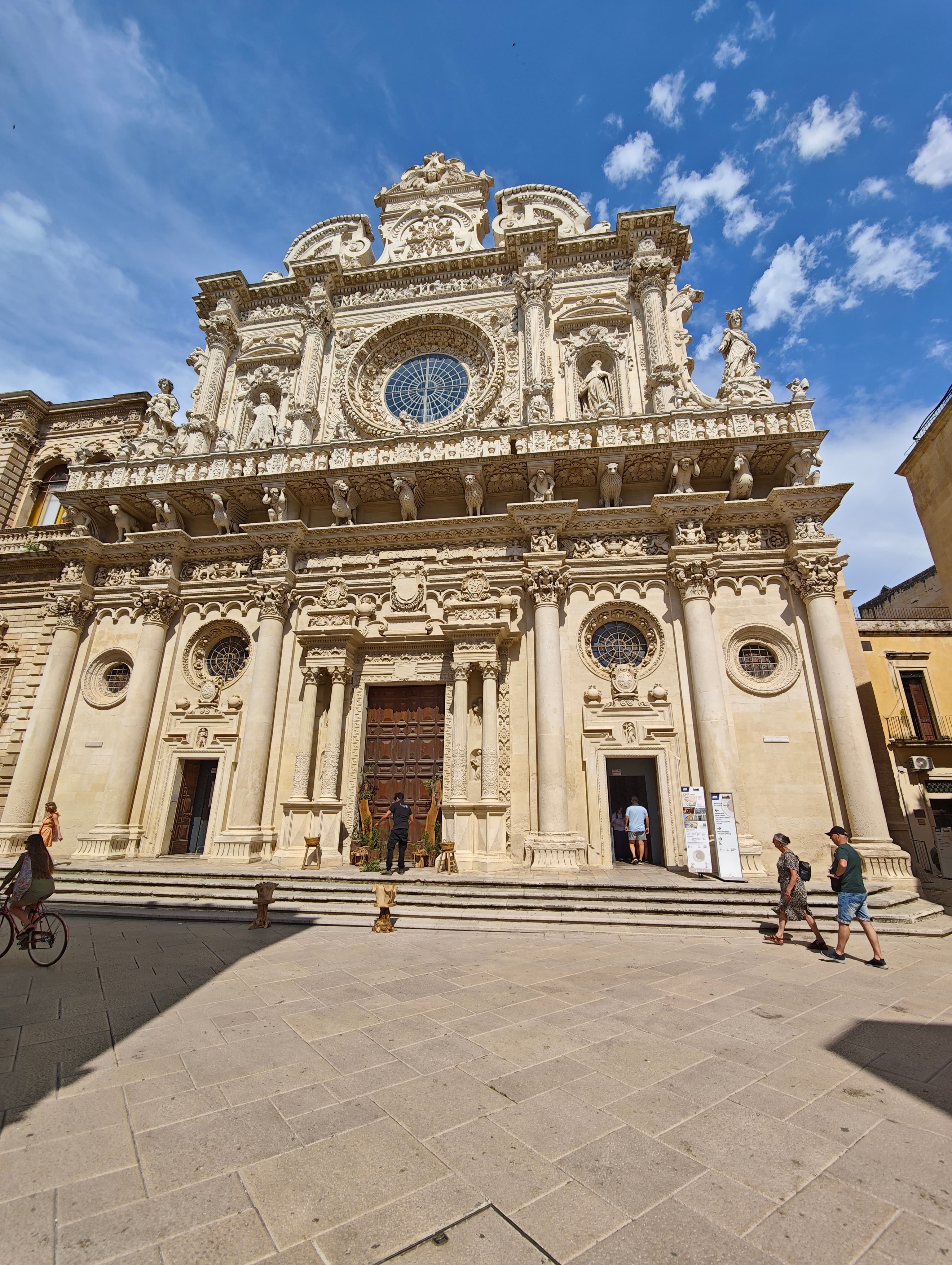
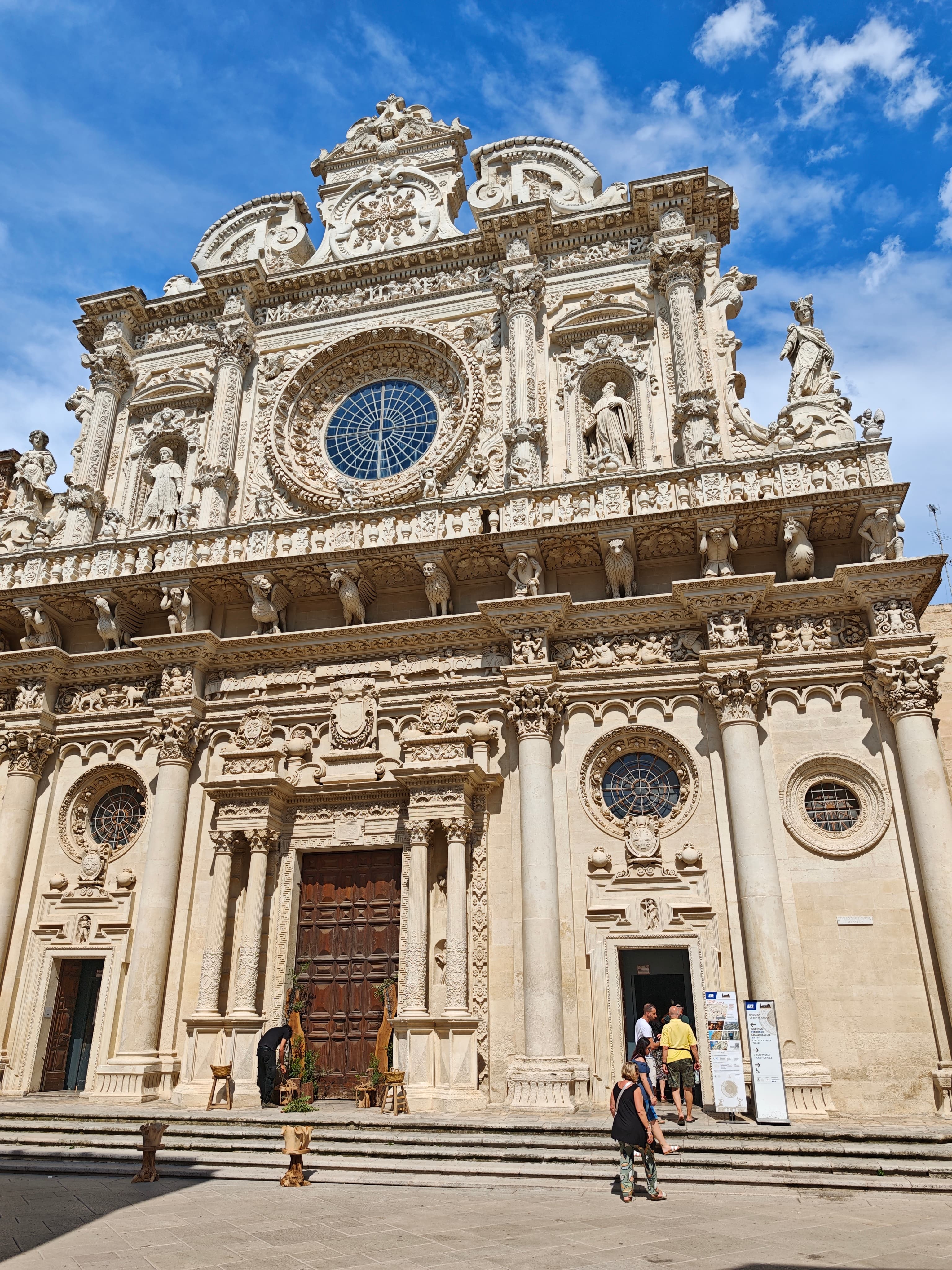
6. Basilica di Santa Croce: Lecce’s Baroque Masterpiece
The Basilica di Santa Croce is the most famous masterpiece of Lecce Baroque and a must-see even if you have limited time.
History
- First Santa Croce church built by Celestine monks in the 14th century near the medieval castle to house a relic of the True Cross
- Demolished after Charles V ordered castle enlargement in 1539
- New basilica begun in 1549 on Via Umberto I
- Built in the area of San Martino, which had been the medieval Giudecca, abandoned after the expulsion of Jews from the Kingdom of Naples in 1541
- Façade completed in 1646, as marked by a cartouche beside the rose window
- Some English sources give later completion dates up to 1695, but local sources emphasize mid-17th century completion
Architects and Artists
- Lower façade attributed to Gabriele Riccardi
- Later upper façade and portals involved Cesare Penna and Francesco Antonio Zimbalo
Significance
- Conventual church of the Celestines
- Attached to former Celestine convent, now Palazzo della Provincia / Celestini Palace
- Holds a fragment of the Holy Cross of Jesus
- Declared a national monument in 1906
- Today a minor basilica, parish seat, and symbol of Lecce
Architecture
The façade is arranged in three horizontal sections:
- Lower level: Renaissance sobriety, robust pilasters, classical orders
- Central level: famous rose window
- Upper level: full Baroque explosion
Look for:
- Caryatids
- Animals
- Mythological figures
- Putti
- Flowers and fruits
- Coats of arms
- Allegorical motifs
- Saints and angels
- Men and beasts symbolizing Christianity’s triumph over chaos and sin
The portals, especially the central one, are richly carved and linked to Francesco Antonio Zimbalo.
Interior
The interior has a basilical plan with:
- Long central nave
- Twelve columns
- Cupola completed by the end of the 16th century
- Baroque side altars
- Notable altar of St Francis, attributed to Zimbalo
- Rich stone, stucco, and polychrome decoration
Atmosphere
Santa Croce feels like a Baroque fever dream. At late afternoon the façade glows caramel; after rain it releases a chalky mineral scent. Travelers often stand rooted in place, trying to decode the overload of animals, cherubs, faces, vines, and saints.
At night, lighting makes the carvings appear and disappear in shadow, giving the basilica an almost uncanny presence.
Reviews
Overwhelmingly positive. The façade is frequently called jaw-dropping and among the most intricate in Italy. Some visitors find the interior less dramatic than the exterior. Scaffolding during restoration can disappoint.
Practical Information
Ticketing varies:
- Sometimes free as a place of worship
- Often included in church circuits
- Single-church estimate if required: €3–€5
- Combined church circuit: €10–€15, or extended LeccEcclesiae ticket around €21
Approximate hours:
- Weekdays: 09:00–13:00, 16:30–20:30
- Weekends: generally similar, with possible Sunday liturgy restrictions
- Always verify around Mass, weddings, funerals, restoration, and events
7. Celestini Palace / Palazzo dei Celestini
Adjacent to Santa Croce, Celestini Palace is the former Celestine convent and part of the same monumental Baroque ensemble.
- Geo rating: 4.5
- Reviews: 184
- Address: Via Umberto I
- Coordinates: 40.3550366, 18.1730487
Visitors often enjoy it as a façade and urban backdrop rather than a fully accessible attraction. Reviewers like the elegant portals, balconies, and courtyard atmosphere but note that many palaces in Lecce are offices or private spaces with limited interior access.
Best experienced together with Santa Croce and the Jewish Museum nearby.
8. Museo Ebraico di Lecce: Jewish Museum
The Jewish Museum of Lecce is small but powerful. It sits in Palazzo Personè / Palazzo Taurino, directly over the remains of the medieval synagogue in Lecce’s former Giudecca.
History
- Inaugurated in May 2016
- Private initiative to restore memory of Lecce’s medieval Jewish community
- Housed in a medieval palazzo later remodeled in Renaissance and Baroque style
- Located on the site of the 15th-century synagogue
- After Jewish expulsion from the Kingdom of Naples in 1541, the area was taken over by Santa Croce and the Celestine convent; the synagogue became a church
What to See
The exhibition spans seven rooms and includes:
- Mikva’ot / ritual baths
- Mezuzah recess in a doorframe
- Foundations of the post-expulsion church built over the synagogue
- Maps of the medieval Giudecca
- Documents, artifacts, panels, and multimedia on Jewish life, trade, scholarship, coexistence, hostility, forced conversions, and expulsion
Atmosphere
Descending into the museum, you feel the air cool and damp. Lighting is soft. The mood is moving and memory-laden, a striking contrast to Baroque exuberance above ground. Many visitors describe it as more emotionally affecting than expected.
Reviews
Praised for:
- Knowledgeable guides
- Illuminating minority history
- Emotional depth
- Clear interpretation
Complaints:
- Small size
- Short visit
- Higher cost relative to size for those not deeply interested
- Need to coordinate tour language and timing
Practical Information
- Access: Guided tour only
- Address: Via Umberto I, 9
- Geo rating: 4.7 / 215 reviews
- Duration: 45–60 minutes museum only; 1–1.5 hours with Giudecca walk
- Languages: Usually Italian and English; check for others
Opening hours from official updates:
- Monday–Saturday: 10:00–16:00
- Sunday: 10:30–13:30
Tripadvisor may show daily 10:00–14:00, but official updates are more reliable.
Ticket estimates:
- Museum guided visit: €10–€15 adults
- Youth / concessions: €6–€10
- Local association tour benchmark: €15 full, €12 reduced disability, €7 children 6–16
- Commercial platforms: often €12–€20
Contact / booking recommended, including phone or WhatsApp +39 0832 247016.
9. Charles V Castle: Castello di Carlo V
The Castle of Charles V is Lecce’s major fortress and one of Puglia’s largest fortified structures.
- Geo rating: 4.3
- Reviews: 5,695
- Address: Via XXV Luglio, 52
History
The site has Norman origins, with a residence already present in the 12th century. In 1537, rebuilding began on the older structure, and by 1539–1540 the redesign was underway under military engineer Gian Giacomo dell’Acaya.
The castle formed part of Charles V’s defensive program against Saracen raids, Ottoman threats, and Mediterranean conflict. Later it served as a military district or barracks from the late 19th into the 20th century before becoming a civic and cultural venue.
Architecture
Look for:
- Massive walls
- Projecting corner bastions
- Renaissance artillery-defense design
- Central inner courtyard
- Piazza d’Armi
- Royal Gate / Porta Reale
- Medieval Torre Mozza
- Exhibition rooms
- Traces of defensive systems, though original moat no longer survives
The castle also includes the Cartapesta Museum, explaining Lecce’s papier-mâché tradition.
Atmosphere
The castle feels austere and grounded compared with Lecce’s ornate churches. Outside: warm stone, earth, trees, and open space. Inside: cool masonry, echoing footsteps, mustiness, and contemporary exhibitions in old defensive rooms.
Reviews
Positive for:
- History
- Courtyards and architecture
- Exhibitions
- Contrast with Baroque churches
Complaints usually concern variable access, expectations, and whether exhibitions are interesting at the time.
Practical Information
Ticket sources conflict:
- Common standard admission: around €8
- Another structure: €3 standard, €2 reduced, €1 children/school groups
- Practical estimate: €3–€8 depending on visit type, event, or guided access
Opening sources conflict:
- Wednesday–Sunday 10:00–20:00, last entry 30 minutes before closing
- Other sources suggest daily around 09:00/09:30–20:30
- Practical estimate: broadly 10:00–20:00, but verify before visiting
10. Porta Napoli
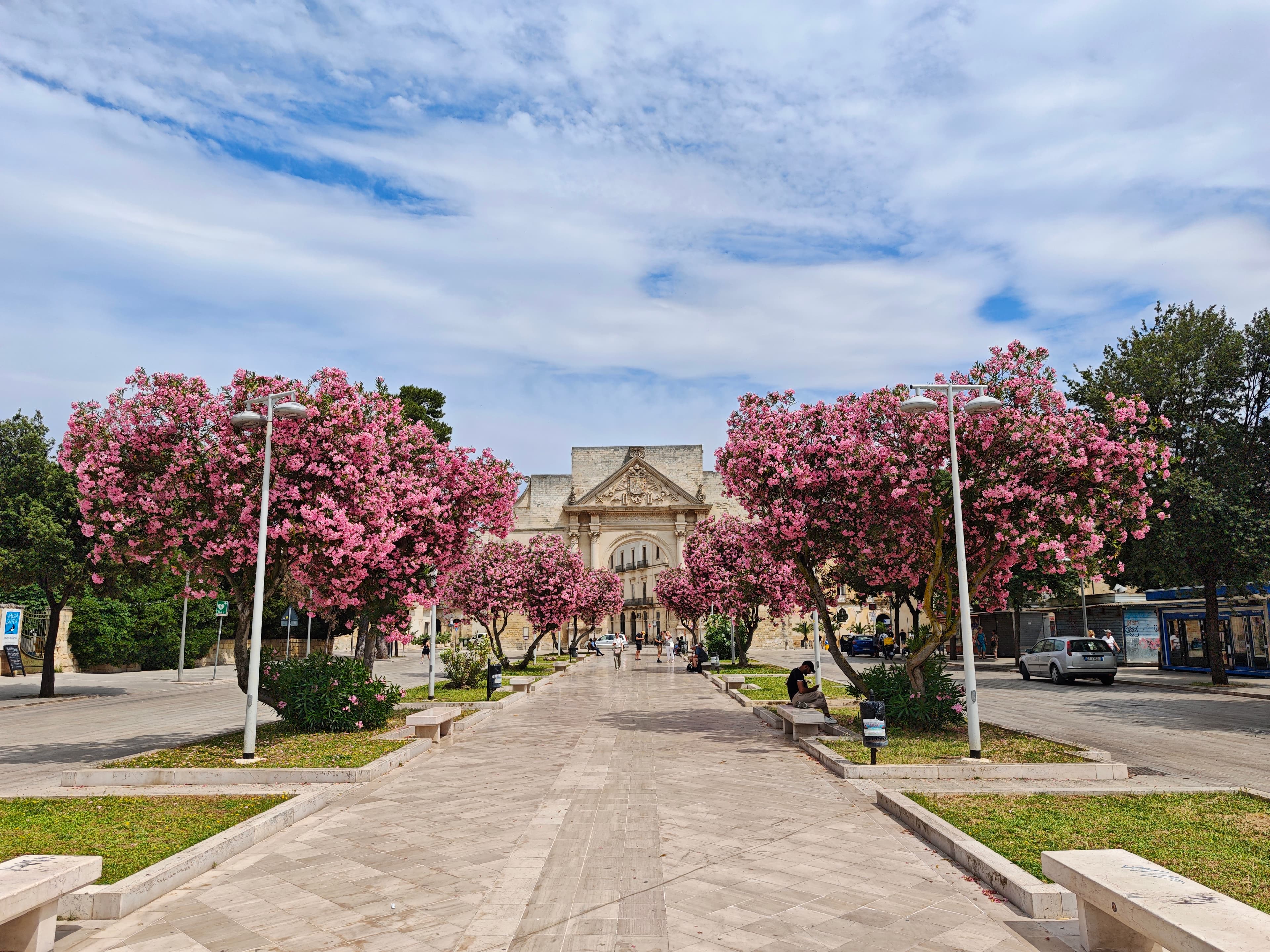
Porta Napoli is the monumental northern entrance to Lecce’s old town and one of its most recognizable public monuments.
- Geo rating: 4.6
- Reviews: 11,951
- Address: Piazzetta Arco di Trionfo
- Coordinates: 40.3564857, 18.1685583
History
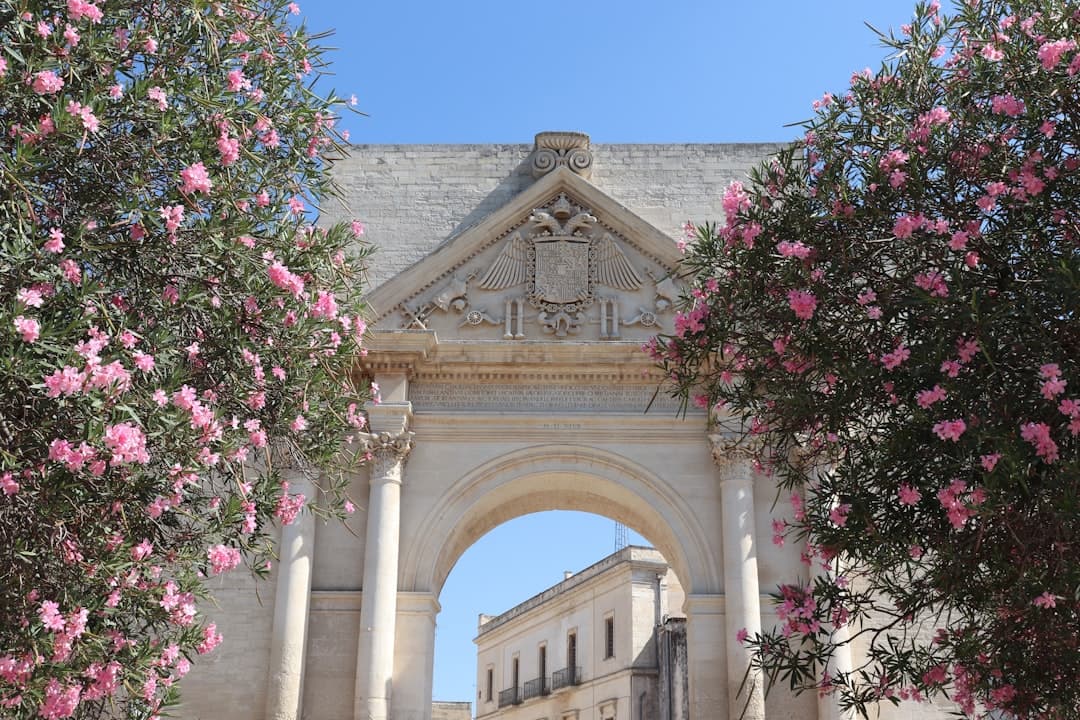
Built in 1548 in honor of Emperor Charles V, Porta Napoli is associated with Lecce’s 16th-century fortification program. It is often attributed to Gian Giacomo dell’Acaya.
Architecture
- About 20 meters tall
- Triumphal arch form
- Large central arch
- Corinthian columns or pilasters
- Triangular pediment
- Carved armor, weapons, and Spanish/Habsburg coat of arms
It blends military monumentality with Renaissance triumphal imagery.
Atmosphere
Passing under Porta Napoli feels like entering the historic city. Traffic noise and car exhaust outside gradually give way to stone lanes, footsteps, and pedestrian chatter inside. Many travelers remember their first arrival through the gate as the moment Lecce “began.”
Reviews
Worth seeing as part of a walk, especially at sunset or night. Not a standalone long visit.
Practical Information
- Ticket: Free
- Hours: Open-air, always accessible
- Best time: Daylight for detail; evening for atmosphere
11. Porta Rudiae
Porta Rudiae, also called the Rudiae Gates, is often considered the most elaborate of Lecce’s gates.
- Geo rating: 4.6
- Reviews: 6,343
- Address: Via Giuseppe Libertini
Travelers praise its statues and decorative elements, and some prefer it aesthetically to Porta Napoli. It makes a strong starting point for a walking tour and is less busy than the central piazzas. It is still a quick visual stop rather than a major time commitment.
Practical:
- Free
- Open-air
- Include it in a historic-center loop, especially along Via Libertini
12. Porta San Biagio
Porta San Biagio is the southern city gate near restaurants, bars, and routes toward Museo Faggiano and San Matteo.
- Geo rating: 4.6
- Reviews: 5,803
- Address: Piazza D’Italia
It has handsome Baroque details and is pleasant as a start or end point for an evening stroll. Nearby traffic and parking slightly affect the atmosphere, but the gate remains a good photo and orientation landmark.
Practical:
- Free
- Open-air
- Best included in a wider old-town circuit
13. Museo Faggiano: 2,000 Years Beneath a House
Museo Faggiano is one of Lecce’s most unusual and beloved museums.
- Geo rating: 4.8
- Reviews: 1,461
- Address: Via Ascanio Grandi, 56/58
Origin Story
In 2001, owner Luciano Faggiano, a cook, began work to replace faulty sewer pipes before opening a restaurant. Breaking through the floor, he discovered ancient structures and artifacts. Excavations continued for about seven years, supervised by the Soprintendenza Archeologica of Taranto and largely funded by the Faggiano family.
The museum opened on 8 April 2008. Its story drew international attention, including a New York Times front-page feature in 2015.
Historical Layers
Inside one house, you find:
- Messapic walls and floors
- Roman cisterns, rooms, and water systems
- Medieval and possible Templar-period structures
- A chapel and tombs from a cloistered nuns’ convent
- Underground corridors and small chambers
- Ceramic fragments, Greek vases, Christian symbols, domestic objects
The current palace structure dates to around the 12th century, associated with the era of the Templar Knights. The building later served as a convent for cloistered nuns.
Atmosphere
It feels raw, personal, and vertical: less like a polished institution, more like entering a family excavation. Narrow stairs, shafts, cisterns, low spaces, and exposed walls make it tactile and memorable.
Reviews
Highly praised for:
- Unique story
- Authentic “dig” feel
- English and Italian explanations
- Intimacy
- Historical depth
Complaints:
- Small and cramped
- Steep stairs
- Tight passages
- Not ideal for mobility issues or claustrophobia
- Some question value vs. visit length
Practical Information
- Hours: Generally daily 09:30–20:00
- Ticket: Adults about €3, youths about €2, under 6 free; expect roughly €3–€5 in 2024/2025
- Duration: 45–60 minutes, longer for archaeology lovers
- Warnings: Verify hours; private museum may close for events or maintenance
14. Roman Theatre / Teatro Romano
The Roman Theatre is a smaller, hidden 2nd-century Roman theatre in Lecce’s old town, distinct from the amphitheatre.
- Geo rating: 4.1
- Reviews: 1,022
- Address: Via Degli Ammirati, 5
History
- Dates to the 2nd century AD
- Part of Roman Lupiae
- Used for plays and performances, not gladiatorial games
- Rediscovered in the early 20th century, with key excavations in the 1920s
- Integrated with the Museo Teatro Romano
- Museum housed in a 17th-century palazzo formerly belonging to the Romano family, later supported by the Memmo Foundation
What to See
- Semicircular cavea
- Orchestra
- Stage area and remnants of scaenae frons
- Stone seating rows
- Columns, carved fragments, mosaic pieces
- Museum exhibits: statues, reliefs, masks, costumes, inscriptions, performance-related fragments
Atmosphere
It is tucked into narrow streets and often seen behind railings. The mood is quieter, more secretive, and less crowded than the amphitheatre.
Reviews
Pros:
- Hidden surprise
- Good exterior view
- Less crowded
Cons:
- Small
- Partially preserved
- Limited signage
- Many feel paying for entry offers little extra if you can see much from outside
Practical Information
Access is usually combined as “Amphitheater and Roman Theater of Lecce”, managed by Aditus Culture.
Estimated tickets:
- Adult combined ticket: €6–€8
- Reduced: €4–€6
- Children under 18: often free or symbolic €1
- Guided tour supplement: €5–€10
Estimated hours:
- Likely core: daily 09:30–13:30
- Possible afternoon / peak re-opening: 16:00–19:00, especially Fri–Sun or high season
- Plan morning visit; verify locally at tourist office or ticket desk
- Allow 45–60 minutes for theatre plus museum
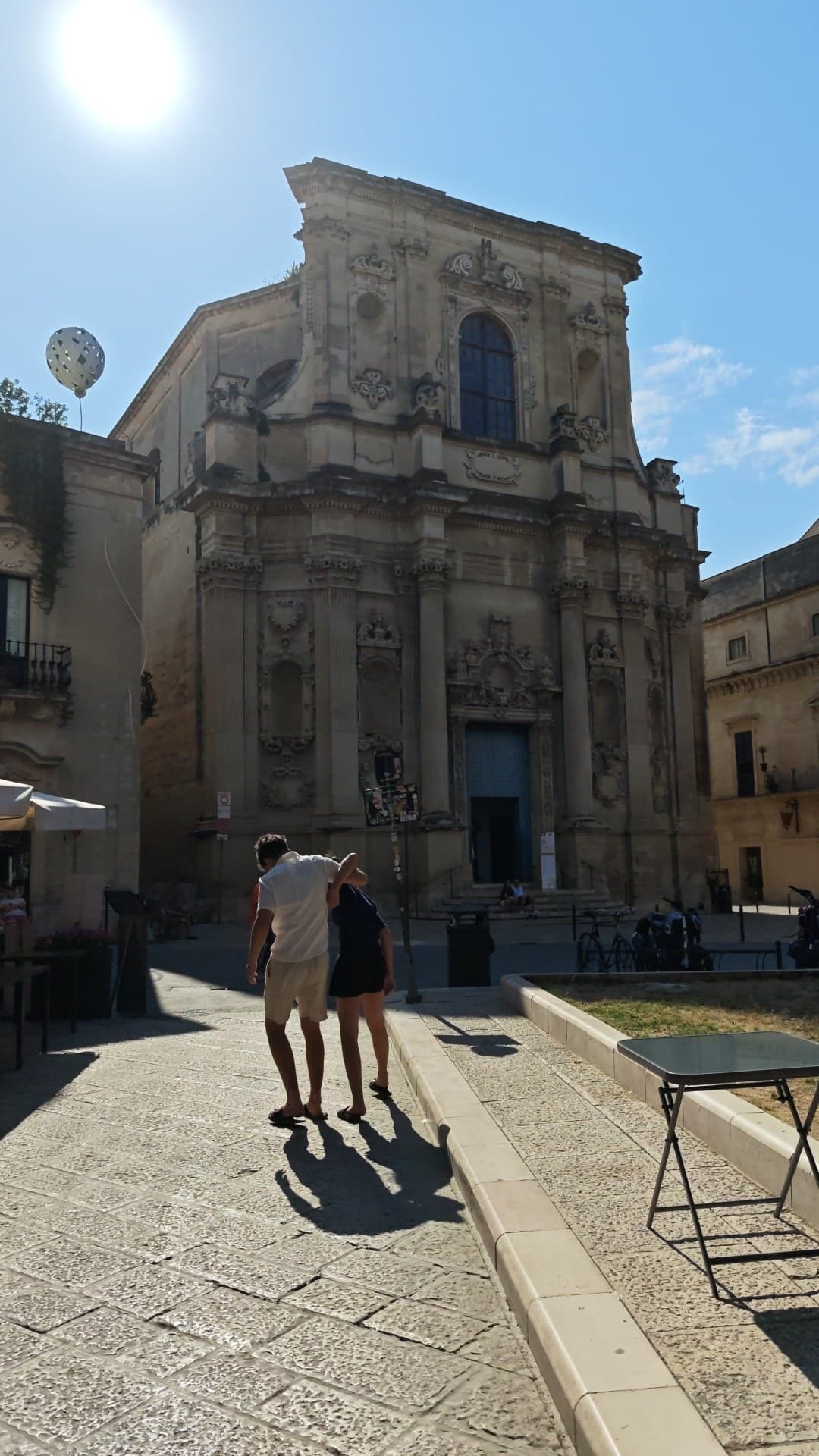
15. Chiesa di Santa Chiara
The Church of Santa Chiara is one of Lecce’s finest Baroque churches and a key stop in the LeccEcclesiae circuit.
- Geo rating: 4.6
- Reviews: 876
- Address: Piazzetta Vittorio Emanuele II
History
- Original church and monastery founded in 1429 by Bishop Tommaso Ammirato, within a broader conventual foundation dated between 1410 and 1430
- Built for the Clarisse, the female Franciscan order
- Damaged in the 16th century by fires and deterioration
- Baroque reconstruction began in 1687 and ended in 1691, as noted by an inscription on the façade
- Traditionally attributed to Giuseppe Cino
- Recent studies attribute the original design to Giovanni Andrea Larducci of Salò, who died in 1685
Architecture
Exterior:
- Baroque façade in Lecce stone
- Slightly convex
- Richly decorated with volutes, putti, cartouches
- Incomplete upper section, making it recognizable
- Epigraphic cartouche above the central window with completion date
Interior:
- Octagonal tendency in plan
- Majestic Baroque high altar
- Six side chapels
- Baroque side altars
- Neapolitan wooden statues
- 18th-century cartapesta ceiling, a key example of Lecce’s papier-mâché tradition
Atmosphere
The area blends sacred calm and urban nightlife. The piazzetta is one of the centers of Lecce’s evening scene, but inside the church you feel wax, old wood, incense, and cool stone.
Practical Information
Ticketing:
- Usually included in LeccEcclesiae
- Full: around €10–€11
- Reduced: around €5
- Under 10: generally free
- Mass access free
Tourist hours:
- Summer: about 09:00–21:00
- Winter: about 09:00–18:00
Mass times from Visit Lecce:
- Sunday: 08:00, 10:00, 18:00
- Weekdays: 08:00, 18:00
Dress appropriately during services.
16. Chiesa di San Matteo
The Church of San Matteo, also called Santa Maria della Luce in San Matteo, is one of Lecce’s most theatrical Baroque churches.
History
- Located at Via dei Perroni 29
- Built for the Franciscan Tertiary nuns
- Commissioned by Bishop Luigi Pappacoda
- Replaced a 15th-century chapel dedicated to San Matteo, attached to a convent founded in 1474
- First stone laid in 1667
- Built 1667–1700
- Designed by Giovanni Andrea Larducci di Salò, nephew of Francesco Borromini
- Completed after his death by Giuseppe Zimbalo
The church is sometimes called the “Pantheon of Lecce Baroque” or “the most Baroque of Baroque churches.”
Architecture
The façade is famous for its concave-convex curves, recalling Borromini’s Roman church San Carlo alle Quattro Fontane:
- First order convex
- Second order concave
- Unusual scales and rustication
- Positioned dramatically at the convergence of four lanes
Interior:
- Pseudo-elliptical nave
- Twelve statues of the Apostles in Lecce stone by Placido Buffelli
- Numerous Baroque side altars
- Grand high altar attributed to Giuseppe Cino
- Late-Gothic fresco of Madonna della Luce
- Upper bifora openings from which nuns attended services
- Relic of San Matteo
Legends
San Matteo is linked to the “colonna del diavolo” legend: the devil supposedly killed a master stonecutter out of envy and fear that such beauty would convert passersby.
A historical memory also recalls a former “colonna infame” where the severed head of a Lecce noble accused of betrayal in favor of the Turks was displayed.
Practical Information
Ticketing:
- Arte.it lists free entry
- Some tourist reviews mention paid or combined church tickets
- Best estimate: independent entry often €0, unless included in guided circuits
Opening:
- Daily 09:00–14:00 and 15:00–21:00
Mass times:
- Sept–Oct: weekdays 19:00, holidays 10:30
- Late Oct–early May: weekdays 18:30, holidays 10:30
- May–June: weekdays 19:00, holidays 10:30
- July–early Sept: weekdays 19:30, holidays 10:30
17. MUST – Museo Storico della Città di Lecce
MUST is Lecce’s civic museum, located in a 15th-century former monastery associated with Santa Chiara.
History and Mission
- Building dates to around 1410
- Former monastic complex in the historic center
- Created as a municipal hub for Lecce’s history and cultural heritage
- Designed as a “living” museum with multimedia, temporary exhibitions, contemporary art, education, and events
- Notable accessibility mission: developed to help visitors with visual disabilities engage through audio descriptions and participatory tools
Exhibits and Spaces
Address: Via degli Ammirati 11
Expect:
- Monastic architecture: stone halls, vaulted ceilings, cloister-like spaces
- Multimedia route from Messapian origins to Baroque Lecce
- Ancient maps, vintage photographs, interactive installations
- Permanent works by Cosimo Carlucci
- “De Sculptura”, contemporary sculpture from Apulia
- Photographic works by Jenny Okun
- Temporary exhibitions, living labs, cultural events
Reviews
Pros:
- Beautiful setting
- Helpful context for Lecce’s history
- Quiet and uncrowded
- Good air-conditioned break
Cons:
- Sparse or uneven exhibits
- Limited English captions in some sections
- Some feel value is modest if short on time
Verdict: Liked but not universally loved. Best for travelers staying several days, history lovers, contemporary art viewers, or those needing a calm indoor stop.
Practical Information
Ticket estimate:
- Standard: €5–€6, often around €5 or €5.50
- Possible reductions for students, teachers, seniors, groups
Opening hours conflict across sources. One listing gives:
- Monday–Thursday: 10:00–21:00
- Friday: 10:00–18:00
- Saturday: 09:00–13:30
- Sunday: Closed
Other sources say it is typically closed Monday. Therefore:
- Verify on mustlecce.it, Comune di Lecce, tourist office, or recent same-month reviews
- Expect variable hours, especially for temporary exhibitions
18. Abbey of Santa Maria di Cerrate
The Abbey of Santa Maria di Cerrate is outside central Lecce but important if you have a car or want a cultural half-day trip.
Significance
It is one of the most important examples of Apulian Romanesque and a rare witness to Byzantine / Italo-Greek monastic culture and later agricultural life. It is managed by FAI – Fondo Ambiente Italiano.
History
- Founded in the early 12th century
- Linked to Greek Basilian monks following the will of Bohemond of Hauteville
- Legendary origin connects it to Tancred of Hauteville, who supposedly founded it after a vision of the Virgin while hunting
- Important Byzantine-rite monastery with scriptorium and library
- Later became a Renaissance agricultural estate focused on olives and oil production
- In 2012, Province of Lecce granted FAI a 30-year concession
- Restoration revealed 12th-century Byzantine frescoes and returned the church to liturgical use
What to See
- Romanesque church in pale Lecce stone
- Hanging arches
- Small rose window
- 13th-century portals
- Sculpted capitals
- Loggia / portico
- Byzantine frescoes
- Detached fresco display
- Central courtyard
- Mill and oil rooms
- Two hypogeum olive presses
- Well
- Massaro’s house
- Oven room
- Café and visitor areas
Practical Information
Address: SP 100 Squinzano–Casalabate, km 5.9
By car:
- From Lecce–Brindisi SS 613, exit Squinzano
- Follow signs to Casalabate / SP 100
Tickets:
Self-guided:
- FAI members: free
- Adult: €9
- Children 6–18: €5
- Students up to 25: €5
- Family: €23
- Free under 5, INTO members, selected Louvre patrons, disabled visitors plus companion
Guided:
- FAI members: €6
- Adult: €15
- Children 6–18: €11
- Students up to 25: €11
- Family: €38
Seasonal hours:
- Feb 14–28: Thu–Sun 10:00–18:00
- Mar 1–May 31: Tue–Sun 10:00–18:00
- Jun 1–Aug 31: daily 10:00–19:30
- Sep 1–Oct 31: Tue–Sun 10:00–18:00
- Nov 1–Dec 31: Tue–Sun 10:00–16:00
- Dec 31 closes 14:00
- Closed for maintenance roughly early Jan–mid Feb
- Usually closed Mondays outside summer
Lesser-Known and Additional Places to Know
Torre di Belloluogo
- Geo rating: 4.5
- Reviews: 294
- Address: Via Vecchia Surbo, 48
- Coordinates: 40.3620113, 18.1595116
A historic tower north of the center, useful for travelers interested in Lecce beyond the core Baroque route. It is not as central as Santa Croce or Piazza del Duomo, but it adds medieval and defensive texture to the city.
Arco di Prato
- Geo rating: 4.5
- Reviews: 51
- Address: Piazzetta Arco di Prato, 18
- Coordinates: 40.3544052, 18.1705011
A small, atmospheric historic arch and piazzetta. Best included as part of aimless wandering rather than a destination.
Palazzo Tamborino Cezzi
- Geo rating: 4.8
- Reviews: 111
- Address: Via Guglielmo Paladini, 50
A historic palazzo that fits Lecce’s hidden courtyard culture. Travelers who love palazzi, courtyards, and noble domestic architecture should keep it on their radar.
Church of Saint Mary of Grace / Santa Maria della Grazia
- Geo rating: 4.5
- Reviews: 110
- Address: Via Ernesto Alvino
- Coordinates: 40.3524425, 18.1731778
This church is associated with Piazza Sant’Oronzo’s historic ensemble and was completed in 1590. It is one of the oldest major buildings around the square aside from the amphitheatre.
Museo dei Bambini – Lecce Children’s Museum
- Geo rating: 4.7
- Reviews: 312
- Address: Via Niccolò Foscarini, 24
A useful family-friendly option for travelers with children, especially during hot midday hours or rainy periods.
Casa Museo Spada – Antichi Strumenti Musicali
- Geo rating: 4.9
- Reviews: 63
- Address: Via Lupinacci Sindaco, 11
A highly rated small museum focused on antique musical instruments. Ideal for niche interests, music lovers, or travelers who enjoy intimate house museums.
Cartapesta: Lecce’s Papier-Mâché Soul
Lecce is famous not only for carved stone but also for cartapesta, papier-mâché sculpture. Since at least the 17th century, artisans used humble materials—paper, glue, straw, paint—to create saints, angels, processional figures, and devotional art.
What It Feels Like
Stepping into a workshop is like slipping backstage:
- Smell of wet paper, flour paste or glue, varnish, paint
- Dust motes in shafts of light
- Sandpaper rasping
- Radios murmuring
- Shelves crowded with half-finished saints and angels
These workshops offer a tactile counterpoint to stone Baroque. Watching a face emerge from paper can be surprisingly moving.
Reviews and Buying Advice
Visitors love genuine workshops for authentic craftsmanship and unique souvenirs. But quality varies.
Tips:
- Compare before buying
- Shops near main piazzas may be more tourist-oriented
- Artisan pieces can be expensive because they are handmade
- Avoid assuming every “local craft” shop sells genuine work
Food and Local Experiences
What to Eat in Lecce
Travelers consistently praise Lecce’s food scene, especially when they avoid the most obvious tourist restaurants.
Local specialties include:
- Pasticciotto: custard-filled pastry, best at breakfast with coffee
- Rustico leccese: puff pastry filled with mozzarella, béchamel, and tomato
- Orecchiette
- Seafood
- Local vegetables and legumes
- Salento wines, including Primitivo
- Occasionally more adventurous local dishes such as horse meat
Morning Food Streets
Around Via Palmieri and nearby old-town lanes, you’ll find bakeries, delis, fruit and vegetable stalls, and bars.
Morning smells:
- Ripe tomatoes
- Citrus
- Basil
- Fresh bread
- Cheese and cured meats
- Butter, sugar, custard, and coffee
Travelers often remember small interactions: a vendor offering fruit, a barista recommending rustico, or a local helping with an order.
Aperitivo and Evening Eating
Lecce excels at aperitivo in side streets and small piazzas. The best experiences often happen away from the main squares:
- Order a spritz, wine, or local drink
- Expect snacks in some places
- Linger slowly
- Let the evening passeggiata flow around you
Tourist-Trap Food Warnings
The most repeated warning in reviews:
Avoid relying on restaurants directly on Piazza Sant’Oronzo and other obvious central tourist spots unless you have checked reviews and prices.
Common issues:
- Higher prices
- Mediocre tourist menus
- Cover charges
- Bread, water, or table-service charges not clearly noticed
- Paying for the view rather than food quality
Better strategy:
- Walk one or two streets away
- Look for smaller osterie and family-run places
- Reserve popular restaurants in high season
- Read the posted menu before sitting
- Clarify coperto and service charges
Lecce by Time of Day
Sunrise
One of the most magical times in Lecce. The city is almost empty. The light begins cool and blue, then warms slowly down façades.
Expect:
- Fresh bread
- Coffee starting to brew
- Damp night air
- Street cleaners
- Sparrows
- Your own footsteps echoing
Best for photographers and anyone who wants Santa Croce or Piazza Sant’Oronzo without crowds.
Midday
In summer, midday can be intense. Stone streets get hot and shade can be limited.
Best uses of midday:
- Long lunch
- Siesta
- Museums
- Churches
- Children’s Museum
- Castle exhibitions
- Shaded courtyards
Golden Hour
This is when Lecce’s stone becomes honey, caramel, and gold. Prioritize:
- Piazza del Duomo
- Santa Croce
- Porta Napoli
- Small lanes off Via Libertini
- Hidden courtyards and palazzo doorways
Night
Lecce at night is one of the city’s peak experiences.
Do:
- Join the passeggiata
- Revisit Piazza del Duomo
- Walk past illuminated Santa Croce
- Sit in a small piazza with wine or gelato
- Avoid eating on the most touristy squares unless chosen carefully
Practical Tips, Warnings, and Real-World Advice
Safety
Lecce is generally perceived as safe, including at night in the historic center. Violent crime is not a major theme in traveler reports.
Use normal precautions:
- Watch belongings in crowded piazzas
- Be alert during festivals and busy evening strolls
- Avoid leaving valuables visible in cars
- Use common sense late at night outside busy areas
Scams and Tourist Traps
No major systemic scams are strongly reported, but common annoyances include:
- Overpriced cafés and restaurants in main piazzas
- Confusing service charges
- Pushy trinket sellers
- Tourist-oriented souvenir shops with inflated prices
- Marginal-value entry fees for small sites if expectations are wrong
- Church ticket bundle frustration if you only want one or two churches
Heat
Summer daytime heat is one of the biggest complaints.
Plan:
- Sightsee early and late
- Carry water
- Wear a hat
- Use churches and museums as cooling stops
- Accept the local rhythm: long lunch, rest, late evening activity
Crowds
July and August bring crowds, especially evenings in:
- Piazza Sant’Oronzo
- Santa Croce
- Piazza del Duomo
- Main lanes
- Restaurants without reservations
Shoulder months tend to be calmer and still atmospheric.
ZTL, Parking, and Driving
The historic center is largely pedestrian and protected by ZTL / limited traffic zones.
Advice:
- Do not drive into the old town unless your accommodation has given exact instructions and permissions
- Park outside the walls
- Walk in through Porta Napoli, Porta Rudiae, or Porta San Biagio
- Be careful with GPS directing you into restricted areas
Opening Hours
Opening hours are a recurring frustration. Churches and small museums may:
- Close midday
- Change hours seasonally
- Close for events
- Restrict access during Mass
- Have outdated online listings
Always verify locally if a sight is important to you.
Tickets and Value
Best-value approach:
- If you love churches and Baroque art, buy the LeccEcclesiae pass.
- If you are casual, prioritize Santa Croce and the Duomo, then add Santa Chiara or San Matteo if you remain interested.
- View the Roman Theatre from outside unless you specifically want the museum.
- The Amphitheatre is free to appreciate from the square.
- Museo Faggiano is widely considered worth it for history lovers.
- Jewish Museum is best if you value guided historical interpretation.
- MUST is a good extra, not essential for everyone.
Suggested Walking Flow for Your First Full Day
Morning: Ancient and Civic Lecce
- Start early at Piazza Sant’Oronzo
- View the Roman Amphitheatre
- Note the Column of Sant’Oronzo, Lupa mosaic, Sedile, and Santa Maria della Grazia
- Walk to the Roman Theatre
- Continue to Museo Faggiano near Porta San Biagio
Midday: Rest and Cool Interiors
- Lunch away from the main square
- Visit a church or museum
- Consider MUST, Children’s Museum, or castle exhibitions depending on interests
Afternoon: Baroque Lecce
- Visit Basilica di Santa Croce
- See Celestini Palace
- Visit Jewish Museum if booked
- Wander craft streets and cartapesta workshops
Golden Hour and Evening
- Enter Piazza del Duomo
- Visit the Duomo if open
- Consider Campanile if access is available
- Join the evening passeggiata
- Dinner in a side street or small piazza
Day Trips and Lecce as a Salento Base
Many travelers use Lecce as a base for Salento. Two frequently evoked day-trip atmospheres:
Gallipoli
An island-like old town connected by a bridge, with:
- Salt air
- Fish and algae smells
- Waves against walls
- Fishing boats
- Sea-breezy lanes
After Lecce’s inland warmth, Gallipoli feels like release.
Porto Selvaggio
A protected coastal park with:
- Pine resin
- Wild herbs
- Cicadas
- Rocky coves
- Cold clear water
- Cliffs and scrub instead of architecture
Returning to Lecce afterward—showering off sea salt, then joining the evening passeggiata—makes the city feel like a cultured, golden nest.
Final Verdict: How to Get the Most from Lecce
Lecce is very much worth the praise. It is beautiful, walkable, food-rich, culturally layered, and atmospheric at all hours—but especially at sunrise, golden hour, and night.
The key is to approach it properly:
- Do not rush it as a quick checklist stop.
- Wander as much as you sightsee.
- Revisit places in different light.
- Eat away from the obvious tourist terraces.
- Book or verify guided sites like the Jewish Museum.
- Respect church services.
- Plan around heat.
- Expect occasional opening-hour confusion.
- Let the evening passeggiata become part of your itinerary.
If you are already booked, you have done the hard part. Now your task is to arrive ready to slow down. Lecce’s greatest memories may not be only Santa Croce’s façade or the Duomo’s square, but the small things between them: the smell of pasticciotto in the morning, the sound of bells in a stone alley, the sudden glimpse of a courtyard through an open door, the glow of limestone at sunset, and the feeling that for a few days you are moving not through a museum, but through a living city made of light, memory, and conversation.