Locorotondo Travel Guide: The Complete Pre-Trip Guide for Travelers Who Have Already Booked
Locorotondo is one of those places that rarely overwhelms you at first glance—and then, slowly, completely wins you over. It is a small white hill town in Puglia’s Valle d’Itria, compact enough to cross in minutes, yet layered enough to reward slow wandering over days. Its name comes from the Latin locus rotundus, meaning “round place,” a direct reference to the circular medieval plan of its historic center. From above and from the surrounding countryside, Locorotondo appears like a white crown set on a hill: limewashed houses, steep stone roofs, narrow lanes, church domes, and terraces overlooking vineyards, olive groves, red soil, dry-stone walls, and trulli.
This guide is written for travelers who have already booked a trip to Locorotondo and now want the full picture: what to see, how to understand what you are looking at, when to go to specific places, what to expect from the atmosphere, where the practical frustrations are, and how to avoid common disappointments.
Locorotondo is not a blockbuster destination in the sense of major museums, monumental cathedrals, or nonstop nightlife. Its appeal is quieter and more cumulative. It is a town of white alleys, flowered balconies, small churches, valley views, wine bars, family-run trattorie, bells, sunset walks, and soft evenings. Travelers consistently praise it as charming, safe, immaculate, peaceful, and less aggressively touristic than nearby Alberobello. The main complaints are equally consistent: it is small, some churches have irregular hours, parking can be confusing in peak periods, and in high season the best restaurants fill quickly.
If you calibrate your expectations toward atmosphere, food, wine, architecture, views, and slow travel, Locorotondo is one of the most rewarding bases in the Itria Valley.
Quick Orientation: What Locorotondo Is Best For
Locorotondo is especially good for:
- Wandering a beautifully preserved whitewashed historic center.
- Photographing narrow lanes, archways, balconies, flowers, and stone roofs.
- Walking along panoramic terraces over the Valle d’Itria.
- Drinking local white wine, especially Locorotondo DOC.
- Eating Puglian food in atmospheric osterie and trattorie.
- Using the town as a calmer base for Alberobello, Martina Franca, Cisternino, Ostuni, and the countryside.
- Visiting small historic churches with deep local significance.
- Experiencing festivals such as the Festa di San Rocco, Locus Festival, Christmas lights, and religious processions.
- Cycling or e-biking through vineyards, olive groves, dry-stone walls, and trulli-dotted roads.
Locorotondo is less ideal if you are looking for:
- Major museums.
- Big-ticket monuments.
- Extensive nightlife.
- A packed sightseeing itinerary with many paid attractions.
- Easy public transport to every nearby village without planning.
- Long opening hours at every small church or chapel.
Essential Map Points and Reviewed Attractions
Several of Locorotondo’s most reviewed or mapped attractions are public streets, viewpoints, churches, and architectural landmarks rather than conventional ticketed sights.
| Place | Type | Rating / Reviews | Address / Location Details |
|---|---|---|---|
| Belvedere di Locorotondo | Viewpoint / public terrace | 4.7, 78 reviews | Via Solferino, 37, 70010 Locorotondo BA |
| Centro Storico | Historic district | 4.8, 249 reviews | Via Eroi di Dogali, 7, 70010 Locorotondo BA |
| Palazzo Morelli | Historic palace | 4.6, 287 reviews | Via Morelli, 30, 70010 Locorotondo BA |
| Locorotondo / Centro Storico | Historic center listing | 4.8, 220 reviews | Centro Storico, 70010 Locorotondo BA |
| Porta Napoli | Historic gateway | 4.5, 60 reviews | Piazza Dante, 2, 70010 Locorotondo BA |
| Trulli Olistici | Countryside / wellness-related site | 5.0, 19 reviews | SP 216 Neglia, 14, 70010 Locorotondo BA |
| Punto Panoramico Locorotondo | Viewpoint | 4.7, 99 reviews | 70010 Locorotondo, Province of Bari |
| Chiesa Rettoria Madonna della Greca | Church | 4.5, 220 reviews | Via Madonna della Greca, 70010 Locorotondo BA |
Approximate coordinates from mapped listings include:
- Belvedere di Locorotondo: 40.7527762, 17.3277555
- Centro Storico: 40.7529084, 17.329226
- Palazzo Morelli: 40.7531369, 17.3291375
- Porta Napoli: 40.752984, 17.3283647
- Trulli Olistici: 40.7737163, 17.3676053
- Punto Panoramico Locorotondo: 40.7527479, 17.3280246
- Chiesa Rettoria Madonna della Greca: 40.7536129, 17.330648
The Story of Locorotondo
A “Round Place” with Ancient Roots
Locorotondo’s documented origins are medieval, but the land around it has been inhabited far longer. Archaeological research in the Itria Valley shows evidence of prehistoric settlement, supported by fertile land and access to water. There is no strong evidence that Locorotondo itself existed as a Roman town; rather, the area belonged to the broader rural hinterland of Roman Apulia, with farms and minor rural structures scattered across the countryside.
After the collapse of the Western Roman Empire, the area came under Byzantine influence. During the 5th century AD, groups connected to the Byzantine world settled in the Itria Valley. Later, during Lombard domination of parts of southern Italy in the 6th and 7th centuries, these rural settlements were reinforced.
The early Middle Ages brought insecurity to the Adriatic coast. Repeated wars and coastal raids pushed people inland toward the Murgia Plateau, where elevated settlements offered better visibility and defense. Locorotondo developed from this pattern: a hilltop hamlet, compact and defensible, looking out over the valley below.
The birth of the municipality is generally placed around the year 1000, when a recognizable organized community formed on the hill. Its name derives from Latin: locus rotundus, “round place.” Medieval documents describe it as locus qui dicitur rotondus—“the place that is called round.”
The first known written references date to the late 11th and 12th centuries. A document from 1087, connected with the foundation of the Abbey of Santo Stefano in Monopoli, mentions a church dedicated to Saint George near this settlement. A more explicit reference appears in an imperial privilege of 1195, issued by Emperor Henry VI, confirming the existence of a village called “Locus qui dicitur rotondus.”
These records show that by the High Middle Ages, Locorotondo was already a named community within monastic, imperial, and feudal networks.
Medieval Locorotondo: Feudal Control and Circular Form
The Middle Ages are the decisive period for Locorotondo’s identity. By around 1000 a commune existed; by the 12th and 13th centuries it appears in documents under forms such as:
- Locus rotundus
- Locirotundi in 1276
- terra Loc Rotundi in 1431
Locorotondo never became an autonomous city-state or a major political power. Its history is less about grand battles and more about rural continuity, feudal transfers, land disputes, religious devotion, and the preservation of its circular urban plan.
In 1314, the settlement was connected with or contested by the Knights Hospitaller, showing its integration into wider ecclesiastical and feudal networks.
By the 15th century, Locorotondo belonged to the powerful Del Balzo-Orsini family as part of the Principality of Taranto. The town’s circular medieval form was already established by then: a ring of whitewashed houses and narrow alleys enclosing the central core.
The Church of the Madonna della Greca is traditionally linked to Pirro del Balzo / Pirro Orsini del Balzo around 1481, and this late-medieval religious layer remains one of the most important parts of the town’s heritage.
Early Modern Locorotondo: Noble Families, Churches, and Civic Buildings
From the late Middle Ages into the early modern era, Locorotondo passed through several noble families:
- Del Balzo-Orsini in the 15th century.
- Carafa at the end of the 15th century.
- Pirro Loffredo, who received the fief from Aragonese rulers in the 16th century.
- Ottavio Loffredo in the 17th century.
- Around 1530, the Loffredo family again held control, sharing dominion with the Figueroa and Borrassa families.
- In 1645, Francesco Caracciolo, Duke of Martina, purchased Locorotondo.
Under the Caracciolo family, who retained control until the early 19th century, the town experienced relative stability. This period helped shape the urban fabric visible today.
From the 16th century onward, Locorotondo saw significant religious and civic construction. Churches were built, the Università—the communal administrative body or town hall—was consolidated, and civic spaces developed. Palazzo Morelli, still one of the town’s most admired Baroque palaces, belongs to this broader world of early modern status, family power, and civic presence.
The Mother Church of Saint George the Martyr was constructed between the late 18th and early 19th centuries. Sources vary slightly on dates: one tradition gives 1769–1821, while another reconstruction gives 1790–1825, with completion and consecration in 1829. In either case, it bridges late Baroque and Neoclassical periods and incorporates older religious material, including 14th-century bas-reliefs.
Modern Locorotondo: Wine, Trulli, and Heritage Recognition
In the early 19th century, feudal rights ended as reforms transformed the Kingdom of Naples. Locorotondo became part of modern administrative structures and eventually part of unified Italy, within Puglia and the province/metropolitan area of Bari.
A major 19th-century development was the spread of emphyteutic leases—long-term hereditary leases that encouraged peasants to improve and cultivate land. Around Locorotondo this led to:
- Expansion of vineyards.
- Planting of white grape varieties such as Bianco d’Alessano and Verdeca.
- Development of small trulli farmsteads.
- Rural clusters organized around communal spaces called jazzile.
- A dispersed settlement pattern known as jazzelere.
These agricultural patterns created the landscape that visitors admire today: vineyards, trulli, olive groves, dry-stone walls, and scattered rural dwellings. They also laid the foundations for modern DOC Locorotondo white wine.
In the 20th and 21st centuries, Locorotondo remained agricultural, with viticulture as a key economic sector, while its historic center attracted growing attention. Its whitewashed houses, circular plan, narrow lanes, and steep cummerse roofs made of thin limestone slabs known as chiancarelle led to its recognition as one of I borghi più belli d’Italia, Italy’s official association of most beautiful small towns.
Italian writers sometimes call Locorotondo “una città senza storia”—a town without history—not because it lacks a past, but because it rarely entered the grand narratives of war and high politics. Its history is instead one of continuity: rural work, feudal governance, religious devotion, local architecture, wine, and the enduring shape of a “round place.”
Understanding the Town’s Atmosphere
Locorotondo’s atmosphere is central to the experience. It is an intimate, almost cinematic town where light, silence, distant farm sounds, and everyday domestic details become as important as churches and monuments.
Travelers describe it as:
- Peaceful.
- Almost unreal.
- One of the prettiest places in Puglia.
- Clean and immaculate.
- Safer and calmer than many larger tourist towns.
- Less commercialized than Alberobello.
- A place for wandering rather than ticking off sights.
Its beauty is cumulative. You notice it in small details: a white wall glowing at dusk, a green shutter half-open, a broom leaning by a doorway, a Madonnina statue in a niche, a cat moving through a silent lane, a terrace of glasses catching the last evening light.
The town’s most immediate sensory impressions are:
- White light reflecting off limewashed walls.
- Cool stone interiors inside churches.
- Coffee and cornetti in the morning.
- Tomato sauce, garlic, and frying oil around lunchtime.
- Grilled meat, wine, focaccia, and olive oil in the evening.
- Dry grass, earth, vines, and wood smoke from the valley.
- Bells, footsteps, cups, scooters, birds, and distant tractors forming the everyday soundscape.
Locorotondo’s spirit is also shaped by proportion. Streets are narrow but not oppressive. Buildings are modest but elegant. The town is small enough to know quickly yet complex enough to keep revealing new corners.
Top Experiences in Locorotondo
1. Wander the Centro Storico
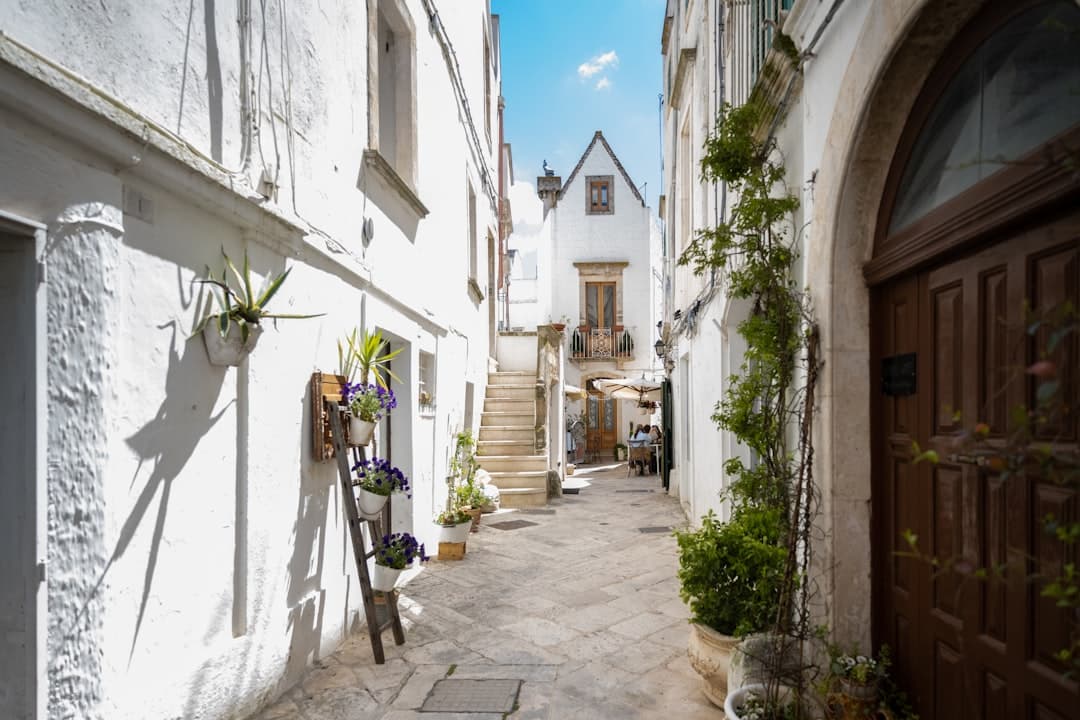
The Centro Storico is Locorotondo’s main attraction and its most important monument. It is an open historic district rather than a single paid site. Its value lies in the survival of its circular medieval street pattern, its whitewashed houses, and its atmosphere.
Expect:
- Narrow cobbled lanes.
- Limewashed facades.
- Wrought-iron balconies.
- Flower pots and cascading plants.
- Stone doorframes.
- Small shrines.
- Quiet piazzas.
- Archways and staircases.
- Houses with steep cummerse roofs.
The historic center is often described as a maze, but it is not large enough to truly get lost in. The pleasure is in looping through its lanes and reappearing unexpectedly in a square or near a church you recognize.
What to Look For
- Cummerse houses: tall, narrow buildings with steeply pitched roofs, distinct from trulli but equally characteristic of Locorotondo.
- Whitewashed lanes: especially beautiful in early morning and at blue hour.
- Flowered balconies: geraniums, bougainvillea, herbs, and small potted gardens.
- Doorway details: religious icons, votive candles, wreaths, old door knockers, stone thresholds.
- Everyday life: laundry, locals chatting, residents sweeping doorsteps, children playing.
- Small piazzas and corners: places where the town feels private and lived-in.
Practical Information
- Ticket price: Free. There is no official admission ticket to walk through the historic center.
- Opening hours: Open access at all times. The district itself has no fixed opening hours.
- Best time: Early morning for empty lanes; late afternoon and evening for atmosphere; blue hour for photography.
- How long to allow: You can see the main lanes in 1–2 hours, but the town rewards slower wandering, meals, and repeated walks.
Real-World Review Verdict
Most travelers find the historic center absolutely worth visiting. However, a minority feel underwhelmed if they expect major monuments or museums. The key is to treat Locorotondo as an atmosphere destination, not a checklist destination.
2. Walk Via Nardelli, the “Lungomare” Without a Sea
Via Nardelli is Locorotondo’s panoramic promenade along the edge of the old town. Locals and visitors sometimes call it the town’s lungomare, jokingly, because it functions like a seaside promenade even though it overlooks fields rather than water.
From here you see:
- Valle d’Itria.
- Vineyards.
- Olive groves.
- Trulli.
- Dry-stone walls.
- Scattered farms.
- The slopes descending from Locorotondo’s hilltop.
The atmosphere is expansive and contemplative. Couples lean on railings, solo travelers stand quietly, locals stroll, and photographers wait for the valley to turn gold.
Best Time to Visit
Sunset is the classic time. The light softens over the valley, white walls glow behind you, and scattered farm lights begin to appear. Blue hour is equally atmospheric, when the town becomes pearly and warm lights appear in windows and restaurants.
Practical Information
- Cost: Free.
- Opening hours: Public street/promenade, effectively open at all times.
- Warnings: Midday in summer can be hot and exposed, with limited shade in some stretches.
- Crowds: Peak summer evenings can be busy.
Real-World Review Verdict
For many travelers, the belvedere terraces are one of the most memorable elements of Locorotondo. If you love landscapes and photography, this is essential. If you are indifferent to views, it may feel like a pleasant quick stop.
3. Visit Punto Panoramico / Belvedere di Locorotondo
The Punto Panoramico Locorotondo, also called Belvedere di Locorotondo, is a public terrace and park area overlooking the Valle d’Itria. It is integrated into the Villa Comunale “Giuseppe Garibaldi”, near Piazza Dante and the outer rim of the historic center.
Mapped listings include:
- Belvedere di Locorotondo: Via Solferino, 37; rating 4.7.
- Punto Panoramico Locorotondo: rating 4.7.
- Nearby coordinates around 40.7527, 17.3280.
What You See
- A wide-angle view of the Itria Valley.
- Trulli rising from fields.
- Vineyards and olive groves.
- Terraced slopes below the town.
- The white skyline of Locorotondo behind or beside you.
- Benches, shaded paths, and park elements near Villa Garibaldi.
Atmosphere
This is where the town’s relationship with the countryside becomes obvious. Locorotondo feels less like an isolated village and more like a lookout built by generations of farmers above their land.
Sounds drift up from below: dogs, birds, distant tractors, the occasional engine, farm tools, and sometimes bells from nearby towns. The silence between these sounds is part of the experience.
Practical Information
- Ticket price: Free.
- Reservations: None.
- Opening hours: Effectively open 24/7 as a public terrace and park area. Some listings may show platform quirks, such as 12:00 AM–12:00 AM or inconsistent closure notes, but practical access is generally continuous.
- Best time: Late afternoon, sunset, and blue hour.
- Safety: Most visitors go from early morning to late evening rather than late at night.
4. Rest in Villa Comunale / Villa Garibaldi
The Villa Comunale, also referred to as Villa Garibaldi, is Locorotondo’s main public garden and one of its most important belvederes. It sits near Piazza Dante Alighieri, on the edge of the historic center, on a slope locally identified as Monte Grappa.
Some guide sources say it was built in the mid-1800s and associate it with Baron Giovanni Giacomo Borrassa, using funds donated by a local citizen. This attribution should be treated cautiously, but it reflects the broader 19th-century development of civic spaces around the old center.
What to Expect
- Shaded walking paths.
- Benches.
- Green areas and trees.
- Views toward Martina Franca and Cisternino.
- A transition between the dense old town and open countryside.
- A social space for locals: children, elderly residents, couples, and visitors.
Atmosphere
Compared with the stone lanes, the Villa Comunale feels leafy and relaxed. You may smell damp earth, leaves, pine resin, cigarette smoke, coffee, seasonal flowers, and warm stone. Sounds include birds, children, soft laughter, swings, leaves rustling, and conversations from benches.
It is a good place to pause, journal, sit after lunch, or let the town slow down around you.
Practical Information
- Ticket price: Free.
- Opening hours: Generally open access. TripAdvisor-style listings may show 24/7 hours, but this should be understood as platform labeling rather than a guaranteed official municipal timetable.
- Best time: Hot afternoons for shade; sunset and blue hour for views.
- Weekdays and weekends: Effectively accessible on both.
5. Start at Piazza Vittorio Emanuele II and Enter Through Porta Napoli
Piazza Vittorio Emanuele II is one of Locorotondo’s key civic spaces and a natural starting point for exploring the old town. It occupies the area of the former Piazza Castello, the space in front of the old castle and gate of the fortified center.
Over time, as defensive functions declined and the town expanded beyond medieval walls, this area became a more refined civic square. It was renamed for Vittorio Emanuele II, first king of unified Italy, and reshaped in the 19th century with civic buildings, smooth stone paving, and a more elegant urban design.
What to See
- Porta Napoli / Porta Vecchia, the historic gateway into the old town.
- The War Fallen Memorial in the middle of the square.
- Cafés and bars around the edges.
- The local tourist office.
- Light or cream facades, regular windows, balconies, and iron railings.
Atmosphere
This piazza is a threshold. It is more animated than the inner lanes, with espresso, pastries, aperitivo snacks, chairs scraping, cups clinking, pigeons, delivery vans, and conversation. Late afternoon and early evening are especially atmospheric.
Travelers often begin here before entering through Porta Napoli into the white lanes. It has the feeling of a theater entrance: the prettiest streets lie just beyond the archway.
Practical Information
- Ticket price: Free.
- Opening hours: Open 24 hours as a public square.
- Tourist office: Located on or near the piazza; hours vary seasonally and should be checked locally.
- Cafés and bars: Usually open from morning into evening, often later in summer.
- What might cost money: Drinks, meals, guided tours, or temporary events nearby.
6. Visit Porta Napoli
Porta Napoli, also called Porta Vecchia, is one of the main historic gateways into Locorotondo’s old town. It stands at Piazza Dante, 2, with a mapped rating of 4.5.
It marks the transition from the more open civic space outside to the tight medieval lanes inside. Remnants of ancient gates and fortifications are visible in this area, and the portal serves as one of the classic photographic entrances to the centro storico.
Practical Information
- Ticket price: Free.
- Opening hours: Always viewable as part of the public street network.
- Best experience: Enter the old town through Porta Napoli from Piazza Vittorio Emanuele II to feel the shift from 19th-century civic space into medieval Locorotondo.
7. See Palazzo Morelli
Palazzo Morelli is one of Locorotondo’s most important historic palaces and one of its most reviewed attractions. It is located at Via Morelli, 30, with a mapped rating of 4.6 from 287 reviews.
The palace is often cited as one of the most beautiful Baroque palaces in the village and lies just steps inside the historic center. While detailed visitor logistics are not always standardized, the exterior alone is worth seeking out as part of a walking route through Via Morelli and surrounding lanes.
Why It Matters
Palazzo Morelli belongs to the town’s early modern civic and aristocratic fabric. Alongside the municipal buildings and churches, it reflects the period when Locorotondo’s noble and administrative life took architectural form.
Practical Information
- Exterior: Free to view.
- Interior: Access may depend on events or private use; verify locally if you hope to enter.
- Best combined with: Via Morelli, Chiesa Madre, Piazza Vittorio Emanuele II, and the inner lanes.
Churches and Sacred Sites
Locorotondo’s churches are central to its identity. Some are major monuments; others are tiny chapels that may only be open occasionally. A key practical point: many churches in Locorotondo are places of worship, not museums. Entry is usually free, but opening hours can be irregular, tied to Mass, parish schedules, volunteer availability, local feasts, weddings, or restoration work.
Dress respectfully and avoid visiting during services unless you are prepared to behave quietly and discreetly.
Chiesa Madre di San Giorgio Martire
The Chiesa Madre di San Giorgio Martire is Locorotondo’s principal church and one of the most important religious buildings in the Valle d’Itria. It is dedicated to Saint George the Martyr, patron of the town.
History
A local cult of Saint George is documented by 1195, and the present church stands on earlier religious structures. Some sources mention an earlier reconstruction phase in 1578–1579, incorporating a medieval chapel. The current building was constructed between the late 18th and early 19th centuries, with dates given variously as:
- 1769–1821
- 1790–1825
- Completion and consecration in 1829
The overall project is attributed to the Bari architect Giuseppe Gimma, with 19th-century continuation associated with Giuseppe Campanella.
Architecture and What to See
The church is a notable local example of Neoclassical architecture, with a sober but monumental facade.
Look for:
- The tympanum showing Saint George killing the dragon.
- Statues of Saints Peter and Paul.
- The bell tower.
- Four stone statues of the Three Marys and Veronica, said to come from the dismantled Polittico della Pietà of the old mother church.
- The central dome, more than 35 meters high, once covered with colorful glazed terracotta tiles.
- A Greek-cross interior plan.
- Nave, transept arms, side chapels, raised apsed presbytery.
- The Cappellone del Santissimo Sacramento, containing 42 panels with scenes from the Old and New Testaments.
- Older 14th-century bas-reliefs incorporated into the building.
Atmosphere
Approaching through the lanes, San Giorgio appears as the town’s spiritual heart. Inside, the air is cool and slightly damp, with candle wax, incense, old wood, flowers, and stone. Bells mark the hours, and during Mass, the murmured responses of parishioners remind you that this is an active religious space.
Practical Information
- Ticket price: Free. No ordinary paid ticket is indicated for 2024/2025.
- Opening hours: Tripadvisor reports broad hours of 7:00–21:30 from Wednesday to Sunday, but regional sources do not provide a full official daily calendar. Treat online hours as indicative and subject to religious services.
- Weekdays/weekends: Access appears broad, but reliability is highest around liturgical hours and typical church opening times.
- Best advice: Step in if open during your walk; do not build your entire day around guaranteed access unless you confirm locally.
Review Verdict
Worth entering as part of a historic center walk. Not a standalone reason to visit Locorotondo if you are not interested in churches, but it is important for understanding the town.
Chiesa di Santa Maria / Madonna della Greca
The Chiesa di Santa Maria della Greca, also known as Madonna della Greca, is considered the oldest church in Locorotondo and one of its key religious monuments. It is located on Via Madonna della Greca and mapped as Chiesa Rettoria Madonna della Greca, rating 4.5 from 220 reviews.
History
The dedication to Santa Maria della Greca recalls the Greek / Byzantine rite and a Marian cult associated with refugees or communities from Greek areas. The name points to an ancient phase of Greek-rite worship in the region.
Its origins are uncertain. The first secure documentary reference dates only to 1520, but architectural and stylistic evidence suggests a much earlier foundation. Local tradition and studies indicate:
- A first building between the 7th and 8th centuries.
- Major reconstruction in the late 14th to 15th century.
- A key rebuilding around 1480–1481 by Pirro Orsini del Balzo, Prince of Taranto.
- Additional works continuing up to the 17th century.
The church was built extra moenia, outside the medieval walls, because there was little buildable space inside the compact historic core. This edge-of-town position contributes to its belvedere quality.
From the mid-16th to late 19th century, all perimeter niches contained altars, indicating intense devotional and confraternal use.
Architecture
The church combines Romanesque, Gothic, Renaissance, and local Apulian elements.
Key features:
- Basilica plan with three naves.
- Central nave divided into four bays.
- Ogival ribbed cross vaults in the central nave.
- Side aisles with ramping half-barrel vaults.
- Rare combination of Gothic ribbed vaults and Puglian barrel-vault systems.
- Simple gabled facade, Romanesque in spirit.
- A large rose window rebuilt in the 20th century by Domenico Rosato, inspired by the cathedral of Acquaviva delle Fonti.
- Renaissance lunetted portal.
- Statues of Saints Peter and Paul at the facade corners, originally from a triptych in the old mother church.
- Pillars with semi-columns and decorated capitals featuring scrolls, cornucopias, fluting, putti, sirens, and fantastic creatures.
- High altar with the Polittico della Madonna delle Rose.
- A fragment of a fresco of the Madonna and Child.
Today the interior may appear relatively bare compared with its former devotional richness, emphasizing architectural volume rather than lavish decoration.
Belvedere Santa Maria della Greca
The church stands in Largo Madonna della Greca, at the edge of the old town. The surrounding square and nearby streets function as a secondary panoramic area, with views over the Valle d’Itria, trulli, vineyards, and olive groves.
Practical Information
- Ticket price: Most likely free. No fixed entrance ticket is indicated.
- Donations: Optional.
- Guided tours/events: May involve separate fees or contributions.
- Opening hours: No precise official daily timetable is widely published. It is listed as open to the public but should be expected to follow parish patterns.
- Likely weekday pattern: Morning around 8:00/9:00–12:00, possible afternoon reopening around 16:00–19:00/19:30.
- Likely weekend pattern: Open around Mass times, usually Sunday morning and late afternoon/evening.
- Belvedere outside: Generally accessible 24/7 as public urban space.
- Contact tip: Regional tourism data gives +39 080 4311236 as a useful contact number to verify access.
Review Verdict
A worthwhile stop for history and architecture lovers. Many visitors only see it from outside because of irregular hours. If closed, it can feel like a quick photo stop; with context, it is one of Locorotondo’s most significant buildings.
Chiesa di San Rocco
The Chiesa / Santuario di San Rocco stands just outside the old town walls and is tied to one of Locorotondo’s major devotional traditions.
History
The first documented mention dates to 1568, when it was a small chapel outside the medieval walls. Its dedication to San Rocco reflects his role as protector against plague and epidemics. In southern Italy, plague-related chapels were often placed at the edge of settlements, allowing devotion while keeping potentially infected pilgrims and processions on the periphery.
Over time the chapel was enlarged and rebuilt as devotion to San Rocco strengthened, becoming a more substantial church or sanctuary.
The church is central to the annual Grande Festa di San Rocco in mid-August. The novena and feast days, especially 6–15 August, include daily evening celebrations in the church. A local news report from 2023–2024 mentioned inspections and the hope of reopening the church from 6 August, suggesting that opening may sometimes be affected by safety or restoration issues.
Architecture
San Rocco is a simple, local Apulian church rather than a grand monument.
Features include:
- Extra-mural location just outside the old urban fabric.
- Sober facade in local stone.
- Rectangular front.
- Central entrance with simple stone portal.
- Small eye or window above the door.
- Single-nave interior.
- Rectangular presbytery / choir area.
- Main altar with statue or image of San Rocco.
- Barrel-vaulted nave in white or light tones.
- Lateral altars or devotional panels.
- Classical pilaster strips and modest cornices.
- Restrained Baroque decoration.
- Peaceful, intimate sanctuary atmosphere.
Practical Information
- Ticket price: Free. No standard admission fee.
- Opening hours: Not reliably published.
- Ordinary period: Likely open around Mass times, especially early morning or late afternoon/evening; otherwise may be closed.
- During Festa di San Rocco: More reliably open. The 2025 program lists evening liturgies at 20:15 from 6–14 August and morning liturgy on 15 August.
- Important caution: Because of references to inspections/reopening, access may be event-based or limited until works are complete.
- Best strategy: Visit just before or after Mass, or during the August feast period.
Review Verdict
Historically important and emotionally meaningful locally, especially during San Rocco festivities. Architecturally modest; not essential if you only have a short visit unless you are interested in local devotion.
Chiesa di San Nicola
The Chiesa di San Nicola is a small 17th-century church in the historic center, on or near Via Dottor Oliva, not far from Chiesa Madre di San Giorgio.
History
The church was built around 1660, likely through the generosity of the Aprile family, whose role is documented by an inscription near the entrance. Archival documents attest to a church of San Nicola by 1663.
The present temple dates to the second half of the 1600s and was built intra moenia, inside the walls, on the site of earlier chapels dedicated to Saint Nicholas of Myra.
There was also, in the late Middle Ages, another church of San Nicola extra moenia, outside the walls, with an attached monastery in the area of today’s Corso XX Settembre, later demolished.
The church was enlarged between the 18th and 19th centuries. By the 1970s it had degraded so much that it was used as a store for construction tools. A major restoration in the 1980s recovered fresco fragments and plasterwork and returned it to public use.
Architecture
San Nicola is considered a piccolo gioiello artistico, a small artistic jewel.
It is especially interesting because it fuses two local architectural forms:
- The elongated urban cummersa.
- The domed, trullo-like rural form.
Features include:
- Small single-nave plan.
- Plain facade with traces of original gable and small bell gable.
- Small rose window in the tympanum.
- Local carparo stone.
- Lime-washed exterior.
- Plastered interior.
- Flooring made of local Locorotondo stone.
- Front section with barrel vault, corresponding externally to cummersa form.
- Rear section with a small dome on pendentives, evoking the trullo.
- Restored fresco fragments and original plasterwork.
- Entrance step without ramp, a barrier for visitors with disabilities.
Practical Information
- Ticket price: Most likely free. No ticketing system is mentioned.
- Guided tour cost if included: Usually charged by external guides, often roughly 10–20 euros per person for a multi-site walking tour, not for the church itself.
- Opening hours: Not continuously open. Likely limited windows, occasional liturgical use, or openings by parish/volunteers.
- Weekdays: Possibly short late-morning or late-afternoon openings, or closed.
- Weekends: More likely around devotional or Mass times, but not guaranteed.
- Best strategy: Ask at the tourist office or Chiesa Madre parish office.
Review Verdict
Not a marquee attraction, but a quiet, authentic small church that rewards curiosity. Worth entering if open; not worth reorganizing your whole day around.
Chiesa di San Francesco da Paola
The Chiesa di San Francesco da Paola and attached former convent are part of Locorotondo’s early 17th-century religious heritage and are connected to the Ordine dei Minimi, followers of Saint Francis of Paola.
History
The church and convent complex were erected in 1614. Construction was promoted by a local priest known as sacerdote Mizio and his brother-in-law Manipolo, who used their own funds to build the convent after the church.
The convent was suppressed in 1809 under Napoleonic reforms implemented by Gioacchino Murat, which dissolved many religious houses in the Kingdom of Naples. After suppression, the complex passed to the municipality and had various civil uses. The church later fell into precarious condition.
In 1815, municipal authorities financed restoration work, and the complex was later entrusted to the Padri Colasaziani to restore religious function.
The complex is recognized as a cultural heritage asset: Complesso della chiesa e del convento di San Francesco da Paola, code BABIC000004.
Architecture
The complex includes church and former convent.
Facade features:
- Two-order facade.
- Distinctive mistilinear cornice dividing lower and upper registers.
- Lower order in local tuff stone with stone plinth.
- Lesene / pilaster strips framing the main portal.
- Narrower upper frontispiece.
- Arched, inflected side elements creating a dynamic Baroque profile.
- Rectangular central window.
- Broken curvilinear tympanum.
Interior features:
- Single nave.
- Deep side chapels.
- Four finely carved stone holy-water stoups near the entrance.
- Side chapels divided by lesene with Ionic capitals.
- Main and lateral altars in the tradition of 17th–18th-century Paolotti churches.
Former convent features:
- Stone balcony with balustrade, corner pilastrini, and large mensoloni.
- Quadrangular cloister.
- Three arched bays on each side.
- Masonry pillars.
- Lunettes with frescoes showing scenes from the life of San Francesco da Paola.
- Central cistern well.
Practical Information
- Ticket price: Likely free for individual church entry.
- Events/guided visits: May involve optional contributions or separate fees.
- Opening hours: No reliable centralized timetable. Likely church-style hours, roughly mornings and late afternoons, but not guaranteed.
- Possible weekday pattern: 08:00–12:00 and 16:30–19:30.
- Possible weekend pattern: 08:00–12:30 and 16:30–20:00.
- Cloister access: May be restricted; ask locally.
Visit Advice
If you specifically want to see the cloister frescoes, do not assume open access. Ask at the tourist office or parish before planning your day around it.
Chiesa della Madonna del Carmine
The Chiesa della Madonna del Carmine is a small devotional church in Locorotondo’s pinewood area, at the foot of Monte Carmelo.
History
It is documented at least from 1686. During the Second World War, it was deconsecrated and used as a military hospital, then reconsecrated for worship after the war.
Its significance is local and religious, tied to Marian devotion and to popular prayer traditions on the edge of the town.
Architecture
Features include:
- Small size.
- Single nave.
- Arches dividing the interior.
- Wooden truss roof.
- Facade preceded by a double-ramp staircase.
- Horizontal crowning.
- Single-arched bell gable.
- Entrance portal.
- Octagonal window aligned above the portal.
- Marble plaque outside with a 1931 poem by Gavino Leo dedicated to the church.
Practical Information
- Ticket price: No ticket indicated; likely free when open.
- Opening hours: No official hours available.
- Best expectation: Access depends on Masses, celebrations, or local availability.
- Advice: Verify with the municipality, parish, or tourist office before making a dedicated visit.
Chiesetta / Cappella dello Spirito Santo
The Chiesetta dello Spirito Santo or Cappella dello Spirito Santo is a small 17th-century chapel on Corso XX Settembre 39.
History
It was built in 1683 on the initiative of the local archpriest don Giuseppe Antonio Nardelli, who wanted a place of worship dedicated to the Holy Spirit.
It is considered one of the older sacred buildings in Locorotondo and underwent conservative restoration in the early 2000s, stabilizing the structure and restoring its exterior.
Architecture
Features include:
- Small chapel directly on Corso XX Settembre.
- Simple rectangular facade.
- Light plastered exterior.
- Central doorway framed in stone.
- Small oculus or window above the portal.
- Small bell gable.
- Threshold almost flush with the sidewalk.
- Very small single-space interior.
- Simple altar.
- Ancient painting or fresco representing the Holy Spirit / Holy Trinity.
- Whitewashed walls and modest stucco frames.
Practical Information
- Ticket price: Free when open.
- Opening hours: No fixed timetable. Often closed, opened for specific liturgical moments, local feasts, or by volunteers/priests.
- Exterior: Viewable at any time from Corso XX Settembre.
- Interior access: Occasional.
- Advice: Ask at the tourist office or Chiesa Madre parish office.
Chiesa di Sant’Anna di Renna
The Chiesa di Sant’Anna, also called Sant’Anna di Renna, is a rural church outside Locorotondo on the road toward Martina Franca.
History
According to local tradition, the Renna family built the church at their own expense in the 17th century. The name “di Renna” comes from the family associated with the site.
The area was previously known as “pietre rotonde”, recalling the terrain and the presence of trulli and dry-stone walls.
The church is dedicated to Sant’Anna, mother of the Virgin Mary, a saint especially important in rural devotion because of associations with motherhood, family, and protection of crops.
It is sometimes highlighted during cultural events such as the Festival dei Sensi, which presents it as an 18th-century rural sacred building connected to the agricultural landscape.
Architecture
Features include:
- Rural location along the Locorotondo–Martina Franca road.
- Load-bearing local stone masonry.
- Simple single-room plan.
- Likely rectangular nave with small presbytery.
- Sober facade.
- Rectangular portal.
- Central window above portal.
- Horizontal or slightly tympanum-like crowning.
- Setting among dry-stone walls, fields, vineyards, olive groves, and trulli.
- Simple interior with main altar dedicated to Sant’Anna.
- Possible devotional images, flowers, ex-votos, especially around 26 July, the feast of Sant’Anna.
Practical Information
- Ticket price: Free when open.
- Events/guided visits: May involve event fees, often roughly 5–15 euros for an overall guided visit or cultural program, not specifically for church entry.
- Opening hours: Generally not regular.
- Weekdays: Usually closed outside functions.
- Saturday/Sunday: Possible opening for Mass or occasional celebrations, especially in summer or near 26 July.
- Advice: Contact the tourist office, main parish, or check Festival dei Sensi programming.
Civic Architecture and Cultural Sites
Palazzo Comunale and Torre Civica
The Palazzo Comunale of Locorotondo, together with the Civic Tower, is an 18th-century civic complex in the historic center. It once housed the municipal hall and the Università, the southern Italian term for the community governing body.
Today it houses:
- Civic Library.
- Archaeological Documentation Center.
- Historical Archive.
Significance
The palazzo represents the town’s transition from fortified medieval village to organized early modern town. It is one of Locorotondo’s civic symbols and preserves local memory through books, documents, and archaeological material.
Architecture
Features include:
- White stone facade.
- Imposing but sober civic volume.
- Baroque-style arched windows.
- Symmetrical composition.
- Adjacent Civic Tower, a vertical symbol of communal authority.
- Spacious interior rooms adapted for cultural use.
Practical Information
- Exterior: Free and viewable as part of the old town.
- Interior: Likely free during public opening hours for library/archives; may require registration.
- Temporary exhibitions/events: Possible fees, perhaps around 3–8 euros depending on event.
- Opening hours: No reliable general visitor timetable.
- Likely weekday pattern: 09:00–13:00 and possibly 15:30/16:00–19:00.
- Saturday: Often morning only in small-town civic institutions.
- Sunday/public holidays: Commonly closed except special events.
- Civic Tower: Regular access not reliably listed; may be tied to guided tours or special cultural initiatives.
If you need archive access or specific research time, contact the Comune or library/archivio in advance.
Wine, Food, and Local Experiences
Locorotondo DOC and the Wine Culture
Locorotondo is an agricultural town with viticulture at the heart of its modern identity. The surrounding countryside produces white wines associated with the Locorotondo DOC, especially from grape varieties such as:
- Bianco d’Alessano
- Verdeca
Other regional tastings may include:
- Primitivo
- Uva di Troia
- Maresco
- Verdeca
- Bianco d’Alessano
Travelers consistently describe local white wines as fresh, crisp, summery, and excellent with Puglian food. House wines in town restaurants are often good value.
Wine Experiences
Wine experiences around Locorotondo may include:
- Local enoteca tastings.
- Vineyard dinners.
- Walks through vineyards.
- Food and wine pairings.
- Visits to cantine.
- Cooking classes with wine.
Practical Warnings
- Rural wineries can be hard to reach without a car.
- Taxis may be limited.
- Public transport is not convenient for many countryside experiences.
- High-season tastings may be fully booked.
- Some organized experiences can feel short for the price if you expected in-depth winemaking instruction.
Best Budget Alternative
If a full vineyard tasting is too expensive or logistically difficult, order local wine by the carafe in town. This is often the simplest and most authentic way to taste the region.
Wine Bars and Enotecas
Travelers frequently mention wine-focused places such as:
- Pavì Wine Restaurant
- La Bottega de I Pastini
These represent Locorotondo’s intimate wine-bar culture: small terraces, local bottles, knowledgeable staff, food pairings, and conversations about soil, family vineyards, and harvest traditions.
Atmosphere
Expect:
- Cold mineral white wine.
- Olive oil on bruschetta.
- Grilled vegetables.
- Charcuterie.
- Rosemary, thyme, and valley breezes.
- Glasses clinking.
- Low conversation.
- Soft music such as jazz, bossa nova, or Italian pop.
For couples, these places can feel romantic; for solo travelers, they can be warmly social without being overwhelming.
Osterie and Trattorie
Locorotondo’s evening dining scene is one of the main reasons to stay overnight or spend a long evening here.
Expect menus centered around:
- Orecchiette.
- Cime di rapa.
- Burrata.
- Local vegetables.
- Grilled meats.
- Bombette pugliesi, stuffed pork rolls typical of the Valle d’Itria.
- Focaccia.
- Taralli.
- Olive oil.
- Local white wine.
- Some seafood, though Locorotondo is inland and seafood may be less central than on the coast.
Atmosphere
In the evening, small tables spill into lanes and piazzas. Food smells replace the neutral scent of stone: grilled meat, tomatoes, garlic, fried antipasti, warm bread, and wine. Servers call orders, pans clatter, conversations rise and fall, and the white walls glow under warm lamps.
Practical Warnings
- In high season, reserve restaurants in the historic center.
- Restaurants may be fully booked, especially in summer evenings.
- Some central restaurants are slightly tourist-focused.
- Service can be brisk at peak times.
- Vegetarians and vegans may find fewer options due to the meat/cheese focus, though vegetables are important in Puglian cooking.
- Standard Italian coperto cover charges may apply; this is normal, not a scam.
Review Verdict
The food scene is generally considered good value and one of Locorotondo’s highlights. The setting enhances the meal.
Local Bars and Cafés
Outside the most picturesque lanes, local bars on the town’s edges offer a more everyday Locorotondo experience.
Expect:
- Espresso.
- Cornetti with jam.
- Cappuccino in the morning.
- Fresh orange juice.
- Panini.
- Beer or amaro later in the day.
- Workers grabbing quick coffees.
- Older men discussing football or politics.
- Teenagers meeting in the afternoon.
- TV sports commentary.
- Cups clacking and baristas calling orders.
Standing at the bar for a quick coffee is one of the easiest ways to blend into local routine.
Artisan and Local-Product Shops
Small shops in the centro storico sell:
- Olive oil.
- Wine.
- Ceramics.
- Local delicacies.
- Giftable food products.
- Crafts.
Pros
- Convenient for gifts.
- Often beautifully presented.
- Shopkeepers may offer tastings and explanations.
- Good if you want small bottles or pretty packaging.
Cons
- Prices may be higher than supermarkets or rural cooperatives.
- Some shops are clearly aimed at tourists.
- Serious food and wine enthusiasts may prefer buying directly from producers.
No widespread counterfeit or scam pattern is reported; the issue is mainly convenience versus price.
Cantina Museo Albea near Locorotondo
Although located in Alberobello, not Locorotondo, Cantina Museo Albea is close to the Locorotondo DOC area and is one of the most comprehensive nearby wine-history stops.
Location
- Address: Via Due Macelli 8, Alberobello, Province of Bari.
- Close to Locorotondo by car or organized tour.
History
The winery was founded in 1905, making it one of the oldest in the Alberobello / Itria Valley area. It was built entirely in local stone, including vats carved into rock.
It owns around 52 hectares of vineyards and produces about 20,000 cases of wine annually, with about 30% sold directly to visitors.
The winery emphasizes eco-sustainable viticulture and local heritage through its “Albea Land” project.
Architecture and Museum
Features include:
- Stone construction.
- Star-vaulted ceilings.
- Ancient cisterns.
- Rock-carved vats.
- Modern stainless steel tanks.
- Barrel storage.
- Bottling line.
- Warehouse and offices.
- Upper-floor wine museum.
- Ancient agricultural tools.
- Presses.
- Old bottles.
- Historic photographs.
- Historical labels.
- Exhibits tracing winemaking from traditional methods to modern technology.
Tastings
Wines may include:
- Primitivo.
- Uva di Troia.
- Maresco.
- Verdeca.
- Bianco d’Alessano.
Practical Information
- Tour/tasting price: Approximately €25–€50 per person, depending on package.
- Lower range: cellar and museum tour with standard tasting.
- Upper range: premium wines, food pairings, private or small-group experiences.
- Capacity: Around 40 people.
- Opening hours: Vary by season and booking schedule.
- Weekdays: Often morning/afternoon set slots.
- Saturday: Commonly open, high demand.
- Sunday/public holidays: May be limited or by advance booking.
- Reservation: Strongly recommended.
Cooking Classes and Food/Wine Pairings
Cooking classes around Locorotondo often take place in countryside masserie, local homes, or food-focused venues.
Typical experiences include:
- Making orecchiette.
- Preparing local vegetables.
- Learning traditional recipes.
- Eating the prepared meal.
- Wine tasting or pairing.
Pros
- Hands-on cultural experience.
- Warm hosts.
- Strong connection to local food traditions.
- Often a highlight for food-focused travelers.
Cons
- Relatively expensive compared with eating out.
- Rural locations may be hard to reach without a car.
- English may be limited in some classes.
- Group size and depth of instruction vary.
Verdict
Strongly recommended for culinary travelers, less essential for very short stays or tight budgets.
Countryside, Trulli, and Outdoor Experiences
The Trulli-Dotted Countryside
The countryside around Locorotondo is one of the town’s greatest attractions. Even though the historic center has relatively few trulli, the surrounding landscape is filled with them.
Expect:
- Red Puglian soil.
- White trulli.
- Vineyards.
- Olive groves.
- Dry-stone walls.
- Wild herbs.
- Farm lanes.
- Small chapels and roadside shrines.
- Scattered masserie.
- Distant views back to the white town.
Atmosphere
The smell is earthy and vivid: crushed grass, thyme, oregano, fennel, red soil, grapevines, olive leaves, hay, animals, and sometimes wood-fired ovens.
Sounds include cicadas, bees, roosters, tractors, three-wheeled Ape vehicles, gravel footsteps, and wind moving through vines.
Best Ways to Experience It
- Drive slowly on rural roads.
- Rent a bike or e-bike.
- Take a guided cycling tour.
- Walk mapped routes if you are comfortable with narrow roads.
- Book a vineyard experience.
- Stay in a trullo or countryside B&B.
The Trulli Belt Between Locorotondo and Alberobello
The road and countryside between Locorotondo and Alberobello contain one of the densest trulli landscapes in the area.
Some trulli are restored as holiday homes; others are still used for storage or agricultural purposes. At golden hour, the landscape can feel almost unreal: conical roofs, painted symbols, red soil, stone walls, vines, and low evening light.
Practical Tip
If you are driving between Locorotondo and Alberobello, allow extra time to stop safely for photos. Do not block narrow country roads or private entrances.
Cycling and E-Bike Tours
Cycling and e-bike tours are popular ways to connect Locorotondo with Alberobello, Martina Franca, and surrounding countryside.
Pros
- Scenic vineyards and trulli.
- E-bikes help with hills.
- Guides provide context on agriculture, architecture, and history.
- Good for active travelers.
Cons
- Some packaged tours are expensive for their duration.
- Midday summer heat can be uncomfortable.
- Road traffic can feel intimidating on certain stretches.
- Some tours marketed as multi-town experiences may spend limited time in each place.
Verdict
Highly recommended if you enjoy active travel. Budget travelers can rent bikes and use mapped routes, but should be comfortable navigating rural roads.
Trulli Olistici
Trulli Olistici appears in mapped listings with a rating of 5.0 from 19 reviews, located at SP 216 Neglia, 14, coordinates approximately 40.7737163, 17.3676053.
While not one of the core historic monuments, its inclusion among mapped attractions suggests a countryside or holistic/wellness experience connected to trulli architecture outside the town center. If you are interested in wellness, rural stays, or trulli-based experiences, check current offerings directly before going.
Festivals and Seasonal Atmosphere
Festa di San Rocco
The Festa di San Rocco in August is one of Locorotondo’s major religious and cultural events. The town transforms with lights, processions, music, crowds, food stalls, and fireworks.
What to Expect
- Luminaria light installations.
- Religious processions with the statue of San Rocco.
- Marching bands.
- Evening services at Chiesa di San Rocco.
- Crowds of locals, visitors, and returning families.
- Fried sweets.
- Roasted nuts.
- Grilled meat.
- Candy.
- Incense and candles.
- Fireworks echoing across stone walls and the valley.
Atmosphere
Everyday Locorotondo is quiet and reflective; festival Locorotondo is collective, extroverted, joyful, and spiritually intense. Experiencing both gives a much fuller understanding of the town.
Practical Warnings
- Restaurants fill quickly.
- Parking becomes difficult.
- Prices at some stalls may be event-inflated.
- The town is less peaceful during the festival.
- If you want quiet, avoid major festival dates.
- If you want local culture, this is one of the best times to be there.
Locus Festival
The Locus Festival is a music and arts event associated with Locorotondo and praised for its vibrant atmosphere and integration with town spaces.
Practical Notes
- Expect more visitors and livelier evenings.
- Accommodation and restaurant availability may tighten.
- Music festival tickets are priced like typical European events: not cheap, but not unusually expensive.
- Check dates and venues well in advance.
Christmas Lights
At Christmas, Locorotondo becomes especially atmospheric, with decorations and lights in the historic center. The white lanes, already cinematic, take on a festive glow.
Best For
- Photography.
- Evening walks.
- Families.
- Travelers who enjoy small-town holiday atmosphere.
Warnings
- Weekends and special dates can be crowded.
- Parking may be more difficult.
Festival dei Sensi
The Festival dei Sensi sometimes highlights rural sites such as Sant’Anna di Renna, connecting visitors with countryside architecture, sensory experiences, and local heritage.
If your visit coincides with the festival, check the program for special openings of rural churches, guided visits, or cultural events that are otherwise unavailable.
Best Times of Day in Locorotondo
Early Morning
Early morning is one of the best times to experience the town if you are staying overnight.
Expect:
- Empty lanes.
- Soft slanting light.
- Coffee brewing.
- Bread and cornetti.
- Damp stone warming.
- Residents sweeping doorsteps.
- Delivery vans.
- Birds.
- A feeling that the town briefly belongs to you.
This is ideal for photography, reflection, and quiet wandering.
Midday
Midday can be beautiful but challenging in summer.
Expect:
- Strong white light.
- Heat reflecting off stone.
- Shutters half closed.
- Quiet lanes.
- Aromas of tomato sauce, garlic, and lunch.
- Some sites closed.
- Fewer people in the streets.
If you visit only at hot peak midday, Locorotondo may feel sleepy or less atmospheric. This is one reason some rushed day-trippers leave underwhelmed.
Late Afternoon and Sunset
This is the classic time for Locorotondo.
Do:
- Walk Via Nardelli.
- Visit the belvedere.
- Sit in Villa Comunale.
- Have aperitivo.
- Photograph the valley.
- Reserve dinner.
The town becomes warmer, more social, and more luminous.
Blue Hour and Night
After sunset, Locorotondo becomes romantic and reflective. White walls glow softly, restaurant tables fill, church bells feel more resonant, and valley lights flicker below.
This is one of the best times for:
- Couples.
- Solo reflection.
- Wine bars.
- Slow dinners.
- Night photography.
- A final walk before bed.
Hidden Corners and Lesser-Known Experiences
Everyday Lanes Around Via Morelli
The most famous sights are important, but Locorotondo’s real magic often lies in ordinary side streets.
Look for:
- White walls and green shutters.
- Bougainvillea and geraniums.
- Potted basil, rosemary, mint, and sage.
- Laundry drying overhead.
- Radios playing old Italian songs.
- Neighbors leaning across balconies.
- Cats, scooters, brooms, doorways, and shadow patterns.
The emotional appeal is intimacy: you feel like a temporary guest in a lived-in neighborhood, not a tourist walking through a stage set.
Quiet Courtyards and Dead-End Alleys
Small courtyards and overlooked corners are often where travelers feel Locorotondo’s quieter magic most strongly.
These spaces may smell of jasmine, laundry soap, herbs, dust, or damp stone. You may hear a TV behind a window, a plate being set down, or a dog barking two streets away.
Be respectful. If a space feels private, do not intrude or photograph residents closely without permission.
Rooftop Terraces and B&B Views
Some boutique accommodations and rentals, including places mentioned by travelers such as Da Concavo e Convesso, offer rooftop terraces with views over town and valley.
These private terraces can create some of the most memorable Locorotondo moments:
- Morning coffee.
- Fresh pastry.
- Swallows circling at eye level.
- Evening wine.
- Church bells.
- Candlelight.
- Valley mist at dawn.
- Scattered lights at night.
If you have already booked accommodation with a terrace, plan to actually use it. Do not over-schedule every evening.
Suggested Walking Route: 60–90 Minutes
If you want a practical route through the essentials:
-
Start at Piazza Vittorio Emanuele II.
- Notice the civic square, cafés, and War Fallen Memorial.
- Stop at the tourist office if open.
-
Enter through Porta Napoli.
- Feel the transition into the old town.
-
Wander the inner lanes toward Via Morelli.
- Look for flowered balconies, cumerse roofs, and small shrines.
-
Stop at Palazzo Morelli.
- Admire the exterior and surrounding streets.
-
Continue toward Chiesa Madre di San Giorgio.
- Enter if open.
-
Loop toward Chiesa di San Nicola.
- Enter if open; otherwise appreciate the modest exterior.
-
Walk toward Chiesa Madonna della Greca.
- Visit the church if open; enjoy the surrounding belvedere area.
-
Head to Via Nardelli / Punto Panoramico.
- Save this for late afternoon if possible.
-
Rest in Villa Comunale / Villa Garibaldi.
- Sit on a bench and look over the valley.
-
Return for aperitivo or dinner.
Practical Tips and Warnings
Tickets and Costs
Most core attractions in Locorotondo are free:
- Centro Storico: free.
- Piazza Vittorio Emanuele II: free.
- Porta Napoli: free.
- Belvedere / Punto Panoramico: free.
- Via Nardelli: free.
- Villa Comunale: free.
- Chiesa Madre: free.
- Madonna della Greca: likely free.
- San Rocco: free.
- San Nicola: likely free.
- Small chapels: generally free when open.
- Palazzo exteriors: free.
Costs arise from:
- Guided walking tours.
- E-bike/cycling tours.
- Cooking classes.
- Wine tastings.
- Vineyard dinners.
- Special exhibitions.
- Festival tickets.
- Food and drink.
- Parking.
Opening Hours: What to Expect
The historic center and public viewpoints are generally accessible at all times.
Churches and small chapels are the tricky part. Many do not operate as museums and may be closed outside Mass or volunteer openings.
Best times to try churches:
- Morning: roughly 8:00/9:00–12:00.
- Late afternoon: roughly 16:00–19:30/20:00.
- Around Mass times.
- Sundays and feast days.
- During local festivals.
Worst time:
- Early afternoon, especially 12:00–16:00.
- Random midday visits to small chapels.
- Winter off-season without checking.
Always verify locally if a specific interior matters to you.
Parking
Parking around the old town can be busy and confusing, especially:
- Summer evenings.
- Festivals.
- Locus Festival dates.
- Christmas lights.
- Sunday lunch or dinner times.
- Peak August.
It is still often easier than in larger towns, but do not assume you can arrive at prime dinner time and park immediately beside the historic center.
Crowds
Locorotondo is quieter than Alberobello, but not undiscovered.
Expect crowds:
- Summer evenings.
- Sunset at the belvedere.
- Main restaurant lanes.
- Festival periods.
- Christmas weekends.
For quiet:
- Stay overnight.
- Walk early morning.
- Visit side streets.
- Explore outside peak dinner hours.
- Use the town as a base rather than a quick stop.
Heat
Summer midday can be hot, bright, and reflective. White stone and pale paving intensify glare.
Tips:
- Walk early or late.
- Use Villa Comunale for shade.
- Bring water.
- Wear sunglasses and a hat.
- Avoid cycling at midday in high summer.
- Do churches and interiors during hotter hours if open.
Safety
Locorotondo is generally considered very safe, with low levels of street crime.
Normal precautions:
- Watch valuables in crowds and festivals.
- Do not leave belongings visible in cars.
- Be careful on narrow rural roads.
- Use common sense at night, especially in quiet areas.
- Be mindful of uneven stone paving and steps.
There is no strong pattern of pickpocketing, harassment, or scams specific to Locorotondo.
Tourist Traps and Overpricing
Locorotondo has fewer aggressive tourist-trap behaviors than many famous towns. No systemic scam patterns are reported.
Possible mild issues:
- Slightly higher prices at cafés with prime views.
- Tourist-oriented restaurants in the most central lanes.
- Gift shops charging more than supermarkets or rural producers.
- Packaged tours that feel expensive for duration or depth.
- Event-time price increases.
- Wine/cooking experiences not matching expectations if you wanted technical detail.
How to avoid disappointment:
- Check menus before sitting.
- Reserve restaurants.
- Ask what a tour includes and how long it lasts.
- Compare wine tasting packages.
- Buy serious food/wine products from producers if price matters.
- Treat view premiums as normal if you choose the terrace.
Accessibility
The historic center has narrow lanes, stone paving, steps, and occasional slopes. Some areas are easier than others, but full accessibility can be limited.
Specific note:
- Chiesa di San Nicola has an entrance step without a ramp, explicitly noted as a barrier.
The belvedere promenade and Piazza Vittorio Emanuele II are more manageable, but cobbles and uneven surfaces remain common.
Public Transport and Getting Around
Locorotondo is a good base if you have a car. Without a car, it can still be enjoyable, but exploring the wider Itria Valley becomes more complicated.
Challenges:
- Public transport between small towns can be infrequent or slow.
- Rural wineries and cooking classes may be hard to reach.
- Taxis can be limited.
- Cycling routes may involve roads without perfect pedestrian/cycling infrastructure.
If you do not have a car:
- Consider guided tours for Alberobello, Martina Franca, or vineyards.
- Stay centrally.
- Plan transport times carefully.
- Avoid booking rural experiences without confirmed transfers.
Nearby and Regional Context
Locorotondo works beautifully as a base for:
- Alberobello, famous for trulli.
- Martina Franca, known for Baroque architecture.
- Cisternino, another atmospheric white town.
- Ostuni, the larger “White City.”
- Itria Valley countryside.
- Wineries and masserie.
- Cycling routes.
- Cooking classes.
- Coastal excursions, if you have a car.
Many travelers prefer Locorotondo to Alberobello as a base because it feels less commercialized and calmer in the evening.
Who Will Love Locorotondo Most?
Locorotondo is excellent for:
- Slow travelers.
- Couples.
- Photographers.
- Food and wine lovers.
- Architecture enthusiasts.
- Travelers who enjoy wandering without a rigid checklist.
- People looking for a calm base in the Itria Valley.
- Visitors who appreciate local festivals and religious traditions.
- Anyone seeking restorative travel.
It may disappoint:
- Travelers who want major museums.
- People who need nightlife.
- Visitors expecting a full day of structured attractions.
- Those rushing through at hot midday.
- Travelers without a car who want to cover many towns quickly.
- Anyone who dislikes “just walking around.”
Final Thoughts
Locorotondo does not shout for attention. It does not compete with Italy’s great art cities, nor does it try to. Its power lies in proportion, quietness, care, and continuity.
Its history is not one of emperors and battles, but of people settling inland for safety, cultivating land, building churches, passing through feudal systems, planting vineyards, shaping stone houses, and preserving a circular town whose form still gives it its name.
Your best memories may not come from a single monument. They may come from a morning lane before anyone else is awake, a glass of white wine at sunset, the smell of garlic drifting from a window, bells over white roofs, a sudden view of trulli in the valley, or the feeling of sitting in Villa Comunale as the town quietly continues around you.
Locorotondo is best experienced slowly. Walk, pause, look, eat, drink, listen, and return to the same streets at different hours. That is when the “round place” begins to feel less like a stop on an itinerary and more like a small, luminous world of its own.