Matera Travel Guide for Travelers Who Have Already Booked: The Complete Pre-Trip Companion
Matera is not a city you simply “visit.” It is a city you descend into, climb through, listen to, and slowly learn to read in layers of stone. If you have already booked your trip, you are about to travel to one of the most extraordinary urban landscapes in Europe: a place of cave dwellings, ravines, rock churches, underground cisterns, frescoed crypts, panoramic terraces, restored noble palaces, artisan museums, and streets that feel carved more than constructed.
This guide is designed for travelers who are leaving for Matera in the coming weeks or months. It is not a quick inspiration piece. It is a practical, detailed, on-the-ground guide that combines attractions, history, atmosphere, reviews, warnings, and real traveler insights so you arrive prepared.
Matera is famous above all for the Sassi di Matera, the two ancient rock-cut districts known as Sasso Caveoso and Sasso Barisano, along with the Civita, the ridge between them. Together they form one of the oldest continuously inhabited urban settlements in the world. The city has been occupied since the Paleolithic, developed through Neolithic villages, Greek and Roman phases, Byzantine monastic life, medieval and early modern rule, extreme poverty in the 19th and 20th centuries, forced evacuation in the 1950s, abandonment, rediscovery, UNESCO recognition in 1993, and finally cultural rebirth as European Capital of Culture in 2019.
Matera’s atmosphere is defined by stone, silence, shadow, poverty memory, sacred space, and lived-in antiquity. It can feel ancient, cinematic, biblical, haunting, intimate, and astonishingly beautiful. At the same time, it is a real city with cafés, tour groups, restaurants, museums, modern hotels, ticket offices, souvenir shops, and all the practical frictions that come with a major cultural destination: stairs, crowds, fragmented ticketing, seasonal opening hours, and expensive restaurants in prime-view locations.
Use this guide to plan your days, choose which paid sites matter most to you, understand what you are seeing, and avoid the common frustrations travelers report.
Essential Orientation: Understanding Matera Before You Arrive
Matera sits in the region of Basilicata in southern Italy, above the dramatic Gravina di Matera ravine. The old city is not flat. It is a cascade of stone districts, caves, stairways, terraces, alleys, churches, and underground spaces carved into soft limestone/calcarenite rock often referred to as tufa-like stone.
The historic core is usually understood through several key areas:
-
Sasso Caveoso
The more ancient-feeling cave district, known for rock churches, dramatic ravine views, cave-house museums, San Pietro Caveoso, Santa Maria de Idris, and the edge district of Rione Casalnuovo. -
Sasso Barisano
The more commercially restored and developed Sassi district, with restaurants, boutique hotels, cave houses, museums, artisan spaces, and access toward Piazza Vittorio Veneto. -
Civita
The ridge between Sasso Caveoso and Sasso Barisano. This is where you find major landmarks such as the Matera Cathedral and Casa Noha. -
Il Piano / Upper Town
The more modern plateau above the Sassi, including Piazza Vittorio Veneto, Via Ridola, Piazza Pascoli, and many shops, cafés, museums, and access points into the old city. -
Murgia Materana / Murgia Timone
The plateau across the ravine, inside the regional park. This is where you get the famous frontal panorama of Matera from Belvedere di Murgia Timone.
Matera rewards walking, wandering, and looking back. You will constantly move between enclosure and release: narrow alleys opening suddenly onto ravine views; dark cave interiors giving way to sunlit terraces; lively squares leading into silent stone passages.
Quick Reality Check: What Travelers Love and What Can Frustrate Them
What travelers usually love
Travelers consistently praise Matera for:
- Its otherworldly cave cityscape
- Spectacular views, especially at sunrise, sunset, and night
- The emotional depth of its history
- The uniqueness of the Sassi
- Atmospheric cave houses and rock churches
- Underground cisterns and hypogea
- Rustic Basilicata cuisine
- The chance to wander without a fixed plan
- The view from Murgia Timone across the ravine
- The powerful transformation story from “Italy’s shame” to UNESCO city
Many visitors describe Matera as one of the most memorable places in Italy.
What travelers often dislike or underestimate
Common complaints include:
- Lots of stairs and uneven stone surfaces
- Physically demanding walking
- Slippery stone steps when wet
- Heat and lack of shade in summer
- Crowds at peak times, especially weekends, holidays, summer, sunset, and key viewpoints
- Many separate paid micro-attractions
- Fragmented tickets for cave houses, churches, museums, and underground sites
- Touristy restaurants in the most central areas
- Expensive drinks at panoramic bars
- Occasional aggressive tour selling near main squares
- Confusing parking and ZTL restrictions for drivers
- Limited direct transport connections compared with larger Italian destinations
- Some sites having seasonal or inconsistent opening hours
The honest verdict
Matera is not a tourist trap as a whole. It is widely considered absolutely worth visiting. The “trap” feeling comes mainly from:
- Paying repeatedly for small sites
- Booking low-value tours
- Eating at restaurants that rely on view rather than quality
- Expecting large museums or grand interiors when many sites are compact
- Arriving unprepared for walking conditions
With realistic expectations, Matera is extraordinary.
The Story of Matera: From Prehistoric Caves to UNESCO Revival
One of the Oldest Continuously Inhabited Urban Settlements in the World
Matera is often described as one of the oldest continuously inhabited towns in Europe, and in some accounts among the oldest continuously inhabited urban settlements in the world. Human presence in the area dates back to the Paleolithic, when natural caves along the Gravina di Matera ravine provided shelter.
UNESCO recognizes that the first inhabited zone dates from the Paleolithic and that the later settlement layers illustrate major stages of human history. Over thousands of years, people adapted the caves, carved new spaces into the soft rock, built above-ground structures, created cisterns, chapels, stables, workshops, homes, and churches, and formed the landscape now known as the Sassi.
Neolithic Matera
During the Neolithic, settlement became more organized. Archaeological work around Matera has revealed Neolithic villages with:
- Hut structures
- Storage pits
- Defensive ditches
- Walls
- Settlement evidence from around the end of the 7th millennium BC
People gradually shifted from using only natural caves to carving new cave chambers, creating the distant origins of Matera’s cave urbanism.
The nearby Murgia Timone plateau preserves evidence of Neolithic presence from around 5000–4000 BC, including a trincerated village. The broader Murgia Materana area contains prehistoric villages, tombs, caves, ravines, and rocky ridges across an 8,000-hectare karst landscape.
Greek and Roman Matera
The ancient urban nucleus of Matera was built on an entrenched prehistoric village and is likely influenced by Greek settlement patterns and the broader world of Magna Graecia, the Greek colonies of southern Italy. Material from the Greek period has been identified in the area.
Roman evidence is comparatively scarce. Matera lay inland, away from the major coastal trade centers, and probably remained a smaller agricultural and pastoral settlement under Roman administration.
Early Medieval and Byzantine Matera
Matera’s recognizable urban form began to develop in the early Middle Ages, around the 8th century. The Civita became the fortified ridge or acropolis-like area, while below it the two Sassi districts grew along the slopes.
Byzantine influence was crucial. Southern Italy was contested among Byzantines, Lombards, and other powers. Matera’s famous rupestrian churches—rock-cut churches and chapels—reflect the presence of Byzantine-style religious traditions, Greek-rite monastic communities, and later Latin Christian communities.
Many rock churches were created between the 8th and 14th centuries, especially by Basilian and Benedictine monks. They were carved into caves and decorated with frescoes in Byzantine, Lombard, and local styles.
Lombards, Arabs, Swabians, Angevins, Aragonese, and Bourbons
Matera passed through many hands over the centuries:
- Romans
- Lombards
- Arab-influenced periods of regional instability
- Byzantine Greeks
- Swabians / Hohenstaufen rulers
- Angevins
- Aragonese
- Bourbons
Under the Swabians, especially in the era of Frederick II, southern Italy saw military and administrative reorganization. Under the Angevins, Aragonese, and Bourbons, Matera continued as a provincial town tied to agriculture, pastoralism, and local landholding elites.
During these centuries, the Sassi functioned as a complex urban organism. Cave spaces were used as:
- Homes
- Workshops
- Cellars
- Olive presses
- Granaries
- Cheese storage rooms
- Mills
- Water cisterns
- Tanneries
- Stables
The built portions often served as family living areas, while underground or rock-cut spaces supported work, storage, animals, and water management.
19th-Century Decline
In the 19th century, Matera’s economy declined. Population growth among poorer rural classes created a severe housing shortage. Spaces that had previously been used for storage, stables, or productive work were converted into cheap improvised housing.
Families lived in caves, often sharing space with animals such as mules and chickens. Sanitation, ventilation, and water access were poor.
After Italian unification in the 1860s, Matera became part of the new Italian state but remained emblematic of the Southern Question: the economic and social disparity between northern Italy and the Mezzogiorno.
“Italy’s Shame” and the Evacuation of the Sassi
By the early and mid-20th century, living conditions in the Sassi had deteriorated severely. Overcrowded cave homes lacked adequate sanitation, water supply, ventilation, and health infrastructure. Disease and infant mortality were major problems.
In 1945, the writer and painter Carlo Levi published Christ Stopped at Eboli, based on his political exile in Basilicata under Fascism. Although only part of the book concerned Matera, his depiction of the cave dwellings and poverty of the Sassi shocked the Italian public.
Matera came to be called “la vergogna d’Italia” — “Italy’s shame.”
In 1952, the Italian government passed a special law to address the crisis. Residents were forcibly relocated into newly built modern quarters on the plateau above the old city. By the late 1950s, roughly 16,000 inhabitants had been moved out of the Sassi.
The evacuation improved public health but emptied the ancient districts of much of their community life. The Sassi became largely abandoned and derelict for decades.
Rediscovery, Restoration, and UNESCO
From the 1980s, scholars, architects, activists, and local figures began to argue that the Sassi were not merely slums but a unique, historic, ecological, and architectural system. In 1986, recovery efforts gained legal momentum.
In 1993, “The Sassi and the Park of the Rupestrian Churches of Matera” were inscribed on the UNESCO World Heritage List. UNESCO described Matera as an outstanding intact example of a troglodyte settlement in the Mediterranean, reflecting continuity from prehistoric caves to medieval and modern urban structures.
This recognition triggered conservation, investment, controlled reinhabitation, restoration, cultural tourism, and adaptive reuse. Cave dwellings became homes, museums, cultural spaces, restaurants, and cave hotels.
In 2014, Matera was selected as European Capital of Culture for 2019, cementing its transformation from symbol of poverty to model of heritage-led regeneration.
Today, Matera is a living palimpsest: prehistoric settlement, medieval monastic landscape, poor rural city, abandoned cave district, UNESCO site, cultural capital, and globally admired travel destination.
The Atmosphere of Matera: Stone, Silence, Shadow, and Light
Matera’s atmosphere is difficult to separate from its geology. The city feels less “built” than revealed, as though houses, churches, cisterns, lanes, courtyards, and stairways were always latent in the rock and only slowly uncovered by human need.
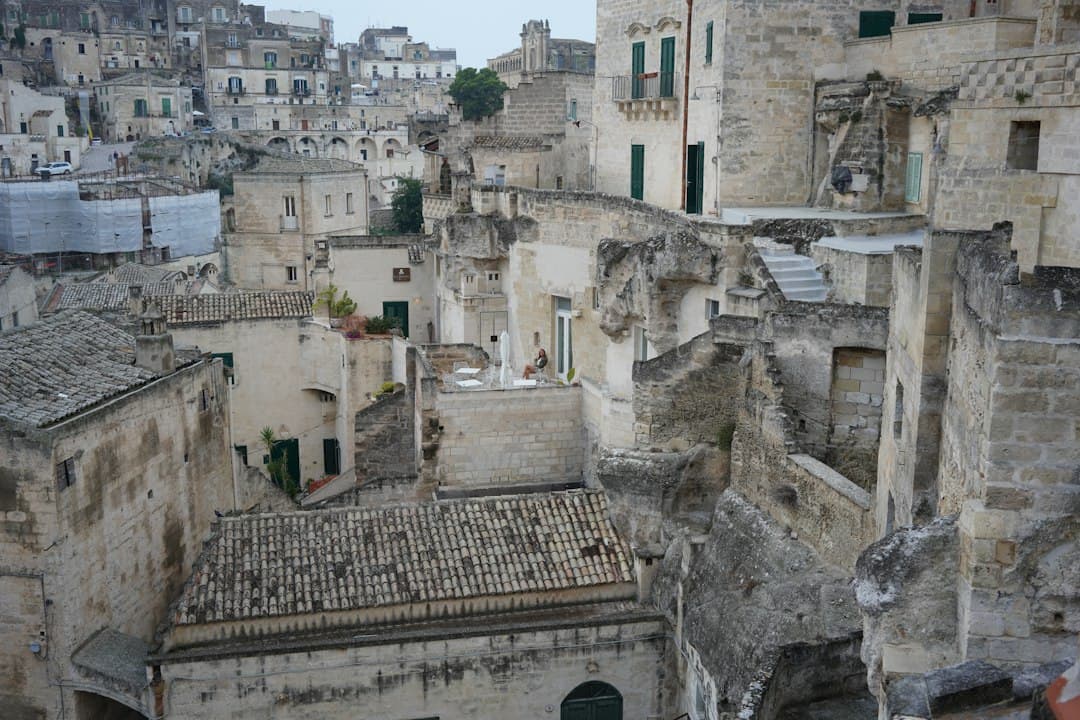
The Sassi districts create a feeling of time made visible. You see cave mouths, built facades, stone stairways, terraces, roofs that become streets, churches that look like cliffs, and cliffs that become houses. The urban fabric tumbles into the ravine and rises back up in layers.
Matera is often described as:
- Ancient
- Cinematic
- Biblical
- Haunting
- Quiet
- Surreal
- Intimate
- Humble
- Enduring
- Mysterious
It does not have the polished grandeur of Rome, Florence, or Venice. Its beauty is more elemental. It comes from stone, endurance, and adaptation.
Poverty Memory and Beauty
Matera’s charm is inseparable from its painful history. The cave houses were once homes of poverty, overcrowding, and survival. The city does not hide that past. It has converted memory into interpretation.
When you enter a furnished cave house or an underground museum, the city’s picturesque image becomes morally and emotionally more complex. Beds, tools, animal areas, kitchens, grain storage, and water systems show how domestic life, labor, faith, and geology occupied the same space.
Darkness and Light
Matera constantly alternates between enclosure and release:
- Dark cave interiors
- Narrow stairways
- Sudden sunlight
- Open ravine views
- Cool underground cisterns
- Hot stone squares
- Silent chapels
- Bustling cafés
This is part of its cinematic power. One moment you are in a shadowed alley, the next on a terrace looking across the Gravina toward the Murgia plateau.
Lively Matera
Despite its ancient mood, Matera is not static or mournful. Piazza Vittorio Veneto is lively, with cafés, shops, tour meeting points, street life, and access to underground attractions. Via Ridola has bars, boutiques, and historic palaces. Evening brings café clatter, conversations, aperitivo, and glowing stone views.
Matera shifts from contemplative to social as you move from the Sassi into the upper town.
The Sacred Landscape
Matera’s religious spaces intensify the city’s mystical atmosphere. There are more than 150 rock churches, oratories, hermitages, and monastic spaces in and around the city. These places combine:
- Cool mineral air
- Rock-cut walls
- Faded frescoes
- Byzantine-style saints
- Simple altars
- Damp stone
- Silence
- Fragile sacred imagery
Faith here was literally embedded into the cliff.
Matera at Night
At night, Matera becomes one of Italy’s most magical cityscapes. The Sassi glow in warm light, stone facades become golden, alleys quiet down, and the city can look like a nativity scene. Night views are widely considered essential.
Be aware, however, that some quieter alleys can feel disorienting after dark, and stone steps may be uneven or slippery. Major tourist areas are generally safe, but use ordinary caution.
Top Attractions and Experiences in Matera
Below is a detailed guide to the major sights, museums, churches, viewpoints, and experiences mentioned across the research.
1. Sassi di Matera: Sasso Caveoso, Sasso Barisano, and the Civita
The Sassi di Matera are the heart of the city and the main reason most travelers come. They consist principally of:
- Sasso Caveoso
- Sasso Barisano
- Civita, the ridge between them
Together they form the UNESCO-listed old center.
Why they matter
The Sassi are not a monument built by one ruler or architect. They are the result of millennia of human adaptation. Successive communities expanded natural caves, carved new chambers, built facades, created water systems, dug churches, established workshops, and connected everything with stairways, courtyards, tunnels, and terraces.
UNESCO recognizes them as one of the most outstanding intact examples of a Mediterranean troglodyte settlement.
What to look for
As you walk, notice:
- Cave dwellings cut into the rock
- Built stone facades attached to cave interiors
- Roofs that function as streets
- Courtyards shared by multiple dwellings
- Cisterns and water channels
- Rock churches and hermitages
- Narrow alleys and steep stairways
- Views over the Gravina ravine
- Restored cave hotels, restaurants, and galleries
- Abandoned or semi-restored cave mouths, especially toward Rione Casalnuovo
Practical information
There is no universal ticket for walking through the Sassi. They are part of the city and generally open at all hours.
Costs apply to:
- Cave-house museums
- Rock churches
- Underground cisterns
- Guided tours
- Museums
- Private attractions
Typical individual paid attractions often range from €3–€10, while guided tours cost more depending on duration and inclusions.
Real traveler verdict
The Sassi are overwhelmingly considered worth the hype. Complaints are mostly about:
- Crowds
- Stairs
- uneven stone
- heat
- fragmented ticketing
- commercialization in some areas
The best experience is often simply to wander, get slightly lost, and let the city unfold.
Warning
If you have mobility limitations, Matera requires planning. The Sassi involve:
- Steep steps
- Uneven paving
- Climbs and descents
- Limited vehicle access
- Slippery surfaces when wet
Wear sturdy shoes.
2. Sasso Caveoso
Geo listing:
- Name: Sasso Caveoso
- Rating: 4.8
- User ratings: 1,733
- Location: Piazza S. Pietro Caveoso, 75100 Matera MT, Italy
- Coordinates: 40.6634764, 16.6118324
Sasso Caveoso is often the more dramatic and ancient-feeling of the two main Sassi districts. It slopes toward the ravine and contains some of Matera’s most iconic scenes: San Pietro Caveoso, Santa Maria de Idris, cave houses, stone stairways, and views toward the Murgia plateau.
Why visit
Travelers love Sasso Caveoso for:
- More atmospheric, less polished streets
- Ravine views
- Uninhabited caves near Rione Casalnuovo
- Strong sense of abandonment and restoration side by side
- Dramatic photography spots
- Access to major rock churches
Real traveler insight
Many visitors find Sasso Caveoso quieter and more evocative than the busier parts of Sasso Barisano. It is excellent for wandering and photography, but it has fewer services in some areas and requires climbing.
3. Sasso Barisano
Sasso Barisano is the more restored, commercially active side of the Sassi. It contains many restaurants, hotels, cave houses, artisan shops, and access routes from Piazza Vittorio Veneto.
Why visit
Sasso Barisano is ideal for:
- First impressions from central viewpoints
- Restaurants and cafés in cave settings
- Easier access from the upper town
- Museums such as the Museo Laboratorio della Civiltà Contadina
- San Pietro Barisano
- Atmospheric evening walks
Traveler caution
Because it is more developed, some visitors find parts of it more touristy. But it remains essential.
4. Casa Grotta di Vico Solitario / Cave House in the Sassi of Matera
Geo listing:
- Name: Cave House in the Sassi of Matera
- Rating: 4.6
- User ratings: 2,731
- Address: Vico Solitario 11, 75100 Matera MT, Italy
- Coordinates: 40.6637768, 16.6122649
This is one of the best-known furnished cave-house museums in Matera. It shows how families lived in the Sassi before the evacuation of the 1950s.
Why it matters
A cave-house museum makes the Sassi understandable at a human level. Instead of just admiring stone facades, you see the reality of domestic life:
- Sleeping area
- Kitchen corner
- Tools
- Storage
- Animal area
- Cramped shared space
- Conditions that contributed to disease and poverty
Many travelers say this is where Matera’s history “clicks.”
How long to spend
Usually 15–30 minutes.
Pros
- Very concrete insight into daily life
- Small and focused
- Often good value
- Useful early in your visit
Cons
- Can feel crowded
- Small interior
- Tour groups may rush through
- Repetitive if you visit several cave houses
Practical advice
Seeing at least one furnished cave house is strongly recommended. You do not need to visit every similar cave-house museum unless you have a special interest.
5. Casa Grotta “C’era una volta…”
Geo listing:
- Name: Casa grotta “C’era una volta...”
- Rating: 4.7
- User ratings: 338
- Address: Via Fiorentini 251, 75100 Matera MT, Italy
- Coordinates: 40.6676241, 16.6101005
This is another cave-house museum, focused on everyday life in the Sassi.
Why visit
It gives additional perspective on domestic life, tools, and how people organized space inside cave dwellings. It may be useful if it fits your route or if Casa Grotta di Vico Solitario is too crowded.
Traveler caution
Many visitors report that multiple cave-house museums become repetitive. If you are short on time, choose one strong example.
6. Casa Grotta del Casalnuovo
Geo listing:
- Name: Casa Grotta del Casalnuovo
- Rating: 4.5
- User ratings: 754
- Address: Rione Casalnuovo 307, 75100 Matera MT, Italy
- Coordinates: 40.6620761, 16.6122391
Located in Rione Casalnuovo, this cave house is especially interesting because the surrounding district retains a rougher, more edge-of-the-Sassi atmosphere.
Why visit
- Good for understanding the less polished side of Matera
- Combines cave-house interpretation with a walk in atmospheric Rione Casalnuovo
- Useful if you want quieter corners
Traveler insight
Rione Casalnuovo is valued for its sense of abandonment and uninhabited caves. It can feel more authentic but also less serviced and more physically demanding.
7. Casa Cisterna
Geo listing:
- Name: Casa Cisterna
- Rating: 4.5
- User ratings: 133
- Address: Ponte S. Pietro Caveoso 39, 75100 Matera MT, Italy
- Coordinates: 40.663773, 16.6108758
Casa Cisterna is another small attraction connected to Matera’s cave and water-management world. The name itself points to the crucial relationship between domestic spaces and cistern systems.
Why include it
Matera’s story is not only about cave dwellings but about water. The Sassi survived through carefully managed cisterns, channels, and water storage. Sites like Casa Cisterna help reveal that hidden infrastructure.
Practical caution
As with many small Matera sites, check current hours locally. Small attractions can have variable schedules.
8. Casa Noha
Geo listing:
- Name: Noha House / Casa Noha
- Rating: 4.6
- User ratings: 1,460
- Address: Recinto Cavone 9, 75100 Matera MT, Italy
- Coordinates: 40.6663327, 16.6121117
Casa Noha is one of the best introductions to Matera and is widely recommended as a first stop.
What it is
Casa Noha is a historic noble residence in the Civita area, a few steps from Matera Cathedral. It was built in the 16th century or possibly late 15th–16th century as a residence of the Noha family, a local noble lineage.
It is now managed by FAI – Fondo per l’Ambiente Italiano, the National Trust of Italy.
Historical significance
- Built by the Noha family within the Sassi
- Part of a larger estate with gardens and a bridge toward the San Paolo quarter
- During structural work, reused stone and earlier material revealed traces from the Bronze Age, Iron Age, Greek, Roman, and medieval phases
- Donated to FAI by the family heirs in 2004
- Restored carefully for cultural use
What you see
The main experience is the multimedia film:
“I Sassi invisibili. Viaggio straordinario nella storia di Matera”
“The Invisible Sassi. An Incredible Journey within the History of Matera”
It was designed by science communicator Giovanni Carrada and is projected directly onto the walls, vaults, and stone surfaces.
It covers:
- Prehistoric settlement
- Development of the Sassi
- Poverty and abandonment
- Carlo Levi and public outrage
- Evacuation
- UNESCO recognition
- Cultural rebirth
Layout
- Three darkened rooms for projections
- Two brighter rooms for refreshment, rest, interactive/educational activities
- Bookshop
- Refreshment room
- Multimedia room
- Audio guides in English and French
- Easy-to-read and accessibility-oriented content
Duration
About 25–30 minutes.
Practical information: tickets
Recent FAI pricing:
- FAI members: free
- Adults: €7
- Students up to 25: €5
- Ages 6–18: €3
- Family ticket, 2 adults + 2 children: €18
- Children up to 5: free
- Matera residents: free
- People with disability + 1 companion: free
- National Trust and Bienfaiteurs Amis du Louvre members: free
Some older sources list €6.50 adult / €3 child, but €7 / €5 / €3 is the better current estimate.
Opening hours
Casa Noha varies seasonally and is generally closed Wednesday in many seasons.
Reported FAI pattern:
- November–6 January: daily except Wednesday, 10:00–17:00
- February: Thursday–Sunday, 10:00–17:00; Monday–Tuesday by appointment for groups of at least 15
- March: Thursday–Tuesday, 10:00–17:00
- April: Thursday–Tuesday, 10:00–19:00
- June–September: Thursday–Tuesday, 09:15–19:00
- October: Thursday–Tuesday, 10:00–19:00
- 1–6 January: 10:00–17:00 with holiday adjustments
- Last admission: 1 hour before closing
Contact
- Phone: +39 0835 335452 or +39 324 0561747
- Email: fainoha@fondoambiente.it or promonoha@fondoambiente.it
Real traveler verdict
Casa Noha is strongly recommended early in your stay. Criticism is mostly about opening days, timed entries, and language timing—not about value.
9. Matera Cathedral / Basilica Cattedrale di Matera
Geo listing:
- Name: Bazylika katedralna w Materze / Matera Cathedral
- Type: church
- Rating: 4.6
- User ratings: 4,467
- Address: Piazza Duomo, 75100 Matera MT, Italy
- Coordinates: 40.6667941, 16.6110991
Matera Cathedral stands on the Civita ridge, physically and symbolically above the Sassi. It is one of the city’s major historic religious landmarks.
Why visit
The cathedral gives you:
- A sense of Matera’s medieval and religious authority
- Views across the Sassi from the ridge
- A strong contrast with cave churches below
- A key orientation point between Sasso Caveoso and Sasso Barisano
Atmosphere
Where the rock churches feel cave-like and intimate, the Cathedral represents institutional Christianity and civic prominence. It anchors the skyline and helps you understand the Civita as the old fortified high point.
Practical note
Check current opening hours locally, as church access can vary with services and maintenance.
10. Piazza Vittorio Veneto
Piazza Vittorio Veneto is Matera’s main central square and one of the best starting points for understanding the city.
Geo-related attraction nearby: Palombaro Lungo / Long Cistern
History
The square has had several names:
- Piazza del Plebiscito
- Piazza della Fontana
It was once associated with the Ferdinandea Fountain, built in 1832 to collect water from the hill above the castle area. The fountain was later moved near the town hall.
The square’s modern appearance dates largely from 1993, when restoration works removed the road crossing the square, relocated the war memorial, and revealed the underground complex below.
Why it matters
Piazza Vittorio Veneto sits above a major subterranean system sometimes described as a “middle warehouse” or underground city layer. This system extends under the square for more than 5,000 square meters and continues beneath the Convent of the Annunziata.
It includes:
- Cisterns
- Warehouses
- Shops
- Homes
- Snow-storage chambers
- The Palombaro Lungo
- Underground church spaces
What to see
- View over Sasso Barisano
- Belvedere Luigi Guerricchio area
- Entrance to Palombaro Lungo
- Access stairs to underground spaces
- Café and evening street life
- Tour meeting points
Practical information
The square itself is a public space and accessible at all hours. Underground attractions beneath it have their own tickets and schedules.
Traveler warnings
- Touristy cafés may charge premium prices
- Crowds at peak times
- Tour touts may approach visitors
- Limited shade in hot weather
- You pay for location if drinking or eating directly on the square
Real verdict
It is unavoidable and useful as a starting point, meeting place, and first viewpoint.
11. Palombaro Lungo / Long Cistern
Geo listing:
- Name: Long Cistern
- Rating: 4.5
- User ratings: 12,299
- Address: Piazza Vittorio Veneto, 75100 Matera MT, Italy
- Coordinates: 40.6669026, 16.6065001
Palombaro Lungo is one of Matera’s most important underground attractions. It is a huge cistern beneath Piazza Vittorio Veneto, often called the “Cathedral of Water.”
Historical significance
Matera historically suffered from chronic water scarcity. Its residents developed elaborate systems to capture and store rainwater and spring water.
Palombaro Lungo was created by combining multiple underground rooms and bell-shaped cisterns into a single reservoir, enlarged over time.
Dating varies by source:
- Some say it was fully dug around 1870
- Others note that it functioned as a major public cistern from at least the 16th century
- These can be reconciled if earlier cisterns were gradually joined and expanded in the 19th century
It was supplied by:
- Rainwater from surrounding hills
- Water from roofs and channels
- Local springs
Water was drawn from wells and openings in the square above using buckets.
In the 1920s, with the arrival of the Apulian aqueduct and new public fountains, the cistern was decommissioned. It fell into disuse and was forgotten.
It was rediscovered in 1991 during redevelopment works in Piazza Vittorio Veneto. Early exploration was by rubber boat because it was still full of water.
Architecture
- Located beneath Piazza Vittorio Veneto
- Approximately 15–18 meters deep
- Approximately 50 meters long
- Capacity often cited around 5 million liters
- Interconnected chambers and bell-shaped tanks
- Coated with cocciopesto, waterproof plaster made of crushed brick/tile and lime mortar
- Massive rock pillars
- Curved walls
- Traces of former water levels
- Former well mouths
Visitor experience
You walk along narrow platforms and walkways with lighting that reveals:
- Tall chambers
- Water marks
- Rock pillars
- Cocciopesto lining
- Organic shape created by joined cisterns
The atmosphere is silent, cool, and cathedral-like.
Tickets
Recent adult price: €3
Estimated 2024/2025 range: €3–4
School groups minimum 15 students: €1.50 per student
Minors in non-school groups: often free
Opening hours
Published ticket office hours from one official page:
- 15:00–17:30
Tickets are generally purchased on site for the same day. Advance reservations for future dates are usually not possible for individuals or standard groups.
Payment: cash or card. Groups over 20 may pay in advance by bank transfer.
Duration
About 15–30 minutes, though some visitors describe it as a 30–45 minute stop depending on waiting and commentary.
Traveler verdict
Worthwhile, central, inexpensive, and memorable. Not a labyrinth—expect one impressive cistern, not miles of tunnels.
12. Ipogeo MateraSum
Geo listing:
- Name: Ipogeo MateraSum
- Rating: 4.5
- User ratings: 409
- Address: Recinto XX Settembre 7, 75100 Matera MT, Italy
- Coordinates: 40.667763, 16.6068338
Ipogeo MateraSum is a 1,200 m² underground complex about 12 meters below street level, near Piazza Vittorio Veneto.
What it is
It is presented as a “city under the city,” an underground history-and-anthropology museum showing Matera’s subterranean world.
Historical layers
The complex is carved into tuff and associated with ancient cave-dwelling civilizations, later reused for many purposes. It has been linked to the Malvezzi noble family, whose palazzo stood above and who used underground spaces for agricultural storage.
Uses included:
- Warehouses
- Cisterns
- Granaries
- Furnaces
- Service areas
- Possibly crypt-like worship spaces
- Domestic and storage environments
The name “Ipogeo MateraSum” is modern. “Ipogeo” means underground structure; “Materasum” is an invented word.
What you see
- Interconnected underground rooms
- Alley-like passages
- Open carved spaces
- Barrel-vaulted chambers
- Niches
- Rock-cut steps
- Cisterns
- Granaries
- Furnaces
- Recreated domestic rooms
- Crypt-like or worship spaces
- Interpretive panels
Interpretation
Visits are usually self-guided with audio guide in:
- Italian
- English
- French
- Spanish
Panels may be in Italian, English, French, and Japanese. An introductory video often precedes the visit. Photography is reportedly permitted.
Duration
About 30 minutes.
Tickets
Reasonable 2024/2025 estimates:
- Adults: about €7
- Ages 11–17: €5
- Ages 75+: €5
- Groups of 8 or more: €5
- Older data listed €5; online reseller/audio-guide products may be €9–12
Opening hours
Reported schedules vary:
- 9:00–13:00 and 15:00–19:00 daily
- 10:00–18:00 daily
- 10:00–12:30 and 15:00–17:30, last admission 17:00
- Older: 9:00–13:00 and 16:00–19:00, last entry 18:30
Practical estimate: expect daily opening with morning and afternoon sessions, roughly:
- 9:00–13:00
- 15:00–19:00
Confirm before visiting.
Accessibility
Not wheelchair accessible; stairs and uneven underground surfaces.
Traveler verdict
Good for those interested in underground Matera. Less essential if you are short on time and already visiting Palombaro Lungo.
13. MUSMA – Museo della Scultura Contemporanea
Geo listing:
- Name: MUSMA - Museo della Scultura Contemporanea
- Rating: 4.5
- User ratings: 392
- Address: Via S. Giacomo, 75100 Matera MT, Italy
- Coordinates: 40.6661031, 16.6122937
MUSMA is one of Italy’s major museums devoted entirely to sculpture and one of Matera’s most distinctive museum experiences.
What it is
MUSMA is housed in Palazzo Pomarici, a 16th- or 17th-century historic palace in Sasso Caveoso, and extends into the underground hypogea beneath it.
It opened in 2006, with one source specifying 14 October 2006.
It was promoted by Fondazione Zétema di Matera and assembled through donations from artists, collectors, galleries, and critics.
Why it matters
It is described as:
- The principal Italian museum entirely dedicated to sculpture
- One of the most important sculpture museums in Italy
- A unique “museum in a cave”
Collection
Sources vary:
- About 400 works
- Or about 270 works by 200 artists
Artists include:
- Arnaldo Pomodoro
- Giacomo Manzù
- Pietro Consagra
- Pericle Fazzini
- Others
The collection spans the late 19th century to the present.
Experience
The route moves through:
- Noble rooms of Palazzo Pomarici
- Underground limestone galleries
- Caves, niches, and chambers where contemporary sculpture dialogues with stone
Tickets
Estimated:
- Full: €7
- Reduced: €4
- Some reductions for students, young visitors, groups
- Free for children under 6 and some categories
Opening hours
Reported schedules vary:
- Tue–Sun 10:00–14:00 and 16:00–20:00 from April to September
- Tue–Sun 10:00–14:00 from October to March
- Another source: daily 10:00–18:00
Confirm before visiting.
Traveler verdict
Highly recommended if you like art or unusual spaces. Less compelling for travelers uninterested in contemporary sculpture. Generally not seen as a tourist trap.
14. Palazzo Lanfranchi and the National Museum of Medieval and Modern Art of Basilicata
Geo listing:
- Name: Palazzo Lanfranchi
- Rating: 4.6
- User ratings: 991
- Address: Piazzetta Pascoli 1, 75100 Matera MT, Italy
- Coordinates: 40.6630506, 16.6103262
Palazzo Lanfranchi is one of Matera’s most important Baroque buildings and houses the National Museum of Medieval and Modern Art of Basilicata.
Historical background
Palazzo Lanfranchi was commissioned in the second half of the 17th century by Bishop Vincenzo Lanfranchi as a diocesan seminary, following post-Council of Trent guidelines.
The main facade on Via Ridola and the internal layout are attributed to Capuchin friar Francesco da Copertino.
From 1864, it housed the Liceo ginnasio Emanuele Duni classical high school.
Since 2003, it has housed the National Museum of Medieval and Modern Art of Basilicata.
A major restoration and enhancement project culminated in a formal reopening on 15 October 2024, with renovated display spaces, redesigned routes, and new technological supports.
Architecture
- Matera’s most representative Baroque palace
- Monumental Baroque facade on Via Ridola
- Two floors around a central cloister
- Stone construction visually linked to the Sassi
- Located by Piazzetta Pascoli, one of Matera’s key viewpoints
- In front is “La Goccia” (The Drop) by Japanese artist Kengiro Azuma
Collections
The permanent exhibition is divided into three main sections.
1. Sacred Art
Includes:
- Paintings
- Sculptures
- Wooden and stone artifacts
- Works from churches across Basilicata
- Medieval, early modern, and Baroque religious culture
2. Camillo d’Errico Collection
A collection from Palazzo San Gervasio with over 300 paintings of the Neapolitan school from the 17th–18th centuries. It documents 19th-century private collecting in Basilicata.
3. Contemporary Art
Focuses on 20th-century artists linked to Basilicata, including:
- Carlo Levi
- His major work “Lucania ’61”
- Luigi Guerricchio, Matera-born painter
- Works such as “Domenico”
Accessibility
Part of the “Museo per tutti” network:
- Facilitated guide focused on 12 representative works
- Useful for visitors with intellectual disabilities
- Lifts
- Benches
- Decompression areas
Tickets
Recent listing:
- Standard cumulative ticket: €7
- Valid also for:
- Ex Ospedale di San Rocco
- National Archaeological Museum “Domenico Ridola”
Opening hours
Recent detailed listing:
- Monday: 09:00–20:00, last entry 19:00
- Tuesday: 14:00–20:00, last entry 19:00
- Wednesday: 09:00–20:00, last entry 19:00
- Thursday: 09:00–20:00, last entry 19:00
- Friday: 09:00–20:00, last entry 19:00
- Saturday: 09:00–20:00, last entry 19:00
- Sunday: 09:00–20:00, last entry 19:00
Older sources say closed Wednesday; check official channels.
15. Belvedere di Piazza Giovanni Pascoli
Geo listing:
- Name: Belvedere di Piazza Giovanni Pascoli
- Rating: 4.8
- User ratings: 5,621
- Address: Piazzetta Pascoli, 75100 Matera MT, Italy
- Coordinates: 40.6632559, 16.6102925
This is one of Matera’s most accessible and beloved viewpoints, located beside Palazzo Lanfranchi.
Why visit
It provides an outstanding view over the Sassi, especially Sasso Caveoso. It is also conveniently located near:
- Palazzo Lanfranchi
- Via Ridola
- Chiesa del Purgatorio
- San Pietro Caveoso route
- Santa Maria de Idris route
Best time
- Morning for clearer views
- Sunset for warm stone colors
- Evening for illuminated Sassi
Traveler note
It can be crowded, but it is easy to access and a must for first-time visitors.
16. National Archaeological Museum “Domenico Ridola”
The National Archaeological Museum Domenico Ridola is the oldest museum in Basilicata.
Historical significance
Founded on 9 February 1911 by physician, senator, politician, and self-taught archaeologist Domenico Ridola, who donated decades of finds and research to the Italian state.
It is housed in the former 17th-century Convent of Santa Chiara on Via Domenico Ridola 24.
It covers human occupation in the Matera and Lucania area from the Lower Paleolithic through the Upper Neolithic, Lucanian, and Roman periods.
Highlights
- Stone tools
- Ceramics
- Everyday prehistoric objects
- Neolithic village reconstructions
- Animal bones
- Protohistoric and classical ceramics
- Metal objects
- Coins
- Hidden treasures
- Finds from Timmari and Montescaglioso
- The Rizzon Collection of Lucanian and Apulian red-figure vases from the 4th century BC
- Founder’s room with manuscripts, documents, and memorabilia
- The fossil whale “Giuliana”
- Temporary exhibitions and educational programs
Accessibility
- Lifts
- Sensory trail using touch, smell, sight, and hearing
- Refreshment/rest area
- “Museo per tutti” approach
Tickets
Recent estimate:
- Full cumulative ticket: €7
- Valid for:
- Domenico Ridola Museum
- Palazzo Lanfranchi
- Ex Ospedale di San Rocco
Older visitor reports mention €5; current planning should assume €7.
Reduced/free categories likely follow Italian state museum policies; confirm.
Sundays may be free under national museum initiatives, but verify.
Opening hours
- Monday: 14:00–20:00
- Tuesday–Sunday: 09:00–20:00
- Last entry: usually 19:00
Time needed
Most visitors spend 1–2 hours.
17. Museo Laboratorio della Civiltà Contadina
The Museo Laboratorio della Civiltà Contadina is one of the most important museums for understanding the rural and artisan culture of the Sassi.
Location
- Via San Giovanni Vecchio 60
- Sasso Barisano
Origins and purpose
Founded and set up by Donato Cascione, and managed by an ONLUS association of the same name.
It occupies about 500 m² in a restored courtyard building integrated with cave spaces. The lower part dates to the 16th century. A central feature is a lamione soppalcato, a vaulted 16th-century room extending a pre-existing cave dwelling.
The museum grew from years of collecting tools and objects from Matera’s agricultural, pastoral, and artisan society.
Why it matters
It preserves the material and social memory of life in the Sassi before evacuation, including:
- Domestic life
- Work conditions
- Water supply
- Childhood
- Brigandage
- Rural poverty
- Artisan trades
What you see
The museum is immersive, with reconstructed environments rather than just display cases.
Typical Sassi dwelling
Shows how humans and animals shared space, with:
- Sleeping area
- Kitchen corner
- Household tools
- Storage
- Animal space
Cantina and food storage
Includes wine, grain, food preservation, grain processing, milling, bread, and pasta-related implements.
Artisan workshops
Reconstructed trades include:
- Setacciaio / sieve maker
- Conciapelli / tanner
- Cestaio / basket maker
- Panieraio / basket maker
- Vasaio / potter
- Mastro d’ascia / wood carpenter
- Fabbro / blacksmith
- Sarto / tailor
- Calzolaio / shoemaker
- Arrotino / knife grinder
- Scalpellino / stonecutter
- Barber
- Ebanist
- Saddler
- Coppersmith
- Others
Agriculture and pastoral life
Tools and displays related to:
- Field work
- Sheep and goat herding
- Grain cultivation
- Water collection
Thematic sections
- Brigandage
- Childhood
- Water procurement
- Broader Southern Italian social history
Future/workshop idea
The museum has plans to expand and create functioning laboratories where young people can learn ancient crafts such as:
- Papier-mâché making
- Pottery
- Basket weaving
Tickets
Older reference:
- Full: €2
- Reduced: €1.50
Realistic current estimate:
- Adults: €2–3
- Reduced: €1.50–2
Opening hours
Standard reports:
- Daily 09:00–13:00 and 16:00–19:00
- Summer may extend afternoon to 16:00–20:00
No fixed weekly closing day clearly indicated, but call ahead.
Contact
- Phone: +39 0835 344057
- Official site: museolaboratorio.it
Practical note
Some sources say the main entrance can appear closed even during opening hours. Ring the bell if instructed.
Time needed
About 45–90 minutes.
18. MOOM – Matera Olive Oil Museum
Geo listing:
- Name: MOOM / Matera Olive Oil Museum
- Rating: 4.8
- User ratings: 266
- Address: Vico I Casalnuovo 3, 75100 Matera MT, Italy
- Coordinates: 40.6616161, 16.611715
MOOM is a small but rich museum inside an ancient underground olive oil mill in Sasso Caveoso.
Historical background
Located in Vico I Casalnuovo 3, MOOM occupies a rock-hewn oil mill, or frantoio rupestre.
The original cave structure likely dates to the 15th–16th century, with evidence of operation by around the 1600s. The upper masonry building was added between the late 19th and early 20th century.
Historically, the oil factory was owned and run by the Church, while farmers brought olives for pressing.
A private owner rediscovered and restored the underground mill, transforming it into a museum.
What you see
- Original cave mill spaces
- Pressing area with traditional wooden or stone presses
- Large screw mechanisms
- Grinding zone with animal-driven millstones
- Tethering points and paths for animals
- Decanting and storage rooms
- Stone basins
- Settling tanks
- Jars
- Worker and animal spaces
Themes
Guided visits explain:
- Olive harvesting
- Traditional pressing
- Modern extraction
- Technological change in the 20th century
- Labor and rural life
- Extra virgin olive oil in Basilicata and Mediterranean culture
Tickets
Reported:
- Normal: €7
- Reduced: €5
- Children 0–5: free
- Ticket platforms may list around €10–11 including guided visit
Practical estimate:
- Adults: €7–10
- Reduced/children over 5: €5
- Young children: free
Opening hours
Published schedules are unreliable and may show placeholder all-day hours. In practice, visits are usually by guided tour and reservation.
Assume midday to evening availability, but reserve a specific time.
Duration
About 1 hour.
Languages
Tours commonly in Italian and English.
Accessibility
Underground spaces may involve steps and uneven surfaces. Check in advance.
19. Rock Churches of Matera
The rock churches are among Matera’s defining features. There are over 150 cave-hewn churches, oratories, monasteries, and hermitages in the Sassi and Murgia Materana Park.
Historical importance
Most were created between the 8th and 14th centuries, although religious use and reuse continued later. They are associated with:
- Basilian monks
- Benedictine monks
- Greek-rite communities
- Latin-rite clergy
- Lay confraternities
They show the fusion of monastic life, cave architecture, agriculture, and urban settlement.
Architecture
Common elements include:
- Single- or multi-nave rock-cut halls
- Apses carved into rock
- Rock altars
- Niches
- Iconostasis-like partitions
- Frescoes from the 9th–13th centuries
- Simple facades or later masonry fronts
- Bell towers in some cases
Key churches
Important rock churches include:
- San Pietro Barisano
- Santa Lucia alle Malve
- Santa Maria de Idris
- San Giovanni in Monterrone
- Madonna delle Virtù
- San Nicola dei Greci
- Crypt of the Original Sin
- San Falcione
- Madonna delle Tre Porte
Tickets
There is no single universal ticket for all rock churches.
Typical estimates:
- Single church: €4–6
- Reduced: €2–4
- Guided surcharge: €2–4
- Combined tickets for 3–4 churches: €10–15
- Some combo tickets may include San Pietro Barisano, Santa Lucia alle Malve, Santa Maria de Idris / San Giovanni in Monterrone, and Madonna delle Virtù / San Nicola dei Greci
Opening hours
Typical high-season pattern:
- 10:00–13:00
- 14:00–18:30
Winter may be shorter, sometimes only morning or reduced afternoon hours.
Practical tips
- Wear sturdy shoes
- Flash photography is usually prohibited
- Interiors may close for conservation, services, or events
- Visit earlier in the day to avoid crowds
- Do not try to see every church unless you have a deep interest
Traveler verdict
Essential for art and history lovers. Casual visitors should choose a small curated selection to avoid repetition and ticket fatigue.
20. Church of Santa Maria de Idris and San Giovanni in Monterrone
Geo listing:
- Name: Church of Saint Mary of Idris
- Type: church
- Rating: 4.5
- User ratings: 1,032
- Address: Via Madonna dell’Idris, 75100 Matera MT, Italy
- Coordinates: 40.6641107, 16.612031
Santa Maria de Idris is one of Matera’s most iconic rock churches. It is carved into the Monterrone cliff above Sasso Caveoso.
Name and origin
“Idris” is linked to the Greek Odigitria, meaning “Our Lady who shows the way,” a Marian title associated with Byzantine influence.
The church was likely used by the Middle Ages and belongs to the broader rupestrian monastic tradition of the 8th–13th centuries.
Structural history
The church suffered collapses because of its friable rock. A major collapse in the 15th–16th century destroyed the original vault system. The current masonry facade and bell gable were rebuilt around the 15th century, while much of the interior remains rock-cut.
It continued to function on certain feast days until the 1940s. In the 1970s, deteriorated frescoes were detached for conservation.
Architecture
- Perched on Monterrone
- Half rock-cut, half masonry
- Simple tuff facade
- Small bell gable
- Small intimate interior
- Connected by internal passage to San Giovanni in Monterrone
Frescoes
Works include:
- 17th-century tempera Madonna and Child
- Saint Eustace, patron saint of Matera
- Christ Pantocrator, 12th century
- Saint John the Baptist
- Saint John the Evangelist
- Archangel Michael
- Saint Nicholas, 13th century
- St. Onofrio and other saints
Practical info
Often managed by the Oltre l’Arte cooperative as part of a combined rock-church ticket with sites such as:
- Santa Maria de Idris
- San Giovanni in Monterrone
- Santa Lucia alle Malve
- San Pietro Barisano
Estimated combo price:
- Adult: €7–8
- Reduced: €5–6
- Children under 6: often free or low cost
Indicative hours:
- Daily in main season
- Morning around 10:00–13:00
- Afternoon around 15:00–18:00 or 19:00
Confirm locally.
Traveler verdict
The exterior and surrounding views are unquestionably worth it and free. Paying to enter is more worthwhile for fresco and history lovers; casual visitors may find the interior small.
21. Madonna delle Virtù and San Nicola dei Greci
Geo listing:
- Name: Madonna delle Virtù e San Nicola dei Greci
- Rating: 4.6
- User ratings: 258
- Address: Via Madonna delle Virtù, 75100 Matera MT, Italy
- Coordinates: 40.6683942, 16.611388
This is a complex of rock churches overlooking the Gravina canyon.
Why it matters
The complex contains layers from different periods and religious traditions, including Greek and Latin rites. Its spaces include multiple chapels, niches, frescoes, and carved environments.
What to expect
- Rock-cut chapels
- Fresco traces
- Spatial layering
- Strong canyon setting
- A sense of monastic and liturgical evolution
Practical note
It may be included in some combined rock-church circuits. Check current access and hours.
22. San Pietro Barisano
San Pietro Barisano is described as the largest of Matera’s rock churches. It dates to around the 12th century and combines a cave interior with a built stone facade and bell structures.
Why visit
- Major rock church
- Important Sasso Barisano landmark
- Rock-cut spaces and altars
- Subterranean areas historically used for burials and liturgy
- Scenic steps and setting
Traveler insight
Worth including on a walk even if you do not enter. Interior access may be ticketed or included in rock-church passes.
23. San Pietro Caveoso
San Pietro Caveoso, also known as the Church of Saints Peter and Paul, is one of the most important churches in Sasso Caveoso.
Historical background
Its origins are generally placed in the early 13th century or late 13th/early 14th century. One source states initial construction in 1218.
It became an important parish due to its size and wealth.
Major transformations:
- 17th-century renovation: facade rebuilt, bell tower added, interior enlarged, side chapels introduced
- 18th-century restoration: nave lengthened, wooden roof replaced by stone vault, new facade and bell tower built
- Spire added later
- Baroque stucco decoration by Monsignor Lanfreschi in 1756
Artworks
Inside are:
- 16th-century polychrome stone statues of Madonna and Child by Altobello Persio
- Statues of St. Leonard and St. John of Matera
- Wooden polyptych dated 1540
- 15th-century frescoes
- Chapel of St. Anthony with six stone panels by Altobello Persio from 1531
- Annunciation chapel with 15th-century frescoes
Architecture
- Baroque facade
- Three portals
- Sculptural niches
- Central niche: Madonna della Misericordia
- Side niches: St. Peter and St. Paul
- Long nave
- Deep choir
- Side chapels
Setting
The church sits dramatically on the edge of Sasso Caveoso facing the ravine.
Practical info
Specific current entrance fee and hours were not confirmed. As a church, access may be free, donation-based, or vary with services. Check locally.
Traveler verdict
Worth seeing for its exterior and setting even if you do not enter.
24. Crypt of the Original Sin
The Cripta del Peccato Originale is one of the most important rock churches near Matera, often called the “Sistine Chapel of rupestrian art.”
Location
- Contrada Pietrapenta / Petrapenta
- About 14 km south of Matera
- Within the Natural Archaeological Park of the Rupestrian Churches of Matera
- Overlooking the Gravina di Picciano gorge
- On the Murgia plateau
History
The crypt was the oratory of a Benedictine cave monastery from the Lombard period, dating to the 8th–9th century. Some sources date the frescoes around 849 AD.
It belonged to a Benedictine community linked to Beneventan/Benedictine artistic traditions and Lombard culture.
The anonymous artist is known as the “Painter of the Flowers of Matera”, named for distinctive red floral motifs.
Later use and rediscovery
After its monastic phase, the cave was used by shepherds as a shelter for flocks and was nicknamed the “Cave of the 100 Saints.”
Accounts of rediscovery vary:
- Initial local discovery in 1959
- Scholarly rediscovery in May 1963 by young enthusiasts led or later studied by Dr. Raffaello De Ruggieri
- Archaeological study began in 1981
- UNESCO context from 1993
- Restoration by Zètema Foundation and the Italian Central Institute of Restoration
- Opened to public visits under controlled conditions by 2005
Architecture
- Natural cavern adapted as a cave church
- Three shallow arched chapels/apses carved into the rock
- Tri-apsed sanctuary wall
- Marine sedimentary rock: Cretaceous limestone and yellow-white calcarenite
Frescoes
The cave is covered with biblical frescoes.
Back wall: Genesis
Scenes include:
- God the Father Creator
- Light and Darkness
- Creation of Adam
- Birth of Eve
- Temptation
- Original Sin: Adam and Eve eating the fruit
Side wall: three apses / triarchies
- Apostles: John, Peter, Andrew
- Archangels: Raphael, Gabriel, Michael
- Marian apse: Virgin Mary with Child, like a Byzantine Basilissa, flanked by two saints
Style
The frescoes combine:
- Benedictine-Beneventan traits
- Lombard influence
- Oriental/Byzantine elements
- Linear narrative compositions
- The red floral motifs of the Painter of the Flowers
They are among the oldest and most important examples of rock-cut Christian art in southern Italy, created around 500 years before Giotto.
Practical info: reservation required
Access is strictly by reservation only with limited timed visits.
Tickets
Estimated 2024/2025:
- Standard guided visit including shuttle from meeting point near Matera: €25–30, often around €28
- Reduced: €15–20
- Private/small-group: €40–60+
Confirm whether transport is included.
Opening slots
Reported pattern:
Tuesday–Sunday by reservation.
April–September:
- 09:30
- 11:00
- 12:30
- 15:30
- 17:00
- 18:30
October–March:
- 09:30
- 11:00
- 12:30
- 15:30
Normally closed Monday for regular public slots.
Transfer
Allow 20–30 minutes each way by car/shuttle.
Traveler verdict
A highlight for those interested in medieval frescoes and religious art. More debatable for casual visitors because it is expensive relative to the short time inside and requires logistics.
Warning
Photography is usually prohibited.
25. Parco Regionale della Murgia Materana
Geo listing:
- Name: Parco Regionale della Murgia Materana
- Rating: 4.6
- User ratings: 3,590
- Address: 75100 Matera, Province of Matera, Italy
- Coordinates: 40.6316055, 16.6645007
The Murgia Materana Park is the wild ravine and plateau landscape opposite the Sassi. It is essential for understanding Matera as more than a city: it is a landscape of caves, churches, ravines, paths, prehistoric sites, and views.
Why visit
- Best panoramas back toward Matera
- Hiking
- Nature and silence
- Rock churches
- Neolithic remains
- Ravine views
- Birdlife
- A less commercial experience than the city center
Traveler warnings
- Rocky, steep trails
- Heat and little shade
- Bring water
- Wear proper shoes
- Signage may be confusing
- Not ideal for limited mobility
26. Belvedere di Murgia Timone
Belvedere di Murgia Timone is the famous viewpoint across the Gravina from Matera.
Historical significance
The plateau preserves:
- Neolithic settlement evidence from around 5000–4000 BC
- A trincerated Neolithic village
- Natural caves
- Tombs
- Rupestrian churches
Nearby churches include:
- San Falcione, 9th century
- Madonna delle Tre Porte, frescoed cave church below the viewpoint
The area has also been used as a film set for major productions associated with directors such as Mel Gibson, and films such as Wonder Woman and 007.
Landscape
From the belvedere you see:
- Sasso Barisano
- Sasso Caveoso
- Civita ridge
- The full skyline of Matera
- Gravina di Matera canyon
- Karst limestone
- Mediterranean shrubs
- Wild thyme
- Lino delle fate
- Lesser kestrels / falco grillaio
Best times
- Early morning: sun illuminates the Sassi from behind you
- Sunset: city lights create a nativity-scene effect
- Avoid midday in summer if hiking
Access
Options include:
By car
Drive to Jazzo Gattini / Murgia Timone and walk to the belvedere.
By bus
Reviews mention a bus from Piazza Matteotti every 30 minutes, travel time about 30 minutes, with a €1 ticket valid for 3 hours, enough for round trip and visit.
On foot
Itinerary 406 from Piazza Vittorio Veneto:
- Descend via steps to Porta Pistola
- Enter the Gravina
- Cross a wooden bridge
- Climb to the opposite plateau
AllTrails-style route:
- Belvedere Murgia Timone via Ponte Sospeso Tibetano
- About 4.2 km
- 221 m elevation gain
- 1.5–2 hours
Tickets and managed area
The open viewpoint may be accessible at all hours, but the managed Murgia Timone area has tickets and services.
Official park ticket estimates:
- €10 from 1 April to 31 October
- €7 from 1 November to 31 March
Includes:
- Trail network access
- San Falcione
- Visitor center/info point at Jazzo Gattini
- Multimedia area
- Shuttle service to/from belvedere
- Toilets
Some visitors complain that €10 feels expensive “just for a panorama,” so understand whether you are entering the managed/service area.
Managed area hours
- Winter, 1 Dec–28/29 Feb: 10:00–16:30
- Spring, 1 Mar–31 May: 9:00–19:00
- Summer, 1 Jun–15 Sep: 8:00–20:00
- Autumn, 16 Sep–30 Nov: 10:00–18:30
Traveler verdict
A must-do if you can manage the terrain. The view is among the most iconic in Italy.
27. Matera Ravine
Geo listing:
- Name: Matera Ravine
- Rating: 4.8
- User ratings: 91
- Address: 75100 Matera, Province of Matera, Italy
- Coordinates: 40.6790636, 16.6048211
The ravine is not just scenery. It is the geological reason Matera exists.
Why it matters
The Gravina ravine provided:
- Natural caves
- Shelter
- Defensive advantage
- Water channels
- Monastic isolation
- Agricultural and pastoral routes
- Dramatic urban setting
Many of the best views in Matera depend on the relationship between city and ravine.
Practical note
Take care near edges, especially with children, at night, or on windy days. Some viewpoints may lack railings.
28. Palazzo del Sedile
Geo listing:
- Name: Palazzo del Sedile
- Rating: 4.5
- User ratings: 40
- Address: Piazza del Sedile, 75100 Matera MT, Italy
- Coordinates: 40.665362, 16.6096965
Palazzo del Sedile is located in Piazza del Sedile, an important historic square between the upper town and the Sassi.
Why include it
It helps connect Matera’s civic, administrative, and urban history with the more famous cave districts. While less discussed than the Sassi or major museums, it is part of the historic center’s architectural fabric.
Best use
Pass through while walking between:
- Piazza Vittorio Veneto
- Cathedral area
- Via Ridola
- Sassi access points
29. Castello Tramontano
Geo listing:
- Name: Castello Tramontano
- Rating: 4.0
- User ratings: 1,397
- Address: Via del Castello, 75100 Matera MT, Italy
- Coordinates: 40.6639501, 16.6059453
Castello Tramontano is Matera’s castle, located outside the Sassi on the upper town side.
Why visit
It offers a different side of Matera’s history: feudal, defensive, and political rather than cave-dwelling or monastic.
Traveler expectation
Its rating is lower than many Sassi attractions, suggesting visitors may find it less essential. It is still worth noting if you enjoy castles, urban parks, or want a break from the main Sassi circuit.
30. Chiesa del Purgatorio
Mentioned among notable historic-center churches, Chiesa del Purgatorio lies along the elegant upper-town axis near Via Ridola.
Why visit
It is a striking church and useful stop when walking between:
- Piazza Vittorio Veneto
- Via Ridola
- Palazzo Lanfranchi
- Piazza Pascoli
- Sassi viewpoints
Check current opening access locally.
31. Via Ridola
Via Ridola is an elegant street lined with bars, boutiques, historic buildings, and access to key museums.
Why it matters
It connects the upper-town social life with major cultural sites such as:
- Palazzo Lanfranchi
- National Archaeological Museum Domenico Ridola
- Chiesa del Purgatorio
- Piazza Pascoli viewpoint
Atmosphere
This is where Matera feels more refined and urban, contrasting with the cave-and-ravine atmosphere of the Sassi.
32. Sassi in Miniatura
Mentioned as a small-scale model reflecting the city’s identity in miniature, Sassi in Miniatura can help visitors visualize Matera’s complex urban form.
Why include it
Matera’s layout is confusing. A miniature model can help you understand the relationship between Sasso Caveoso, Sasso Barisano, the Civita, stairways, and ravine.
33. “Matera, Italia” General Location Listing
Geo listing:
- Name: Matera, Italia
- Rating: 4.9
- User ratings: 39
- Address: 75100 Matera, Province of Matera, Italy
- Coordinates: 40.6663601, 16.6044454
This listing simply reinforces Matera itself as a highly rated destination.
Food and Local Experiences in Matera
Matera’s food culture is rooted in Basilicata’s rustic, peasant cuisine. Expect earthy, hearty dishes based on bread, grains, legumes, vegetables, lamb, olive oil, and simple preparations.
What to try
Pane di Matera
Matera’s bread is one of the city’s signature foods. Travelers praise its flavor and texture. Try it:
- Plain
- With olive oil
- In sandwiches
- As part of cialledda
- With local cheeses or cured meats
Cialledda
A traditional bread salad or bread-based dish, connected to peasant cooking and reuse of stale bread.
Orecchiette and pasta
Look for orecchiette with vegetables or local sauces.
Legume soups
Basilicata’s rural cuisine often uses beans, chickpeas, lentils, and grains.
Lamb
Lamb dishes are common in the region’s pastoral culinary tradition.
Olive oil
MOOM gives excellent context for olive oil production. Use your meals to taste local extra virgin olive oil carefully.
Dining experiences
Cave restaurants
Dining in a cave room is memorable and atmospheric. Many visitors enjoy the uniqueness, even when food quality varies.
Aperitivo with a view
Sunset aperitivo overlooking the Sassi is popular. It can be magical, but check prices before sitting.
Bakeries and less central trattorias
For better value and quality, look beyond the most obvious tourist-view restaurants.
Food warnings
Travelers report:
- Central Sassi restaurants can be touristy
- Menus may be repetitive
- Prime-view restaurants may charge more without better food
- Fixed “typical Materan menu” packages can be hit or miss
- Popular restaurants need reservations
- Coperto / cover charge is normal in Italy but may surprise some visitors
Real verdict
Matera’s food reputation is generally positive if you choose carefully. Prioritize well-reviewed trattorias, bakeries, and places slightly away from the busiest viewpoints.
Guided Tours: Should You Book One?
A guided walking tour can be very useful in Matera, especially at the start of your stay.
What good tours offer
- Orientation in a confusing city
- Historical context
- Explanation of the Sassi evacuation
- Social history
- Access to a cave house or rock church
- Better understanding of water systems and urban layers
- Local stories and routes you might miss
Common complaints
- Large groups
- Formulaic commentary
- Guides rushing through small interiors
- Upselling shops or extra activities
- Tuk-tuk or golf-cart rides that feel short and overpriced
- Tours advertising many sites but entering only a few
Advice
Choose tours based on:
- Recent reviews
- Group size
- Exact inclusions
- Language
- Whether entry tickets are included
- Whether it focuses on history, food, photography, or general orientation
A good tour is worthwhile. A vague cheap tour may disappoint.
Practical Tips and Warnings
Footwear
Wear sturdy, comfortable shoes. Matera is not a place for flimsy sandals if you plan to explore.
Expect:
- Uneven stone
- Stairs
- Slopes
- Slick surfaces when wet
- Dusty trails in Murgia
- Long walking days
Mobility
Matera can be difficult for travelers with mobility issues. The Sassi have limited accessibility. Some museums have lifts and accessibility programs, including:
- Palazzo Lanfranchi
- Domenico Ridola Museum
- Casa Noha
- Some “Museo per tutti” resources
But outdoor movement remains challenging.
Heat and sun
In warm months:
- Carry water
- Avoid exposed trails at midday
- Wear a hat
- Use sunscreen
- Plan underground sites during hot hours
Murgia Timone has little shade.
Crowds
Crowds are worst:
- Weekends
- Holidays
- Summer
- Sunset
- Piazza Vittorio Veneto
- Santa Maria de Idris area
- Main viewpoints
- Popular cave houses
Go early or later, and explore side routes.
Fragmented ticketing
Expect many separate small fees. Decide in advance what matters most:
- One cave house
- One underground cistern
- Casa Noha
- A rock-church combo
- One museum
- Murgia viewpoint
Trying to enter everything can become expensive and repetitive.
Photography
Restrictions are common in frescoed churches and crypts. Flash is usually prohibited; some places ban photography entirely.
Safety
Matera is generally safe and calm. The main safety issues are physical:
- Slippery steps
- Uneven stones
- Low railings or no railings
- Dark alleys
- Ravine edges
- Heat exhaustion
Standard precautions still apply for bags and valuables, but Matera does not have a strong reputation for serious tourist scams or violent crime.
Driving and parking
If driving:
- Watch for ZTL restricted traffic zones
- Do not drive into historic areas unless your accommodation has arranged access
- Confirm parking with your hotel
- Use official parking where possible
- Avoid last-minute confusion near the Sassi
Unexpected ZTL fines are a common frustration in Italian historic cities.
Restaurants and bars
Check menus before sitting in panoramic bars. High prices may reflect the view.
When to visit viewpoints
- Morning: best light on Sassi from Murgia
- Sunset: magical but crowded
- Night: unforgettable illuminated views
- Midday: harsh light and heat, but fewer sunset crowds
Suggested Priorities by Interest
If you have only one full day
Prioritize:
- Casa Noha early
- Walk Sasso Caveoso and Sasso Barisano
- One cave house, preferably Casa Grotta di Vico Solitario
- Santa Maria de Idris exterior and viewpoint
- Palombaro Lungo
- Piazza Pascoli or Piazza Vittorio Veneto viewpoint at sunset/night
If you have two days
Add:
- Rock-church combo
- MUSMA or Palazzo Lanfranchi
- Domenico Ridola Museum
- Murgia Timone viewpoint
- Museo Laboratorio della Civiltà Contadina
If you have three days or more
Add:
- Crypt of the Original Sin
- MOOM
- Ipogeo MateraSum
- Rione Casalnuovo
- Deeper Murgia hiking
- More food experiences
- Time to wander at night
Complete Attraction Reference Table
| Attraction | Rating / Reviews from Geo Data | Address / Area | Main Reason to Visit |
|---|---|---|---|
| Cave House in the Sassi of Matera | 4.6 / 2,731 | Vico Solitario 11 | Furnished cave dwelling |
| Sasso Caveoso | 4.8 / 1,733 | Piazza S. Pietro Caveoso | Ancient-feeling Sassi district |
| Noha House / Casa Noha | 4.6 / 1,460 | Recinto Cavone 9 | Multimedia introduction |
| Matera, Italia | 4.9 / 39 | Matera | General destination |
| Matera Cathedral | 4.6 / 4,467 | Piazza Duomo | Main cathedral on Civita |
| Long Cistern / Palombaro Lungo | 4.5 / 12,299 | Piazza Vittorio Veneto | Underground water cathedral |
| Casa Cisterna | 4.5 / 133 | Ponte S. Pietro Caveoso 39 | Cave/water-related site |
| Church of Saint Mary of Idris | 4.5 / 1,032 | Via Madonna dell’Idris | Iconic rock church |
| Casa grotta “C’era una volta...” | 4.7 / 338 | Via Fiorentini 251 | Cave-house museum |
| Parco Regionale della Murgia Materana | 4.6 / 3,590 | Murgia Materana | Ravine park and viewpoints |
| MUSMA | 4.5 / 392 | Via S. Giacomo | Contemporary sculpture in caves |
| Palazzo Lanfranchi | 4.6 / 991 | Piazzetta Pascoli 1 | Art museum and Baroque palace |
| Palazzo del Sedile | 4.5 / 40 | Piazza del Sedile | Historic civic architecture |
| Ipogeo MateraSum | 4.5 / 409 | Recinto XX Settembre 7 | Underground city experience |
| Belvedere di Piazza Giovanni Pascoli | 4.8 / 5,621 | Piazzetta Pascoli | Major Sassi viewpoint |
| Castello Tramontano | 4.0 / 1,397 | Via del Castello | Castle and upper-town history |
| Casa Grotta del Casalnuovo | 4.5 / 754 | Rione Casalnuovo 307 | Cave house in atmospheric district |
| Madonna delle Virtù e San Nicola dei Greci | 4.6 / 258 | Via Madonna delle Virtù | Rock-church complex |
| Matera Ravine | 4.8 / 91 | Matera | Geological setting |
| MOOM Olive Oil Museum | 4.8 / 266 | Vico I Casalnuovo 3 | Underground olive mill |
Final Thoughts: How to Experience Matera Well
Matera is best experienced with a balance of structure and wandering.
Do not reduce it to a checklist. The city’s strongest moments often happen between paid attractions: turning a corner into a quiet stairway, hearing your footsteps on stone, seeing the ravine open suddenly beside you, watching the Sassi glow at night, or realizing that a roof beneath your feet is also someone else’s ceiling.
At the same time, the paid sites matter because they give context. Without a cave house, you may miss the human reality of the Sassi. Without Casa Noha, you may miss the social and political story. Without Palombaro Lungo, you may miss the engineering genius. Without the rock churches, you may miss the sacred and artistic depth. Without Murgia Timone, you may not fully grasp Matera’s relationship to the ravine.
The ideal Matera trip includes:
- Walking the Sassi slowly
- Learning the history early
- Entering at least one cave house
- Visiting at least one underground water site
- Seeing one or more rock churches
- Watching sunset or nightfall over the Sassi
- Looking back from Murgia Timone
- Eating rustic Basilicata food
- Accepting that stairs, stone, and unevenness are part of the experience
Matera is beautiful because it is layered, difficult, and real. It is not merely an old city preserved for photographs. It is a place where survival became architecture, poverty became memory, stone became shelter, faith became fresco, and abandonment became cultural rebirth.
Arrive prepared, walk carefully, choose your paid sites wisely, and give yourself time to be quiet. Matera rewards attention.