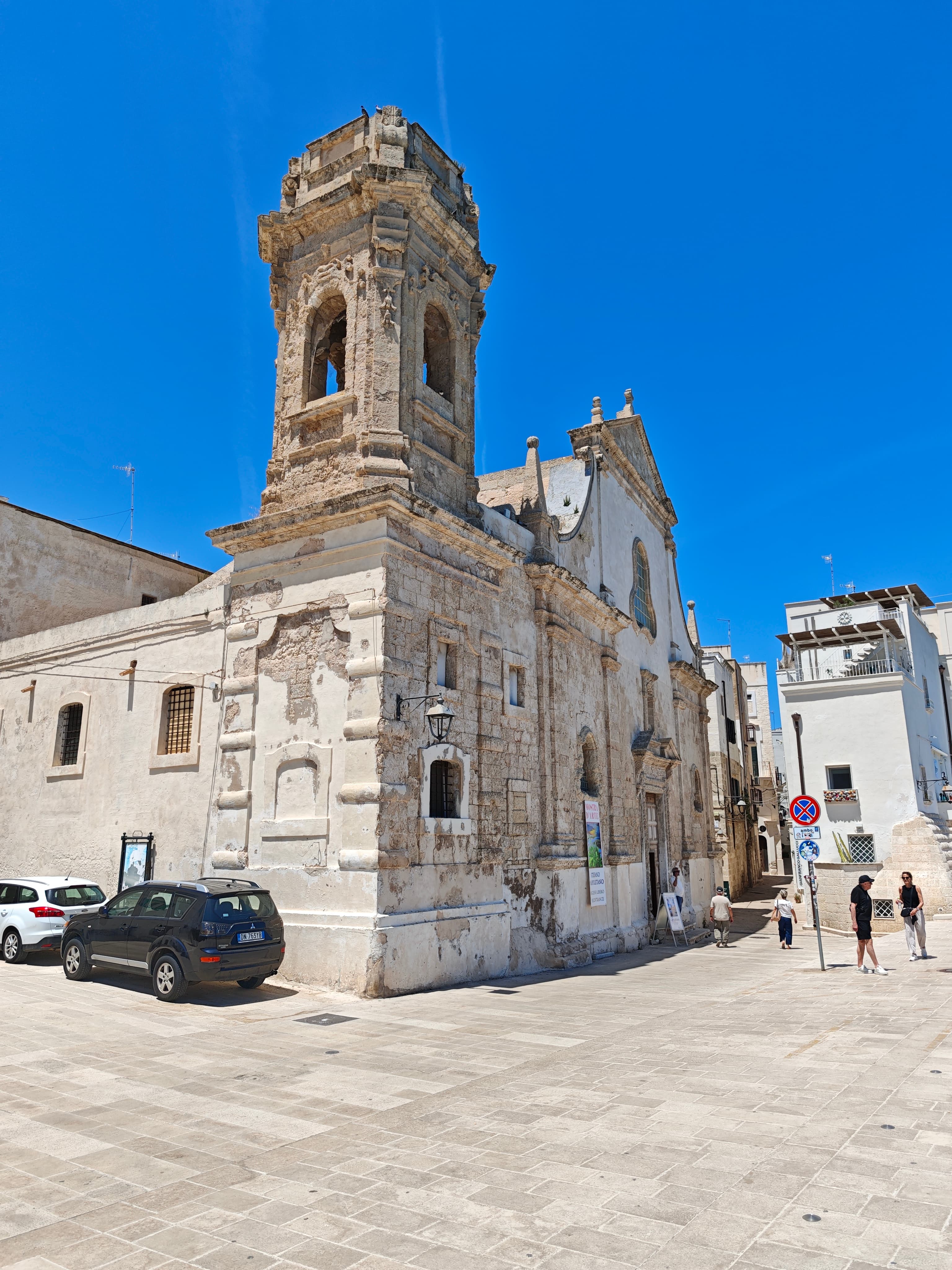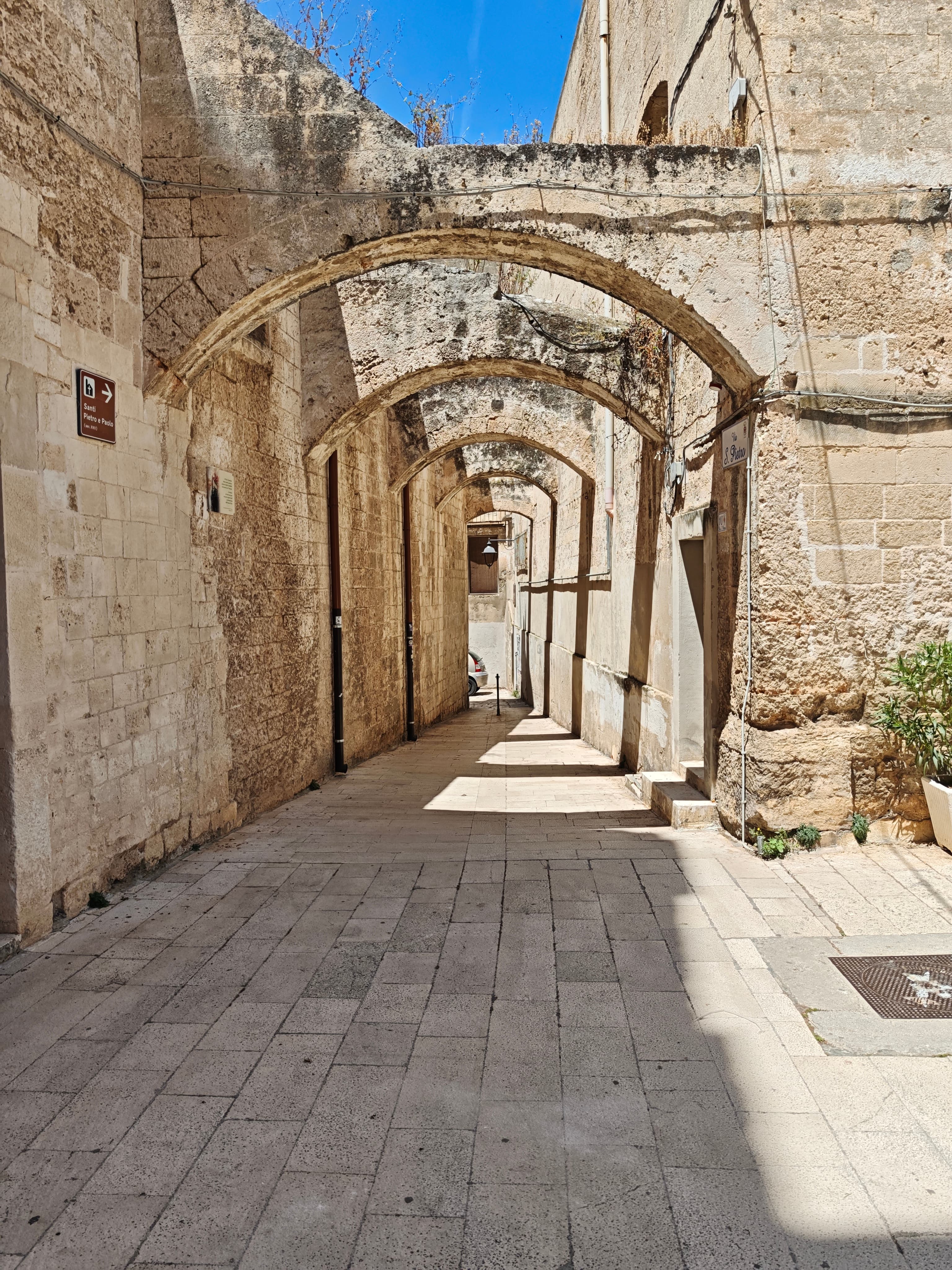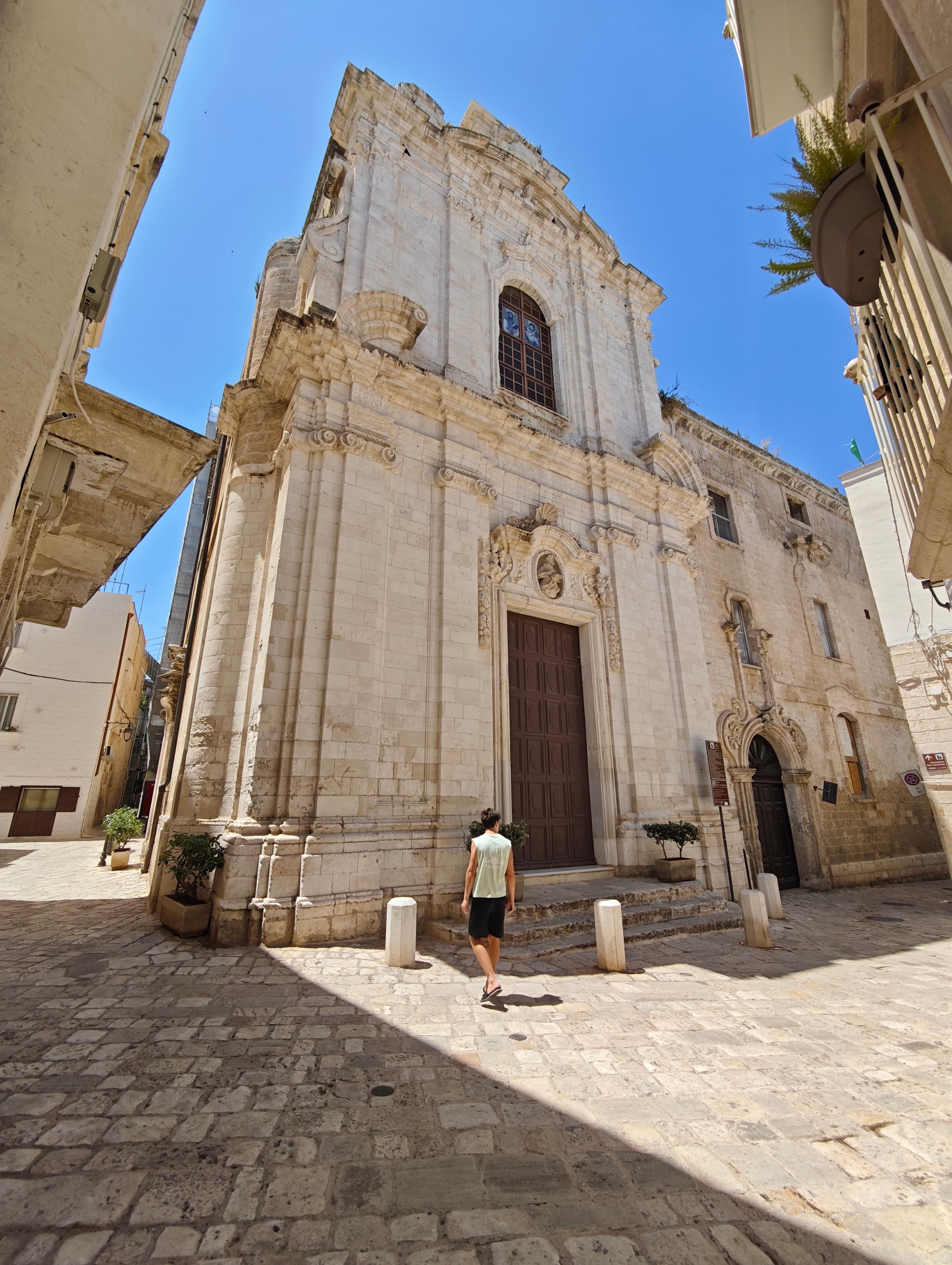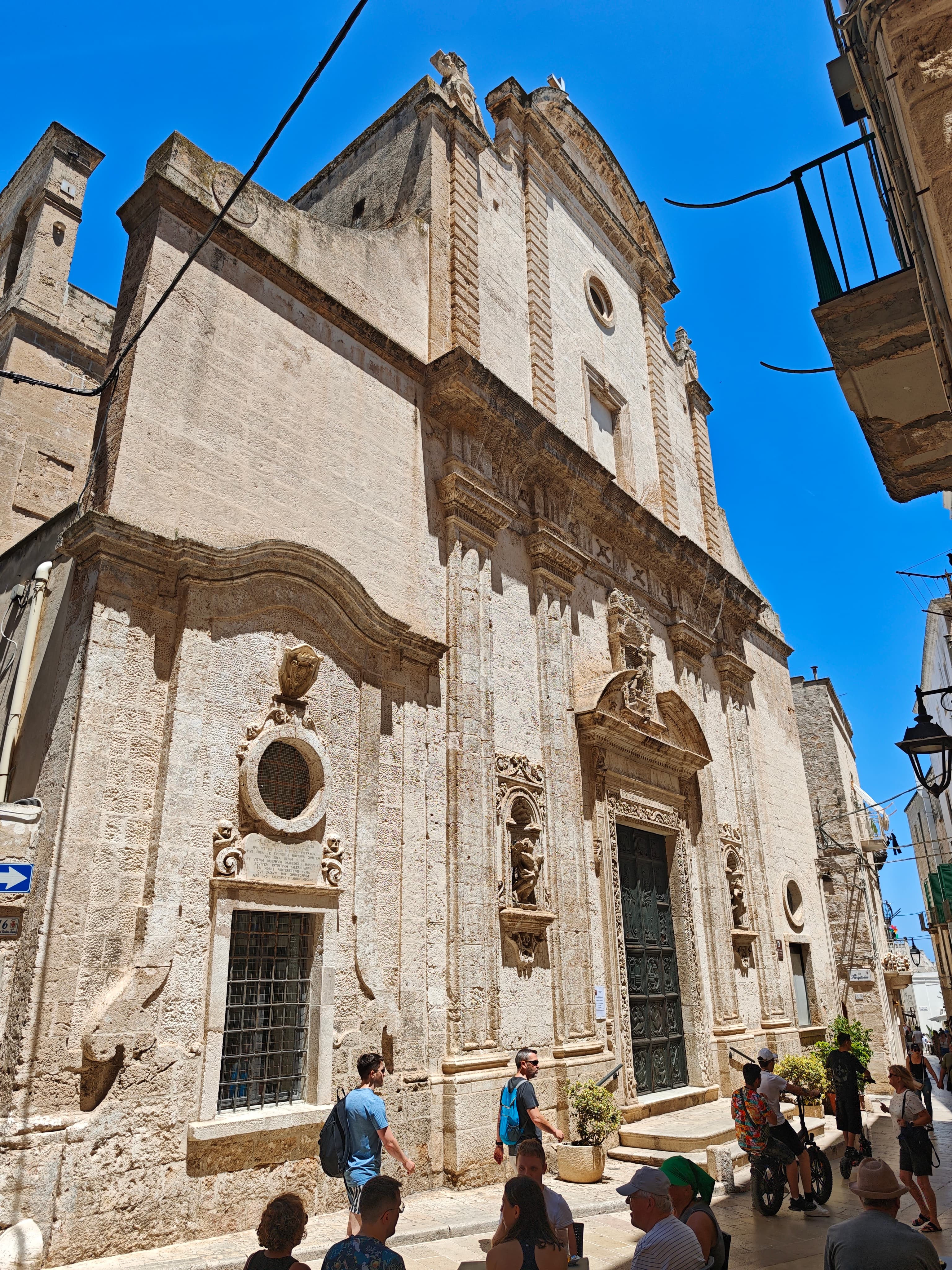
Monopoli
Monopoli

Monopoli

Show Notes

Comprehensive Travel Guide: Monopoli

Monopoli Travel Guide: The Complete, Practical, Atmospheric Guide for Travelers Who Have Already Booked

Monopoli is one of those Adriatic towns that seems, at first glance, almost too picturesque to be real: whitewashed lanes twisting toward a working harbor, blue wooden fishing boats rocking beneath ochre stone walls, small coves pressed against defensive bastions, and church bells ringing over the sound of waves. But what makes Monopoli linger in memory is not just beauty. It is that the beauty still feels lived-in.

This is not simply a polished seaside stage. Monopoli is a real coastal town in Apulia, southeast of Bari, with roughly 49,000 inhabitants, a long maritime history, an active fishing port, local markets, families on the evening promenade, teenagers perched on sea walls, grandmothers watching life from doorways, and fishermen still repairing nets in the Porto Antico. Travelers consistently describe it as authentic, walkable, safe, romantic, and atmospheric, though increasingly popular—especially in July and August, when its small beaches and narrow streets can become very crowded.

If you have already booked your trip, this guide is designed to help you make the most of the town in real time: what to see, what to prioritize, where to slow down, what to book ahead, what to expect from beaches, how to understand the history under your feet, and which sights are magnificent exteriors but unreliable interiors.

Monopoli’s essential experiences revolve around a few powerful themes:

  • The Centro Storico, a compact old town of white limestone lanes, shrines, churches, palaces, and small piazzas.
  • The Porto Antico / Porto Vecchio, a working old harbor with traditional blue and red gozzi boats.
  • The Cathedral Basilica of Maria Santissima della Madia, rooted in a famous 1117 sea miracle.
  • The Castello Carlo V, a 16th-century coastal fortress on the old harbor.
  • The seafront walls and bastions, among the most scenic free walks in town.
  • The small coves and beaches, including Cala Porta Vecchia, Cala Paradiso, Porto Rosso, Cala Porto Nero, Cala Cozze, Grotta della Cala Tre Buchi, and Porto Ghiacciolo.
  • The evening rituals: aperitivo, the passeggiata, Piazza Garibaldi, seafront bars, and long, slow meals.
  • The deeper historical layers: prehistoric caves, Messapian walls, Roman roads, Byzantine legends, Norman castles, Venetian trade, Spanish fortifications, Bourbon rule, World War bombardments, and modern tourism.

This is a town best experienced at different times of day: early morning at the harbor, midday in cool churches, late afternoon on the lungomare, sunset at the bastions, and evening in the piazzas.


Quick Orientation: What Monopoli Feels Like When You Arrive

Monopoli is a coastal town in Puglia / Apulia, on the Adriatic Sea, southeast of Bari. It is compact enough to explore on foot, especially if you are staying near the old town or seafront. The historical core is wrapped around the old harbor and bordered by sea walls, bastions, and small beaches. The train station lies inland from the center; from there, it is roughly a 10–15 minute walk to Piazza Vittorio Emanuele II, the main civic square, and then onward into the old town.

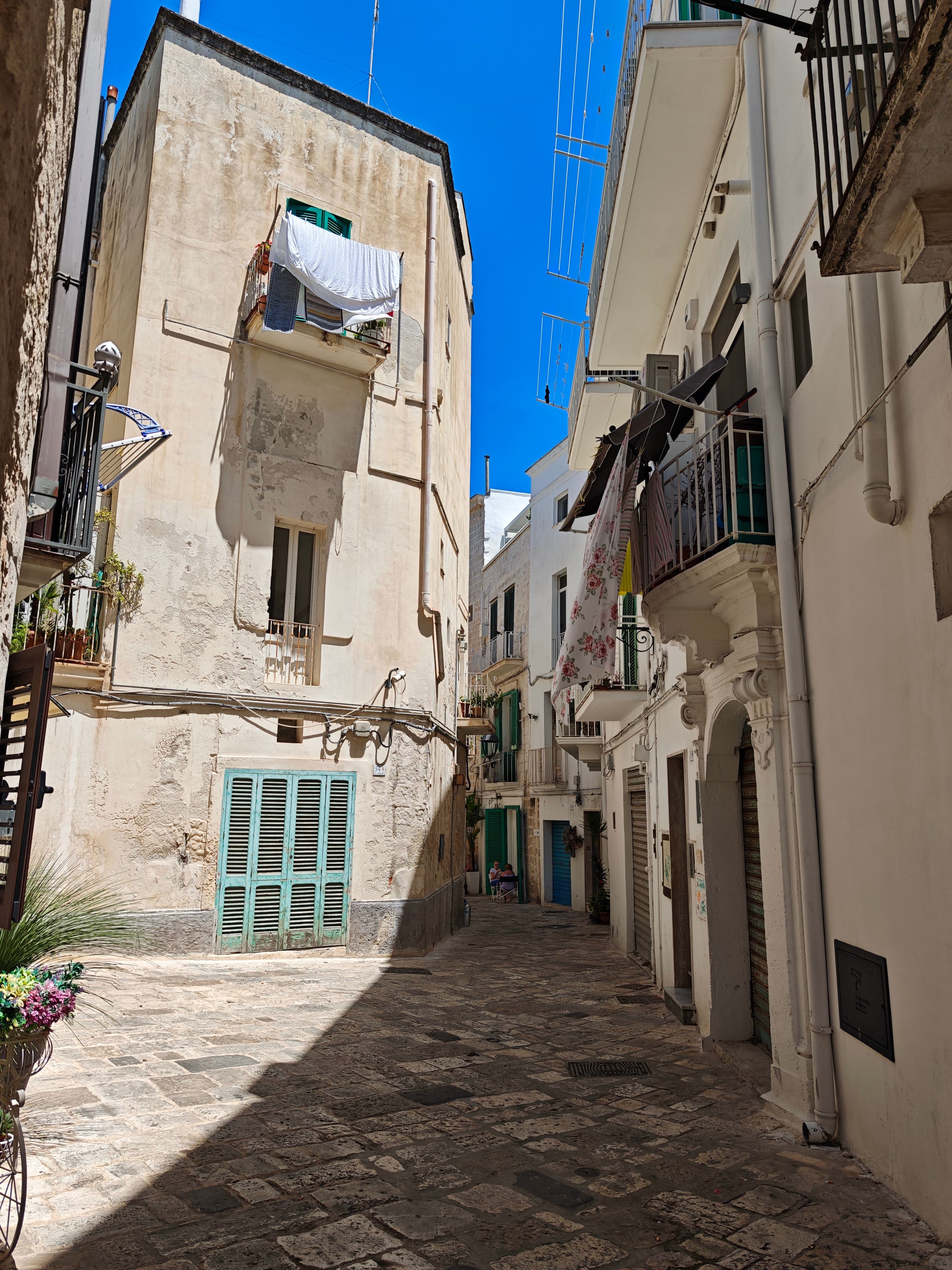
The first impression is usually one of brightness: pale limestone, white facades, green shutters, strong sun, and flashes of blue water appearing unexpectedly between streets. The old town is a maze rather than a grid. You should expect to get lost, and that is part of the pleasure. Many travelers say Monopoli rewards wandering more than checklist sightseeing.

Yet it is also a practical place. It has cafés, markets, beaches, lidos, restaurants, shops, churches, cultural sites, and train connections that make it a strong base for day trips to Polignano a Mare, Bari, Trani, Fasano / Zoosafari, the countryside masserie, and other Puglia destinations.

Top Google-Rated / Geo-Listed Attractions

The following major points of interest were identified with ratings, review counts, and locations:

AttractionTypeRatingReviewsAddress / Location
Castello Carlo VFortress / establishment4.42,340Largo Castello, 5, 70043 Monopoli BA
Porto anticoOld harbor4.71,521Via Porto, 70043 Monopoli BA
Centro storico di MonopoliHistoric center4.758Largo Palmieri, 70043 Monopoli BA
Cathedral Basilica of Maria Santissima della MadiaChurch4.73,690Largo Cattedrale, 70043 Monopoli BA
Piazza Giuseppe GaribaldiSquare4.6205Largo Giuseppe Garibaldi, 20, 70043 Monopoli BA
Palazzo PalmieriPalace4.4270Largo Palmieri, 70043 Monopoli BA
Grotta della Cala Tre BuchiCoastal cave / cove4.7996Via Procaccia, 70043 Monopoli BA
Apulia - The window on the seaViewpoint / establishment4.8101Via Porto, 8/n. 12, 70043 Monopoli BA
Museo e Sito Archeologico Cripta RomanicaMuseum / archaeological site4.833Via Argento, 3, 70043 Monopoli BA
Pescaturismo | Fatti piu làFishing tourism / boat experience4.978Porto Vecchio, Via Porto, 70043 Monopoli BA

These ratings align with the broader traveler consensus: Monopoli’s strongest attractions are its old town, cathedral, old harbor, castle, crypt, piazzas, and coastal experiences.


The Story of Monopoli: A Deep Historical Guide

Monopoli’s appeal becomes richer once you understand how many eras are layered into its streets. The city is not just “pretty Puglia”; it is a historical palimpsest shaped by prehistoric settlement, Messapian fortification, Roman roads, Byzantine migration, Norman conquest, Swabian loyalty, Venetian trade, Spanish military engineering, Bourbon administration, Italian unification, and wartime bombardment.

Prehistoric Beginnings: The “City of Dens”

The territory around Monopoli shows traces of very early human presence. Sea grottoes such as Cala Camicia and Cala Corvino have produced evidence of prehistoric occupation and even earlier human remains. The abundance of caves and grottoes along this coastline helped give rise to an ancient epithet for the area as a “City of Dens”città delle tane — referring to the many natural hollows along the shore.

This cave landscape still matters to the modern visitor. When you take a boat trip into the sea caves, swim near rocky coves, or explore places such as Grotta della Cala Tre Buchi, you are encountering the same coastal geology that shaped settlement here long before Monopoli became a fortified port.

Messapian and Peucetian Origins

In proto-historic times, the region belonged to ancient Peucezia, inhabited by the Messapians, an Italic people who occupied much of what is now central Apulia. Archaeological and local historical accounts indicate that Monopoli’s nucleus began as a Messapian fortress and seaside village, already functioning as a coastal hub around the 5th century BCE, often summarized as a fortified Messapian city around 500 BC.

This early settlement controlled routes along the Adriatic coast and inland toward the Murge plateau. The presence of Messapian walls beneath later structures, especially at the site of Castello Carlo V, is one of the most vivid examples of Monopoli’s ancient foundations surviving beneath later architecture.

Egnazia, Refugees, and Monopoli’s Rise

Nearby Egnazia — also called Ignazia — was a major Messapian and then Roman city located south of Monopoli. For a long time, Egnazia overshadowed Monopoli. But in 545 CE, Egnazia was reportedly destroyed by the Ostrogoths. According to local tradition and historical accounts, survivors moved north along the coast and founded or reinforced the Byzantine-era settlement at Monopoli.

This migration raised Monopoli’s importance dramatically. Population, skills, trade, and religious life shifted toward its harbor, helping it become a more significant Adriatic town.

The Name “Monopoli”

The name Monopoli is widely linked to Greek roots:

  • monos = single, unique
  • polis = city

Thus, many guides interpret Monopoli as the “single city” or “unique city.” The precise etymology and ancient toponym remain debated, but the idea of Monopoli as a “unique city” has become part of its modern identity.

Roman and Late Antique Monopoli

Under Roman rule, the Monopoli area sat along major coastal routes. The Via Traiana and Via Minucia converged near a settlement called Diria, considered a precursor or component of the Monopoli area. These roads connected Brundisium / Brindisi to Beneventum and onward to Rome, making the Adriatic coast a major corridor for imperial movement, commerce, and military communication.

Nearby, the harbor of Turris Paola served as a landing place for Egnazia. Remains of Turris Paola are still visible today inside the Abbey of Santo Stefano near Monopoli, preserving a tangible link to the Roman maritime network. The late Roman Tabula Peutingeriana records a settlement called Dertu in this coastal stretch, often associated with the area of modern Monopoli.

As Roman authority weakened in late antiquity, coastal centers like Egnazia declined or were destroyed. More defensible harbor settlements such as Monopoli gained importance, especially under Byzantine influence.

Byzantine Monopoli and the Madonna della Madia

After the fall of the Western Roman Empire, Monopoli came under Byzantine control, becoming part of the Eastern Empire’s defensive and administrative network in southern Italy. Its harbor made it a strategic Adriatic hub, used across various periods for the movement of goods and people.

By the High Middle Ages, Monopoli’s port was used at times as a staging and supply base for Crusaders traveling toward the Holy Land. The town was therefore connected not only to Puglia but to the wider Mediterranean world.

The defining religious event in Monopoli’s history is dated to 16 December 1117. According to legend, an icon of the Madonna della Madia drifted into the harbor on a raft laden with large wooden beams. Bishop Romualdo used these beams to repair or complete the collapsing roof of the cathedral. The miracle remains central to Monopoli’s identity and is commemorated annually in the Festa della Madonna della Madia, especially in December.

This legend is not just a story attached to the cathedral. It gives spiritual meaning to the old port itself, because the harbor is remembered as the place where the icon arrived from the sea.

Norman, Swabian, and Medieval Monopoli

In the 11th century, during the Norman conquest of southern Italy, Monopoli was destroyed again in 1042. It then passed under Norman control, and the town was rebuilt along with the Castle of Santo Stefano, guarding harbor approaches from a rocky spur protruding into the sea.

Through the 12th and 13th centuries, Monopoli became involved in conflicts associated with the Hohenstaufen / Swabian dynasty. Emperor Frederick II of Swabia granted the city its coat of arms, featuring three white roses on a red field. The roses symbolize fidelity to the emperor, while the red field recalls blood shed by inhabitants during the siege of 1207 by Gualtiero di Brienne, remembered as a major episode of civic resistance.

Monopoli’s medieval urban fabric—narrow limestone lanes, dense housing, churches, courtyards, and small squares—developed under successive Norman, Swabian, Angevin, and early Aragonese rulers.

The original Romanesque cathedral began in 1107 under Bishop Romualdo. It would later be transformed into the Baroque cathedral visitors see today.

Venetian, Aragonese, and Spanish Monopoli

From the 15th century, Monopoli’s fate was tied to struggles for control over the Adriatic.

After a period of Aragonese rule, the city endured a significant siege in 1456, after which control passed to the Venetians. Under Venetian rule, Monopoli prospered as a trading port. Its fortifications and walls were completed or strengthened to resist Saracen raiders and Turkish pirate fleets, which frequently threatened the Apulian coast.

The city returned to Aragonese control in 1530. Under the broader Habsburg-Spanish system, fortification became crucial. In 1522, the Castle of Santo Stefano was rebuilt or modified by order of Charles V, rising from the sea on three sides to dominate the harbor entrance.

The more famous Castello Carlo V, at the edge of the old town, dates from the mid-16th century. It reflects Monopoli’s role in the Habsburg-Ottoman confrontation across the Adriatic.

In 1545, Monopoli was granted Free Port status, accelerating commercial development. It became an agricultural and maritime harbor, with a strong fishing industry centered on the old port, the Molo Vecchio / Porto Vecchio.
Religious and charitable institutions also expanded. The Jerusalem Hospital, founded by the Order of the Hospitaller Knights in 1350, remained part of Monopoli’s historic memory.

Over the following centuries, Monopoli passed through the control of Spanish, Austrian, and Bourbon dynasties, reflecting the wider political changes of the Kingdom of Naples.

Risorgimento, World Wars, and Modern Monopoli

In the 19th century, Monopoli became part of the story of the Risorgimento, the movement for Italian unification. In 1861, it was unified with the rest of Apulia into the Kingdom of Italy.

The 20th century brought war back to the Adriatic. Because Monopoli’s harbor remained strategically important, the city suffered naval bombardment in World War I in 1916 and again in World War II in 1940. These events left scars and underscored the town’s continued military vulnerability.

Beneath Piazza Vittorio Emanuele II, anti-aircraft shelters from World War II survive as underground tunnels. They have only recently been made accessible on special occasions or guided visits.

Post-war Monopoli shifted from a primarily agricultural and fishing economy toward a mixed profile including industry, services, and tourism, while retaining its maritime identity.

Today, Monopoli is best understood as a layered town shaped by Messapian, Roman, Byzantine, Norman, Venetian, Spanish, Austrian, Bourbon, and Italian phases. Its old town is a living museum without being frozen as one.


The Historic Center: Centro Storico di Monopoli

The Centro Storico di Monopoli is the emotional and visual center of the town. It is a compact, whitewashed medieval quarter wrapped around the old harbor and bordered by city walls, bastions, churches, palaces, and coves. It is not a gated attraction. It is a lived-in neighborhood, freely accessible 24 hours a day, with no general admission fee.

Geo listing:

  • Centro storico di Monopoli
  • Rating: 4.7
  • Reviews: 58
  • Location: Largo Palmieri, 70043 Monopoli BA
  • Coordinates: 40.952487, 17.3050651

Why the Centro Storico Matters

Monopoli’s old town preserves layers of Greek, Roman, Byzantine, Norman, Venetian, Spanish, and local Apulian identity. It is a maze of:

  • Whitewashed homes
  • Limestone paving
  • Stone arches
  • Tiny courtyards
  • Shrines and votive niches
  • Baroque churches
  • Noble palaces
  • Winding alleys
  • Sea views at unexpected corners
  • Fortified walls overlooking the Adriatic

It is often praised in reviews as the main reason to come to Monopoli. Travelers love that it feels “genuine” and “lived-in,” unlike some old towns that seem staged entirely for tourism. People still live behind the shutters. Laundry still hangs across alleys. Children still play in squares. Grandmothers still sit in doorways. Locals still duck into churches for prayer.

There are said to be about 20 churches in the historic center, creating an unusually dense religious landscape. You may turn a corner and find a small Baroque façade filling a micro-piazza, or a simple stone doorway with a cross in a residential lane.

The Sensory Experience

The old town changes dramatically by time of day.

Morning

Early morning is one of the best times to wander. The streets are quieter, delivery vehicles pass through, cafés smell of espresso and warm pastries, and the harbor is still connected to its working rhythms. You may hear footsteps echoing on stone, the putter of a scooter, a neighbor calling down from a balcony, or fishermen at the port.

Midday

At midday, especially in summer, shutters close and the alleys become cool and dim. The town feels sleepy, stone-scented, and hushed. This is a good time to visit churches, the cathedral, or the crypt, or retreat for lunch.

Golden Hour

Late afternoon is magical. Light bounces off white walls, the limestone glows, and the sea appears intensely blue. This is when photographers and wanderers fall in love with Monopoli.

Evening

In the evening, the old town fills with the passeggiata. Restaurants open, piazzas glow, children play, couples stroll, and tables fill with wine, seafood, focaccia, and spritzes. Reviewers consistently praise Monopoli’s evening atmosphere as lively but not frantic.

Key Things to See in the Historic Center

Cathedral Basilica Maria Santissima della Madia

The most important church in town, with a Baroque interior and deep local legend.

Museo e Sito Archeologico Cripta Romanica

The Romanesque crypt and archaeological museum beneath the cathedral.

Castello Carlo V

The 16th-century fortress on the seafront.

Porto Antico

The old fishing harbor with traditional gozzi boats.

City Walls and Bastions

Especially the seafront promenade and Bastione Santa Maria.

Cala Porta Vecchia

The small beach immediately below the old walls.

Palazzo Palmieri

A late Baroque palace in Largo Palmieri.

Palazzo Martinelli-Meo Evoli

A dramatic seafront palace overlooking the old port.

Piazza Giuseppe Garibaldi

A social hub for aperitivo and evening dining.

Churches and Oratories

Including San Salvatore, San Domenico, Santa Maria Amalfitana, Santa Maria della Zaffara, San Francesco d’Assisi, and other smaller churches such as Santa Teresa.

Practical Information for the Centro Storico

  • Access: Free, open public neighborhood.
  • Opening hours: Streets and squares accessible 24/7.
  • Time needed: A few hours for a basic wander; half a day to a full day if visiting the cathedral, crypt, castle exterior/interior if open, port, bastions, and eating in the area.
  • Footwear: Wear comfortable shoes. Streets are stone-paved, uneven, and sometimes slippery.
  • Best times: Early morning for quiet; late afternoon/evening for light and atmosphere.
  • Safety: Generally considered safe, including at night. Normal city awareness applies in crowds.
  • Crowds: July and August evenings can be very crowded; narrow lanes may feel packed.
  • Parking: Difficult near the old town in high season. If arriving by car, allow extra time and expect stress.

Review Verdict

The Centro Storico lives up to the hype for most visitors. The main complaints are high-season crowds, some increasingly tourist-oriented shops, and higher prices around prime piazzas. But even critical travelers usually acknowledge its beauty. If you want it at its best, explore early in the morning or outside August.


Porto Antico / Porto Vecchio: The Old Harbor

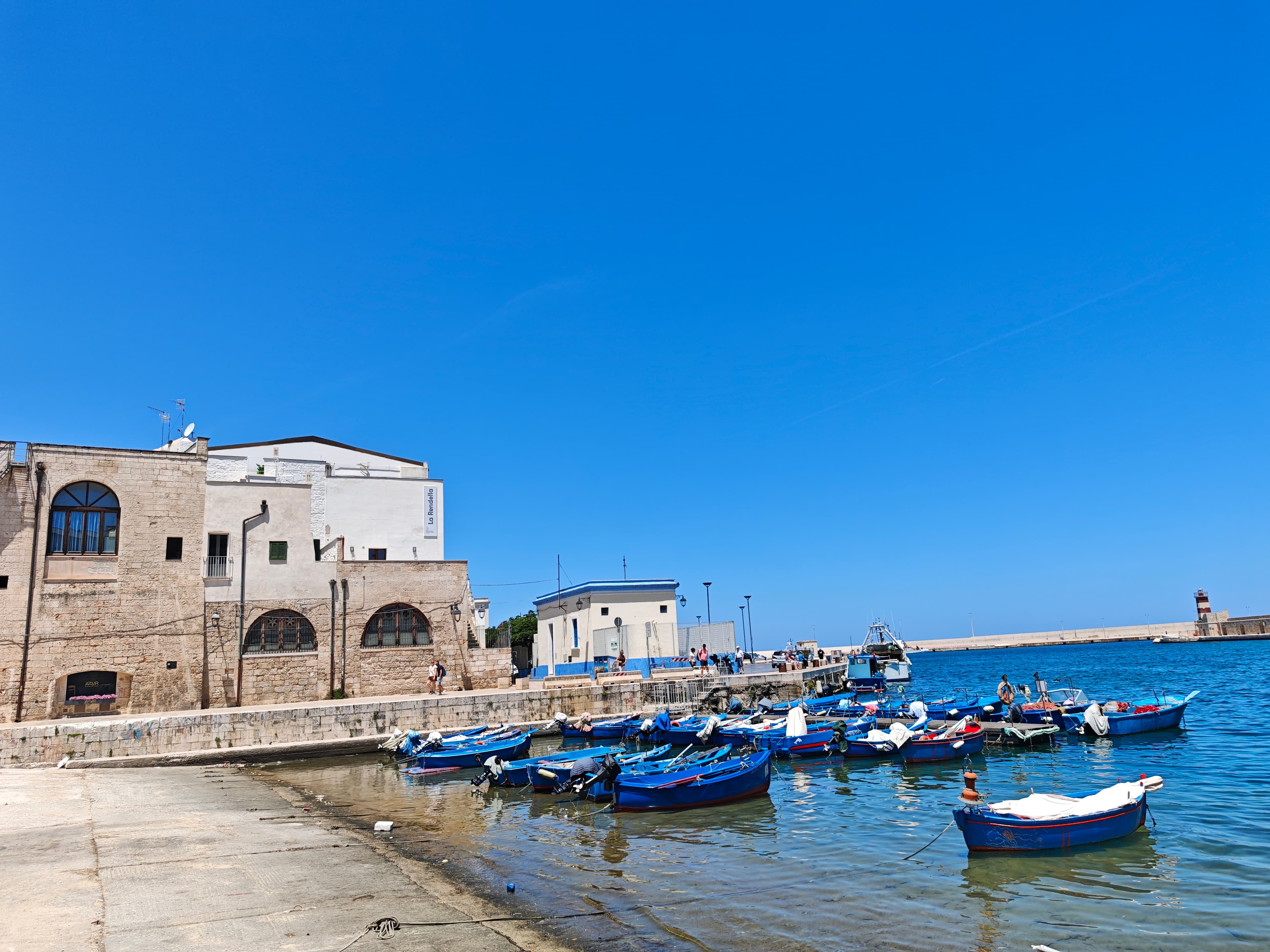
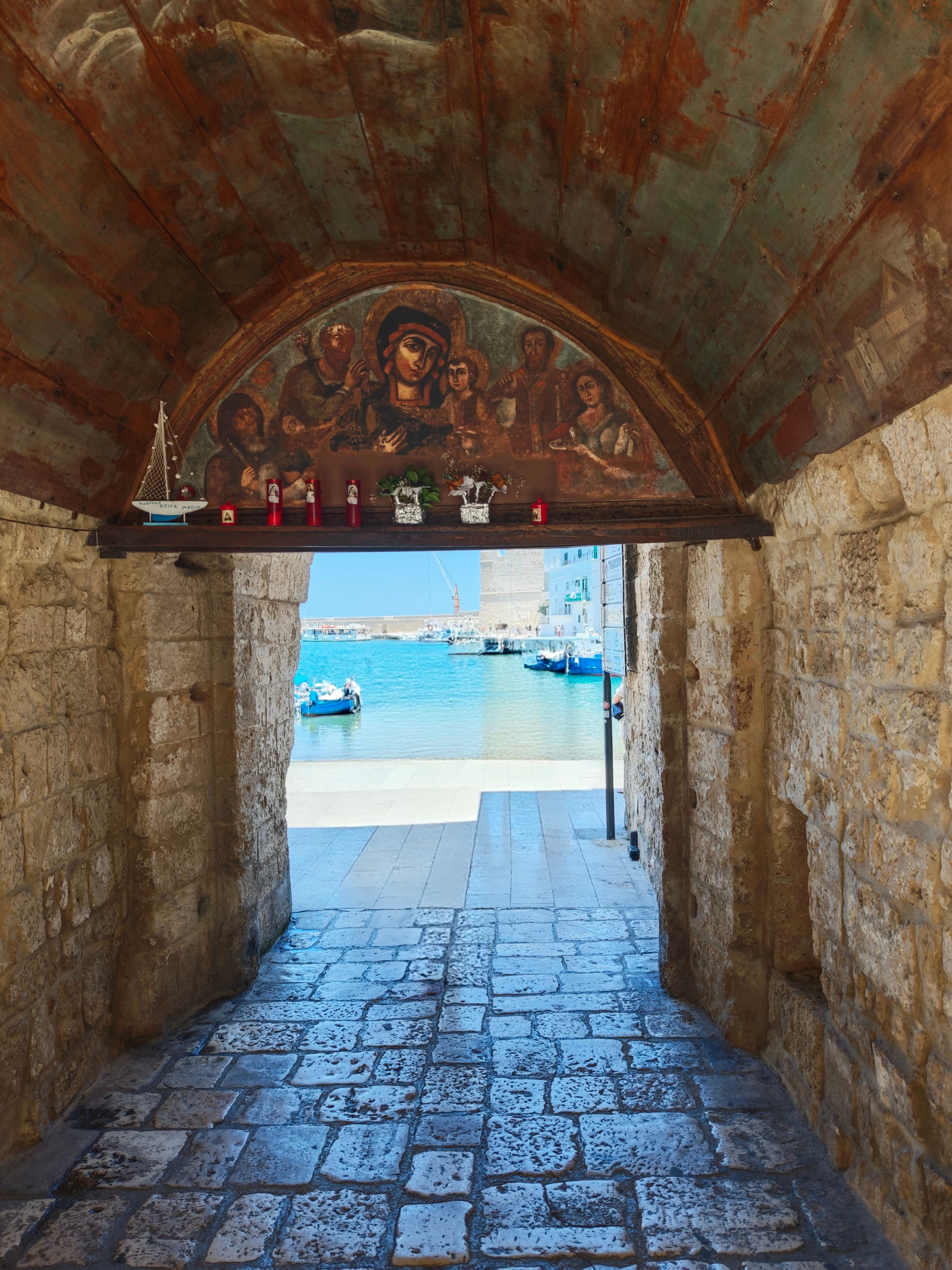
The Porto Antico, also called Porto Vecchio, is one of Monopoli’s defining sights: a small, enclosed working fishing harbor beneath the old town walls, filled with colorful wooden boats.

Geo listing:

  • Porto antico
  • Rating: 4.7
  • Reviews: 1,521
  • Address: Via Porto, 70043 Monopoli BA
  • Coordinates: 40.9530196, 17.3040435

Nearby also:

  • Pescaturismo | Fatti piu là
  • Rating: 4.9
  • Reviews: 78
  • Address: Porto Vecchio, Via Porto, 70043 Monopoli BA
  • Coordinates: 40.9532761, 17.3040699

And:

  • Apulia - The window on the sea
  • Rating: 4.8
  • Reviews: 101
  • Address: Via Porto, 8/n. 12, 70043 Monopoli BA
  • Coordinates: 40.952957, 17.303792

Why the Port Matters

Monopoli’s prosperity has always been tied to its harbor. The old port served as a maritime hub from antiquity through medieval, Venetian, Spanish, and modern periods. It was a place of trade, fishing, defense, and religious memory.

Local tradition connects the old harbor with the arrival of the Madonna della Madia icon in 1117. Thus, the port is not only scenic; it is a sacred civic memory site.

The Gozzi Boats

The visual hallmark of Porto Antico is the cluster of traditional wooden fishing boats called gozzi, locally also referred to as vozz. They are usually painted blue and sometimes red, and are among Monopoli’s most photographed symbols.

Traditional features include:

  • Length around 3.5–5 meters / 12–17 feet
  • Built from local pine wood
  • Keel and ribs made of oak
  • Planking historically caulked by hand
  • Coated with hot pitch and tar to protect against shipworm and barnacles
  • Originally rowboats
  • Many motorized since the 1970s
  • Some older fishermen still use traditional oared versions

These boats are not props. Porto Antico remains a working harbor, and you may see fishermen unloading catch, mending nets, preparing boats, or chatting on the quay.

Atmosphere by Time of Day

Dawn and Early Morning

This is the most authentic time. You may smell diesel, wet rope, fish, salt, and tar. Engines rumble. Gulls scream. Nets are piled. Buckets move. Instructions are shouted. The harbor feels like a workplace first, postcard second.

Midday

The port becomes quieter, hotter, and more photogenic. Boats rock gently in turquoise water. White walls reflect bright light. It is a quick but essential stop during an old-town walk.

Sunset

Late afternoon and sunset soften the colors. The blue boats, pale walls, and castle become luminous. Photographers gather. The harbor becomes one of the best places in town for images.

Evening

The castle and bastions are lit, reflections shimmer in the water, and restaurant smells drift from nearby alleys: tomato sauce, garlic, olive oil, grilled fish.

Practical Information

  • Access: Free public harbor.
  • Opening hours: Accessible 24/7, subject only to temporary restrictions.
  • Best times: Early morning for working harbor life; golden hour for photography; evening for atmosphere.
  • Footwear: Stone quays can be uneven and slippery near water.
  • Respect: Do not step on nets, block fishermen, or enter restricted working areas.
  • Typical visit length: 10–30 minutes, longer if photographing or sitting.

Optional Boat and Fishing Experiences

Boat tours and fishing tourism experiences may depart from or near the old port. One highlighted operator is Pescaturismo | Fatti piu là, rated 4.9 with 78 reviews. Fishing tourism can be a meaningful way to experience Monopoli’s maritime identity beyond simply photographing the boats.

Boat tours by gozzo or small craft often explore Monopoli’s coast, sea caves, and sometimes continue toward Polignano a Mare. Typical shared boat tours of around 2.5 hours are often in the €30–€50 per person range, depending on operator and season. Always confirm:

  • Group size
  • Swim stops
  • Drinks included
  • Route
  • Music / party vibe vs quiet excursion
  • Weather cancellation policy

Review Verdict

The old port is widely considered one of Monopoli’s must-see viewpoints. The main criticism is that there is “not much to do” beyond admire, photograph, and absorb the scene. But that is the point. It is a scenic, emotional, identity-rich place rather than an activity complex. It is absolutely worth visiting, especially at sunrise or sunset.


Cathedral Basilica of Maria Santissima della Madia

The Cathedral Basilica of Maria Santissima della Madia is Monopoli’s central religious landmark and one of its highest-rated attractions.

Geo listing:

  • Cathedral Basilica of Maria Santissima della Madia
  • Rating: 4.7
  • Reviews: 3,690
  • Address: Largo Cattedrale, 70043 Monopoli BA
  • Coordinates: 40.9508368, 17.3033327

History and Legend

The first church on this site was begun in 1107 by Bishop Romualdo in Romanesque style. Work was difficult to complete, partly because the necessary roof timber was lacking.

Then, according to Monopoli’s central legend, on 16 December 1117, a Byzantine icon of the Madonna and Child arrived from the sea on a raft laden with wooden beams. The beams were interpreted as providential and used to complete or repair the church roof. The icon became the Madonna della Madia, Monopoli’s patroness.

The cathedral was consecrated on 1 October 1442 after centuries of development. In the 18th century, the church was extensively rebuilt, giving it its present late-Baroque appearance.

What to See

The cathedral’s exterior is monumental but harmonious. The square includes the cathedral façade, the Bishop’s Palace, and decorative elements such as statues and a clock. At night, the square becomes calm and theatrical.

Inside, visitors find:

  • Rich Baroque decoration
  • Polychrome marble
  • Frescoes
  • Side chapels
  • Paintings by artists including Palma il Giovane and Francesco De Mura
  • The revered Byzantine icon of the Madonna della Madia
  • The “Cupboard of the Beams”, containing 31 wooden pieces associated with the legendary raft
  • A cool, hushed, incense-scented interior that offers refuge from heat and crowds

The interior often surprises travelers because it is grander than expected for a town of Monopoli’s size.

Atmosphere

Stepping inside from the bright streets can feel like entering a shaded pool. The air is cool and heavy with candle wax and incense. Sounds become soft and echoing: footsteps, whispers, doors closing. The cathedral is both a tourist sight and an active devotional space. Religious life is not just historical here; it is still present.

The legend of the Madonna della Madia gives the church emotional weight. Even if you are not religious, the story explains how deeply the town understands itself through the sea, protection, miracle, and gratitude.

Practical Information

Reported opening schedules vary slightly:

  • One reported schedule: 07:30–12:00 and 16:00–20:30
  • Another listed schedule: 8:00 AM–12:00 PM and 4:00 PM–8:00 PM
  • It is generally open daily, but hours may vary for services, feast days, and local circumstances.

Tickets

  • Main cathedral nave: Generally free.
  • Donations may be appreciated.
  • Charges apply to the crypt museum beneath, not to the main church.

Review Verdict

Travelers consistently recommend the cathedral for at least 20–30 minutes, longer if you enjoy religious architecture. It is considered an integral part of Monopoli’s identity. The main practical issue is timing: if you arrive during midday closure or services, you may need to return later.


Museo e Sito Archeologico Cripta Romanica

The Museo e Sito Archeologico Cripta Romanica, also called the Museo della Cripta di Romualdo or Museo di Romualdo – Cattedrale di Monopoli, is the archaeological museum beneath the cathedral. It is one of Monopoli’s most underrated cultural sites.

Geo listing:

  • Museo e Sito Archeologico Cripta Romanica
  • Rating: 4.8
  • Reviews: 33
  • Address: Via Argento, 3, 70043 Monopoli BA
  • Coordinates: 40.95091, 17.303882

Why It Matters

The museum occupies the Romanesque crypt of the old cathedral built under Bishop Romualdo in the 12th century. That Romanesque cathedral was demolished in 1742 to make way for the present Baroque cathedral dedicated to Madonna della Madia.

Restoration and archaeological works beneath the 18th-century cathedral revealed earlier remains: Romanesque structures, burials, tombs, sculptural fragments, and artifacts that help reconstruct Monopoli’s long history from pre-Roman times to the Baroque era.

What You See

The visit path is suspended above archaeological layers beneath the apse and transept of the cathedral. It includes:

  • The atmospheric Romanesque crypt
  • Romanesque, Gothic, and Renaissance sculptural fragments
  • Capitals, reliefs, cornices, and liturgical elements
  • Earlier tombs and burial areas
  • Messapic and Hellenistic tombs from the 7th–2nd century BC
  • The Brigida private collection, a major donation of archaeological finds from the Monopoli area
  • Grave goods of high value
  • A unique bronze trozzella, exceptional because trozzelle are normally ceramic
  • A 12th-century stone architrave considered among Monopoli’s most important artworks
  • The crypt of the Confraternita del Santissimo Sacramento
  • A putrefazio, or mummification/decomposition area used for confraternal funeral rituals

The stone architrave narrates the death and resurrection of Christ in five carved panels, populated by symbols, prophets, angels, saints, and Old and New Testament figures.

The final mummification area is frequently described by visitors as one of the most striking and unusual parts of the tour.

Atmosphere

The crypt feels secret, subterranean, and reverent. The air is cooler and slightly damp. Light is subdued. Fresco fragments appear in muted reds, golds, and blues. Footsteps echo. The experience creates a strong sense of vertical time: the modern town above rests on centuries of burials, prayers, and earlier buildings.

Many visitors find it unexpectedly moving. Emerging back into the sunny cathedral square can feel like resurfacing from deep water.

Tickets and Prices

Current official-style tariff for the Museo di Romualdo / Cripta Romanica:

  • Standard ticket: €5
  • Reduced ticket: €4
    • Touring Club members
    • Groups of more than 15 people
    • Personnel of the Italian Ministry of Culture
  • Special ticket: €1
    • School groups with reservation
    • One accompanying person per visitor with disabilities
    • Young people up to 18 years old
  • Free admission for:
    • Individual students in Cultural Heritage, Art History, Archaeology, Archival and Library Sciences
    • Children up to 7 years
    • Teachers
    • Licensed tour guides
    • Visitors with disabilities
    • Members of ICOM, ICOMOS, ICCROM
    • Clergy and seminarians
    • Ministry of Culture personnel
  • Audioguide: €2

Older reviews sometimes mention €2 including a short guided tour, but the more current tariff is €5 / €4 / €1.

Opening Hours

Officially reported regular opening times:

  • Friday: 18:00–21:00
  • Saturday: 11:00–13:00 and 18:00–21:00
  • Sunday: 11:00–13:00 and 18:00–21:00
  • Last entry: 30 minutes before closing

Implications:

  • Usually closed Monday–Thursday
  • Limited hours
  • Verify before going

Another broader historical-center summary reported Thursday–Sunday hours of 09:30–13:30 and 16:00–20:00, but the more detailed official-style schedule above should be treated as the stronger baseline. Because schedules can change, check shortly before your visit.

Contact

  • Phone: +39 339 678 0670
  • Email: museodiromualdo.monopoli@gmail.com
  • Check also local channels associated with Pietre Vive Monopoli, whose volunteers often run guided visits.

Review Verdict

For history-minded travelers, the crypt is an underrated gem and well worth the €5. It is small, often a 30–45 minute visit, but dense in history. The main complaint is limited opening hours and sometimes limited English signage. If you catch it open, go.


Castello Carlo V: The Charles V Castle

Castello Carlo V is Monopoli’s iconic coastal fortress, standing at the edge of the old town near the harbor.

Geo listing:

  • Castello Carlo V
  • Rating: 4.4
  • Reviews: 2,340
  • Address: Largo Castello, 5, 70043 Monopoli BA
  • Coordinates: 40.9541325, 17.3052013

Historical Layers

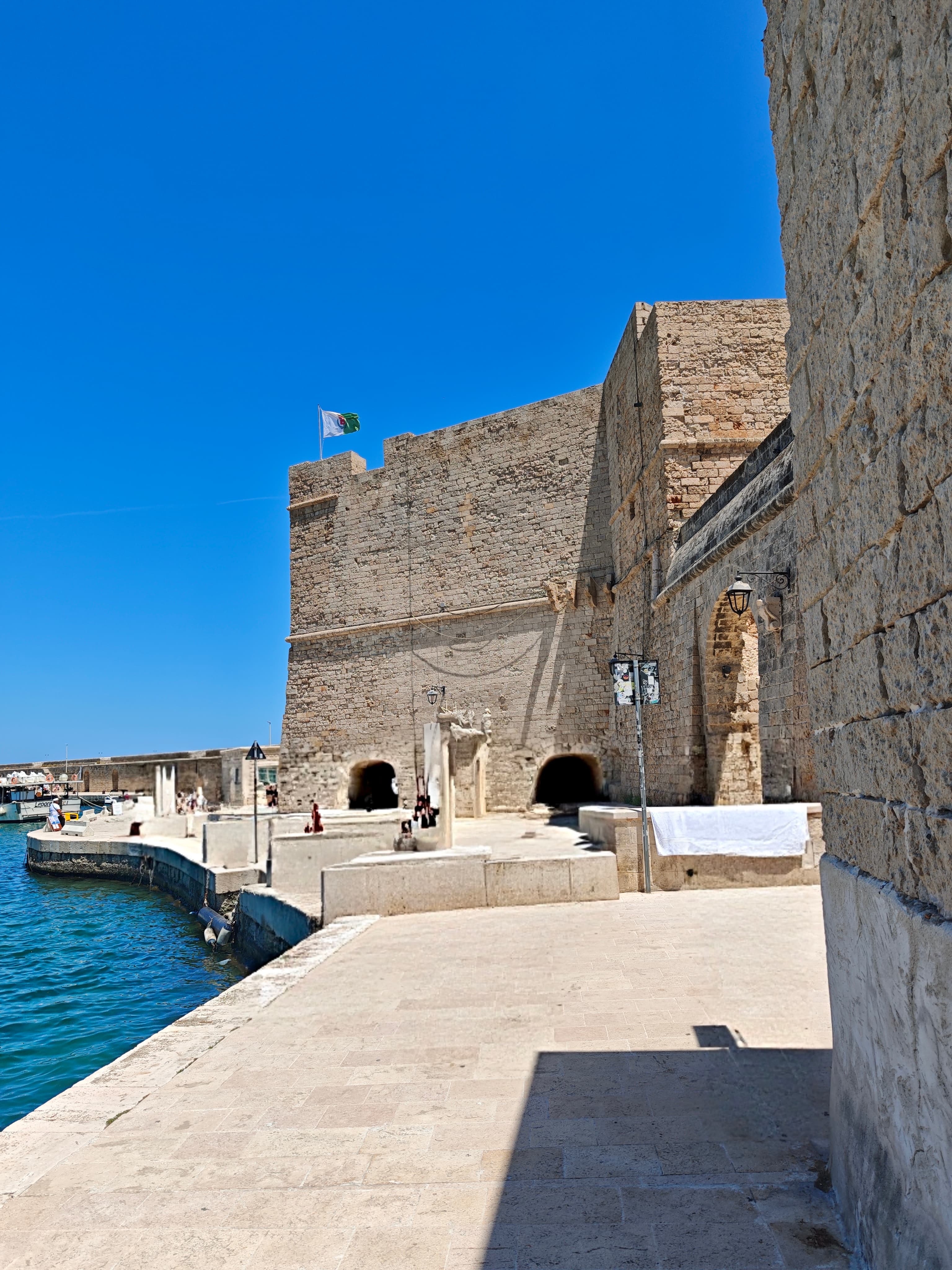
The castle stands on a rocky promontory called Punta Pinna, overlooking the old harbor. It is famous as a 16th-century fortress built under Emperor Charles V as part of the Spanish coastal defense system protecting the Kingdom of Naples from Ottoman and pirate raids.

Construction took place in the first half of the 1500s, with early works completed in 1552. It was ordered by Charles V of Spain and overseen in different accounts by Viceroy Don Pedro de Toledo or Marquis Don Ferrante Loffredo.

The site is older than the castle itself. Its foundations incorporate:

  • Messapian walls from the 5th century BC
  • A large Roman gate from the 1st century BC
  • The rock church of San Nicola in Pinna, dating to the 10th–11th century

This makes the castle site a remarkable stack of defensive, religious, and civic history.

Later Uses

Between about 1600 and 1660, the fortress was enlarged and restructured, becoming not just a defensive stronghold but also a residential and garrison building for Spanish officers and their families.

From the first half of the 19th century until 1969, it served as Monopoli’s prison.

After neglect, the castle underwent consolidation and restoration in the 1990s, especially around 1998. Today it serves as a cultural venue for exhibitions, conferences, weddings, municipal events, and sometimes archaeological or maritime displays.

Architecture and What to See

The castle is described as a pentagonal seaside fortress, typical of Spanish bastion fortifications, with five vertices marked by bastions. It has:

  • Quay / sea level
  • Parade-ground level
  • Intermediate storage floors
  • Main entrance on the southern side
  • Cylindrical tower
  • 15th-century city wall section visible to the left of the tower
  • Loggia with stone coat of arms dated 1552
  • Bastions and ramparts
  • Sentry walkway connecting lookout towers
  • Cannon embrasures facing the sea
  • Cannons outside
  • Internal parade ground / courtyard
  • Armoury or great hall at quay level
  • Neapolitan howitzers from the early 19th century
  • Maritime tradition artifacts
  • Basement rock church of San Nicola de Pinna
  • Panoramic views over the old port and Adriatic

Atmosphere

The castle feels solid, severe, and wind-exposed. Sea breezes carry salt, algae, tar, and diesel. From its ramparts or surrounding bastions, you look down over Porto Antico and out toward open water. The fortress gives Monopoli an undercurrent of resilience and watchfulness.

At sunset, the stone warms gold, the sky turns pink and orange, and the sea darkens. Even if the interior is closed, the exterior and surrounding views are a major part of the Monopoli experience.

Tickets and Opening Hours

This is one of the less predictable sites.

Tickets

Reports suggest:

  • Sometimes free
  • Sometimes low-cost
  • Exhibitions may charge a fee
  • Estimated €0–€5
  • Reduced fees, if applicable, might be around €2–€3
  • Children may be free or symbolic charge
  • Special events ticketed separately

Opening Hours

No consistently reliable current timetable is published in the gathered material. Some travel sources report typical hours such as:

  • 10:00–13:00 and 17:00–21:00
  • Other broader patterns suggest 8:00–12:00 and 16:00–19:00
  • Summer may bring more evening openings
  • Winter may be very limited
  • Private events and weddings may close areas

Treat all times as provisional. Check:

  • Monopoli official tourism portal
  • Comune di Monopoli pages
  • Tourist office
  • Signage at the castle

Review Verdict

The castle exterior and views are widely praised. The interior is hit-or-miss. Some visitors find it underused, sparsely interpreted, closed, or lacking English information. Others enjoy exhibitions and events. The safest expectation: go for the fortress setting, harbor views, and exterior, and treat interior access as a bonus.


City Walls, Seafront Bastions, and Lungomare

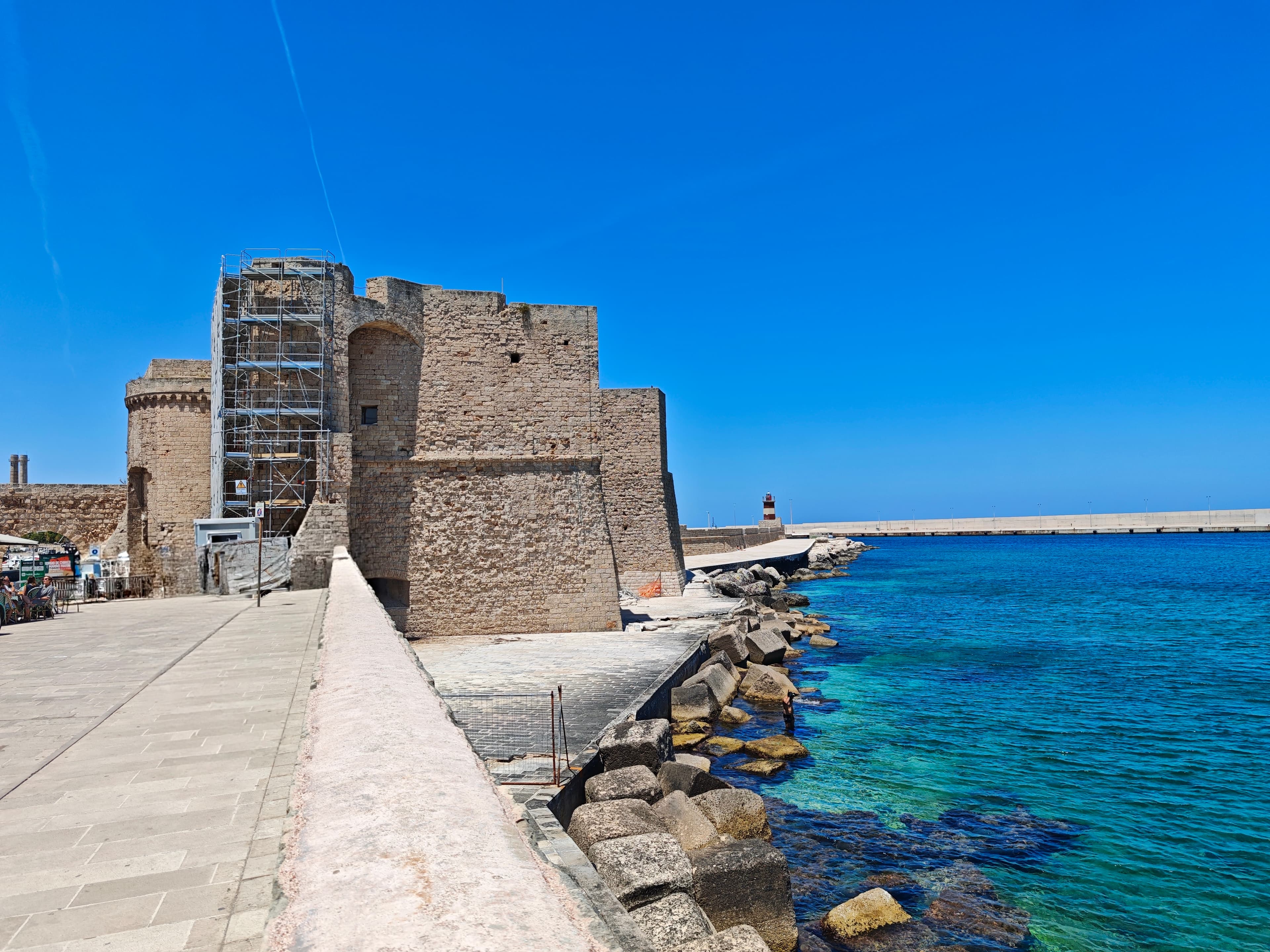
The city walls and seafront bastions form one of Monopoli’s best free experiences. They wrap the old town along the Adriatic, linking the old port, castle, bastions, coves, and beaches.

Historical Role

The walls and bastions reflect Monopoli’s strategic role as a coastal stronghold. They were shaped by medieval and early modern threats, especially Ottoman, Turkish, pirate, and Saracen raids from the sea. The defensive ensemble includes:

  • Thick stone walls
  • Bastioned projections
  • Watchtowers
  • Seafront promenade
  • Bastione Santa Maria
  • Links to Castello Carlo V
  • Views over Porto Antico and the Adriatic

Bastione Santa Maria

Bastione Santa Maria is a key defensive tower/bastion along the seafront. It is noted for two cannons pointing out to sea. It offers classic views of the fortified town and coastline.

The Lungomare Experience

The lungomare runs along the old town walls, from Porto Antico toward Porto Rosso, with honey-colored fortifications on one side and open sea on the other.

Travelers describe it as one of the most local and atmospheric walks in town. Families stroll arm-in-arm, teenagers sit on walls, older men watch the sea, dogs bark, waves slap rocks, and church bells drift across the air.

The walk changes by time:

  • Morning: bright, clear, peaceful
  • Afternoon: hot and exposed
  • Sunset: romantic and golden
  • Night: reflective, with lamps shimmering on water

Practical Information

  • Access: Free
  • Opening hours: Public promenade, essentially 24/7
  • Best times: Sunrise, sunset, evening
  • Cautions: Windy, exposed, sometimes crowded; stone can be uneven
  • Nearby: Porto Antico, Castello Carlo V, Cala Porta Vecchia, Porto Rosso, old town lanes

Review Verdict

Almost universally recommended. It is one of Monopoli’s simplest and strongest pleasures: free, scenic, romantic, and deeply tied to the town’s identity.


Cala Porta Vecchia: The Iconic Town Beach

Cala Porta Vecchia is the small sandy beach immediately below the old town walls. It is one of Monopoli’s most atmospheric places and one of its most crowded in summer.

Why It’s Special

The setting is extraordinary: you swim with white houses, church towers, and fortified walls rising behind you. The beach is woven into the town rather than separated from it.

The vibe is local and communal:

  • Families with children
  • Older residents wading slowly
  • Teenagers on the rocks
  • Swimmers taking quick dips during sightseeing
  • Restaurants and urban sounds above the beach

The smell is sunscreen, warm saltwater, fried seafood, and sun-baked limestone.

Pros

  • Magical views of old walls and white town
  • Easy to reach on foot
  • Great for a quick swim during sightseeing
  • Lively local feel
  • Free public beach

Cons

  • Very small
  • Extremely crowded in summer afternoons
  • Sand may be compacted, pebbly, or not especially fine
  • Noise and occasional litter due to heavy use
  • Not ideal for a full relaxing beach day in high season

Practical Tips

  • Go early morning or late afternoon.
  • Do not expect solitude in July/August.
  • Use it for a quick dip, sunset, or atmospheric swim.
  • Bring minimal gear because space is tight.
  • Combine with the seafront walls or old town walk.

Review Verdict

Worth seeing and worth swimming at least once if conditions allow. But it is not a peaceful beach escape in peak season. Think of it as a scenic urban beach experience, not a remote paradise.


Other Monopoli Coves and Beaches

Monopoli’s coastline is dotted with small coves, rocky ledges, beach clubs, caves, and swimming spots. Immediate beaches are often small and crowded, but the coastline is one of the town’s great assets if you adapt your expectations.

Cala Porto Nero, Cala Cozze, and Small Coastal Coves

These small coves along the lungomare and south of town are loved by swimmers who do not need services.

Pros

  • Clear turquoise water
  • Free access
  • Rocky ledges for sunbathing
  • Ability to move between coves
  • Often less crowded than Cala Porta Vecchia if you go early

Cons

  • Small and quickly full
  • Minimal or no facilities
  • Uneven or steep access
  • Not ideal for mobility issues
  • Less comfortable for families needing toilets, showers, and shade

Verdict

Excellent for adventurous swimmers and travelers who like low-service natural spots. Arrive early, bring water, and wear good sandals or water shoes.

Grotta della Cala Tre Buchi

Geo listing:

  • Grotta della Cala Tre Buchi
  • Rating: 4.7
  • Reviews: 996
  • Address: Via Procaccia, 70043 Monopoli BA
  • Coordinates: 40.9412708, 17.3170589

This is one of the better-known coastal cave/cove areas around Monopoli. Its high rating and substantial review count reflect the appeal of the rocky coastline and sea-cave setting. Expect natural beauty, uneven access, and peak-season crowds. It fits into Monopoli’s broader cave-and-cove identity that goes back to the prehistoric “City of Dens” landscape.

Cala Paradiso

Cala Paradiso is often cited as one of the best-looking beaches around Monopoli. It has clear water, rocky cliffs, a scenic cove setting, and a lido / beach club setup with loungers and umbrellas.

Atmosphere

More “holiday beach” than old-town beach. Expect music, sunbeds, umbrellas, children shouting, sunscreen smells, beach bar food, and a polished leisure atmosphere.

Pros

  • Scenic cove
  • Clear water
  • Services
  • Loungers and umbrellas
  • Good for a classic beach day

Cons

  • Crowded
  • More commercial
  • Less contemplative
  • Paid lido experience if using services

Verdict

Good if you want an organized beach day with facilities. Less ideal if you are searching for wild solitude.

Porto Rosso and Lido Sabbiadoro

The Porto Rosso area, south of the old town, includes beach and lido options. Lido Sabbiadoro / Cala Porto Rosso is often discussed by reviewers as a convenient sandy lido area.

Pros

  • Sandy option close to town
  • Shallow calm water
  • Sunbeds and umbrellas
  • Toilets and snack bars
  • Family-friendly
  • Easy “plug-and-play” beach day

Cons

  • Packed in July/August
  • Rows of sunbeds
  • Generic/commercial vibe
  • Prices can feel high compared with free coves
  • Extra charges may apply for front row, weekends, parking, etc.

Practical Tip

Ask clearly about:

  • Daily sunbed/umbrella rate
  • What is included
  • Parking
  • Shower/toilet access
  • Front-row supplements
  • Weekend/holiday pricing

Verdict

Convenient and family-friendly but not special. Worth it if you want sand and services; skip if you want dramatic scenery or quiet nature.

Porto Ghiacciolo and Abbazia di Santo Stefano

A bit outside the center, Porto Ghiacciolo is a beloved beach cove known for cool refreshing water and the nearby Abbazia di Santo Stefano, a medieval abbey perched above a rocky promontory.

The name “Ghiacciolo” means “icicle” or “popsicle,” hinting at the water’s coolness.

Atmosphere

The beach combines managed lido elements with dramatic historical scenery. Waves meet rocks, gulls circle overhead, and the abbey creates a powerful sense of history above the beach.

Historical Connection

The Abbey of Santo Stefano also preserves remains of Turris Paola, linked to the Roman maritime network serving nearby Egnazia.

Verdict

A great choice if you want swimming plus historical atmosphere. It feels more removed from town but still strongly tied to Monopoli’s sea-and-history identity.


Boat Tours, Sea Caves, and Pescaturismo

Boat trips are among the most praised experiences around Monopoli, especially when seas are calm.

Why Go by Boat

From the water, the coastline reveals cliffs, caves, arches, coves, and hidden inlets that are difficult to appreciate from land. Many tours also head toward Polignano a Mare, famous for sea caves and dramatic cliffs.

The Experience

Once you leave the harbor, town sounds fade. You hear the boat engine, waves hitting the hull, wind, gulls, and then silence when the engine cuts near caves.

Inside sea caves:

  • Light filters through narrow openings
  • Water glows emerald or cobalt
  • The air feels cooler
  • Stone smells damp and mineral
  • Sound echoes and sloshes rhythmically
  • The mood becomes adventurous and almost mythic

Pros from Reviews

  • Beautiful coastline
  • Sea caves best seen from water
  • Friendly skippers
  • Small group options
  • Swim stops
  • More relaxed than some tours from busier towns
  • One of the top experiences in good weather

Cons

  • High-season routes can be crowded
  • Many boats converge around Polignano caves
  • Weather and sea conditions may limit swimming or cave access
  • Some operators may have louder music / party vibe than expected
  • Last-minute dock pricing may differ from online pricing

Practical Tips

Before booking, confirm:

  • Duration
  • Route
  • Whether Polignano is included
  • Swim stops
  • Drinks/snacks
  • Group size
  • Shade
  • Music style
  • Cancellation policy
  • Accessibility if you have mobility issues
  • Whether the tour is quiet/scenic or party-oriented

Typical Cost

Shared tours often start around €30–€50 per person, varying by operator, length, and season.

Pescaturismo

Fishing tourism, such as Pescaturismo | Fatti piu là, lets visitors engage more directly with Monopoli’s working fishing culture. With a 4.9 rating and 78 reviews, this kind of experience may appeal if you want more than a standard sightseeing boat ride.

Review Verdict

Boat tours are generally considered worth the cost if you enjoy being on the water. Choose the operator carefully based on recent reviews and your preferred vibe.


Piazza Giuseppe Garibaldi

Geo listing:

  • Piazza Giuseppe Garibaldi
  • Rating: 4.6
  • Reviews: 205
  • Address: Largo Giuseppe Garibaldi, 20, 70043 Monopoli BA
  • Coordinates: 40.9531414, 17.3034829

Piazza Garibaldi is one of Monopoli’s key social hubs, especially for aperitivo and evening dining. It is framed by cafés, bars, restaurants, historic buildings, trees, and outdoor tables.

Atmosphere

During the day, it can be relatively quiet: chairs stacked, delivery trucks, locals crossing with bags, espresso machines hissing.

By evening, it comes alive:

  • Spritzes and local wine
  • Clinking glasses
  • Citrus, olives, fried snacks, grilled fish, pizza aromas
  • Waiters weaving between tables
  • Children playing
  • Families and couples strolling
  • Travelers and locals mixing

It feels communal and cheerful but not huge-city chaotic. Many visitors remember evenings here as a highlight precisely because nothing spectacular happened—just good light, food, drink, and conversation.

Practical Advice

  • Reserve popular restaurants in high season.
  • Expect slower service during peak evenings.
  • Check menus before ordering cocktails or seafood snacks.
  • If prices seem high on the square, walk one or two streets away.
  • Great for people-watching.

Review Verdict

Not a “sight” in the museum sense, but a core part of Monopoli’s atmosphere. Strongly recommended for evening aperitivo or dinner.


Piazza Vittorio Emanuele II: The Borgo

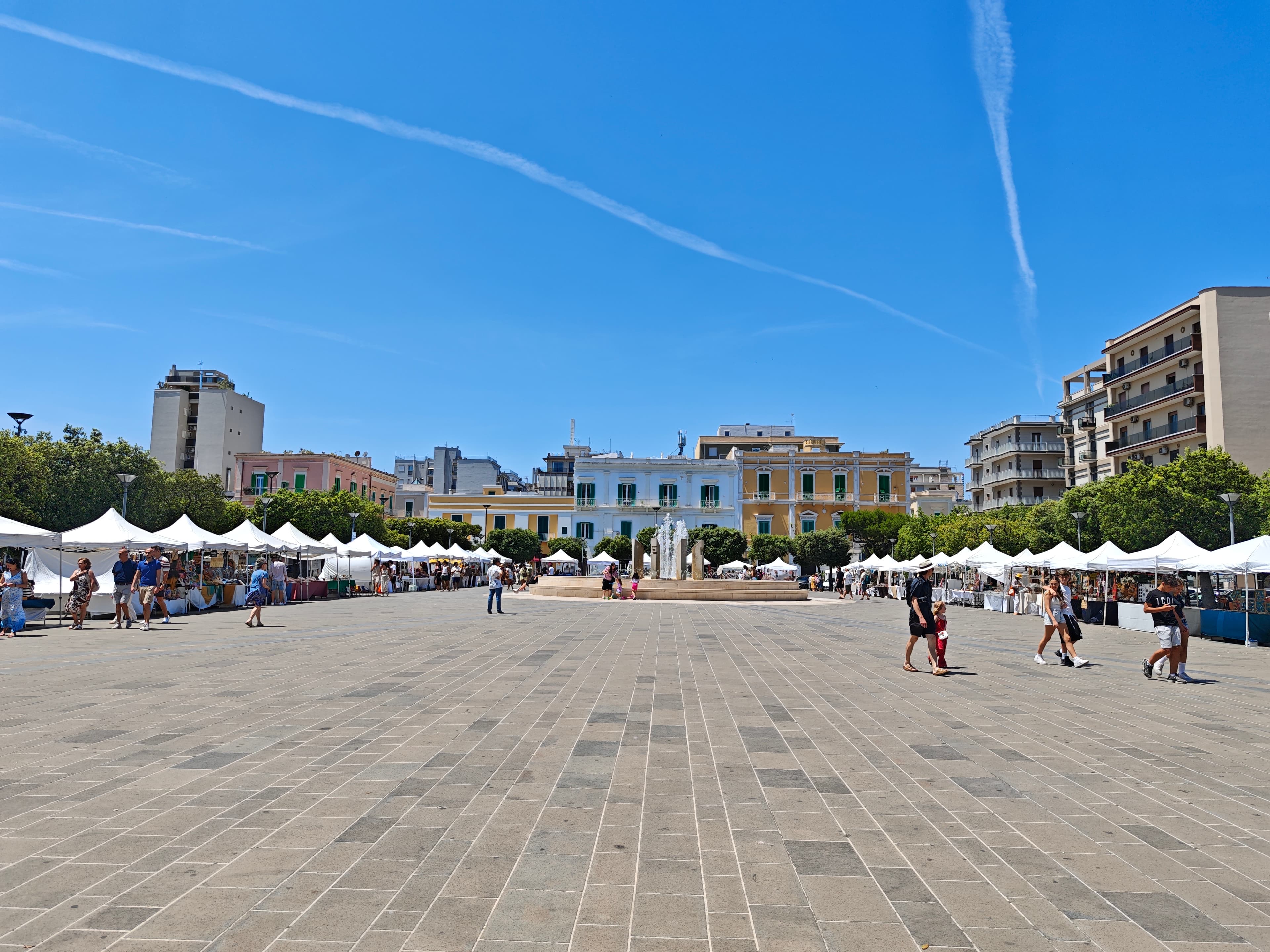
Piazza Vittorio Emanuele II is Monopoli’s main civic square, locally called the “Borgo.” It lies outside the tight medieval core and serves as the bridge between old and newer Monopoli.

History

The square was built in 1796 by architect De Simone as part of a planned expansion beyond the old walls. It was created at the request of the King of Naples, when Monopoli had outgrown the medieval center.

Originally known as Piazza del Borgo Nuovo, it remains the main square and social fulcrum of city life.

Layout

The piazza is large, spacious, and tree-lined. It is organized as two rectangles divided by a wide central avenue about 15 meters across, effectively creating two squares.

Features include:

  • Tree-lined central corridor
  • Fountain in one half
  • Monument to residents who died in World War I
  • Statues on both sides of the street dividing the square
  • Small park-like areas
  • Surrounding shops, cafés, bars, and gelaterie
  • Mixed 18th–20th century architecture

World War II Shelters

Beneath the square are anti-aircraft shelters used during World War II bombing raids. These underground tunnels have recently been made accessible on special occasions or guided tours.

Estimated cost for shelter tours, when available: €5–€10 per adult, but this is not a fixed published tariff and should be confirmed locally.

Practical Information

  • Square access: Free
  • Opening hours: Public square, 24/7
  • Cafés/bars: Often early morning to late evening
  • Shops: Often approx. 9:00–13:00 and 16:30–20:30, Monday–Saturday, with variations
  • Station access: About 10–15 minutes on foot from Monopoli train station

Best Times

  • Morning for architecture and errands
  • Evening for local social life and passeggiata
  • Late afternoon for photography

Review / Visitor Role

This is less romantic than the old harbor but important for understanding modern Monopoli. It is a practical arrival point, meeting space, and civic heart.


Palazzo Palmieri

Geo listing:

  • Palazzo Palmieri
  • Rating: 4.4
  • Reviews: 270
  • Address: Largo Palmieri, 70043 Monopoli BA
  • Coordinates: 40.9524063, 17.3054188

Palazzo Palmieri stands in the heart of the historic center in Largo Palmieri. It is a late Baroque mansion with aristocratic character, often associated stylistically with Neapolitan and Lecce-inspired Baroque.

Atmosphere

The palace evokes Monopoli’s noble, refined side. Its façade, balconies, ornamentation, and square setting give a sense of elegant, slightly faded grandeur.

Inside, where accessible, the palace has an internal courtyard and rooms used for art collections and exhibitions. During events, the mood shifts from aristocratic residence to cultural salon.

Practical Notes

Opening depends on exhibitions, events, and municipal/cultural programming. It is not always accessible as a standard daily museum. Check locally.

Visitor Value

Even if you do not enter, Largo Palmieri and the palace façade are important old-town stops. If an exhibition is open, it can feel like being invited into a private cultural world within the historic city.


Palazzo Martinelli-Meo Evoli

Palazzo Martinelli-Meo Evoli is one of Monopoli’s most iconic waterfront palaces, overlooking the old port.

History

The site belonged in the 16th century to the Lentini family. In later centuries it passed to the Martinelli-Meo Evoli family, becoming their principal urban residence.

The current palazzo was built in the 18th century along the city walls at Via Comes 26. It was constructed partly on the city walls, directly facing the old port and near the castle.

It is classified by the Regione Puglia – Carta Beni Culturali as a protected cultural property, code BABIU000818, under the regional Soprintendenza.

Architecture

Key features:

  • Large, three-level building
  • Long street façade along Via Comes, roughly house numbers 20–36
  • 17th/18th-century door-windows
  • Seafront façade with unusual pagoda-shaped gables
  • Neo-Gothic loggia overlooking the sea
  • Eight pointed / ogival arches
  • Pointed-arch motif repeated at the entrance portal at Via Comes 26
  • Semi-circular balconies on the first floor
  • Internal courtyard
  • Three-flight gallery-style staircase in 18th-century loggiato form
  • Historic stables and servants’ quarters in a building opposite

The Neo-Gothic loggia likely reflects 19th-century romantic revival taste layered onto the 18th-century structure.

Practical Information

Exterior

  • Freely visible from the street and old port
  • No ticket
  • Viewable anytime

Interior

  • Access limited and event-based
  • Possible openings during:
    • FAI heritage days
    • Local cultural events
    • Guided tours
    • Special palace openings

Estimated special interior visit costs, when available:

  • Donation-based or around €5–€10
  • City walking tours including exterior: around €10–€20
  • Not a confirmed standard ticket

Visitor Tip

Photograph the palace from the old port and seafront to appreciate how it visually dominates the harbor with the castle.


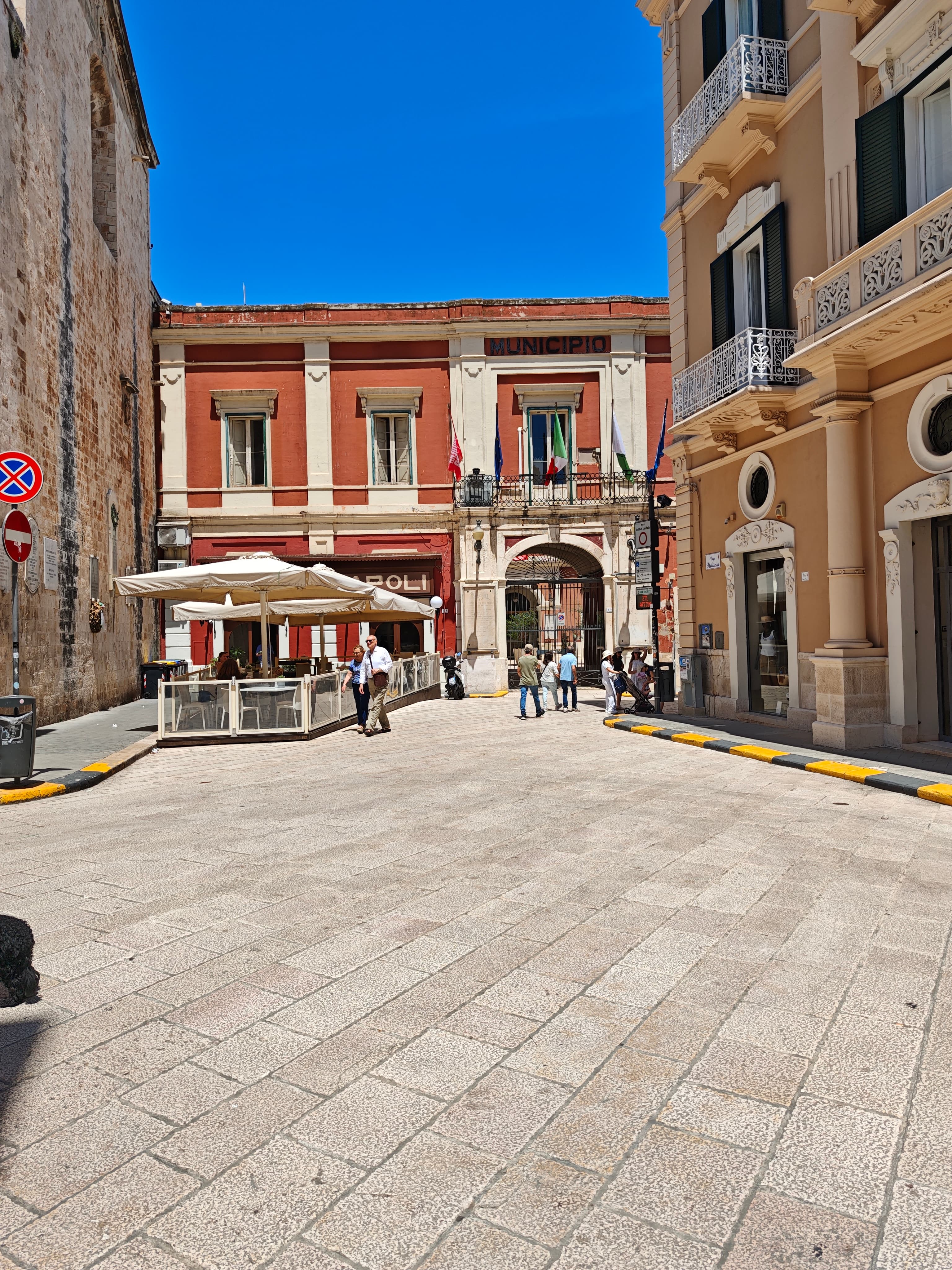
Town Hall Palace / Palazzo del Municipio

The Palazzo del Municipio is Monopoli’s Town Hall and occupies the former Jesuit College complex near the cathedral.

History

The building originated as the Collegio dei Gesuiti, part of the Counter-Reformation expansion of religious and educational architecture in Monopoli. It belongs to the same broad 16th–18th century phase that produced Baroque transformations in the cathedral and noble palaces.

It was declared unsafe in 1910, closed, and later renovated, with major works completed in 1958. It then became home to municipal functions.

Today it houses:

  • Comune di Monopoli offices
  • Mayor’s offices
  • Council functions
  • Administrative services

Architecture

Detailed public descriptions are limited, but as a former Jesuit college it likely includes:

  • Large block-like footprint
  • Sober Baroque façade
  • Rhythmic window bays
  • Central portal
  • Internal courtyard / cloister
  • Former classrooms and religious/educational spaces
  • Later council chamber and administrative offices

It forms part of a civic-religious ensemble with the cathedral and surrounding palaces.

Practical Information

This is an active government building, not a standard museum.

  • Basic foyer/public-office access: likely free
  • Office hours likely weekday mornings, around 08:00–13:00
  • Some afternoon openings may occur for offices
  • Saturday limited or closed
  • Sunday/public holidays generally closed
  • Cultural visits only during special programs
  • Possible event/tour cost: €5–€10, if offered

Treat it mainly as an exterior architectural and civic stop unless a special visit is advertised.


Churches of Monopoli Beyond the Cathedral

Monopoli’s old town is packed with churches. Many are free, atmospheric, and variably open. They are best approached as part of wandering rather than rigid scheduling.

Church of San Salvatore

The Church of San Salvatore is one of Monopoli’s oldest religious buildings, with origins commonly traced to the early Christian period, around the 3rd–4th century. It served as a parish church until 1921 and is now used for exhibitions and cultural activities.

Legend

Local tradition says it was founded by a captain of a pirate ship who survived a shipwreck and dedicated the church to the Savior in gratitude.

Setting

It sits near the waterfront and within the old city walls, giving it strong maritime symbolism. It is small, historic, and visually striking because of its sea-facing position.

Practical Information

  • Ticket: likely free or low-cost; special exhibitions may charge
  • Hours: variable, event-based, not reliably published
  • Treat as a walk-by and enter if open

Church of Santa Maria della Zaffara

A small 17th-century church tucked in the old town near the seafront bastion.

Name

“Zaffara” is explained locally as referring to the blue color of the stone or mantle, tying the church’s identity to a visual/linguistic tradition.

Character

It is a modest neighborhood sacred space rather than a major attraction. Its value lies in its context: narrow streets, old stone, proximity to the sea, and hidden atmosphere.

Practical Information

  • Estimated ticket: €0
  • Hours: no formal published schedule
  • Likely open only during daylight, services, or special occasions
  • Expect possible closure

Church of San Domenico

The Chiesa di San Domenico stands on Via San Domenico in the historic center, near the waterfront and castle area.

History

It is described as a 16th-century rectory church dedicated to San Domenico di Guzmán, founder of the Dominican Order. It is considered a Renaissance religious building with overlapping Romanesque, Gothic, and Baroque layers.

What to See

  • Renaissance structure
  • Romanesque/Gothic elements
  • Notable façade
  • “Very nice” rose window
  • Quiet interior
  • Baroque influence in altars and decoration

Practical Information

  • General admission: effectively free
  • Hours: not reliably published
  • Try morning 9:00–12:00 or late afternoon 16:00–19:00
  • May be closed outside services
  • Worth seeing exterior even if closed

Church of Santa Maria Amalfitana / Santa Maria degli Amalfitani

One of Monopoli’s most historically important smaller churches.

History

Dates to the 11th–12th centuries. It was founded by sailors or merchants from Amalfi who, according to tradition, survived a dangerous voyage or shipwreck and built the church in gratitude to the Virgin Mary.

It represents Monopoli’s medieval maritime links with Amalfi and the wider Mediterranean.

A major 1932 restoration removed later Baroque overlays to reveal more of the original Romanesque character.

Architecture

  • Romanesque structure
  • Robust stonework
  • Semicircular apses
  • Three naves
  • Simple compact stone exterior
  • Austere interior compared with the cathedral

Basilian Crypt

The highlight is the Basilian cave / crypt, accessed from the right nave by stairs. It functioned as a primitive sanctuary and burial ground.

Look for:

  • Frescoes
  • Arches
  • Columns
  • Rock-cut atmosphere
  • Sense of early medieval monastic or hermitic devotion

Practical Information

  • Standard entry likely free or donation-based
  • Guided/crypt visits or special exhibitions may cost €3–€8
  • Hours variable and limited
  • Some visitors found it closed and fenced off
  • Ask locally or join a walking tour if you specifically want to see the crypt

Church and Convent of San Francesco d’Assisi

Located in Piazza Plebiscito, between the Murat/new district and the old town.

History

  • Church of St Francis of Assisi of the Order of Friars Minor Conventual
  • Completed in 1749
  • Design attributed to Michele Colangiuli of Acquaviva
  • Considered one of Monopoli’s most interesting 18th-century churches
  • Example of Renaissance-Baroque style

Architecture

  • Baroque façade articulated by pilasters
  • Central portal
  • Strong volumetric and spatial qualities
  • Likely single nave with side chapels or altars
  • Franciscan iconography
  • Historically connected to a convent complex

Practical Information

  • Entry likely free
  • Donations appreciated
  • Hours not clearly published
  • Typical church pattern likely 8:00–12:00 and 16:00–19:30, but verify locally

Chiesa di Santa Teresa and Other Smaller Churches

Travelers often enjoy stumbling into smaller churches such as Chiesa di Santa Teresa and others. These are usually modest individually but rewarding collectively.

Review Verdict

Not must-see individually unless you love churches, but worth popping into when open. They offer cool air, incense, devotional art, and quiet pauses during a day of walking.


Monopoli’s Jewish Quarter Area: Context, Not a Marked Attraction

There is no formal, museum-like Jewish Quarter in Monopoli comparable to better-documented sites in Trani or Bari. Current evidence suggests any former Jewish area is now absorbed into the broader historic center, reflected more in regional patterns and possible place-name memory than in clearly marked monuments.

Regional Jewish History

Jewish presence in Puglia is documented for at least 2,000 years. After the destruction of the Second Temple in 70 CE, many Jews were deported or migrated to southern Italy. Puglia’s ports—Brindisi, Otranto, Bari, Trani, Barletta, and others—became important landing and transit points.

Rabbi Akiva in the 2nd century CE already mentioned Jewish communities in the region.

How Monopoli Fits

In Apulian port towns, Jewish quarters or giudecche were often located inside the walled core near the harbor, where trade, crafts, and provisioning took place.

Monopoli likely fits the broader port-city pattern, but current specialist Jewish heritage guides do not identify a distinct surviving synagogue or marked Jewish quarter in Monopoli.

What to Look For

As you wander the old town near the harbor and medieval walls, you can look for features comparable to Jewish quarters in Bari and Trani:

  • Narrow lanes
  • Tiny courtyards
  • Arched passageways
  • Modest limestone houses
  • Barrel-vaulted ground floors
  • Street names or plaques with words like Giudea, Giudecca, or Sinagoga
  • Possible later Christianized buildings

But treat this as contextual exploration, not a confirmed marked itinerary.

If Jewish history in Puglia interests you, consider:

  • Bari: old Jewish quarter near cathedral area, former Via Sinagoga / Via San Sabino, engraved lintel referencing community life in 1314.
  • Trani: major medieval Jewish center with Giudecca, Scola Grande, Scolanova, and Jewish museum/church heritage.
  • Otranto, Brindisi, Barletta: additional Jewish history linked to exile and Levantine routes.

Estimated regional Jewish site/museum costs may be around €3–€6 for small museums, and guided Jewish Puglia tours around €25–€60 per person, depending on length and inclusions.

Practical Information

  • Monopoli’s possible Jewish area: public old-town streets, free, 24/7
  • No Jewish museum or synagogue ticket in Monopoli
  • Best explored as part of a broader historical walk

Culture and Atmosphere: The Real Vibe of Monopoli

Monopoli’s atmosphere is not built from a single landmark. It accumulates through repeated sensory impressions: bells, salt, white stone, laundry, seafood, fishermen, children, warm evenings, and sudden glimpses of sea.

The Lived-In Old Town

The Centro Storico is full of small domestic details:

  • Laundry lines overhead
  • Green shutters
  • Potted geraniums, succulents, and herbs
  • Electric candles in street shrines
  • Doorway conversations
  • TV sounds through open windows
  • Cutlery clinking from kitchens
  • Garlic, tomato, fried eggplant smells
  • Damp stone in shaded alleys
  • Espresso and pastry scents from cafés

Travelers often say the most memorable moments are not the famous sights, but the hidden everyday corners: jeans flapping above a shrine, a woman watering plants, the smell of sauce in a lane, a balcony conversation echoing between walls.

The Working Harbor Identity

The old port keeps Monopoli grounded. The boats are beautiful, but they are not decorative props. Fishermen still work here. The harbor smells and sounds like a real harbor: diesel, rope, fish, gulls, engines, wet stone.

This working identity distinguishes Monopoli from more polished beach destinations.

The Evening Passeggiata

Evening is when the town gathers itself. People stroll the lungomare, sit in Piazza Garibaldi, gather near Porto Rosso, drink spritzes by the sea, or linger outside churches and restaurants.

This is not nightlife in the clubbing sense. It is social, slow, family-oriented, and communal.

Aperitivo by the Sea

Aperitivo is one of Monopoli’s defining rituals. It might happen:

  • In Piazza Garibaldi
  • Along the lungomare
  • Near Cala Porta Vecchia
  • At a roof terrace
  • At Porto Rosso
  • In a seafront bar

Typical sensory details:

  • Aperol spritz
  • Local white wine
  • Beer
  • Citrus slices
  • Olives
  • Focaccia
  • Cheese
  • Fried morsels
  • Taralli
  • Sea breeze
  • Low conversation
  • Ice in glasses
  • Waves below

Many visitors experience their strongest “I could live here” feeling during aperitivo.

Roof Terraces and Boutique Stays

Staying in a B&B or boutique hotel in or near the old town can deepen the experience. Many occupy renovated stone houses with roof terraces overlooking sea, rooftops, or church domes.

Morning terrace atmosphere:

  • Sea and coffee smells
  • Swallows overhead
  • Bells striking the hour
  • Waves in the distance
  • Breakfast cups clinking
  • Cool salty air

Night terrace atmosphere:

  • Low conversations
  • Grilled fish smells
  • Lantern light
  • Dark sea
  • White facades glowing softly

These moments can become more memorable than formal sightseeing.


Food, Markets, and Local Experiences

Monopoli is a good food town, especially if you like seafood, vegetables, olive oil, focaccia, pasta, and relaxed outdoor dining.

What to Eat

Common local and Apulian dishes include:

  • Fresh seafood
  • Grilled fish
  • Orecchiette
  • Focaccia barese / Apulian focaccia
  • Taralli
  • Olives
  • Burrata and local cheeses
  • Vegetables such as tomatoes, eggplant, peppers, greens
  • Olive oil
  • Local wines
  • Fried seafood or snacks during aperitivo

Daily Market and Food Streets

Markets and food streets around the old town provide some of Monopoli’s richest everyday atmosphere.

Morning market sensory details:

  • Ripe tomatoes
  • Basil
  • Citrus
  • Fresh seafood
  • Pecorino
  • Caciocavallo
  • Cured meats
  • Olives in brine
  • Crates scraping
  • Vendors calling prices
  • Scales clacking
  • Fish being chopped
  • Espresso and warm bread from nearby cafés

Markets are a great way to connect the coast to the countryside. You see what Monopoli eats: land and sea together.

Food and Wine Experiences

Popular experiences include:

  • Pasta-making classes
  • Orecchiette workshops
  • Focaccia making
  • Olive oil tastings
  • Wine tastings
  • Masseria visits
  • Farm lunches
  • Cooking in family kitchens or small studios

Pros

  • Warm hospitality
  • Hands-on learning
  • Shared meals with wine
  • Insight into olive culture
  • Memorable for food lovers

Cons

  • Can be pricey compared with a normal meal
  • Small groups require booking ahead
  • Quality varies
  • Some classes may be less structured or have limited English

Tourist Trap Advice

Choose providers with recent reviews. Avoid generic large-group classes sold only through mass tour desks if you want something intimate.

Masseria Day Visits

Nearby masserie—historic farm estates—offer meals, olive oil tastings, wine, countryside tours, and insight into Puglia beyond the coast.

Pros

  • Olive groves and stone walls
  • Estate-grown ingredients
  • High-quality food
  • Rural atmosphere

Cons

  • More expensive than eating in town
  • Transport/taxis add cost
  • Booking can be informal
  • “Rustic chic” marketing packages may be overpriced for budget travelers

Verdict

Worthwhile if you have time and budget, especially to understand the countryside behind Monopoli.


Day Trips and Nearby Experiences

Polignano a Mare and Lama Monachile

Polignano a Mare is one of the easiest and most popular day trips from Monopoli.

Why Go

  • Dramatic cliffs
  • Sea caves
  • Famous Lama Monachile cove
  • Postcard viewpoints
  • Easy by train or short drive

What to Expect

The view over Lama Monachile is spectacular, especially from the bridge and clifftop viewpoints. However, reviews consistently warn of Instagram vs reality.

Cons

  • Lama Monachile is tiny and extremely crowded in summer
  • Rocky and uncomfortable underfoot
  • Better as a viewpoint than relaxing beach
  • Polignano can feel more touristy and expensive than Monopoli
  • Cafés near viewpoints may be overpriced

Verdict

Worth visiting for scenery. Not ideal as a relaxing beach day in high season. Many travelers prefer staying in Monopoli and visiting Polignano briefly.

Zoosafari Fasanolandia

Located near Fasano, this major family attraction appears often in Monopoli-based itineraries.

Pros

  • Drive-through safari with animals such as lions and giraffes
  • Fun for children
  • Combines zoo and amusement rides
  • Full-day family entertainment

Cons

  • Ethical concerns about animals, car proximity, feeding, enclosures
  • Long queues in high season
  • Food and drink overpriced and mediocre
  • Extra attractions/rides may have unclear additional costs

Verdict

Very enjoyable for families with children; less compelling for adults focused on culture, towns, and coastline.

Bicycle and E-Bike Coastal Rides

Cycling south from Monopoli into coves, coast roads, and olive groves is rewarding for active travelers.

Pros

  • Beautiful coastal scenery
  • Olive groves
  • Access to coves harder to reach by car
  • Slower immersive experience
  • E-bikes broaden accessibility
  • Guided tours include local insights

Cons

  • Shared roads with traffic
  • Limited dedicated cycling infrastructure
  • Summer midday heat
  • Bike quality varies

Tips

  • Ride morning or late afternoon
  • Check brakes, tires, battery, lock
  • Understand deposit/insurance terms
  • Bring water and sun protection

Verdict

A highlight for active travelers, not essential for everyone.


Practical Tips and Real-World Warnings

Best Time to Visit

Travelers especially praise May, June, September, and early October for warm weather and manageable crowds.

July and August

Expect:

  • Crowded beaches
  • Busy old town
  • Difficult parking
  • Higher prices
  • Heat
  • Restaurants requiring reservations
  • Small coves filling early

August is the most challenging month. Monopoli remains beautiful, but charm can be diluted by crowds.

Safety

Monopoli is generally considered safe, including at night. Reviews often mention feeling comfortable walking late through the old town.

Standard precautions:

  • Watch bags in crowds
  • Be cautious on slippery harbor stones
  • Don’t leave valuables unattended at beaches
  • Use normal awareness in busy piazzas

There are no systematic reports of major scams specific to Monopoli.

Tourist Trap Themes

Not scams, but watch for:

  • Main-piazza and waterfront restaurant markups
  • Paying for the view at harbor-facing cafés
  • Lido pricing surprises
  • Front-row umbrella surcharges
  • Weekend/holiday lido prices
  • Generic souvenir shops in high tourist lanes
  • Boat tours that are more party-oriented than expected
  • Polignano “Instagram vs reality” crowds

Restaurant Tips

  • Check menu prices before sitting.
  • Book ahead in high season.
  • Walk a few streets away from prime piazzas for better value.
  • Expect slower service during peak dinner rush.
  • Do not assume harbor-view restaurants are best value.
  • Seafood specials can be expensive; ask prices clearly.

Beach Tips

  • Arrive early for free coves.
  • Bring water shoes for rocky access.
  • Bring water and shade if using wild coves.
  • Expect limited facilities outside lidos.
  • Use Cala Porta Vecchia for a quick atmospheric swim, not a full beach day in August.
  • Confirm lido pricing before committing.

Opening Hours Reality

Italian small-town schedules can be inconsistent. Many sites close midday. Churches may close outside worship times. Small museums may open only weekends. Castle access may depend on events.

Always verify:

  • Cathedral
  • Crypt museum
  • Castle
  • Smaller churches
  • Palace interiors
  • WWII shelters
  • Special tours

Money and Costs

Free / public:

  • Centro storico
  • Porto Antico
  • City walls and lungomare
  • Piazza Garibaldi
  • Piazza Vittorio Emanuele II
  • Cala Porta Vecchia
  • Many coves
  • Most church entries when open
  • Exterior palace views

Likely paid:

  • Crypt museum: €5 standard
  • Audioguide: €2
  • Castle exhibitions: often €0–€5
  • Boat tours: often €30–€50+
  • Cooking/food experiences: varies, usually premium
  • Masseria visits: varies, often premium
  • Lidos: daily sunbed/umbrella fees
  • Special palace/shelter tours: often €5–€10 estimate

Getting Around

  • Old town: best on foot
  • Train station to Piazza Vittorio Emanuele II: roughly 10–15 minutes
  • Bari to Monopoli by train: often around 30 minutes
  • Polignano: easy train or short drive
  • Beaches south of town: walk, bike, e-bike, car, or taxi depending on distance
  • Parking: difficult near old town in high season

What to Pack

  • Comfortable walking shoes
  • Sandals/water shoes for rocks
  • Sun hat
  • Sunglasses
  • Sunscreen
  • Light cover-up for churches
  • Refillable water bottle
  • Small cash for donations, cafés, tips, small tickets
  • Swimsuit under clothes for spontaneous dips
  • Light sweater for breezy evenings/roof terraces

Suggested Ways to Experience Monopoli

If You Have One Full Day

Morning:

  1. Walk the Centro Storico early.
  2. Visit Porto Antico while fishermen are active.
  3. Enter the cathedral.
  4. Visit the crypt if open.

Midday:

  1. Lunch in or near the old town.
  2. Rest during heat.

Afternoon:

  1. Walk city walls and bastions.
  2. Swim at Cala Porta Vecchia or another cove.

Evening:

  1. Aperitivo in Piazza Garibaldi or by the sea.
  2. Dinner in the old town.
  3. Night walk along the lungomare.

If You Have Two or Three Days

Add:

  • Boat tour / sea caves
  • Porto Ghiacciolo and Abbazia di Santo Stefano
  • Cala Paradiso or other beach/lido
  • Palazzo Palmieri if open
  • Smaller church trail
  • Market morning
  • Food class or olive oil tasting
  • E-bike coastal ride
  • Polignano a Mare half-day

If You Love History

Prioritize:

  • Cathedral
  • Cripta Romanica
  • Castello Carlo V
  • City walls and bastions
  • San Salvatore
  • Santa Maria Amalfitana and Basilian crypt if open
  • San Domenico
  • Palazzo Martinelli-Meo Evoli exterior
  • Piazza Vittorio Emanuele II and WWII shelters if accessible
  • Abbey of Santo Stefano / Porto Ghiacciolo area
  • Contextual Jewish Puglia day trips to Bari or Trani

If You Love Atmosphere More Than Museums

Prioritize:

  • Getting lost in the old town
  • Dawn at Porto Antico
  • Hidden alleys with shrines and laundry
  • Cala Porta Vecchia swim
  • Sunset lungomare
  • Piazza Garibaldi aperitivo
  • Roof terrace mornings/evenings
  • Market wandering
  • Boat trip
  • Porto Rosso casual evening

If You Have Children

Good options:

  • Cala Porta Vecchia for quick swim, but early
  • Lido Sabbiadoro / Porto Rosso for facilities
  • Cala Paradiso lido
  • Boat tour if children tolerate boats
  • Piazza Vittorio Emanuele II for space
  • Zoosafari Fasanolandia day trip
  • Gelato and evening passeggiata

Be cautious with:

  • Rocky coves
  • Uneven old-town streets
  • Midday heat
  • Crowded August beaches
  • Long cultural visits in small churches

Final Verdict: What Makes Monopoli Worth It

Monopoli is worth the trip because it balances beauty and reality. It has the whitewashed aesthetic travelers dream of in Puglia, but also a working harbor, real neighborhoods, local food rhythms, devotional traditions, and historical depth. It is scenic without being entirely theatrical.

Its best experiences are often free:

  • Watching blue boats in Porto Antico
  • Walking the seafront walls
  • Getting lost in alleys
  • Sitting in Piazza Garibaldi
  • Swimming below the old walls
  • Listening to bells over the sea
  • Seeing the town glow at sunset

Its weaknesses are real but manageable:

  • Small beaches crowd quickly
  • August can be overwhelming
  • Parking can be stressful
  • Castle and church interiors may have unreliable hours
  • Prime-view restaurants and lidos can be expensive
  • Some nearby famous spots, especially Polignano’s Lama Monachile, are more crowded than photos suggest

But if you arrive with the right expectations—seeking atmosphere, sea, food, history, and slow local rhythms rather than huge museums or empty beaches—Monopoli is likely to exceed them.

By the time you leave, you may remember less a single monument than a composite feeling: warm limestone underfoot, salt on your skin, blue boats in pale water, incense in a cool church, frying seafood in an alley, bells at dusk, and the quiet thought that life here, at least for a few days, feels wonderfully complete.

Episode Info
49:15
Europe
HistoryCultureBeachArchitectureFood

Join the journey

Get new episodes and travel notes delivered straight to your inbox.