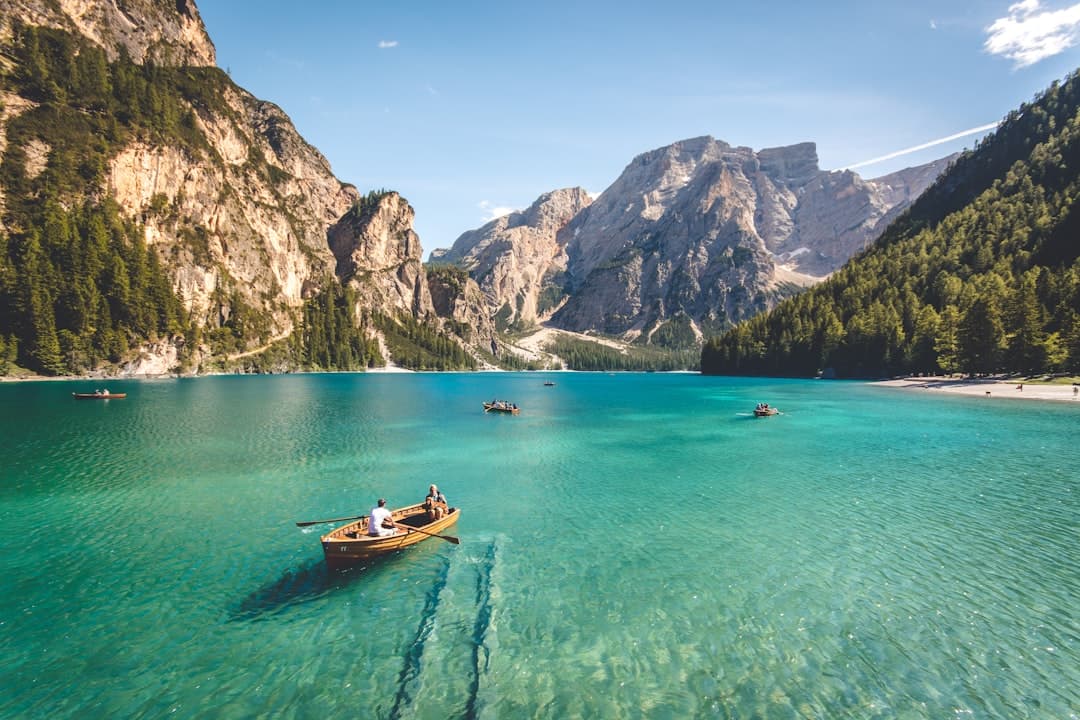
Comprehensive Travel Guide: Otranto
Otranto Travel Guide: A Deep, Practical, Atmosphere-Rich Guide for Travelers Who Have Already Booked
Otranto is not just a pretty seaside town in Puglia. It is Italy’s eastern threshold: a white-stone, sea-facing, fortified town where turquoise water, medieval walls, Byzantine memory, Norman churches, Ottoman trauma, summer beach life, and evening promenades all overlap in a compact, walkable place. If you have already booked your trip, this guide is designed to help you arrive prepared—not just with a checklist of sights, but with a sense of what Otranto feels like, how its history shapes the town, what is genuinely worth prioritizing, where reviews are divided, and what practical issues can affect your visit in the coming weeks or months.
Otranto sits on the Salento peninsula in southern Puglia, about 45 km southeast of Lecce, facing the Adriatic and the Balkans beyond. It is widely described as one of Puglia’s most charming coastal towns, with a whitewashed historic center, fortified walls, a harbor, beaches within walking distance, and a cultural core anchored by the Cathedral of Santa Maria Annunziata and the Aragonese Castle.
Its atmosphere is unusual because it combines two moods that do not always coexist so strongly: holiday ease and historical gravity. On one hand, Otranto gives you clear water, sandy beaches, seafood restaurants, gelato, aperitivo terraces, boat trips, sea breezes, and a lively summer evening scene. On the other, it is a place of martyrdom, siege, military architecture, Byzantine frescoes, medieval mosaics, and centuries of exchange between the Latin West and the Greek-Byzantine East.
This is a town where the first impression may be all brightness—white walls, blue-green water, sunlit limestone—but the longer you stay, the more you notice the weight beneath the beauty.
Quick Orientation: What Kind of Trip Have You Booked?
Otranto works beautifully for several types of travelers:
- History-focused travelers will find a remarkable concentration of sites: the cathedral and its mosaic floor, the Chapel/Crypt of the Martyrs, the Aragonese Castle, San Pietro, Porta Alfonsina, Torre Matta, Torre del Serpe, and the sanctuary of Santa Maria dei Martiri.
- Beach travelers get a convenient town beach plus access to Baia dei Turchi, Alimini, Porto Badisco, Baia dell’Orte, and a wider coast of coves, cliffs, and clear water.
- Couples and atmosphere-seekers will love the evening passeggiata, the old-town alleys, seafront views, and sunset walks along the ramparts.
- Families appreciate the compact, walkable layout, pedestrian areas, sandy water access in town, and calmer family-oriented feel compared with more party-driven destinations such as Gallipoli.
- Photographers have endless material: the red earth of Cava di Bauxite, the lighthouse at Punta Palascìa, the castle and bastions, turquoise harbor water, old-town lanes, and the otherworldly mosaic floor.
- Food travelers can enjoy seafood, Puglian pasta, mussels, crudo, orecchiette, vegetables, gelato, pasticciotti, rustici, and aperitivo by the sea—but should also be alert to tourist pricing on the waterfront.
The strongest real-world verdict from reviews is simple: Otranto is definitely worth visiting, especially if you enjoy a mix of history and sea. The main downsides are crowds, prices, traffic, parking, touristy restaurants, and high-season lido culture, especially in July and August.
The Story of Otranto: From Hydrus to the Eastern Edge of Italy
To understand Otranto, you need to understand its position. It is the easternmost town of Italy, historically facing across the Strait of Otranto toward the Balkans, Greece, and the wider eastern Mediterranean. For millennia, that position made it a crossroads, a port, a lookout, a trading place, a religious frontier, and a military target.
Ancient Origins: Hydrus and Hydruntum
The site of Otranto was originally an ancient Greek settlement called Hydrus, later known to the Romans as Hydruntum. The name is linked to the nearby Idro river and to Messapian and Greek terms associated with “water,” reflecting the importance of the coastal landscape.
Long before formal Greek colonization, archaeological evidence shows that an Iron Age Messapian settlement existed on the hill above the port during the 9th–8th century BCE. Classical sources traditionally attributed the foundation of Otranto to Cretan colonists, situating the town within the broader network of Greek maritime expansion in Magna Graecia.
In the pre-Roman period, the indigenous Messapians dominated the Salento peninsula. They were sometimes allied with Taranto, the powerful Spartan colony, but eventually Roman expansion absorbed the region. In 261 BCE, during the Tarentine and Samnite wars, Roman conquest drew Salento and Otranto into the Roman Republic.
Roman Hydruntum: A Port Toward Greece
Under Rome, Hydruntum became an important, though secondary, port of embarkation compared with Brundisium, modern Brindisi. Its position opposite Epirus and the Peloponnese made it useful for journeys and military operations toward Greece and the eastern Mediterranean.
Although many Salentine cities declined after Roman conquest, Otranto retained prosperity because it sat as a crossroads linking Brindisi and Taranto, both connected to the Appian Way, and because it provided a departure point for shipping to the Balkan and Greek coasts.
Roman Otranto also hosted a significant community of Jewish traders, reflecting its role in long-distance Mediterranean commerce. In Roman times, its harbor would have been busy with merchants, soldiers, and travelers heading east.
Byzantine Otranto: Greek Language, Greek Rite, Eastern Identity
As Western Roman power declined, Otranto’s importance did not disappear. Instead, it shifted into the sphere of the Byzantine, or Eastern Roman, Empire. From late antiquity into the early Middle Ages, the region known as Terra d’Otranto became a frontier zone of Byzantine southern Italy.
By the late 6th century, waves of Greek-Byzantine settlers arrived. Otranto evolved into a cultural and political center of Byzantine power in the south. For centuries, Greek language, rites, and traditions dominated the area. Greek was used in administration, liturgy, and daily life, shaping an Italo-Byzantine culture that still echoes in the Church of San Pietro and the region’s sacred art.
The town’s port was heavily fortified against Lombards and other groups pressing into Italy after the fall of Rome.
Some modern summaries refer to a “Moorish” phase, but this should be understood carefully. Otranto did not experience a long period of Islamic rule comparable to Sicily or Spain. Rather, like many coastal towns in the central Mediterranean, it was affected by intermittent Arab-Muslim raids and campaigns, while sustained political control remained primarily Byzantine until the Norman conquest.
Norman Otranto: Latinization, Crusaders, and the Cathedral
In the 11th century, the Normans advanced into southern Italy. Otranto was taken by Robert Guiscard in 1068 and incorporated into the Norman realm of Apulia and Calabria.
This marked a major cultural shift. Latin Christianity and Latin language began to replace the formerly dominant Greek rites and Byzantine culture, though Greek traditions persisted for centuries in places such as San Pietro.
Under Norman rule, Otranto experienced one of its greatest periods of prosperity, especially in the 11th and 12th centuries. Pilgrims, crusaders, merchants, and travelers passed through its harbor en route to the Balkans, the Holy Land, and the eastern Mediterranean. Otranto became an active gateway between East and West, where Latin and Greek worlds mingled in religion, art, and daily life.
The Normans built the great Cathedral of Santa Maria Annunziata, consecrated in 1088. In 1163, during the reign of William I of Sicily, Archbishop Jonathas/Jonatas/Gionata commissioned the cathedral’s extraordinary mosaic floor, traditionally attributed to the monk Pantaleone, from the nearby monastery of San Nicola di Casole. This mosaic, known as the Tree of Life, remains one of the most important medieval mosaics in Europe.
1480: The Ottoman Siege and the Martyrs of Otranto
The defining trauma of Otranto’s history occurred on 28 July 1480, when an Ottoman fleet sent by Sultan Mehmed II attacked the town. Around 150 ships carrying approximately 18,000 soldiers anchored off Otranto’s vulnerable eastern shoreline.
After fierce fighting, the Ottomans stormed the town in an event remembered as the Sack of Otranto. Contemporary accounts describe terrible violence. The bishop was reportedly beheaded and his head paraded through the streets. Many inhabitants were killed—some accounts suggest perhaps 12,000 people in total—and the population collapsed.
Most famously, 813 inhabitants, often traditionally referred to as “the 800 martyrs,” were executed on 14 August 1480 after refusing to convert to Islam. They became known as the Martyrs of Otranto. Their bones are preserved in the cathedral, and the place of execution is commemorated at the sanctuary of Santa Maria dei Martiri on the Colle della Minerva.
The Ottoman occupation lasted about thirteen months, ending after the death of Mehmed II and a shift in Ottoman priorities. The town was eventually liberated by a Christian coalition, but Otranto never recovered its former importance as a major Mediterranean port.
The martyrs were beatified in 1771 and canonized by Pope Francis on 12 May 2013. Their story remains central to Otranto’s religious and civic identity.
Aragonese and Spanish Fortifications
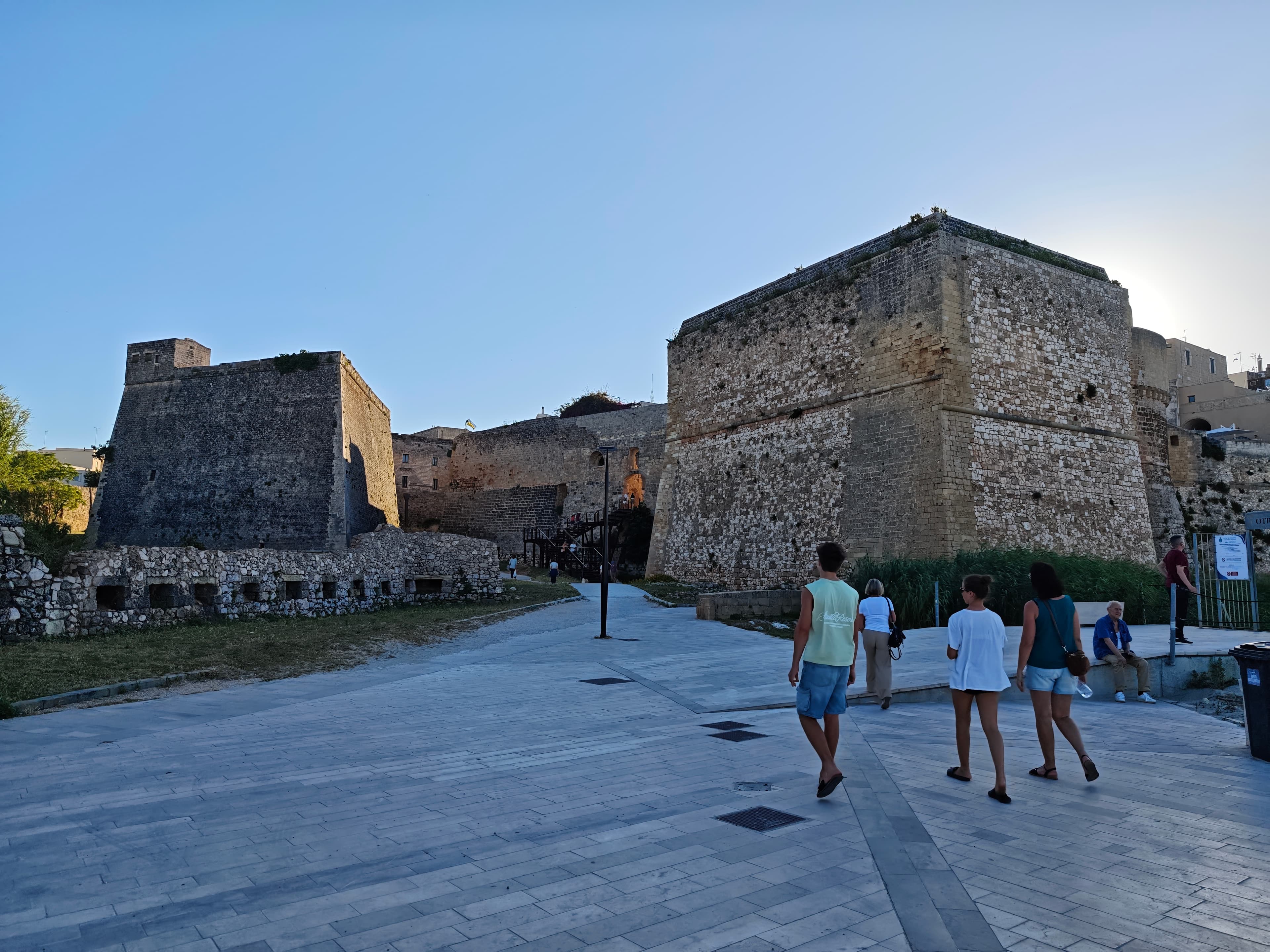
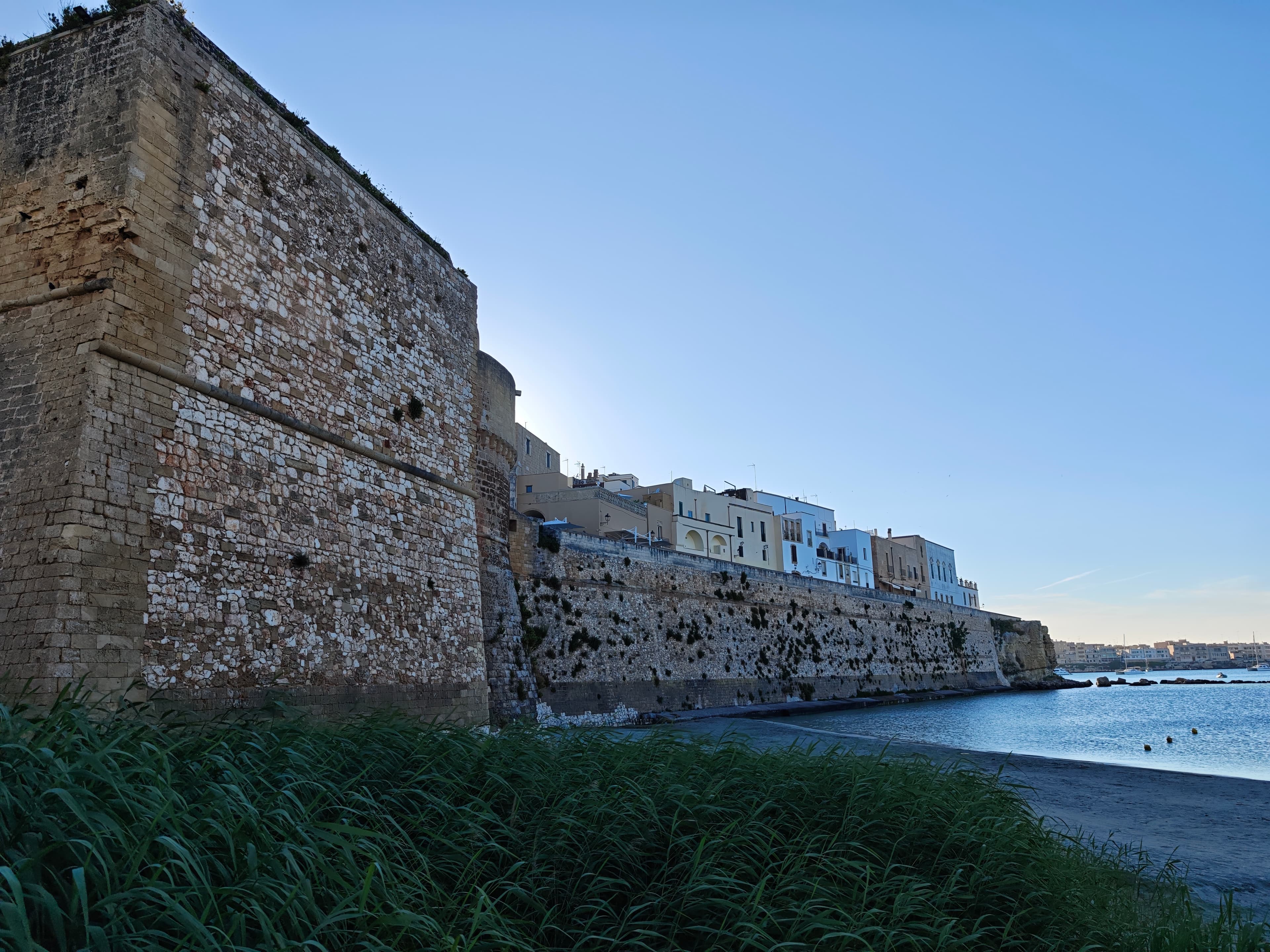
After the Ottoman occupation, Otranto’s defenses were dramatically rebuilt and strengthened. The Aragonese Castle, the city walls, Porta Alfonsina, Torre Matta, and other defensive structures reflect the post-1480 effort to secure the Adriatic frontier.
The Aragonese reconstruction began around 1485 and continued to about 1498, under rulers including Ferdinand/Ferrante I of Aragon and Alfonso of Aragon. Military architects such as Ciro Ciri and Francesco di Giorgio Martini are associated with the modernization of the castle and defensive system.
Spanish viceroys later modified the fortress, adapting it to artillery warfare. Coats of arms, including that of Charles V, still decorate parts of the castle. Works in 1578 reinforced the bastion, with coats of arms of Antonio de Mendoza and Don Pedro da Toledo. Additional consolidation occurred in 1647 under architect Saponaro.
Modern Otranto
In the centuries after the siege, Otranto entered a long period of relative decline. Larger ports such as Brindisi and Bari overshadowed it. In 1860, Puglia and Otranto joined the new Kingdom of Italy.
Today, Otranto has around 5,000 inhabitants and has revived through fishing, agriculture, and tourism. It is recognized among I Borghi più belli d’Italia, Italy’s most beautiful villages, and remains a symbolic gateway between Italy and the Balkans.
Its modern character is inseparable from its layered past: Greek, Messapian, Roman, Byzantine, Norman, Aragonese, Spanish, Ottoman, Catholic, maritime, and touristic.
Essential Otranto Experiences
1. Wander the Centro Storico: Otranto’s Walled Old Town
The Historic Center of Otranto is the core experience. Even travelers who are critical of crowds, souvenir shops, or high-season tourism usually agree that the centro storico is the main reason to visit.
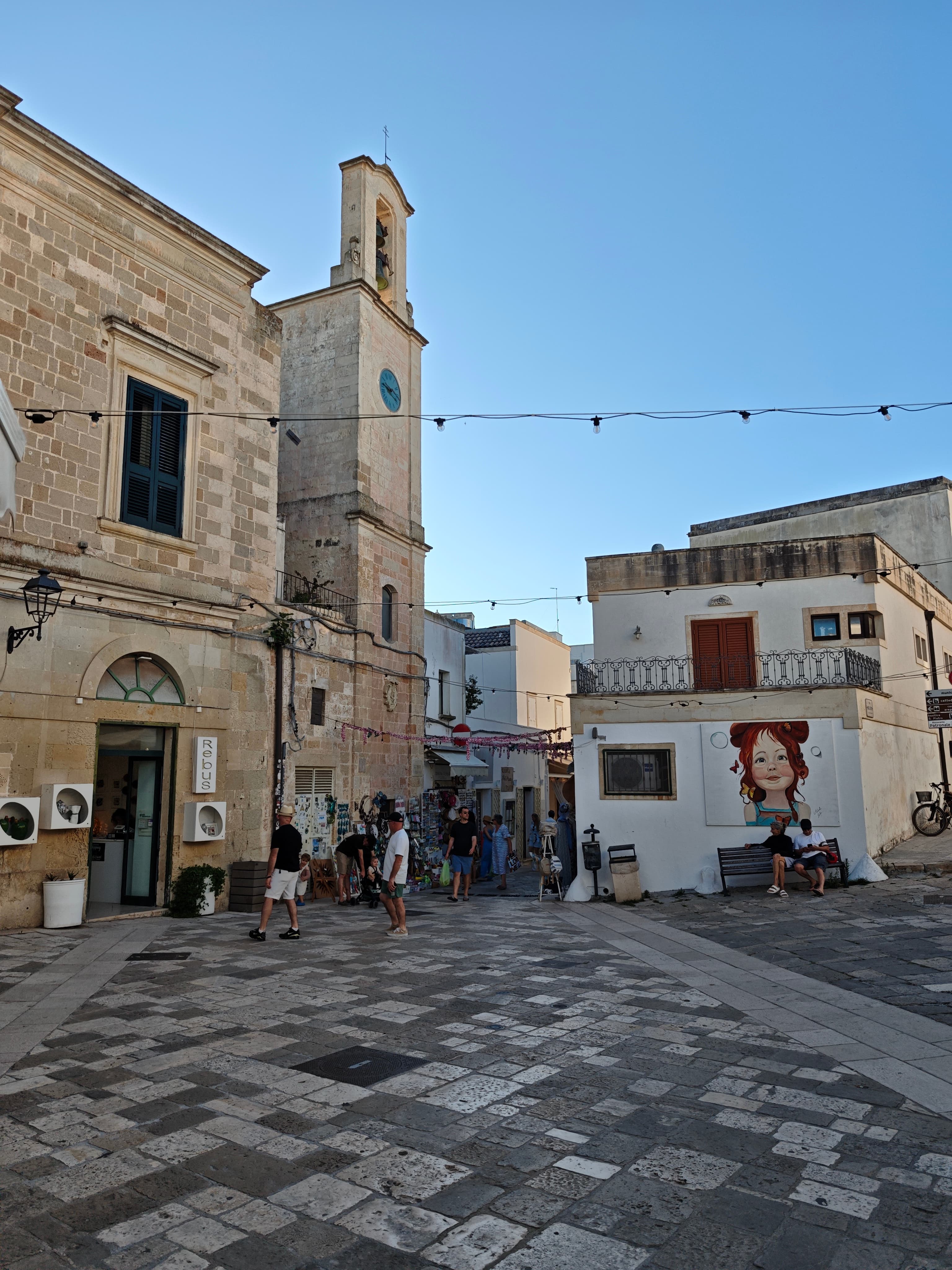
It is compact, walkable, and enclosed by fortifications. The old town rises above the port, with medieval ramparts, bastions, lanes, steps, piazzette, sea views, artisan shops, cafés, and restaurants tucked into white or pastel stone buildings.
What the Old Town Feels Like
The old town is often described as a maze of cobblestone streets and alleys. Its mood is intimate, slightly disorienting, and full of small discoveries. In the morning, it smells of coffee, pastry, and warm stone. Later in the day, the scent shifts toward sea salt, sunscreen, seafood, and old masonry heated by the sun. In the alleys, sound softens: footsteps, conversations from doorways, glasses clinking, and laughter from hidden terraces.
The experience is cumulative. A quiet lane opens onto a bright square. A souvenir street becomes a view toward the Adriatic. A shaded passage suddenly reveals the cathedral or the castle wall.
Otranto’s old town feels like a small-scale labyrinth by the sea, a place where daily life still unfolds inside a medieval structure.
Key Features
- Porta Alfonsina / Porta Terra, the main seaward gate
- Via Basilica, leading toward the cathedral
- Piazza Basilica / Piazza Duomo
- The Cathedral of Santa Maria Annunziata
- Chiesa di San Pietro
- Castello Aragonese
- Ramparts and viewpoints over the Adriatic
- Streets lined with artisan boutiques, ceramics, leather goods, textiles, jewelry, local foods, cafés, bars, and restaurants
- The connection to the Lungomare degli Eroi
Practical Notes
- The historic center itself is free and generally accessible 24/7.
- TripAdvisor-style listings often show access as 00:00–23:59 daily, reflecting public street access.
- Individual monuments have their own schedules and tickets.
- Best times:
- Early morning for quiet lanes and photography.
- Late afternoon and evening for atmosphere.
- Shoulder season—April–May and September–October—for warmth without peak crowds.
- In July and August, expect heavy evening crowds, especially around the main lanes and seafront.
- Watch your footing: polished stone and steps can be slippery, especially when wet or if you are wearing sandals.
Real-World Review Verdict
Worth the hype? Yes.
The centro storico is praised for atmosphere, views, walkability, shopping, family-friendly pedestrian spaces, and evening strolls. Criticisms include overcrowding in high season, repetitive souvenir shops, tourist markup, and slippery paving.
2. Cathedral of Santa Maria Annunziata: Otranto’s Sacred Heart
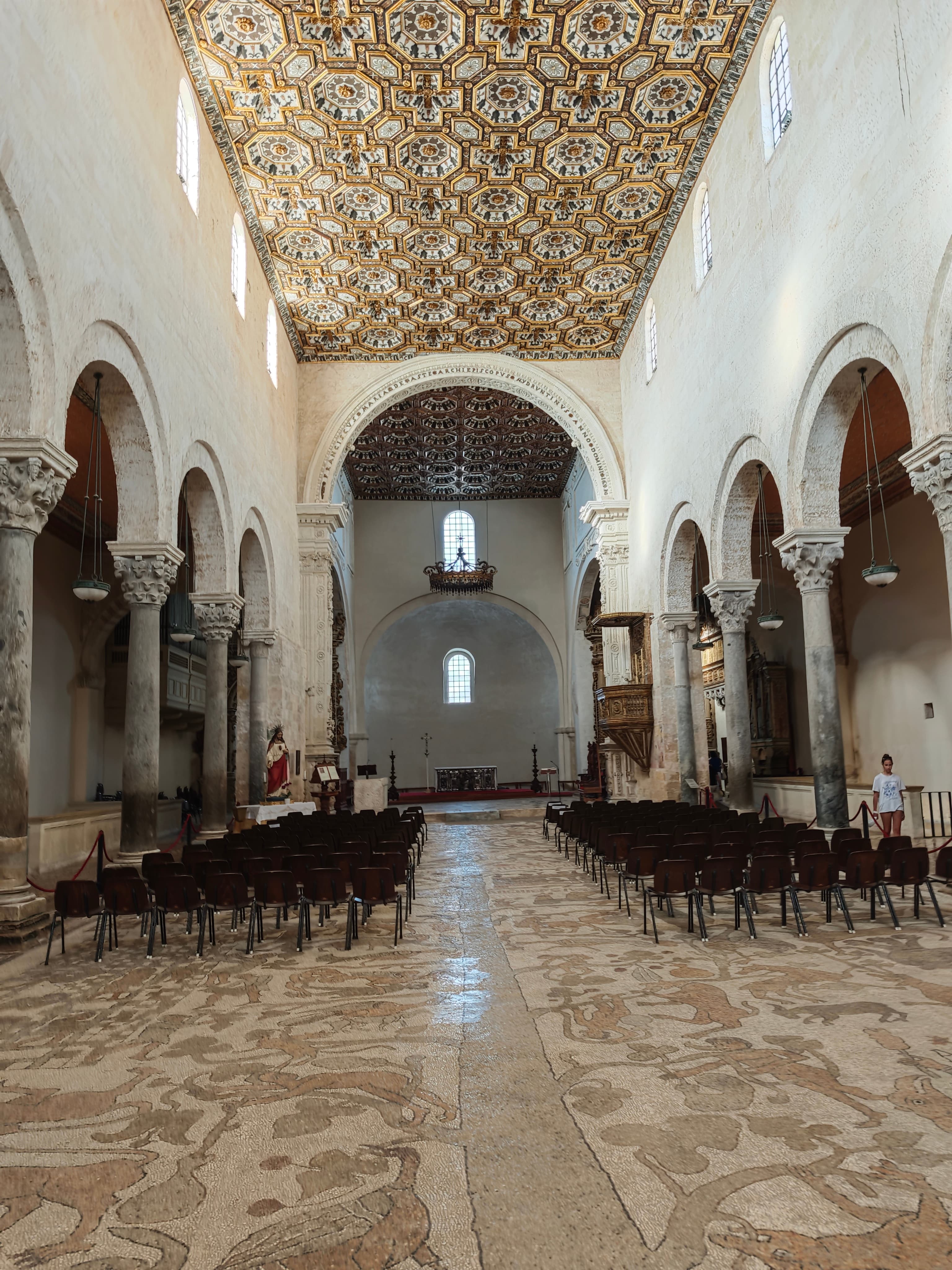
The Cattedrale di Santa Maria Annunziata, or Otranto Cathedral, is one of the most important Romanesque churches in Apulia and one of the defining sights of the town. It is famous for its vast medieval mosaic floor and for preserving the relics of the Martyrs of Otranto.
It stands in Piazza Basilica / Piazza Duomo, on one of the highest points of the old town, where its volume visually anchors the historic center.
History and Significance
The cathedral stands on layers of earlier structures:
- A Messapian acropolis
- A Roman domus
- A paleochristian church
Construction of the current Romanesque cathedral began under the Normans around 1068–1080. It was consecrated on 1 August 1088 during the pontificate of Pope Urban II by the papal legate Roffredo, Archbishop of Benevento, together with the archbishops Guglielmo of Otranto, Alberto of Taranto, and Godino of Brindisi.
In 1480, Ottoman forces entered the cathedral during the siege and massacred clergy and citizens who had sought refuge there. The relics of the martyrs killed after the conquest are still preserved and venerated in the cathedral.
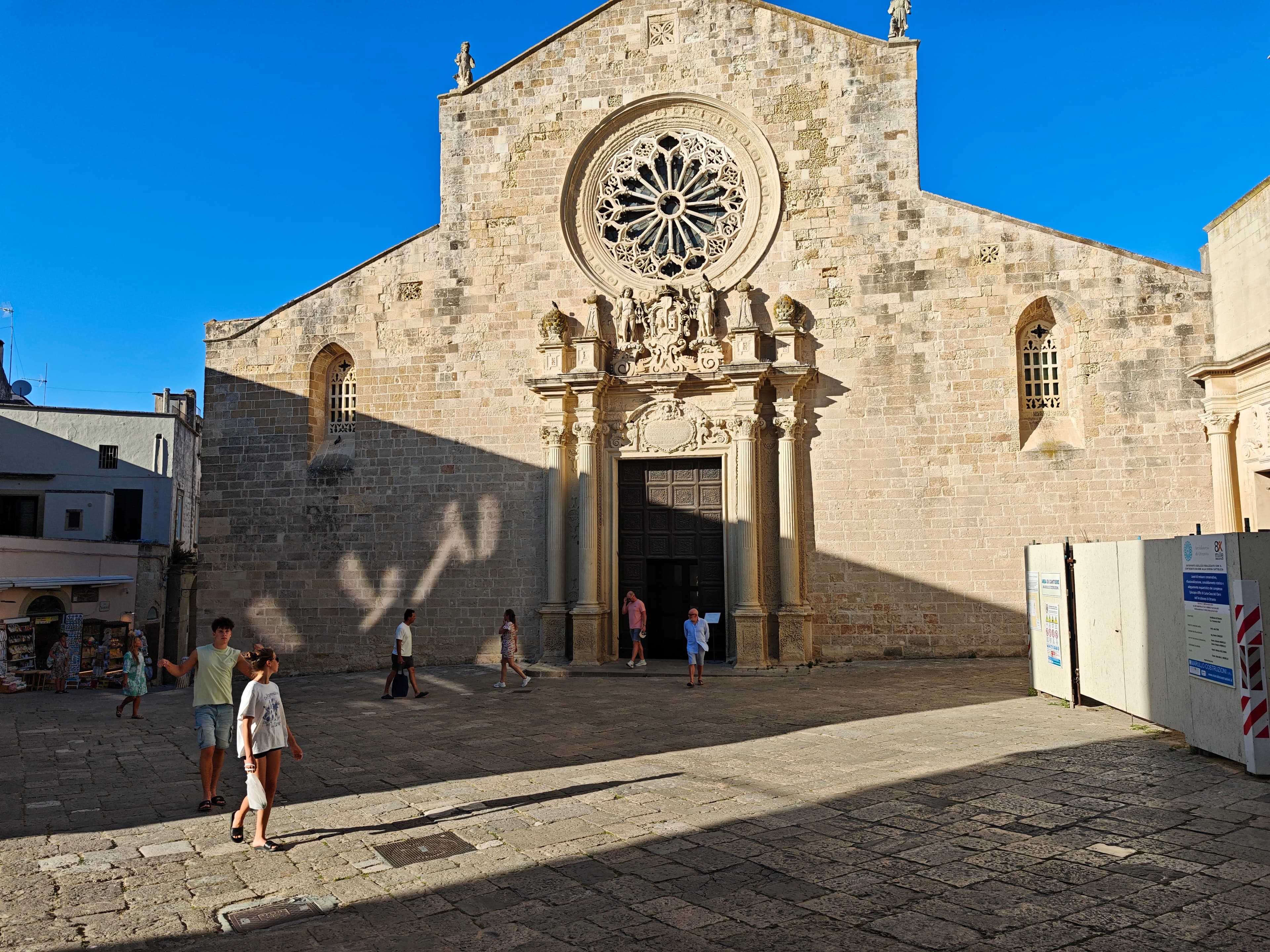
The church was declared a National Monument in 1870 and elevated to the rank of Basilica Minore by Pope Pius XII on 12 July 1945.
Architecture
The cathedral is a Romanesque basilica with a Latin-cross plan, approximately 53 m long and 25 m wide. It has:
- Three naves divided by columns
- Semicircular arches
- A transept
- A large bema
- Three semicircular apses
- A timber truss roof
- Granite and marble columns with varied capitals, many reused from earlier classical or early medieval buildings
- 12 windows in the central nave and 6 in the side naves
The façade has a double-pitched gable and reflects centuries of alteration. Its most striking exterior element is the late 15th-century rose window, inspired by Gothic-Iberian taste, with 16 radiating spokes and fine openwork tracery. The main portal, carved in Leccese stone, dates to 1674 and is in the Leccese Baroque style.
Atmosphere
Inside, the cathedral feels solemn, cool, and layered. The soundscape is quieter than the streets outside: footsteps, low voices, the rustle of visitors, and perhaps incense if services are underway. Light falls in measured ways, creating stillness. The mosaic draws your gaze downward, making you feel as if you are walking through a symbolic map of the medieval world.
Even travelers who feel “cathedraled-out” in Italy often single out Otranto’s cathedral as special because of the mosaic and martyr chapel.
3. The Mosaic Floor: The Tree of Life and a Medieval Universe
The mosaic floor of Otranto Cathedral is the cathedral’s greatest artistic treasure. It is a vast 12th-century pavement, about 52 meters long and roughly 700 square meters, covering the nave, aisles, presbytery, and apse.
It was commissioned in 1163 by Archbishop Jonatas/Gionata, the first Latin archbishop of Otranto, and created between 1163 and 1165 by the monk-artist Pantaleone/Pantaleon, a Basilian monk from the nearby monastery of San Nicola di Casole. Latin inscriptions in the floor identify Pantaleone and mention King William I of Sicily.
The mosaic was made with more than 600,000 tesserae of local limestone and colored glass. Some sources and descriptions refer to the entire pavement as having about 10 million tesserae, reflecting the immense visual complexity visitors perceive.
Why It Matters
The mosaic is often described as a medieval visual encyclopedia, a “talking floor,” or a picture-book of medieval imagination. It represents the History of Salvation, from sin to grace, from the Fall to redemption in Christ.
Its central motif is the Tree of Life, whose trunk runs along the nave and whose branches extend through the church. The tree symbolizes Christ—“the Way, the Truth, and the Life”—and structures the whole narrative.
The mosaic includes:
- Creation scenes
- Adam and Eve
- Cain and Abel
- Noah
- King Solomon and the Queen of Sheba
- Prophets
- Angels and demons
- Heaven and Hell
- Apocalyptic beasts
- Zodiac signs
- Months of the year
- Bestiary animals, both real and imaginary
- Chivalric and Arthurian figures
- Mythological figures
- Classical and secular motifs
- References to chess and courtly culture
- King Arthur, one of the earliest known Italian representations of him
- Alexander the Great
- Diana the Huntress
- Two large elephants supporting the Tree of Life near the entrance
The mosaic’s combination of biblical, mythological, zodiacal, chivalric, and everyday imagery reflects Otranto’s place as a cultural crossroads. It is one of the best-preserved and most extensive medieval mosaics in Italy and is sometimes described as a candidate-worthy monument for UNESCO recognition.
How to Experience It
Do not rush. Walk slowly from the entrance toward the altar. Look at the trunk of the Tree of Life, then the branches. Circle through the side aisles. Step back when possible to understand the structure.
The experience is unusually intimate because you are not looking at art hung on a wall—you are standing over a visual world beneath your feet. The cathedral becomes a vessel of memory.
Practical Notes
- Entry to the cathedral and mosaic is widely reported as free, though donations may be encouraged.
- Some areas or guided visits may involve a small fee or combined ticket.
- Guided tours focusing on the mosaic and martyrs may be offered, often by local operators.
- Parts of the mosaic may be roped off or partially covered by chairs, especially during services or busy periods.
- Avoid Sunday morning Mass if your priority is quiet viewing.
- Best visiting times: early morning or late afternoon.
4. The Martyrs of Otranto: Chapel, Crypt, and Sacred Memory
The cathedral’s most emotionally powerful space for many visitors is the area preserving the relics of the Martyrs of Otranto.
After the Ottoman conquest in 1480, 813 residents were executed for refusing conversion. Their relics are displayed in large glass reliquaries and wall niches, forming a sobering memorial.
Some sources refer to the Crypt of the Otranto Martyrs, though in practical visitor terms, the martyr space is less a dramatic underground crypt and more a sacred memorial chapel/area integrated into the cathedral interior near the altar. The cathedral complex also includes a large crypt beneath the presbytery.
The martyrs were:
- Executed on 14 August 1480
- Beatified in 1771
- Canonized by Pope Francis in 2013
The relics connect the cathedral not only to medieval architecture but to one of Otranto’s defining historical traumas.
Review Verdict
Visitors often describe the Martyrs’ Chapel as:
- Sobering
- Unforgettable
- Moving
- Historically powerful
It is not a tourist spectacle in the usual sense. It is a sacred place and should be approached with respect.
5. The Cathedral Crypt
Beneath the presbytery lies the cathedral’s atmospheric crypt, often compared to a small underground basilica.
It contains:
- A forest of columns
- Vaults
- Reused ancient materials
- Elements of an earlier paleochristian church
- A dense and evocative architectural atmosphere
Some descriptions note 42 marble columns with varied carved capitals. The crypt is one of the most atmospheric spaces in Otranto’s sacred ensemble.
Practical Notes
- Recent traveler reports often describe access to the cathedral and crypt as free of charge.
- Some sources suggest a modest fee may occasionally apply for specific areas or combined cultural itineraries.
- Plan for possible free entry but carry small cash for donations or guided options.
Cathedral Opening Hours: Practical Estimate
Reported schedules vary seasonally. Recent information includes:
- All days: around 08:30–12:30 and 15:00–19:30 in daylight-saving/summer periods.
- Another standard listing: 08:00–12:00 and 15:00–17:15.
- BeautifulPuglia-style typical hours: 07:30–12:30 and 15:30–19:30.
- General practical estimate:
- Low season/winter: 08:00–12:00 and 15:00–17:15
- Spring/summer: 08:30–12:30 and 15:00–19:30
Access can be restricted during Mass, weddings, feast days, or liturgies. If timing is tight, check the tourist office, cathedral noticeboard, diocesan information, or signage at the entrance.
6. Aragonese Castle of Otranto: The Fortress Above the Sea
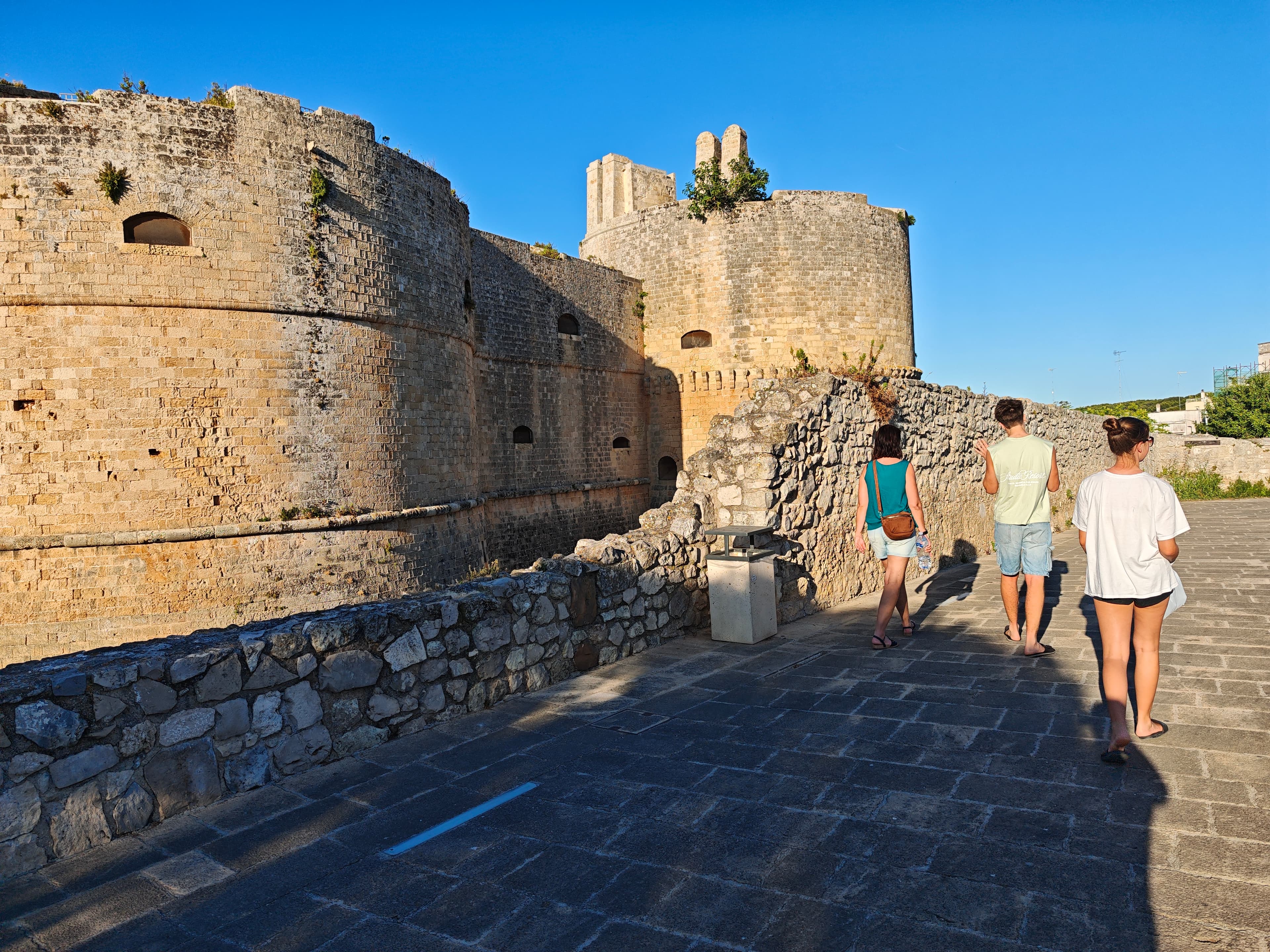
The Aragonese Castle of Otranto is the town’s dominant military monument. It sits at the edge of the old town near the harbor and forms a powerful visual and symbolic presence.
Geo data identifies it as:
- Name: Aragonese Castle of Otranto
- Type: art_gallery / cultural venue
- Rating: 4.4
- User ratings: 6,810
- Address: Piazza Castello, 73028 Otranto LE, Italy
- Coordinates: 40.1445062, 18.4924035
History
The site was fortified before the current structure. Messapian and medieval defenses preceded the present castle. An earlier castle was damaged in 1067 and repaired by Robert Guiscard. Further works were undertaken in 1228 by Frederick II of Swabia, and elements survive in a cylindrical median tower and the north-east curtain wall.
After the Ottoman siege of 1480, the castle and walls were rebuilt and modernized. Construction of the Aragonese layout began in 1485, designed by military architects Ciro Ciri and Francesco di Giorgio Martini, at the request of Ferdinand/Ferdinando I of Aragon. Works continued until about 1498, incorporating earlier Swabian structures and even improvements introduced by the Turks during their occupation.
Spanish viceroys later transformed the castle into a refined Renaissance military work. The bastion was reinforced in 1578, with coats of arms of Antonio de Mendoza and Don Pedro da Toledo, while a large coat of arms of Charles V decorates the entrance. Further consolidation occurred in 1647 under architect Saponaro.
Architecture
The castle has:
- An irregular pentagonal plan
- A broad, deep moat
- Access via a stone bridge/drawbridge area
- Cylindrical corner towers
- Bastions adapted for artillery warfare
- Gunports and fire vents
- Heraldic coats of arms
- A distinctive Punta di Diamante or Diamond Bastion, whose faceted masonry scatters light
- A first-floor gallery
- Courtyards and halls used for exhibitions
- Underground tunnels, dungeons, basements, and defensive spaces, sometimes accessible by guided visit
Some descriptions refer to three main cylindrical corner towers plus projecting elements; others mention four circular towers, including one projecting toward the sea, associated with the “Forte a Mare.”
Atmosphere
The castle feels watchful, wind-swept, fortified, and heavy with memory. Around it, the air is salty and dry. You hear gulls, footsteps, visitors, and wind moving through the walls. From the towers or elevated spaces, the view opens toward the harbor and Adriatic.
The emotional contrast is one of the castle’s great appeals: massive, enclosed stone against bright, open sea.
Horace Walpole and Gothic Literary Heritage
The real castle is associated symbolically with Horace Walpole’s 1764 novel The Castle of Otranto, widely regarded as the first Gothic novel. Walpole likely never visited Otranto, and there is no physical “Castle of Otranto” from the novel that can be securely identified as his model. His fictional castle was partly inspired by medieval imagination and by his own Gothicized villa, Strawberry Hill, in England.
Still, the real Aragonese Castle has become part of a literary heritage circuit. Visitors interested in Gothic fiction can experience the fortress as a physical anchor for the novel’s themes: dynastic struggle, haunted architecture, towers, corridors, underground spaces, and the dramatic atmosphere of a fortified southern Italian town.
Practical Information: Castle Tickets and Hours
There is some inconsistency across sources.
One official-style Visit Puglia breakdown gives:
- Full ticket: €12
- Reduced ticket: €9 for groups of at least 12, concession categories, Otranto Card holders
- Reduced ticket: €7 for minors under 18 and residents
- Underground access supplement: €4
- School groups: €3
- Free entry: minors under 18 accompanied by parents, children under 6, disabled visitors with companion, licensed tour guides
- Daily opening: 10:00–24:00, every day
- Underground guided tours usually require advance reservation
Other sources and guide-style estimates report lower or variable pricing:
- Around €3–4 for basic castle/exhibition visits in some older or local descriptions
- €6–8 as a standard adult estimate in literary heritage summaries
- €8–12 for special exhibitions or evening events
- Combined tickets sometimes in the €10–15 range
The safest approach: expect the castle to cost around €10–12 for a full adult visit, with possible extra for underground areas, but verify locally because exhibitions and management arrangements can affect pricing.
Review Verdict
Reviews are divided:
People love:
- The exterior, moat, towers, views, and photogenic position
- The sense of history
- Exhibitions when well curated
- Using it as a landmark and starting point
People dislike:
- Interior can feel underwhelming or empty
- English labeling may be limited
- Price can feel high for a 45–60 minute visit
- Temporary exhibitions or events may close some areas
Real verdict:
The exterior and setting are must-see. The paid interior is optional unless you love castles, exhibitions, military architecture, or want the views/underground sections.
7. Porta Terra / Porta Alfonsina: Entering the Fortified Town
Porta Terra, also known as Porta Alfonsina, is one of Otranto’s key symbolic entrances. It is the main seaward gate into the historic walled center and marks the transition from harbor and waterfront into the protected medieval core.
History
The gate is closely linked to the post-1480 Aragonese reconstruction. After the Ottoman sack and reconquest, Alfonso of Aragon led the army that freed Otranto from Turkish occupation and commissioned defensive rebuilding. The gate is named in his honor.
It functioned historically as the main access from the sea side into the town. Today, it still gives direct access toward the cathedral, castle, shops, bars, and old-town lanes.
What to Look For
- The imposing stone portal
- Arched opening framing the old town
- Relationship between gate, tower, and walls
- Torre Alfonsina, part of the fortified system
- The small gathering point around Largo Porta Alfonsina
- Views toward the sea and harbor
- Nearby ramparts and seafront
Following Via Basilica from the gate leads you shortly toward the cathedral.
Practical Notes
- Access is free.
- It is a public city gate, not a ticketed monument.
- It is effectively accessible 24/7, weekdays and weekends.
- Tour platforms may sell “tickets” that include Porta Alfonsina, but those are generally guided tours of Otranto, not tickets to the gate itself.
- Guided walking tours including this area may range roughly €15–35 per adult, depending on operator and length.
8. Chiesa di San Pietro: Otranto’s Byzantine Jewel
The Church of San Pietro is one of the most important surviving Byzantine churches in Apulia and one of Otranto’s most atmospheric hidden gems.
It is small, tucked into the old town, and easy to miss. That is part of its charm: it feels discovered rather than announced.
History
Most specialist sources date the present structure to the 9th–10th century. Some traditions suggest earlier origins, even the 5th century, or link it devotionally to a legendary 1st-century visit by St Peter on his way from Antioch to Rome. Those traditions are more devotional than securely historical.
San Pietro belongs to the period when Otranto was a major Byzantine center. It was chosen as an Orthodox metropolis / metropolitan basilica in 968, reflecting the prestige of Otranto in the Byzantine ecclesiastical world.
Remarkably, the church maintained the Greek rite until the 18th century, when the last Greek-rite priests disappeared.
Because of its modest size and absence of an iconostasis, one interpretation suggests it may originally have been a private chapel of a Byzantine aristocrat.
Architecture
San Pietro has a Greek-cross / cross-in-square plan, typical of Byzantine church architecture. It has:
- A square footprint
- Central dome
- Four arms of a Greek cross
- Three naves inside
- Small apses with single-lancet windows
- Local stone construction: carparo, mazara, calcareous and tuffaceous stone
- An almost original early medieval structure despite later repairs
Frescoes
Historically, the dome, vaults, apses, walls, and columns were entirely frescoed, forming a kind of visual catechesis on the Gospels, Christ, the Virgin, and local saints.
Surviving frescoes range from the 10th to the 16th century. The oldest layers are Byzantine in style; later additions show Western medieval influence.
Notable surviving scenes include:
- The Washing of the Feet
- The Last Supper
- Christological scenes
- Passion narratives
- Frescoed apses
Atmosphere
San Pietro is tiny, intimate, dim, devotional, and ancient. It smells of cool stone, old plaster, wax, and perhaps incense. A few footsteps can echo. The faded frescoes make it feel like a preserved pocket of Byzantine Otranto.
Practical Notes
- Entry is often free, sometimes with optional donation.
- Some visitor reports mention a combined ticket with the Diocesan Museum for €5.
- Realistic 2024/2025 expectation:
- Single entry: free or small fee up to around €3
- Combined ticket: around €5–7
- Opening is often volunteer-dependent.
- Typical reported hours:
- Morning: 10:00–12:00 or 10:30–12:30
- Afternoon/evening: 16:30–19:00 or 17:00–19:30
- Some online map listings may say “temporarily closed,” but recent visitors report that this can be outdated.
- If you are in town for a day, pass by both morning and late afternoon.
Review Verdict
Highly recommended for art, history, Byzantine heritage, and quiet sacred atmosphere. Casual beach-focused visitors may find it small, but it is one of Otranto’s best hidden gems.
9. Torre Matta and the Seafront Ramparts
Torre Matta, also known as Torre Matta o del Celso, is a seafront bastion-tower embedded in Otranto’s city walls. It is both a defensive relic and, at times, an exhibition and panoramic space.
History
Originally built in the 15th century, Torre Matta was part of the old defensive walls of Otranto’s port. It began as a cylindrical tower, serving as a watchtower and arms/powder depot.
After the Ottoman siege of 1480 exposed the weakness of the old defenses, Alfonso of Naples, eldest son of Ferrante I of Aragon, ordered modernization. The old cylindrical tower was encased within a powerful square bastion as part of the Aragonese defensive system.
This makes Torre Matta a “tower within a tower”: a visible case of military adaptation from medieval lookout to Renaissance artillery bastion.
What to See
- The original cylindrical tower core
- The later quadrangular bastion shell
- Protruding curved masonry supported by corbels
- Thick defensive walls
- Views over the city, harbor, gulf, and Adriatic
- Temporary exhibitions when open
- Relationship to the Aragonese Castle underground areas
Atmosphere
Torre Matta feels elevated, airy, and watchtower-like. The wind is stronger, the sea more visible, and the structure helps make Otranto’s defensive layout legible. From above, walls, sea, castle, streets, and rooftops become one coastal organism.
Practical Notes
- Exterior/ramparts are generally part of the public urban fabric and can be viewed freely.
- Interior access depends on exhibitions or events.
- Estimated ticket when exhibitions are running:
- Adult: €3–5
- Reduced: €2–3
- Children under 12: often free or symbolic fee
- Combined tickets with castle/underground areas may be €6–8
- Opening hours are event-driven.
- High season estimate:
- 10:00–13:00 and 17:00–21:00/22:00
- Weekends may extend later, possibly to 23:00
- Shoulder/low season:
- Reduced schedules, afternoon-only, weekends-only, or closed between exhibitions
Ask at the tourist office or Castello Aragonese ticket desk.
10. Lungomare degli Eroi: Promenade, Views, and Martyrs’ Memorial
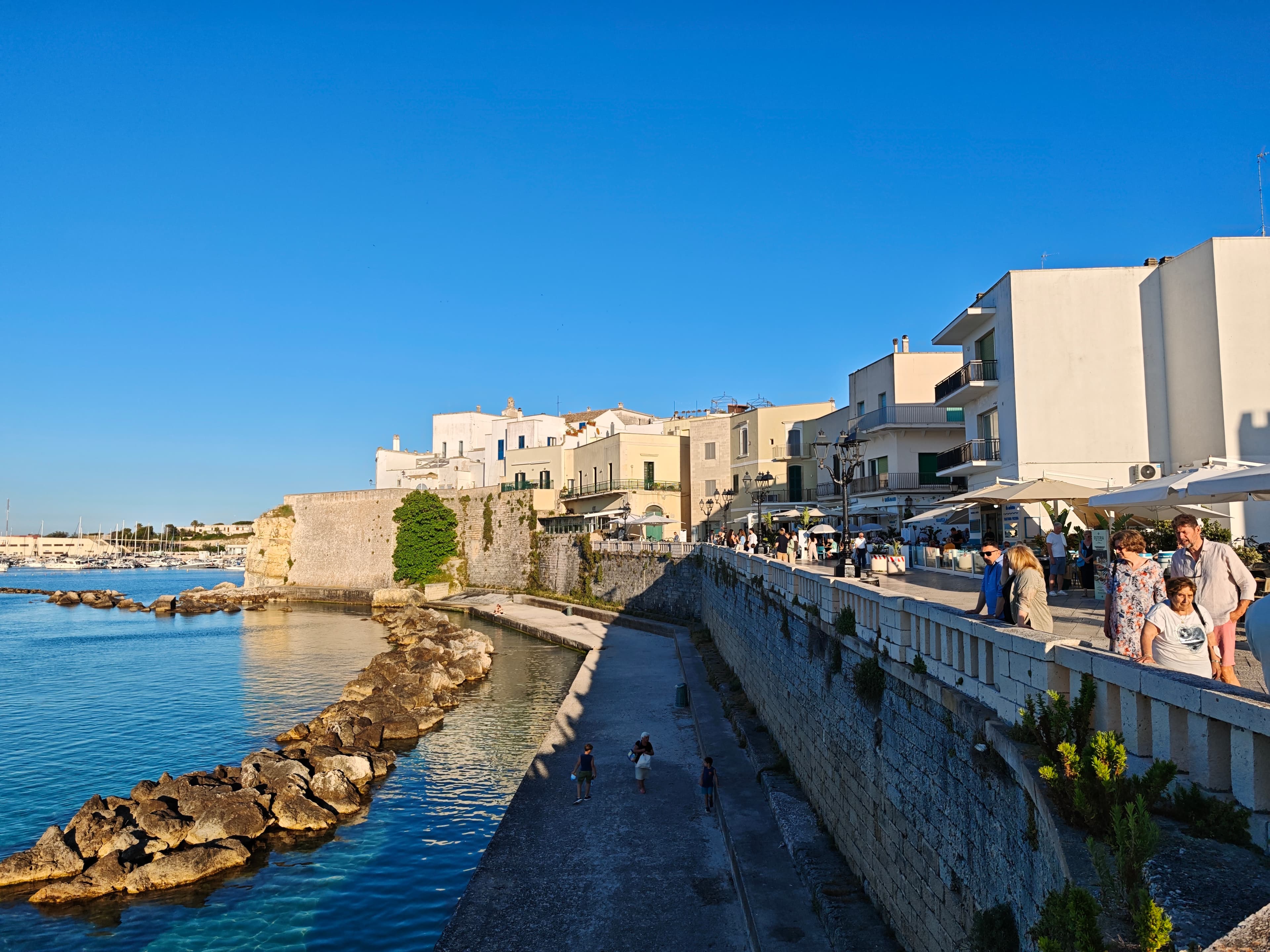
The Lungomare degli Eroi is Otranto’s main waterfront promenade. It links the historic center, castle, harbor, beaches, and modern seafront. It is also a memorial space dedicated to the town’s “heroes,” especially the martyrs of 1480.
The Promenade
The lungomare is panoramic, open, social, and deeply scenic. It is where the old town’s density gives way to sea air and wide views. You hear waves, boat engines, gulls, footsteps, and the hum of evening walkers. The smell is salt, algae, warm stone, and sometimes fish from the waterfront.
It is especially enjoyable at:
- Sunset
- Early morning
- Summer evenings
- After dinner, during passeggiata
Monument to the Heroes and Martyrs
The Monumento agli Eroi e Martiri di Otranto del 1480 stands on the promenade.
Key facts:
- Initiative launched after an article in L’Italia reale on 8 April 1907
- Inaugurated 3 December 1922
- Sculptor: Antonio Bortone
- Materials: stone and bronze
- Central figure: a female allegory of Otranto’s heroic resistance
- She holds a cross and a flag, symbolizing religion and homeland
- Commemorates the martyrdom of the 800/813 citizens on 14 August 1480
- Originally intended for Colle della Minerva but placed on the seafront, facing toward the Adriatic and the direction of the Ottoman threat
Practical Notes
- Free access
- Open 24/7
- TripAdvisor-style listings show 00:00–23:59 daily
- Crowds increase in high season and around mid-August, especially during the Festa dei Santi Martiri di Otranto
- Use the promenade for walking, views, and aperitivo; be selective about dining directly on the waterfront because of higher prices.
Review Verdict
The lungomare is strongly praised for views, evening atmosphere, and photos. Dining along the seafront is more mixed due to tourist pricing, restaurant touts, and service variability.
11. Chiesa di Santa Maria dei Martiri: The Place of Execution
The Chiesa di Santa Maria dei Martiri is a sanctuary on the Colle della Minerva, the hill where the martyrs of Otranto were executed after the Ottoman conquest.
History
In 1480, troops led by Gedik Ahmet Pascià captured Otranto. Around 813 men were led to Colle della Minerva and executed on 14 August 1480 for refusing to renounce Christianity.
To commemorate the massacre, Alfonso d’Aragona had a first sacred structure built on the hill. It later fell into ruin. The current church was rebuilt in 1614 on those ruins, together with a convent, and completed during the 17th century.
The sanctuary is also linked to San Francesco da Paola and the convent of the Minims, dated 1542. In 1992, it was elevated to a diocesan sanctuary. On 5 October 1980, during the fifth centenary of the martyrdom, Pope John Paul II visited and venerated the martyrs there.
What to See
- The climb up Colle della Minerva
- Stone stairway lined with trees
- Late-Renaissance façade with Leccese Baroque elements
- A column near the entrance recalling the place where the converted Berlabei was traditionally impaled
- A side chapel marking the area where the decapitation stone once stood
- Baroque Leccese altars and stuccowork
- Mosaic floor
- Devotional paintings of the martyrdom
- A large painting of the Strage di Otranto, attributed in sources as either Lavinio Zoppo or Ludovico Zoppi, 16th century
- Commemorative plaques with names of some martyrs
The principal relics are not here; they are in the cathedral. This sanctuary marks the physical place of martyrdom.
Practical Notes
- Walk from center/port: about 15–20 minutes, uphill toward the end.
- It is more devotional than touristic.
- Entry appears generally free, with optional donation.
- Carry small cash for an offering.
Reported summer schedule from June to September:
- Monday, Tuesday, Thursday, Saturday: 08:00–12:30
- Wednesday and Sunday through grate access:
- 08:00–12:00
- 16:00–19:30
Recent reviews say it may be open mostly during Mass or depending on religious/convent availability. Outside summer, it can be closed except for services or by request.
Useful phone number listed in tourism information: +39 0836 804954.
12. Church of Madonna dell’Altomare: Maritime Devotion by the Sea
The Church of Madonna dell’Altomare is a small seaside sanctuary associated with Otranto’s maritime devotion and the cult of the Virgin of the Sea.
History and Meaning
It is commonly described as dating to the 17th century. Local tourism descriptions connect it to a legend of a statue of Our Lady allegedly taken by the Turks and later found in Otranto on a piece of wood.
The sanctuary is connected to a September Feast of Our Lady with a sea procession, emphasizing its role in local ritual and seafaring identity.
Description
It is more chapel/sanctuary than large church. Its value lies in:
- Scenic seaside position
- Devotional intimacy
- Association with sailors and the sea
- A noted mosaic floor inside
- Connection to the old town and seafront landscape
Practical Notes
- Public information suggests free or no standard admission.
- Reliable 2024/2025 opening hours are not clear.
- Visitor reports describe it as almost always closed or only briefly accessible.
- Trip.com-style listings may treat it as a ticketed attraction but without verifiable pricing.
- Best approach: admire the exterior if closed, and check locally if you particularly want to enter.
13. Torre del Serpe: Legend, Ruin, and Otranto’s Emblem
Torre del Serpe, or Serpent Tower, is one of Otranto’s most evocative coastal landmarks: a ruined watchtower/lighthouse set on a promontory south of town.
History and Legend
Its origins are uncertain. Some sources suggest Roman-era roots, possibly as a lighthouse for ships approaching ancient Hydruntum. Others emphasize its medieval and early modern role in coastal defense against Saracen, Ottoman, and corsair threats. One source notes restoration in the Frederician era, under Frederick II.
The legend says a giant serpent climbed the tower at night and drank the oil from the lamp, extinguishing the light and causing ships to founder. This story became central to Otranto’s identity and influenced the civic imagery of a serpent around a tower.
Description
- Cylindrical / truncated-conical form
- Partly ruined
- Surviving lower scarpa, or sloped defensive base
- Around 35 meters above sea level
- Roughly 200 meters from the coast
- Panoramic views over the Adriatic, Baia delle Orte, and Otranto
Practical Notes
- Free admission
- No official opening hours
- Visit during daylight for safety
- Sunrise and sunset are especially atmospheric
- Avoid after dark due to uneven ground and visibility
14. Punta Palascìa / Capo d’Otranto: Italy’s Easternmost Point
One of the most symbolic places near Otranto is Punta Palascìa, also called Capo d’Otranto, the easternmost point of Italy.
Geo data identifies:
- Easternmost Point of Italy
- Rating: 4.8
- User ratings: 508
- Coordinates: 40.1072761, 18.5205017
- Lighthouse Punta Palascìa
- Rating: 4.7
- User ratings: 3,414
- Address: Cippano, 73028 Otranto LE
- Coordinates: 40.1074182, 18.5198791
Atmosphere
If the old town is intimate and layered, Punta Palascìa is elemental: wind, rock, sea, horizon. It feels remote even though it is accessible from Otranto. The emotional power comes from the geography: standing at Italy’s eastern edge, looking outward toward the Adriatic and the east.
The vibe is windy, horizon-driven, contemplative, and stripped to essentials.
What to Do
- Visit the lighthouse area
- Take photos of the coast and sea
- Go at sunrise if you want the symbolic “first light of Italy” feeling
- Combine with coastal drives, Torre del Serpe, Baia dell’Orte, or Cava di Bauxite
15. Otranto’s Beaches: Town Sand, Clear Water, and Coastal Choices
Otranto’s appeal is not only historic. It is also a seaside town with beaches in and around the center.
Spiaggia dei Gradoni
Geo data:
- Spiaggia dei Gradoni
- Rating: 4.4
- User ratings: 3,745
- Address: Via Lungomare Kennedy, 73028 Otranto LE
- Coordinates: 40.1492426, 18.4869904
This is one of the main town beach areas, convenient for combining sightseeing and swimming. It is central, accessible, and popular.
Pros
- Steps from the old town
- Clear water for an urban beach
- Views back toward Otranto
- Easy for families and short visits
Cons
- Crowded in high season
- Limited space
- Towels close together
- More urban than natural beaches
Spiaggetta del Molo / Spiaggia dei Bambini
Geo data:
- Rating: 4.4
- User ratings: 59
- Address: Via D’Aragona A, 20, 73028 Otranto LE
- Coordinates: 40.1469539, 18.4894615
Known as a small beach near the pier and often associated with children because of its protected, accessible feel.
Spiaggia degli Haethei
Geo data:
- Rating: 4.5
- User ratings: 121
- Address: 73028 Otranto, Province of Lecce
- Coordinates: 40.1500264, 18.4875327
A beach area north of the historic core, along the town’s seafront stretch.
Scoglio Il Fascio
Geo data:
- Rating: 4.7
- User ratings: 69
- Address: Via Riviera Haethei, 73028 Otranto LE
- Coordinates: 40.1512345, 18.4897786
A rocky sea-edge spot with strong ratings, useful for swimmers and those who prefer rock access and views.
Spiaggia libera La Plancia
Geo data:
- Rating: 4.3
- User ratings: 33
- Address: Via Antonio Sforza, 7, 73028 Otranto LE
- Coordinates: 40.154808, 18.4880634
A free beach area slightly away from the most central old-town zone.
Porto Grande Beach / Baia dell’Orte
Geo data:
- Porto Grande Beach
- Rating: 4.4
- User ratings: 143
- Address: Baia dell’Orte, 73028 Otranto LE
- Coordinates: 40.1330601, 18.5138793
A beach/coastal area south-east of town near Baia dell’Orte, useful for travelers seeking a more natural setting.
Porto Craulo and Nearby Sea Edge
Otranto’s sandy beaches and crystal-clear waters are part of the town’s identity. Porto Craulo and nearby beaches represent the lighter side of Otranto: salt on skin, towels, umbrellas, children playing, sunscreen, waves, and clear water.
The special feature of Otranto’s beach scene is the proximity of history. You can swim, look back at the white town and fortifications, then walk minutes to the cathedral or castle.
16. Baia dei Turchi: The Classic Beach Excursion
Although not in the Geo Agent’s 20-place list, Baia dei Turchi appears strongly in review research as one of the most praised and most crowded beaches near Otranto.
What People Love
- Turquoise water
- Fine sand
- Pine-fringed setting
- Relatively natural atmosphere compared with town beaches
- Calm, shallow waters good for families
- Classic Salento beach feel
Complaints
- Limited parking
- Paid lots
- 10–15 minute walk from car to beach via sandy paths
- Very crowded in July–August
- Increasing commercialization with sunbed rows and beach bars
Tourist Trap Warnings
- Parking fees and sunbed prices are the main issue.
- If you arrive late in high season, you may feel forced into expensive lidos.
- Seek free beach zones if possible.
- Bring your own umbrella to avoid lido costs.
Verdict
Worth it if you want a famous Salento beach and can go early or off-season. Less ideal if you hate crowds or paid-beach culture.
17. Alimini Lakes and Alimini Beach
Geo data:
- Alimini Lakes
- Rating: 4.3
- User ratings: 612
- Address: 73028 Otranto, Province of Lecce
- Coordinates: 40.1989917, 18.4421303
The Alimini area north of Otranto includes lakes, sandy coastline, beach clubs, and nature.
Atmosphere
The lakes offer a tranquil, reflective, nature-leaning contrast to Otranto’s stone and sea. Expect reeds, still water, birdlife, wind through vegetation, insects, and a slower pace.
Beach Experience
Alimini Beach is a long sandy stretch praised for:
- Space
- Family-friendly shallow entry
- Water sports
- Walking and running
- Kitesurfing possibilities
- Combination of sea and lakes
- Birdwatching interest
Complaints
- Lido dominance
- Limited free sections
- Wind and waves on exposed days
- Need for car or transport
- Paid parking
- Pricey lido food/drinks
Verdict
Good for families and those wanting a spacious beach day with facilities. Less ideal if you dislike beach clubs.
18. Cava di Bauxite: Otranto’s Red-Earth Landscape
The Cava di Bauxite is one of the most visually distinctive places near Otranto. It is not in the Geo list by name, but it appears in vibe and review research and is frequently mentioned in Otranto travel discussions.
Atmosphere
The quarry is surreal, geological, colorful, and strikingly photogenic. Red earth contrasts with green vegetation and a small lake, creating a Mars-like or otherworldly landscape.
The sensory world is dry earth, mineral dust, wind, uneven ground, and vivid color.
What People Love
- Unique landscape
- Great photos, especially at golden hour
- Quick visit of 30–60 minutes
- Low cost or donation-based access
- Easy short drive or bike ride from town
Complaints
- Unregulated feel
- Limited official paths
- Lack of signage
- Occasional litter
- Dusty, uneven, slippery trails
- Drops near quarry edges, concerning with children
- Crowds at classic photo points in season
Tourist Trap Warnings
- Informal parking attendants may request small cash fees.
- Confirm the price before parking.
- Some locals may offer “guided” walks that add little value; most visitors find self-guided exploration enough.
Verdict
Worth it for photographers and unusual-landscape lovers. Not a structured nature park.
19. Porto Badisco and the Southern Coast
Porto Badisco is a quieter coastal cove south of Otranto. It is relaxed, locally cherished, and more tucked-away than Otranto proper.
Atmosphere
Clear water, rocks, sun, small waves, salt, sunscreen, seaweed, and a sheltered-bay feeling. It offers a sense of discovery and refuge.
Why Go
- Coastal scenery
- Swimming
- Quieter feel than town beaches
- Good addition to a drive south
- Connects with coastal routes toward Santa Cesarea Terme
Review Context
Travelers often frame Otranto as a base for nearby day trips such as:
- Porto Badisco
- Santa Cesarea Terme
- Coastal road south of Otranto
- Watchtowers and cliff walks
The coastal road south is repeatedly praised as one of Puglia’s most beautiful drives.
20. Torre Sant’Emiliano and Coastal Walks
Torre Sant’Emiliano is often mentioned in hiking, cycling, and coastal-scenery discussions.
What People Love
- Dramatic cliffs
- Open sea views
- Watchtower atmosphere
- Less crowded than beaches
- Sense of defensive history against Ottoman and pirate raids
Practical Warnings
- Paths may not be well-marked
- Little shade
- Few water sources
- Summer walks can be challenging
- Suitable footwear, water, and sun protection are essential
- Usually requires car, bike, or a long walk
Verdict
Excellent for hikers and cyclists. Casual short-stay travelers may skip it unless seeking nature and coastal solitude.
21. Grottos, Coves, and Boat Trips Around Otranto
The Geo Agent identified several coastal attractions and boat operators that are useful for travelers who want caves, swimming stops, and sea views.
Cala di Grotta Monaca
Geo data:
- Rating: 4.6
- User ratings: 331
- Address: Località Grotta Monaca, 73028 Otranto LE
- Coordinates: 40.1626178, 18.4842606
A highly rated coastal spot north of town, associated with coves and rocky sea access.
Grotta Sfondata
Geo data:
- Rating: 4.3
- User ratings: 422
- Address: Unnamed Road, 73028 Otranto LE
- Coordinates: 40.1702393, 18.4805391
A natural coastal cave/rock formation area, popular for scenic exploration.
Grotta della Macchia
Geo data:
- Rating: 4.7
- User ratings: 20
- Address: Contrada Storlacina, 73028 Otranto LE
- Coordinates: 40.0956054, 18.5030767
A lesser-known cave/natural site south of Otranto.
HYDRA Boat Trips
Geo data:
- Rating: 4.8
- User ratings: 266
- Address: Via del Porto, 73028 Otranto LE
- Coordinates: 40.147211, 18.4970803
Salento in BOAT TRIPS – Boat Trip Otranto
Geo data:
- Rating: 4.7
- User ratings: 350
- Address: Via del Porto, 73028 Otranto LE
- Coordinates: 40.1451363, 18.494484
Boat Trip Review Advice
Boat trips from Otranto can be excellent for:
- Coastal scenery
- Caves
- Swimming stops
- Views of cliffs and hidden coves
- Seeing Otranto from the sea
But quality varies. Before paying, confirm:
- Duration
- Route
- Swimming stops
- Group size
- Language of explanation
- Whether fuel/drinks are included
- Cancellation policy in wind or rough sea
Last-minute harbor offers are not necessarily scams, but comparison is wise.
22. Ipogeo di Torre Pinta: Underground Mystery
Geo data:
- Ipogeo di Torre Pinta
- Rating: 4.6
- User ratings: 263
- Address: Via Memorie, 73028 Otranto LE
- Coordinates: 40.1341388, 18.4889978
The Ipogeo di Torre Pinta is a distinctive underground site outside the old-town core. While detailed historical research was not provided in the agent reports, it appears in the Geo list as a highly rated attraction. It is worth considering if you are interested in subterranean or archaeological-feeling places and have extra time beyond the cathedral, castle, and beaches.
Given the name “Ipogeo,” expect an underground/hypogeal structure rather than a conventional monument. Verify opening arrangements locally, as smaller sites may have seasonal or guided-access limitations.
23. Torre dell’Orte and Baia dell’Orte Area
Geo data:
- Torre dell’Orte
- Rating: 4.6
- User ratings: 25
- Address: 73028 Otranto, Province of Lecce
- Coordinates: 40.1377541, 18.50956
Torre dell’Orte lies in the Baia dell’Orte area south-east of town, part of the coastal landscape that includes cliffs, sea views, and access toward Torre del Serpe and Punta Palascìa.
The area is best suited to travelers with a car, bike, or willingness to walk, and to those interested in less urban seaside scenery.
24. Crazy Bastion
Geo data:
- Crazy Bastion
- Rating: 4.3
- User ratings: 307
- Address: Via Immacolata, 26, 73028 Otranto LE
- Coordinates: 40.1453467, 18.4933329
The name “Crazy Bastion” appears in the Geo Agent’s attraction list as a highly reviewed point in the old-town fortified area. It likely refers to a bastion/viewpoint or attraction integrated with Otranto’s defensive walls. Include it in your ramparts wandering, especially around Via Immacolata and the seafront wall system.
25. Bastione dei Pelasgi and Via dei Bastioni
The Bastione dei Pelasgi and Via dei Bastioni are among the best ways to experience Otranto as a fortified coastal town.
Atmosphere
Here the town opens toward the Adriatic. The vibe is exposed, panoramic, historic, and shaped by wind. You hear gulls, waves, footsteps, and the breeze along the walls. The stone can be warm under your hands.
This is where you understand that Otranto has always had to face outward—toward trade, invasion, exchange, and the sea.
Via dei Bastioni
Following the wall along Via dei Bastioni turns a simple walk into a sequence of views. It is cinematic, slow, and scenic. The old town, sea, and fortifications merge into one experience.
26. Otranto Port and Harbor
Geo-related boat operators cluster around Via del Porto, and the port itself is an important atmosphere point.
Vibe
Otranto’s port is working-coastal, transitional, and storied. You hear rigging, water against hulls, engines, dock footsteps, and people moving between boats and shore. It smells of saltwater, diesel, fish, and open air.
Historically, this was the place of traders, pilgrims, crusaders, soldiers, and travelers heading east. Today, it is quieter, but it still feels like a place of arrival and departure.
Review Verdict
The harbor is pleasant and photogenic, especially from viewpoints above. Without a boat trip, some visitors see it as “just a small marina walk.” With a boat trip, it becomes a gateway to the coastline.
27. La Villa Park and Il Pitosforo
La Villa, especially its noted Il Pitosforo tree, gives Otranto a softer, greener space between stone and sea.
Atmosphere
Shaded, leisurely, domestic, and restful. The scent shifts from salt and sun-warmed stone to leaves, resin, and cooler air under the canopy. It is a place to sit, pause, people-watch, and absorb the town.
This small green pause helps Otranto feel less like a hard-edged resort and more like a lived-in town with pockets of softness.
28. Otranto Diocesan Museum
The Museo Diocesano di Otranto is the cathedral museum, created in 1992 by Archbishop Vincenzo Franco to preserve sacred works, liturgical furnishings, and historical materials connected to the cathedral and local religious life.
Significance
It complements the cathedral and helps interpret Otranto’s religious history, including Byzantine, medieval, and post-medieval layers and the memory of the Martyrs of Otranto.
Description
Sources describe it as:
- Located in the historic center close to the cathedral
- Part of the broader cathedral/palace complex
- Spread across three floors
- Containing religious art, paintings, frescoes, liturgical objects, and artifacts
- Including a room dedicated to the martyrs of 1480
- Having labels and explanations in rooms
Practical Notes
- A published visitor figure gives a ticket of €5, possibly combined with San Pietro.
- Official 2024/2025 pricing could not be firmly verified.
- Some listings say the museum was temporarily closed until further notice.
- Verify before planning around it, especially outside peak season.
29. Abbey of Santa Maria di Cerrate: A Major Day Trip Near Lecce
The Abbey of Santa Maria di Cerrate is not in Otranto town, but it belongs to the broader cultural world of Apulian Romanesque and Byzantine-influenced Salento. It makes a strong day-trip option if you are driving via Lecce.
Location
- Address: S.P. 100 Squinzano–Casalabate, km 5.900, 73100 Lecce (LE)
- Between Lecce and Brindisi
- Access usually by car via SS 613 Lecce–Brindisi, exit Squinzano, then follow signs to Casalabate (SP 100)
- From Otranto, plan a car trip via Lecce
History
Legend attributes the foundation to Norman king Tancred of Hauteville after a vision of the Virgin Mary while hunting. Documentary and stylistic evidence date it to the early 12th century, after Italo-Greek/Basilian monks were placed there by Bohemond of Hauteville, son of Robert Guiscard.
Originally a Byzantine-rite monastery with a scriptorium and library, it bridged Greek-Byzantine and Latin Christian worlds. From the Renaissance onward, after decline and damage, it became a large rural masseria focused on olive cultivation and oil production.
FAI obtained a 30-year concession in 2012 and restored the complex, revealing important 12th–13th-century Byzantine frescoes.
What to See
- Romanesque church in pale Lecce stone
- Hanging arches
- Rose window
- 13th-century sculpted portals
- Loggia/portico with carved capitals
- Byzantine frescoes
- Museum spaces with removed fresco fragments
- Mill and oven room
- Hypogeum olive press
- Well and courtyard
- Aromatic plant garden
- Casa del Massaro
- Café and rest areas
Tickets
Standard admission:
- FAI members: free
- Adults: €9
- Children 6–18: €5
- Students up to 25: €5
- Family ticket: €23
- Free for children under 5, INTO members, designated Amis du Louvre categories, visitors with disabilities plus companion
Admission + guided tour:
- FAI members: €6
- Adults: €15
- Children 6–18: €9
- Students up to 25: €11
- Family ticket: €38
Opening Hours
- Closed early January to mid-February for maintenance/restoration in typical schedules
- 14–28 February: Thu–Sun, 10:00–18:00; guided tours 10:00, 11:30, 16:00
- 1 March–31 May: Tue–Sun, 10:00–18:00; tours 10:00, 11:30, 16:00
- 1 June–31 August: daily, 10:00–19:30; tours 10:00, 11:30, 16:00, 17:30
- 1 September–31 October: Tue–Sun, 10:00–18:00; tours 10:00, 11:30, 16:00
- 1 November–31 December: Tue–Sun, 10:00–16:00; tours 10:00, 11:30, 15:00; 31 December closes at 14:00
Recommended duration: 1–2 hours. Combine with Lecce if coming from Otranto.
30. Cave of Poetry: A Famous Excursion North
Geo data:
- Cave of Poetry
- Rating: 4.4
- User ratings: 17,554
- Address: Strada Statale San Cataldo, 73026 Roca Vecchia LE
- Coordinates: 40.2858708, 18.4295973
The Cave of Poetry, or Grotta della Poesia, is one of the most reviewed natural attractions in the wider Salento area. It is north of Otranto at Roca Vecchia, not in town, but it is frequently included in coastal itineraries.
Because of its huge review volume, expect popularity and possible crowding in high season. If you visit, go early or outside peak times.
Food, Drink, Aperitivo, and Local Experiences
Otranto’s dining scene is generally good, especially for seafood and Puglian classics, but reviews are clear: there is a major difference between genuinely worthwhile restaurants and places relying mainly on their view or location.
What to Eat
Look for:
- Fresh fish
- Mussels
- Seafood pasta
- Crudo where reputable
- Orecchiette
- Local vegetable dishes
- Puglian breads and baked goods
- Rustici
- Pasticciotti
- Gelato
- Local wines
- Aperitivo with sea views
Atmosphere of Eating in Otranto
Evening dining is part of the town’s social rhythm. The smells of grilled fish, frying, warm bread, herbs, coffee, and sea air drift through lanes and along the waterfront. Summer evenings bring clinking glasses, families strolling, street performers, and illuminated stone.
Reviews: What People Like
- Seafood and Puglian cuisine
- Aperitivo by the sea
- Sunset drinks on the pier or seafront
- Gelato and bakeries
- Late-night browsing and eating in the old town
Reviews: What People Dislike
- Inconsistent quality
- Rushed tourist-oriented service in high-traffic areas
- Pricey seafront menus
- Tourist plates with photos
- Restaurants relying on location rather than food
- Surprise cover charges or service charges in some anecdotes
Tourist Trap Advice
- Avoid choosing purely by view.
- Check reviews before sitting down.
- Look one or two streets back from the lungomare for better value.
- Read the menu and coperto before ordering.
- Confirm prices for fish sold by weight or off-menu specials.
- Be wary of menus with lots of photos and generic tourist plates.
- Seafront dining is not automatically bad, but expect a view premium.
- For serious food experiences, consider countryside masserie or inland towns as well.
Shopping
Otranto’s old town has artisan boutiques selling:
- Handmade sandals
- Textiles
- Ceramics
- Jewelry
- Leather goods
- Local food products
- Souvenirs
The shopping atmosphere is lively in the evening, especially in summer, when shops stay open late.
Shopping Warnings
- Prime lanes are more expensive than inland towns.
- Some offerings are repetitive or mass-produced.
- For better value, explore side streets or other Salento towns.
- Bargaining is limited.
Practical Tips and Warnings for Otranto
Best Time to Visit
Best overall:
- April–May
- September–October
These months offer warm weather, lighter crowds, and a more enjoyable balance of sightseeing and sea.
High season:
- July–August
- Lively, hot, crowded, expensive
- Heavy pressure on parking, beaches, restaurants, and old-town lanes
Low season:
- Quieter and atmospheric
- Some services, restaurants, small churches, and museums may have limited hours or closures
Crowds
Expect the worst crowding:
- August evenings in the old town
- July–August at Baia dei Turchi and Alimini
- Sunset on the promenade
- Cathedral during tour group hours
- Restaurants on the waterfront
Strategies:
- Visit major monuments early morning or late afternoon
- Book restaurants ahead in high season
- Go to beaches early
- Use shoulder-season travel if possible
- Wander side lanes away from the main shopping streets
Parking and Driving
Otranto is compact and walkable once you arrive, but parking can be frustrating in high season.
Common issues:
- Paid lots near beaches
- Informal attendants at places like Cava di Bauxite or beach access points
- Limited spaces near Baia dei Turchi
- Traffic in July–August
- Need for car to reach many natural sites
Tips:
- Confirm parking price before leaving your car.
- Bring small cash.
- Arrive early for beaches.
- If staying in Otranto, ask accommodation for parking advice.
- Consider walking or biking for nearby sites if weather allows.
Beach Costs
Expect:
- Paid lidos
- Sunbed and umbrella charges
- Parking fees
- Higher food/drink prices at beach clubs
- Limited free sections in some popular areas
To save:
- Use free beach zones
- Bring your own umbrella/towels
- Carry water and snacks
- Check lido prices before committing
Safety
Otranto is generally considered safe, including at night, with a strong family and local presence.
No widespread serious scams or crime patterns are reported. Main “soft traps” are:
- Overpriced seafront restaurants
- Lido costs
- Parking fees
- Tourist markup in shops
- Variable boat tour quality
Standard precautions:
- Watch valuables on crowded beaches
- Check bills
- Confirm prices
- Use normal care in crowds
Footwear
Bring comfortable sandals or shoes with grip. Old-town stones and steps can be slippery, especially when wet or polished smooth from foot traffic.
For Cava di Bauxite, coastal towers, Punta Palascìa, and cliff paths, wear proper shoes, not flimsy flip-flops.
Heat and Sun
In summer:
- Carry water
- Use sun protection
- Avoid long exposed walks midday
- Coastal paths often have little shade
- Beaches and quarry areas can be extremely hot
Church Etiquette
Otranto’s sacred sites are active religious spaces.
- Dress respectfully
- Keep voices low
- Avoid intrusive photography during services
- Respect Mass restrictions
- Treat the Martyrs’ Chapel and Santa Maria dei Martiri as memorial spaces, not just attractions
Opening-Hour Reality
Small churches, museums, towers, and sanctuaries may have irregular or volunteer-dependent hours. Always check locally if a site is important to you.
Particularly variable:
- Chiesa di San Pietro
- Chiesa di Santa Maria dei Martiri
- Church of Madonna dell’Altomare
- Torre Matta interiors
- Diocesan Museum
- Small archaeological or underground sites
More predictable:
- Cathedral, though still affected by liturgy
- Castle, especially in high season
- Public streets, gates, promenade, exterior ramparts
Geo Agent Attraction Index: 20 Mapped Attractions and Experiences
For travelers who like having a complete attraction checklist, here are the 20 Geo Agent places with ratings, review counts, and location details.
| Attraction | Rating | Reviews | Address / Area | Coordinates |
|---|---|---|---|---|
| Aragonese Castle of Otranto | 4.4 | 6,810 | Piazza Castello, 73028 Otranto LE | 40.1445062, 18.4924035 |
| Cala di Grotta Monaca | 4.6 | 331 | Località Grotta Monaca, Otranto | 40.1626178, 18.4842606 |
| Crazy Bastion | 4.3 | 307 | Via Immacolata, 26, Otranto | 40.1453467, 18.4933329 |
| Spiaggetta del Molo / Spiaggia dei Bambini | 4.4 | 59 | Via D’Aragona A, 20, Otranto | 40.1469539, 18.4894615 |
| Ipogeo di Torre Pinta | 4.6 | 263 | Via Memorie, Otranto | 40.1341388, 18.4889978 |
| Grotta Sfondata | 4.3 | 422 | Unnamed Road, Otranto | 40.1702393, 18.4805391 |
| Spiaggia degli Haethei | 4.5 | 121 | Otranto | 40.1500264, 18.4875327 |
| Alimini Lakes | 4.3 | 612 | Otranto area | 40.1989917, 18.4421303 |
| Easternmost Point of Italy | 4.8 | 508 | Capo d’Otranto area | 40.1072761, 18.5205017 |
| Scoglio Il Fascio | 4.7 | 69 | Via Riviera Haethei, Otranto | 40.1512345, 18.4897786 |
| Torre dell’Orte | 4.6 | 25 | Otranto / Baia dell’Orte | 40.1377541, 18.50956 |
| Spiaggia dei Gradoni | 4.4 | 3,745 | Via Lungomare Kennedy, Otranto | 40.1492426, 18.4869904 |
| Otranto Cathedral | 4.7 | 2,364 | Piazza Basilica, Otranto | 40.1458196, 18.4907724 |
| HYDRA Boat Trips | 4.8 | 266 | Via del Porto, Otranto | 40.147211, 18.4970803 |
| Spiaggia libera La Plancia | 4.3 | 33 | Via Antonio Sforza, 7, Otranto | 40.154808, 18.4880634 |
| Grotta della Macchia | 4.7 | 20 | Contrada Storlacina, Otranto | 40.0956054, 18.5030767 |
| Lighthouse Punta Palascìa | 4.7 | 3,414 | Cippano, Otranto | 40.1074182, 18.5198791 |
| Salento in BOAT TRIPS | 4.7 | 350 | Via del Porto, Otranto | 40.1451363, 18.494484 |
| Cave of Poetry | 4.4 | 17,554 | Roca Vecchia LE | 40.2858708, 18.4295973 |
| Porto Grande Beach | 4.4 | 143 | Baia dell’Orte, Otranto | 40.1330601, 18.5138793 |
Suggested Ways to Organize Your Time
If You Have One Full Day
Morning:
- Enter through Porta Alfonsina.
- Wander the old town before crowds.
- Visit the cathedral, mosaic floor, crypt, and Martyrs’ Chapel.
- Visit San Pietro if open.
Midday:
- Lunch away from the most obvious seafront tourist strip.
- Swim at Spiaggia dei Gradoni or Spiaggia dei Bambini.
Afternoon:
- Visit or circle the Aragonese Castle.
- Walk the ramparts, Torre Matta area, Via dei Bastioni.
Evening:
- Lungomare degli Eroi for sunset.
- Aperitivo with a view.
- Dinner in old town or side streets.
If You Have Two Days
Day 1: Historic Otranto
- Old town
- Cathedral
- San Pietro
- Castle
- Torre Matta
- Lungomare
- Shopping and dinner
Day 2: Coast and Nature
Choose a combination:
- Punta Palascìa lighthouse
- Torre del Serpe
- Baia dell’Orte / Porto Grande Beach
- Cava di Bauxite
- Boat trip from the port
- Baia dei Turchi or Alimini
If You Have Three or More Days
Add:
- Porto Badisco
- Torre Sant’Emiliano coastal walk
- Santa Cesarea Terme
- Cave of Poetry at Roca Vecchia
- Abbey of Santa Maria di Cerrate plus Lecce
- More beach time
- Evening return visits to the old town
Final Verdict: What Otranto Will Give You
Otranto is beautiful, but its beauty is not shallow. Its turquoise water and white lanes are real, but so are its martyr bones, Byzantine frescoes, Norman mosaics, Aragonese bastions, Ottoman scars, and watchtowers facing the sea.
The town’s special quality is the way it lets you move between modes in minutes:
- From swimming to sacred art
- From gelato to martyrdom
- From beach towels to medieval theology
- From souvenir lanes to wind-beaten ramparts
- From a crowded summer promenade to a quiet Byzantine chapel
- From a lively aperitivo to the edge of Italy at Punta Palascìa
For travelers who have already booked, the key is to arrive with realistic expectations. Otranto is not an undiscovered village, especially in high season. It can be crowded, touristy, expensive on the waterfront, and logistically annoying for parking and beaches. Some sites have irregular hours. Some paid attractions divide opinion.
But the core experience—the old town, cathedral, mosaic, martyr chapel, castle exterior, ramparts, lungomare, sea views, and wider coast—is absolutely strong enough to justify the trip.
Go early. Wander slowly. Look down at the mosaic. Look outward from the walls. Swim when the heat builds. Eat carefully, not lazily. Take the evening promenade. And if you can, stand at Punta Palascìa and look east.
That is where Otranto’s meaning becomes clearest: a town at the edge, facing the sea, holding centuries of light and memory in its stone.