Comprehensive Travel Guide: Polignano a Mare
Polignano a Mare Travel Guide: A Complete Pre-Trip Guide for Travelers Who Have Already Booked
Polignano a Mare is one of those places that can feel almost unreal before you arrive: whitewashed houses balanced over limestone cliffs, a famous pebble cove squeezed between rock walls, sea caves glowing blue beneath the town, and the words of poems painted on walls and stairways. But if you have already booked your trip, the most useful thing to know is this: Polignano is not only a postcard. It is also a compact, busy, lived-in coastal town with crowds, steep popularity, high-season parking headaches, expensive scenic restaurants, and small coves that may be far less comfortable than they look in photos.
This guide is written for travelers who are about to go — people who already have flights, accommodation, or a Puglia itinerary in place and now need the deeper, practical, atmospheric, and historical picture.
Polignano a Mare sits on the Adriatic coast of Puglia, in the Metropolitan City of Bari. It is famous for:
- Lama Monachile / Cala Porto, the iconic pebble beach beneath the bridge.
- The Centro Storico, a compact medieval cliff-top old town.
- The Ponte Borbonico, the historic bridge over Lama Monachile.
- The Domenico Modugno statue and seafront promenade, honoring the singer of “Volare.”
- Sea cave boat tours, including caves such as Grotta Azzurra, Grotta delle Rondinelle, Grotta Palazzese, Grotta Ardito, and others.
- The luxury cave restaurant Grotta Palazzese.
- The nearby Abbazia di San Vito and San Vito harbor.
- Contemporary art at Fondazione Museo Pino Pascali.
- A lively food scene: gelato, focaccia, seafood sandwiches, trattorie, creative restaurants, and aperitivo.
The town’s reputation is overwhelmingly positive for scenery and atmosphere. Travelers repeatedly call it magical, cinematic, romantic, and one of the most beautiful towns in Puglia. At the same time, reviews consistently warn about crowds in July and August, small beaches, pebble discomfort, limited parking, higher prices than inland Puglia, and the risk of paying too much for average food in prime-view locations.
If you calibrate your expectations, Polignano can be extraordinary.
Quick Orientation: What Kind of Place Is Polignano a Mare?
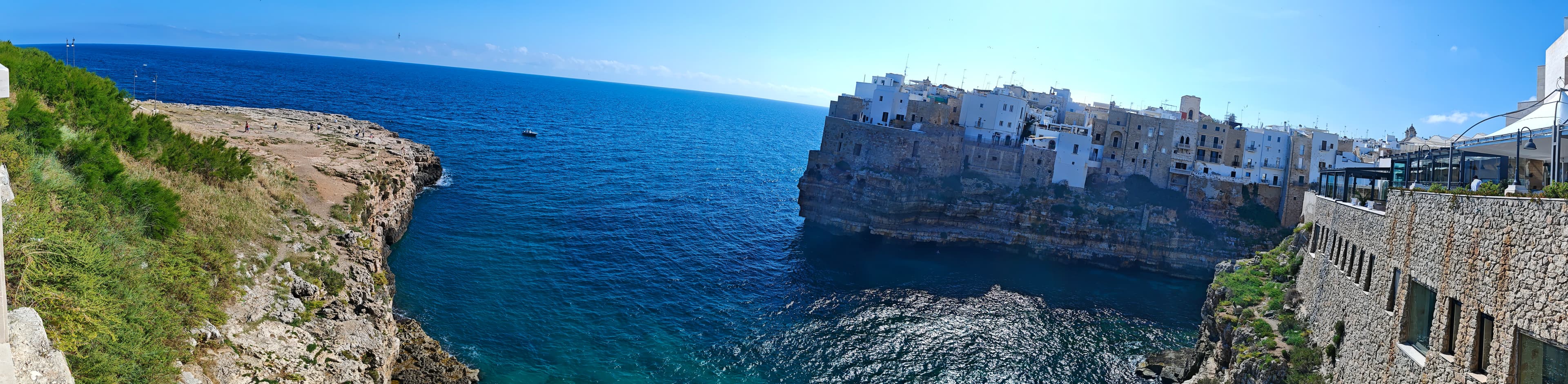
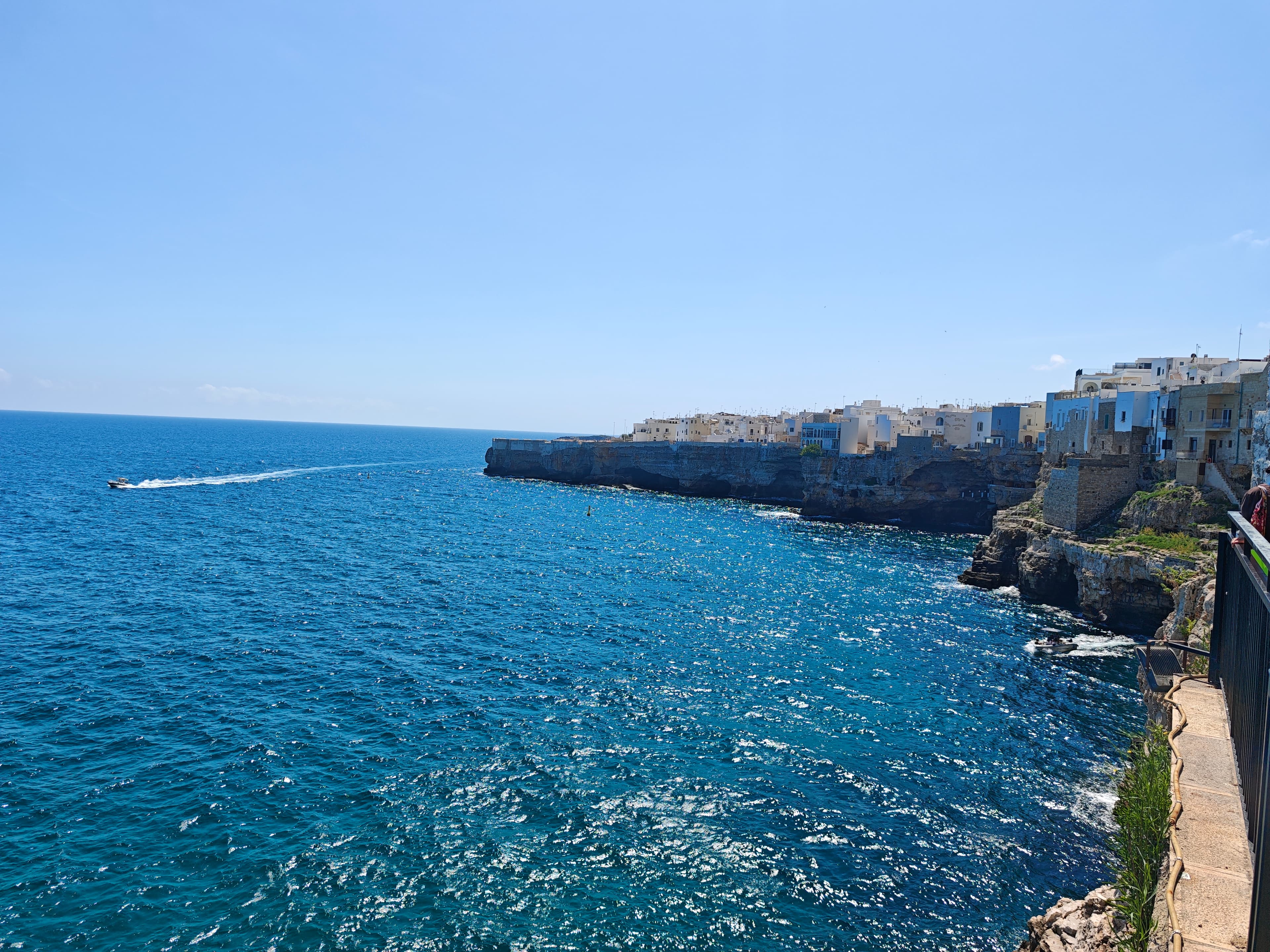
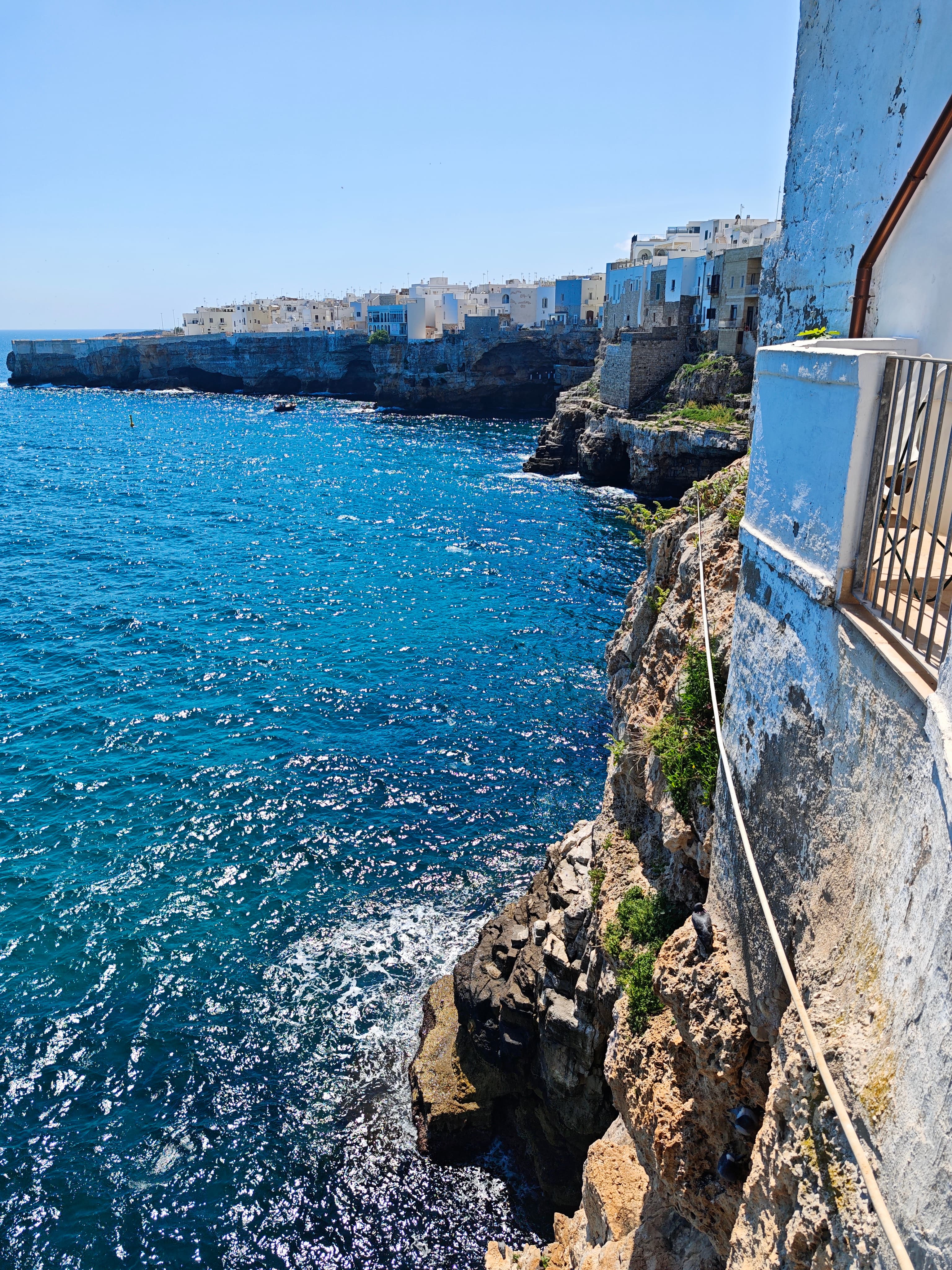
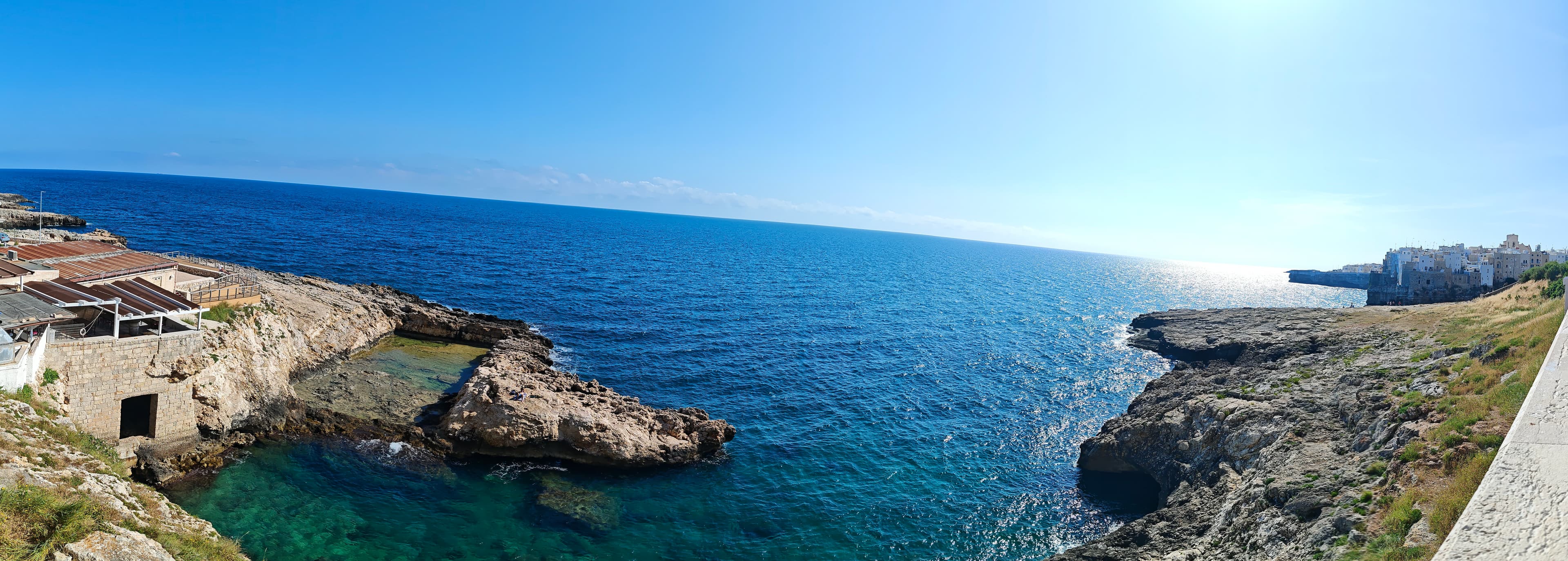
Polignano a Mare is a cliff town. It does not simply sit beside the sea; it seems to hang over it. The old town is built on a rocky limestone spur above the Adriatic. Streets often end suddenly at terraces where the land drops into caves, ledges, and foaming water. Beneath the town, the sea has carved a network of caves into the rock — part of the reason boat tours are one of the top experiences.
The central area is compact. Many of the main sights can be linked on foot:
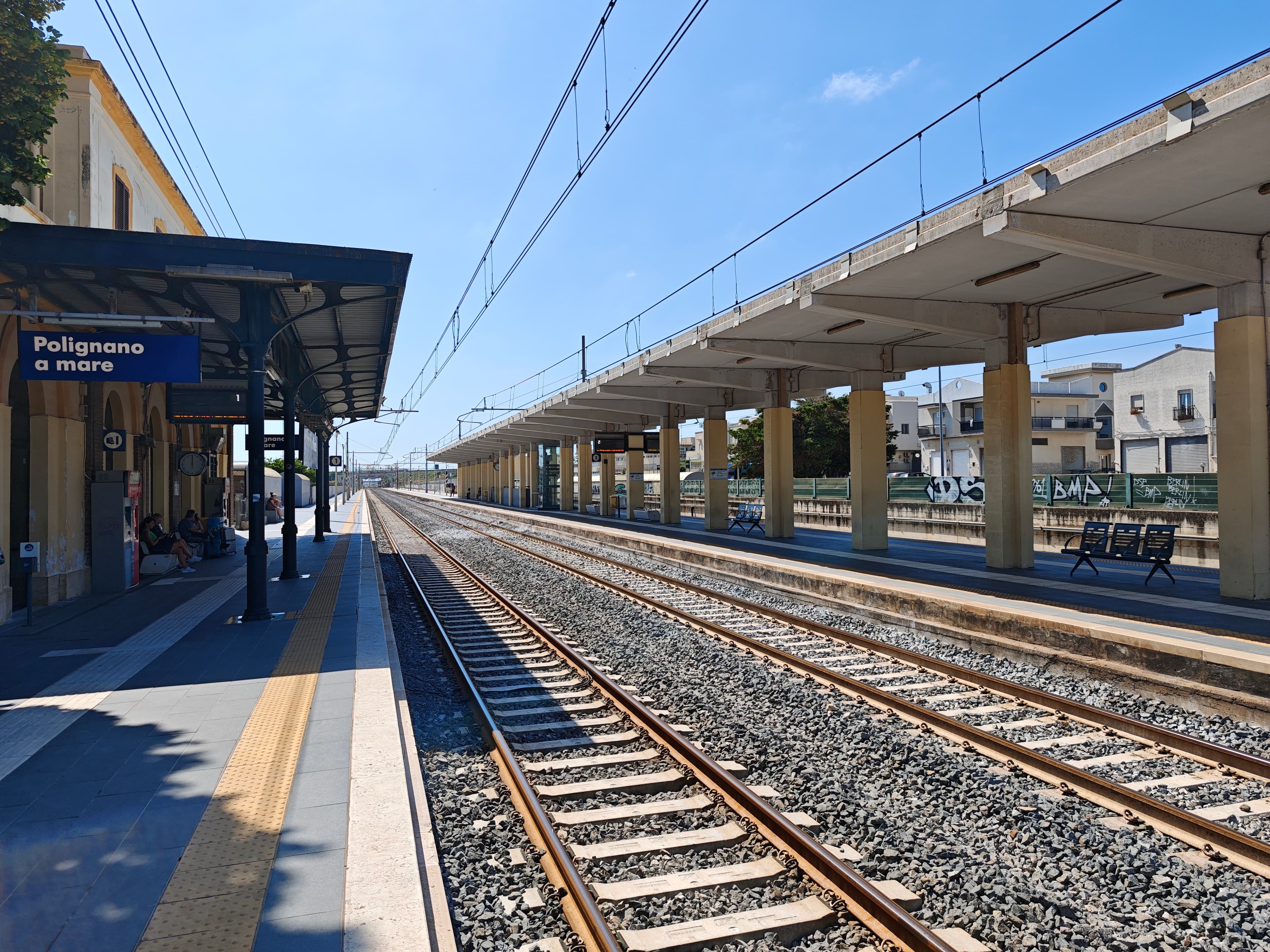
- Polignano a Mare railway station
- Piazza Giuseppe Verdi
- Ponte Borbonico
- Lama Monachile
- Arco Marchesale / Porta Grande
- Centro Storico
- Piazza Vittorio Emanuele II / Piazza dell’Orologio
- Chiesa Matrice di Santa Maria Assunta
- Belvedere Terrazza Santo Stefano / Mirador Blue
- Bastione di Santo Stefano
- Lungomare Domenico Modugno
- Statue of Domenico Modugno
A little farther out are:
- Cala Paura
- Grotta Ardito
- Fondazione Museo Pino Pascali
- Scoglio dell’Eremita / Isolotto dell’Eremita
- San Vito and Abbazia di San Vito
- Calaponte Marina
- Monopoli, including Castello Carlo V, about 8–10 km away
Many travelers find 1–2 days ideal for Polignano: one day for the old town, viewpoints, beach, and food; another for a boat tour, San Vito, the Pino Pascali Museum, Cala Paura, or a Monopoli excursion. If you are staying longer, you can slow down and use Polignano as a base for the Costa dei Trulli, Monopoli, Conversano, Bari, Alberobello, or other Puglia stops.
Essential Polignano a Mare Places at a Glance
The Geo research identified 15 highly rated attractions and points of interest in and around Polignano a Mare. These are useful not only as “things to see,” but as navigation anchors while you are in town.
| Place | Type | Rating | Reviews | Location / Address |
|---|---|---|---|---|
| Lama Monachile | establishment | 4.7 | 21,217 | Via S. Vito, 70044 Polignano a Mare BA, Italy |
| Flat Cave | establishment | 4.8 | 466 | 70044 Polignano a Mare, Metropolitan City of Bari, Italy |
| Grotta delle Rondinelle | establishment | 4.5 | 445 | Via S. Vito, 122, 70044 Polignano a Mare BA, Italy |
| Lungomare di Polignano a Mare | establishment | 4.8 | 686 | 70044 Polignano a Mare, Province of Bari, Italy |
| Viewpoint of Grotta Palazzese | establishment | 4.8 | 303 | Via Gelsomino, 82, 70044 Polignano a Mare BA, Italy |
| Bastione di Santo Stefano | establishment | 4.6 | 658 | Via Porto, 70044 Polignano a Mare BA, Italy |
| Scoglio dell’Eremita | establishment | 4.7 | 139 | 70044 Polignano a Mare, Province of Bari, Italy |
| Statue of Domenico Modugno | establishment | 4.5 | 11,344 | Lungomare Domenico Modugno, 70044 Polignano a Mare BA, Italy |
| Palazzo dell’Orologio | establishment | 4.6 | 150 | Piazza Vittorio Emanuele II, 57, 70044 Polignano a Mare BA, Italy |
| Mirador Blue | establishment | 4.7 | 38 | Via Narciso, 50, 70044 Polignano a Mare BA, Italy |
| Dorino Boating | car_rental / boat tour | 4.9 | 2,222 | Via S. Vito, 342, 70044 Polignano a Mare BA, Italy |
| Flat Stone | establishment | 4.8 | 217 | Lungomare Domenico Modugno, 70044 Polignano a Mare BA, Italy |
| Lama Monachile Lookout | establishment | 4.9 | 282 | Via Porto, 30/A, 70044 Polignano a Mare BA, Italy |
| Bourbon Bridge over Lama Monachile | establishment | 4.7 | 302 | Piazza Giuseppe Verdi, 70044 Polignano a Mare BA, Italy |
| Escursioni Sofia – Gite in Barca Polignano a Mare | boat excursions | 4.8 | 295 | Via S. Vito, 70044 Polignano a Mare BA, Italy |
Approximate coordinates from the attraction data include:
- Lama Monachile: 40.9963887, 17.2181307
- Flat Cave: 40.9965506, 17.218031
- Grotta delle Rondinelle: 40.9999416, 17.2102394
- Lungomare di Polignano a Mare: 40.9964552, 17.2246051
- Viewpoint of Grotta Palazzese: 40.9961895, 17.2216524
- Bastione di Santo Stefano: 40.9971938, 17.219154
- Scoglio dell’Eremita: 40.9945649, 17.2361004
- Statue of Domenico Modugno: 40.9972583, 17.2171201
- Palazzo dell’Orologio: 40.9963747, 17.2189929
- Mirador Blue: 40.9959734, 17.2212765
- Dorino Boating: 41.0137205, 17.1929856
- Flat Stone: 40.9979608, 17.2175392
- Lama Monachile Lookout: 40.9969732, 17.2186376
- Bourbon Bridge over Lama Monachile: 40.9955826, 17.2179697
- Escursioni Sofia: 41.0059383, 17.2000993
The Story of Polignano a Mare
Polignano a Mare’s beauty is immediate, but its history is layered. The town’s story stretches from prehistoric settlement to Roman roads, Byzantine religion, medieval fortifications, Venetian and Bourbon influence, and modern tourism.
Prehistory: Neolithic Roots
The territory of Polignano a Mare was inhabited long before the historic old town existed. Archaeological finds in the area of Santa Barbara, about 4 km south of the present town, and in the Ipogeo Manfredi document human presence between the 6th and 4th millennium BC. Other areas such as Ripagnola and several natural caves also testify to very ancient human use of the territory.
This matters because Polignano’s setting was attractive long before tourism: proximity to the sea, natural shelters, fresh-water routes, ravines, and caves made the area suitable for settlement and passage.
Greek, Peucetian, and Local Traditions
In protohistoric and archaic periods, local tradition and some studies connect the area with a Neapolis of Greek or Peucetian origin, perhaps tied to the broader colonial movements of Magna Graecia. Some local historical traditions even connect a city here with Dionysius II of Syracuse, though this should be treated as local historiographical tradition rather than a settled certainty.
What is clearer is that the site became a place of transit and exchange, helped by its natural coves and small landing points.
Roman Polignano and the Via Traiana
From the 3rd century BC, the area entered the Roman sphere along with the rest of Puglia. Polignano became important not only as a coastal settlement but also as a statio along the Via Traiana.
The Via Traiana was the great Roman road built in the early 2nd century AD by Emperor Trajan, connecting Benevento to Brindisi. It facilitated trade, military movement, and travel toward the Adriatic and the East. In Polignano, this road crossed the ravine above what is now Lama Monachile. The lower Roman bridge and the later Bourbon bridge create one of the town’s most striking historical juxtapositions: ancient road infrastructure below, 19th-century road engineering above, and modern tourists photographing the cove from both.
Roman Polignano was not a vast imperial metropolis, but it was integrated into regional trade networks, especially for agricultural products and grain.
Byzantine and Early Christian Polignano
In the 6th century, Polignano passed under the jurisdiction of the Byzantine Empire and adopted Orthodox Christianity. Local sources suggest that the settlement developed a more defined municipal and ecclesiastical structure during late antiquity and the early medieval period. Polignano was also associated with a diocese in ancient times, perhaps as early as the 7th century.
This ecclesiastical role became central to the town’s identity. The later Chiesa Matrice di Santa Maria Assunta would serve as the cathedral of the Diocese of Polignano until 1818.
Normans, Benedictines, and the Medieval Borgo
Under the Normans, up to 1194, Polignano’s prestige grew. Sources emphasize the presence of two Benedictine monasteries, which contributed to cultural and spiritual life. The borgo consolidated as a fortified coastal center in a politically fragmented but economically active territory.
The medieval historic core was built on a rocky spur above the sea, defended by walls and a single gate. This defensive geography still defines the Centro Storico today: narrow lanes, high walls, cliff edges, and strategic terraces.
Angevin, Aragonese, and Fortified Polignano
Polignano later passed under the Angevins. In 1292, it was aggregated to the Principality of Taranto. During this period and later, defensive structures were reinforced to protect the town from maritime incursions and Adriatic threats.
The location was both a blessing and a vulnerability. The sea brought trade, but also danger: pirates, raids, storms, and exposure.
Venetian Influence and the Early Modern Period
Between the late 15th and early 16th centuries, Polignano entered a politically mobile phase. Sources record a period under the orbit of the Republic of Venice for about twenty years, between 1494 and 1530, reflecting Adriatic commercial and strategic rivalries.
In 1530, Polignano came under the control of Charles V. Relations with Venetian merchants continued, and commercial life remained active. Yet Polignano’s dramatic cliff-edge location prevented the creation of an efficient major port. This limited the town’s potential as a large maritime hub and kept its economy closely tied to agriculture and the hinterland.
The feudal period continued through various noble families. In 1795, one source notes that the fief was sold to Baron Pasquale La Greca.
Bourbon Infrastructure and the Bridge
In the 19th century, the Bourbon government improved road connections in the Kingdom of the Two Sicilies. The Ponte Borbonico su Lama Monachile, built in 1836 under Ferdinand II of Bourbon, became a key part of the new Bari–Lecce road.
The bridge was built with five arches and stands around 15 meters high above the ravine. It remains both an infrastructural and symbolic element: a way into the old town, a panoramic terrace, and a physical marker of the town’s layered history.
Risorgimento and the Name “a Mare”
In the 19th century, Polignano participated in the political movements of the Risorgimento and experienced tensions familiar across southern Italy: patriotism, reaction, and brigandage.
A symbolically important moment came in 1862, when the municipal council resolved to add the phrase “a Mare” to the town’s name. This was sanctioned by royal decree in 1864. From then on, the town’s identity was officially tied to the sea — the same sea that now defines its global image.
Modern Tourism, Music, and Contemporary Culture
Today Polignano a Mare is known internationally as a scenic destination, but its modern identity has several strands:
- The cliff-top old town and Lama Monachile as tourism icons.
- The Red Bull Cliff Diving World Series, hosted at the cove and cliffs since 2008.
- The memory of Domenico Modugno, born in Polignano in 1928, whose song “Nel blu dipinto di blu (Volare)” became one of the world’s great Italian songs.
- The Fondazione Museo Pino Pascali, a major contemporary art institution dedicated to artist Pino Pascali and regarded as the only permanent contemporary art museum in Puglia.
- The continuing religious importance of San Vito Martire, patron saint of Polignano.
Polignano’s modern charm comes from the way all these layers coexist: prehistoric caves, Roman roads, medieval walls, Baroque churches, Bourbon bridges, seaside music, contemporary art, tourism, street food, and everyday local life.
Understanding the Atmosphere Before You Arrive
Polignano a Mare has a dramatic, cinematic atmosphere. The core sensation is vertical: white houses above, cliffs below, water surging through caves, and narrow streets opening suddenly to sea air.
Travelers and vloggers often describe it as:
- Romantic
- Slightly wild
- Nostalgic
- Dreamlike
- Lived-in
- Overwhelmingly photogenic
- Busy and polished in peak season
- More magical in the early morning, evening, or shoulder season
The sensory palette is strong:
- Sight: white walls, blue sea, turquoise coves, honey-colored limestone, bougainvillea, painted poems, bronze statue, cliff terraces.
- Sound: waves slapping caves, pebbles rolling in surf, church bells, espresso machines, scooters, gulls, buskers playing “Volare,” multilingual tourists, local dialect.
- Smell: salt, wet limestone, espresso, cornetti, fried seafood, tomato sauce, laundry detergent, damp stone, grilled fish, olive groves on the outskirts.
- Touch: uneven pebble beaches, warm stone walls, wind on clifftop terraces, cool cave air during boat tours.
- Taste: gelato, focaccia, seafood sandwiches, orecchiette, aperitivo, grilled fish, citrus, wine, coffee.
The town’s emotional identity is a mix of joy and melancholy. It is playful around the Modugno statue, intimate in the old alleys, dramatic at the viewpoints, raw below the cliffs, and contemplative along the seafront paths.
Top Experiences and Attractions
1. Centro Storico di Polignano a Mare
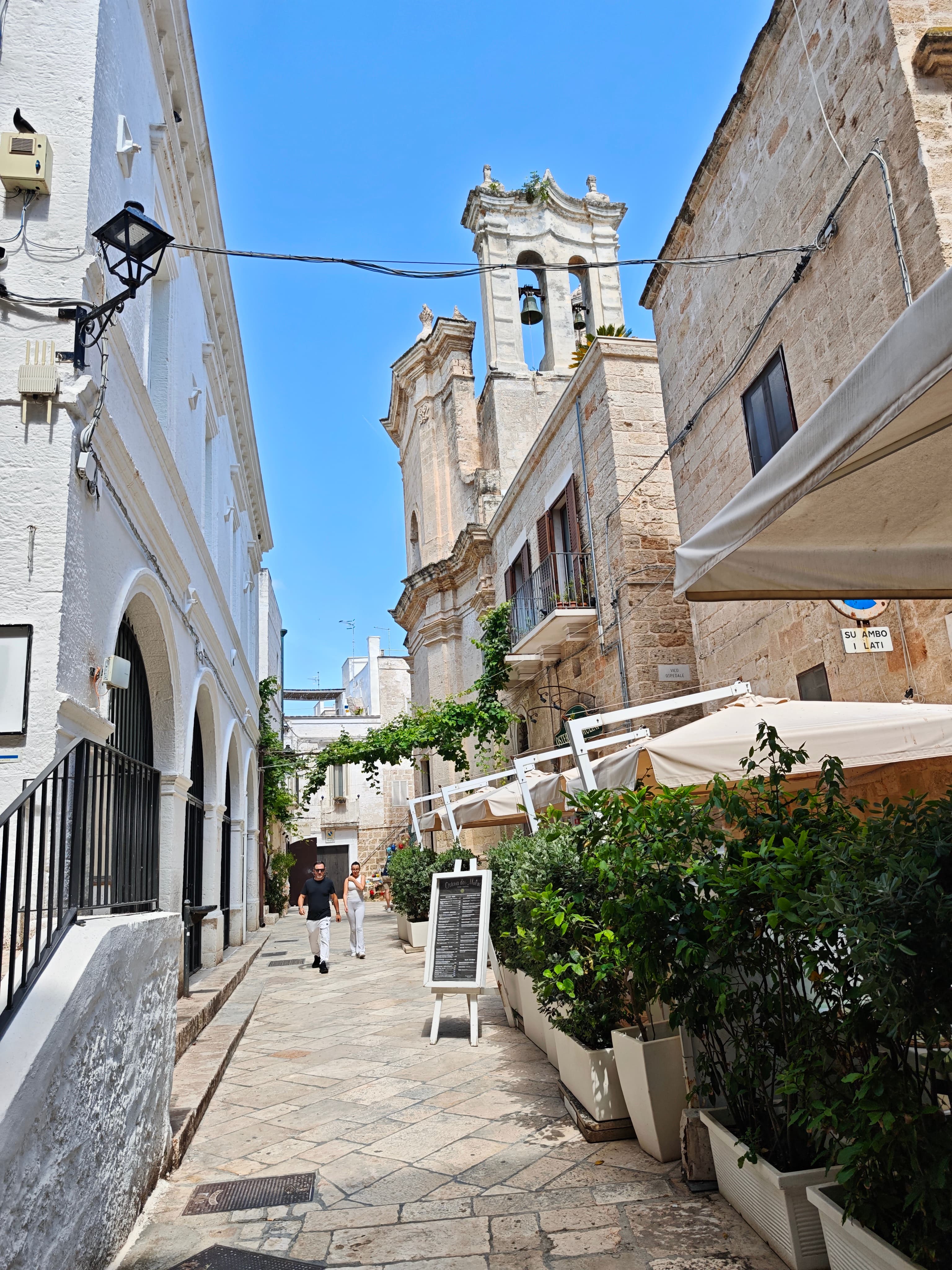
The Centro Storico is the medieval cliff-top heart of Polignano a Mare. It is compact, walkable, atmospheric, and freely accessible. You do not enter through a ticket gate; you simply step through the old gateway and into a dense network of white alleys, small squares, churches, palaces, restaurants, shops, and sea-view balconies.
Why It Matters
The historic center represents the identity, history, and “soul” of Polignano. It is described as closed in on itself in its medieval dimension, with high walls and rocks sheer above the sea. It is both a residential neighborhood and a tourism icon.
Its historic layers include:
- Medieval urban fabric.
- Defensive walls and the Arco Marchesale / Porta Grande.
- Religious centrality through the Chiesa Matrice di Santa Maria Assunta.
- Political and feudal history through the Palazzo Marchesale.
- Public civic life in Piazza Vittorio Emanuele II.
- Cliffside terraces overlooking the Adriatic.
Entering Through Arco Marchesale / Porta Grande
The Arco Marchesale, also called Porta Grande, is the symbolic entrance to the borgo. Built around 1530, it formed part of the city walls. Until about 1780, it was the only access to the walled town. The settlement was surrounded by a moat with a drawbridge, later covered by what is now Piazza Garibaldi.
Passing through this gate is one of the clearest transitions in Polignano. Behind you is the modern town; ahead are narrower lanes, older stone, lower light, and the soundscape of a pedestrian old town.
Streets, Alleys, and Poetry
The old town is a maze of lanes radiating from routes such as Via Roma and from small squares including:
- Piazzetta Fulvia Miani Perotti
- Piazza Vittorio Emanuele II / Piazza dell’Orologio
- Piazza San Benedetto
Typical features include:
- Whitewashed houses crowded close together.
- Blue shutters.
- Balconies with flowers.
- Ceramic and artisan shops.
- Bars, restaurants, gelaterie, and cafés.
- Poems and quotations painted on walls, stairways, doors, and steps.
The painted poetry is one of Polignano’s most memorable details. Travelers often describe feeling as if the town itself is speaking. You may turn a corner and find a line about love, dreams, or the sea. These are not grand monuments, but they are among the town’s most emotionally resonant details.
Main Historic Sites Inside the Old Town
Do not rush the Centro Storico as if it were a museum checklist. Still, these are the main anchors:
Arco Marchesale / Porta Grande
The 16th-century gateway and historic entrance into the old town.
Piazzetta Fulvia Miani Perotti
A medieval hub of political, religious, and economic life.
Palazzo Marchesale
A large noble palace built in stages, with parts dating from the 15th century and later Renaissance-inspired elements. It reportedly contains around 90 rooms and served as the residence of governors and feudal lords.
Piazza Vittorio Emanuele II / Piazza dell’Orologio
The main square and social core of the old town.
Palazzo dell’Orologio
An 18th-century former municipal seat, also called the former “Università,” with a clock tower and a statue or figure of Saint Vito, the patron saint.
Chiesa Matrice di Santa Maria Assunta
The former cathedral, begun or documented by 1295, with older origins and later transformations. It combines Gothic, Romanesque, Renaissance, and Baroque layers and houses major artworks.
Piazza San Benedetto
Another characteristic old-town square near the famous Grotta Palazzese area.
Belvederi
Sea-view terraces and loggias are among the old town’s greatest experiences. Many lanes lead to balconies over the cliffs.
The Vibe
In the morning, the old town smells of espresso, cornetti, and fresh focaccia. Around lunch and dinner, the air shifts toward fried seafood, grilled fish, tomato sauce, and wine. Laundry contributes a clean, soapy scent in residential lanes, while shaded corners smell faintly of damp stone.
Sound changes throughout the day:
- Morning: shutters opening, coffee cups, delivery carts.
- Midday: tourist groups, restaurant prep, sun-drowsy quiet in side alleys.
- Evening: passeggiata, laughter, restaurant service, clinking glasses, music.
- Night: golden lamps, soft conversation, footsteps on stone.
Emotionally, the Centro Storico often creates nostalgia even for travelers who have never lived in an Italian village. It feels authentic and curated at the same time — lived-in, but also deeply shaped by tourism.
Practical Information
- Access: Free.
- Ticket: None for the historic center itself.
- Opening hours: Public streets and terraces are effectively open 24/7.
- Best times: Early morning for quiet photos; late afternoon and evening for atmosphere; night for lit alleys and romantic walks.
- Crowds: Heavy in summer and weekends. Narrow lanes can become jammed with tour groups.
- Accessibility: The old town is compact but includes uneven stone, narrow lanes, steps, and crowded passages.
- Costs: Food, drinks, and souvenirs inside the old town are often more expensive than in less famous Puglian towns.
- Warning: Some central restaurants cater heavily to tourists. Check menus and recent reviews.
Real Verdict
The Centro Storico is the main reason many people come to Polignano. It is worth the hype for atmosphere, views, and wandering. Travelers seeking a quiet, untouched village may find it too busy in peak season, but in the evening or shoulder season it can feel magical.
2. Lama Monachile / Cala Porto
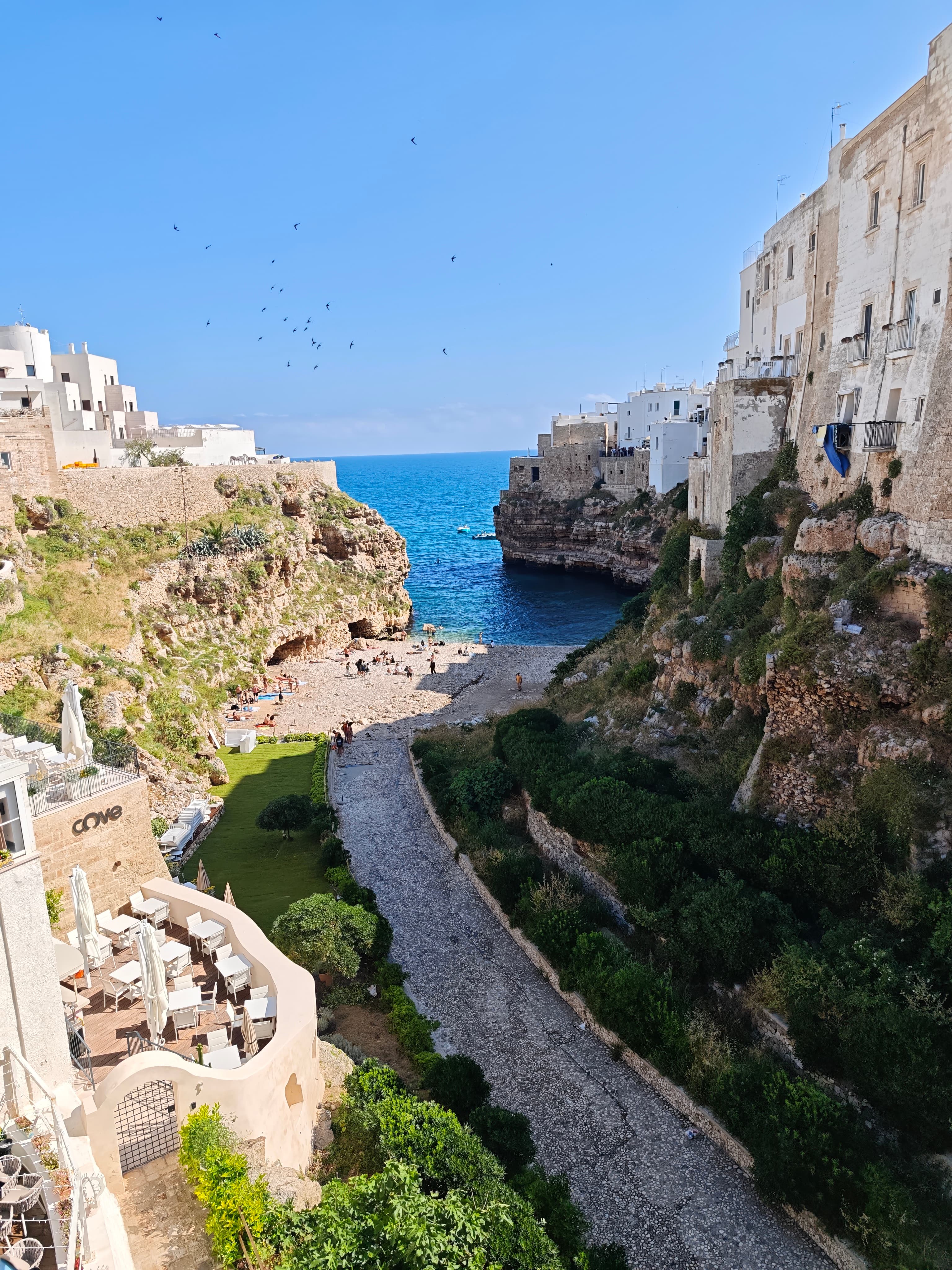
Lama Monachile, also called Cala Porto, is Polignano’s iconic cove. It is the view on postcards: a narrow pebble beach wedged between sheer limestone cliffs, with the old town above and the bridge spanning the ravine behind it.
It is one of the most photographed beaches in Puglia and one of Polignano’s essential stops, whether or not you plan to swim.
History and Meaning of the Name
The word “lama” in Puglia refers to a deep erosive ravine carved by an ancient watercourse, now usually dry. Lama Monachile occupies the bed of such a former river, which cut through the cliffs before meeting the sea.
In Roman times, the crossing above the ravine formed part of the Via Traiana, Emperor Trajan’s road from Benevento to Brindisi. In the 15th century, under Venetian domination, the cove functioned as a commercial port, using its protected natural inlet for loading and unloading goods. In the Bourbon era, infrastructure and coastal defenses around the inlet were reshaped.
The name “Monachile” is often associated in local storytelling with monk seals said to have once sheltered in the nearby caves. You will not see monk seals today, but the story gives the cove an older, ghostly dimension.
Landscape and Beach Characteristics
Lama Monachile is small. The beach is approximately 40 meters wide. It is a pebble beach, not sand. The pebbles are rounded and varied in color, beautiful to look at but uncomfortable for many people to walk or lie on.
Key features:
- High limestone cliffs on both sides.
- Clear turquoise water.
- Limited sun exposure because the cliffs cast shade.
- No full beach-club infrastructure directly on the cove.
- Stone staircase access near the bridge.
- Dramatic views from above.
The water can be stunningly clear, but conditions vary. Waves and rough sea can make swimming less comfortable, and there may be cold water depending on currents.
The Vibe
Arriving on the pebbles is often the moment Polignano “becomes real.” From above, the cove looks almost too perfect. From below, it feels more physical and intense.
You hear:
- Waves slapping stone.
- Pebbles rolling back with each retreating wave.
- Children shouting.
- Boat engines at the mouth of the cove.
- Multilingual conversations packed close together.
- Occasional cliff-jumpers nearby.
The smell is mostly salt, wet rock, and limestone rather than classic sandy-beach smells. In summer midday, heat radiates from the cliffs, turning the cove into a warm chamber. Later in the day, shadows creep across the beach and the water shifts from turquoise to blue-green.
Practical Information
- Access: Public.
- Ticket: Free. It is a spiaggia libera.
- Opening hours: No formal closing; effectively accessible 24/7.
- Facilities: The cove itself is not equipped. Reviews describe it as a free beach without on-site toilets, showers, or official rentals directly on the pebbles.
- Nearby services: Some private establishments nearby offer umbrellas, loungers, food, or amenities, but not directly as a full resort setup on the cove itself.
- Address: Commonly listed as Via S. Vito, 70044 Polignano a Mare BA.
- From the station: About 800 m, roughly 10–12 minutes on foot. Walk along Viale delle Rimembranze, turn left on Via Pompeo Sarnelli, then near Piazza Giuseppe Verdi look for the staircase down near the bridge.
- Blue Flag: Lama Monachile has held Blue Flag status for water quality and environmental management.
- Safety: No fixed guarantee of permanent lifeguards; be cautious near rocks and in rough water.
- Heavy weather: The lama can channel rainwater during storms. On 26 September 2006, runoff covered much of the cove.
Crowds and Comfort
This is one of the most important practical realities of Polignano: Lama Monachile is more spectacular as a view than as a comfortable full-day beach.
Common complaints:
- Extremely crowded in July and August.
- Towel-to-towel conditions by mid-morning.
- Pebbles uncomfortable without water shoes.
- Little shade and limited facilities.
- Nearby bars and kiosks charge premium prices.
- Parking nearby is difficult and sometimes expensive.
Best Strategy
- Go early morning for photos and space.
- Go late afternoon/evening for atmosphere and softer light.
- Use it for a swim and iconic experience, not necessarily a full beach day.
- Bring water shoes, a thick towel, and only what you need.
- Do not leave valuables unattended.
Real Verdict
Lama Monachile absolutely meets expectations visually. As a practical beach, reviews are mixed. It is a must-see, but if you want comfort, shade, space, and services, plan to swim elsewhere after visiting.
3. Ponte Borbonico su Lama Monachile
The Ponte Borbonico is one of Polignano’s defining structures: a multi-arched stone bridge spanning the ravine above Lama Monachile. It is both an infrastructure and one of the town’s most important viewpoints.
History
The bridge was constructed in the Bourbon period as part of the new Bari–Lecce road, developed to improve connections in the Kingdom of the Two Sicilies.
A historic-monumental source states that the five-arched bridge was commissioned by King Ferdinand II of Bourbon in 1836. A commemorative inscription records that by the will of Ferdinand II, king of the Kingdom of the Two Sicilies, the grand five-span bridge rose over the ravine in 1836.
Some older versions attributed it to Gioacchino Murat, but local archival research clarifies that it is a Bourbon work from the 1830s, not Muratian.
Some travel and review sources casually call it 18th-century; the more specific historical account places its construction in 1836.
Architecture
- Five arches / five “lights.”
- Built in blocks of tuff / local stone.
- Approximately 15 meters high.
- Functional 19th-century road engineering with sober monumental proportions.
- Carries pedestrian and vehicular movement.
- Connects the modern town with the old town zone around Piazza Verdi and Via Roma.
The Roman Bridge Below
One of the most fascinating features is the historical layering. Under the Bourbon bridge runs a stretch of the ancient Via Traiana, including a Roman bridge of the 2nd century with a single span, reachable from a side staircase.
This creates a rare double-level historical experience:
- Roman road and bridge below.
- Bourbon road bridge above.
- Modern tourists and traffic crossing today.
Views
From the bridge, you can see:
- Lama Monachile below.
- The high cliffs enclosing the cove.
- White houses of the old town above the sea.
- The open Adriatic.
- Cliff areas used for events such as Red Bull Cliff Diving.
The Vibe
The bridge feels solid and solemn. You hear the echo of voices rising from the ravine, footsteps, car tires, and the distant sound of the sea. The smell mixes exhaust from nearby traffic with strong sea air funneled through the gorge.
At sunset, the tuff and cliffs warm in color and the bridge becomes a natural gathering place. At night, streetlights and the dark ravine create a cinematic atmosphere.
Practical Information
- Access: Public bridge.
- Ticket: Free.
- Opening hours: 24/7, except temporary restrictions for road works or events.
- Best time: Late afternoon, sunset, evening.
- Events: During Red Bull Cliff Diving or local events, access and traffic may be modified.
- Photo tip: Cross it when entering or leaving the old town, then descend the side staircase to see the beach and lower Roman remains.
Warnings
- It can be packed with people taking photos.
- It is a viewpoint more than a long activity.
- Traffic and congestion nearby may reduce the sense of peace.
- Souvenir sellers or tour hawkers may appear nearby in peak season.
Real Verdict
You do not need to plan a separate excursion for the bridge, but you should absolutely stop there. It is part of the classic Polignano experience and one of the best vantage points over Lama Monachile.
4. Belvedere su Lama Monachile and Lama Monachile Lookout
There are several viewpoints over Lama Monachile. The Lama Monachile Lookout at Via Porto 30/A is highly rated, and the old-town balconies provide the famous calendar-photo angles.
What You See
From the main viewpoints, the scene aligns perfectly:
- Pebble cove below.
- Bridge behind.
- Turquoise water at the opening.
- Cliff-hanging houses.
- People below reduced to tiny figures.
- Boats passing the mouth of the cove.
This is where many travelers first feel that Polignano looks “fake” — too neatly composed to be real.
The Vibe
Up above, the beach sounds are softened: children’s cries become distant echoes, waves become a hush, and the main sounds are camera shutters, conversations, buskers, and sometimes “Volare” floating through the air.
At golden hour, the cliffs glow honey-colored and the water becomes glassy. The mood can feel ceremonial: proposals, selfies, couples at the railing, solo travelers lingering longer than expected.
Practical Information
- Access: Free public viewpoints.
- Opening hours: Generally accessible at all hours.
- Best times: Early morning, sunset, blue hour.
- Crowds: Heavy at sunset and high-season afternoons.
- Photo tip: Be patient; everyone wants the same railing spot.
5. Belvedere Terrazza Santo Stefano / Mirador Blue
Mirador Blue is a name often used in travel and social media for the famous public terrace Belvedere Terrazza Santo Stefano. It is one of the principal photo spots in Polignano.
Location
- Address often given as Via Porto 11, Polignano a Mare.
- Geo listing for Mirador Blue: Via Narciso, 50, rating 4.7.
- It sits above Lama Monachile and the Adriatic, in the historic seafront area.
History and Context
The terrace stands above Lama Monachile in an area connected with the ancient settlement tradition of Neapolis of Apulia. The current terrace is not attributed to a single architect or patron. It is part of the incremental urban fabric of the old town’s seafront, evolving from defensive and practical cliff-edge space into a scenic public belvedere.
Nearby historic residential fabric includes old fishermen’s dwellings, including 19th-century stone houses with thick walls.
Architecture and View
The terrace is an open paved platform built over the natural limestone cliff, protected by railings. It is simple architecturally; its power lies in the view:
- Lama Monachile below.
- The Adriatic beyond.
- Cliffside houses rising directly from the rock.
- White stone and blue sea in one frame.
Practical Information
- Ticket: Free.
- Access: Public viewpoint.
- Opening hours: Some platforms list 09:00–18:00 daily, but as an open public terrace it is effectively accessible at all times unless temporarily restricted.
- Best times: Sunrise, golden hour, sunset.
- Crowds: Very crowded in July and August; April and shoulder seasons are quieter.
- Warning: Do not confuse the free public terrace with private terraces or rooftop venues that may require drinks or reservations.
6. Bastione di Santo Stefano
The Bastione di Santo Stefano is another important cliffside point in the old town area, listed at Via Porto with a rating of 4.6 from 658 reviews.
Why Visit
It belongs to the network of old-town viewpoints and defensive edges that make Polignano’s perimeter so atmospheric. From around here, you can appreciate the way the town’s historic structures, walls, and houses meet the sheer sea cliffs.
Vibe
Like the other belvederi, the Bastione offers that sudden shift from narrow alley to open void. On windy days, sea air hits hard. At night, it becomes more mysterious, with the dark sea below and lit town behind.
Practical Notes
- Free public exterior area.
- Best included while wandering Via Porto and the old town viewpoints.
- Crowds vary depending on time; sunset and summer evenings are busiest.
7. Piazza Vittorio Emanuele II / Piazza dell’Orologio
Piazza Vittorio Emanuele II, often called Piazza dell’Orologio, is the main square of the historic center. It is a public, always-open civic space and one of the places where Polignano’s daily life is most visible.
History and Significance
The square developed as the central civic and religious space in front of the Chiesa Matrice di Santa Maria Assunta. Its modern name honors Vittorio Emanuele II, the first king of unified Italy, reflecting the common post-unification naming tradition across Italian towns.
The square’s key civic landmark is Palazzo dell’Orologio, once the Town Hall, now especially noted for its clock façade and connection to Saint Vito.
What to See
Palazzo dell’Orologio
- Former municipal seat / former “Università.”
- 18th-century clock palace.
- Clock on façade.
- Statue or niche of Saint Vito, patron saint of Polignano.
- Geo listing: Piazza Vittorio Emanuele II, 57, rating 4.6.
Chiesa Matrice di Santa Maria Assunta
The town’s principal church stands directly on the square.
Cafés and Restaurants
The piazza is lined with cafés, restaurants, and historic façades. It is a natural aperitivo stop.
Streets Radiating Out
Narrow lanes lead from the piazza toward sea-view terraces, poetry walls, and small squares.
The Vibe
The square is warmer and more sociable than the dramatic cliffs. You hear espresso machines, cutlery, laughter, church bells, and children. It feels like a living room for the old town.
Smells include:
- Espresso.
- Aperol spritz.
- Pastries.
- Pizza.
- Ragù.
- Warm stone.
- Perfume from locals dressed for passeggiata.
Practical Information
- Ticket: Free.
- Opening hours: Public square, accessible 24/7.
- Commercial hours: Cafés and shops vary. Many open around 9:00–10:00, may close in the afternoon outside high season, and reopen into late evening, especially in summer.
- Best times: Early morning for quiet; late afternoon/evening for social life.
- Accessibility: Generally flat and easier than many old-town lanes.
Warnings
- Central-square pricing: expect higher drink and snack prices.
- Some cafés may charge table service or coperto.
- Nighttime music and crowds can be noisy.
- It is charming but not a major standalone monument.
Real Verdict
The piazza is best enjoyed as a place to sit, watch, drink coffee or aperitivo, and feel the town’s rhythm. It enhances your old-town walk rather than replacing the viewpoints.
8. Chiesa Matrice di Santa Maria Assunta
The Chiesa Matrice di Santa Maria Assunta is the main church of Polignano’s historic center, standing in Piazza Vittorio Emanuele II. It was once the cathedral of the local diocese and remains the spiritual heart of town.
History
The church stands on the site of an ancient pagan temple, traditionally attributed to the Roman general Gaius Marius, considered in local tradition a legendary founder of Polignano.
The current church has medieval origins. Some sources give an 11th-century origin, while a 1937 study notes it was already present and solemnly consecrated in 1295 by Bishop Guglielmo.
It served as the cathedral of the Diocese of Polignano until 1818, when the diocese was suppressed and united with Monopoli. After that, it became the Chiesa Matrice, or Mother Church.
Major transformations occurred from the late 16th century through the 17th century, with decorative Baroque interventions in the 18th century.
Architecture
The façade combines Gothic and Baroque elements. The bell tower rises more than 30 meters and dominates the old-town skyline.
Inside, the structure blends:
- Romanesque foundations and volumes.
- Gothic elements.
- Baroque altars, stucco, and decoration.
- Artworks from the 15th to 19th centuries.
The church is often described as almost a museum because of the density of its artworks.
Key Artworks
Bartolomeo Vivarini Polyptych
The Polittico della Madonna con Bambino e Santi is a major 15th-century gilded panel polyptych by Bartolomeo Vivarini, an important Venetian painter active in the Kingdom of Naples.
Stefano da Putignano Sculptures
The church contains the largest nucleus of sculptures by Stefano da Putignano, a leading Apulian sculptor active between the late 16th and early 17th centuries. Among these is a celebrated stone Nativity scene, regarded as one of his masterpieces.
Cappellone di San Vito
A large chapel dedicated to San Vito, patron saint of Polignano. It preserves important relics, including a fragment of the saint’s arm and the kneecap / rotula.
Other Chapels and Furnishings
The side chapels include marble altars, statues, and paintings from the 16th–18th centuries. There are also liturgical vestments and furnishings, some donated by the now-disappeared Monastero di San Benedetto.
The Vibe
Stepping inside changes the temperature and sound. The air is cooler and stiller than outside. You smell old wood, wax, incense, and ancient stone. Even non-religious visitors often find the space calming after the sensory overload of cliffs, sun, and crowds.
During services, hymns and responses fill the church. Outside service times, it becomes a quiet refuge.
Practical Information
- Entry: Usually free; donations appreciated.
- Ticket: No standard entry fee indicated.
- Guided tours: If included in a wider old-town tour, expect roughly €8–€15 per person, depending on the guide.
- Opening hours: Variable. Typical patterns may be:
- Weekdays: about 08:00–12:00 and 16:00–20:00/21:00.
- Weekends: longer opening around multiple Masses, possibly from morning to evening.
- Mass schedules: Reviews mention Masses spread through the day up to around 21:00, but this changes.
- Best time: Late morning or late afternoon outside services.
- Dress code: Modest clothing; cover shoulders and knees.
- Photography: Often possible without flash, but check signs or ask.
- Warning: Hours vary by season, weddings, funerals, feast days, and parish needs. Check the noticeboard or tourist office.
Real Verdict
The Chiesa Matrice is not a massive basilica, but it is historically and artistically important. For travelers interested in local religious art, it is absolutely worth stepping inside.
9. Monumento a Domenico Modugno and Lungomare Domenico Modugno
Polignano’s most joyful modern monument is the bronze statue of Domenico Modugno, the singer-songwriter born here in 1928 and famous worldwide for “Nel blu dipinto di blu (Volare)”.
The Statue
The Monumento a Domenico Modugno is a 3-meter bronze statue created by sculptor Hermann Mejer. It was inaugurated on 31 May 2009 as a tribute from his hometown.
The statue depicts Modugno in mid-performance, arms wide open in a pose associated with “Volare.” It stands on Lungomare Domenico Modugno, on a panoramic square above the sea, with the historic center and Lama Monachile nearby.
The statue’s orientation has its own civic story: locals wanted Modugno to face the town, reflecting civic pride, and this wish was accommodated.
Lungomare Domenico Modugno
The seafront promenade is named after Modugno and functions as a public belvedere and walking area. It offers:
- Views of cliffs and sea caves.
- Access to viewpoints over Lama Monachile.
- Open space compared with the tight old-town lanes.
- Benches, low walls, and gathering areas.
- A strong emotional link between music and landscape.
The Vibe
Approaching the statue, you may hear “Volare” from buskers, speakers, phones, or nearby musicians. Visitors pose with arms outstretched, imitating Modugno. The mood is more playful and open than in the old town.
The promenade smells mainly of salt and wind, with hints of grass or shrubs. The bronze statue, open sky, and sea horizon create a feeling of freedom and possibility. For Italians especially, hearing the song in Modugno’s birthplace can be deeply nostalgic.
Practical Information
- Ticket: Free.
- Opening hours: 24/7, public monument and promenade.
- No reservation required.
- Best times: Sunset, evening, or early morning.
- Address: Lungomare Domenico Modugno, 70044 Polignano a Mare BA.
- From station: About 900 m on foot.
- Time needed: 20 minutes for the statue; 1–2 hours if combined with viewpoints and a relaxed walk.
Warnings
- Crowds cluster around the statue.
- Street vendors and tour sellers may be assertive in high season.
- Limited shade at midday.
- Prime-view bars charge more.
Real Verdict
The statue and promenade are a pleasant, symbolic, photogenic stop. They are not as intimate as the old alleys, but they complete the Polignano experience.
10. Flat Stone and Flat Cave
The Geo research identifies two highly rated places near the central coastal area:
- Flat Stone, rating 4.8, 217 reviews, on Lungomare Domenico Modugno.
- Flat Cave, rating 4.8, 466 reviews, near Lama Monachile.
These names suggest natural or semi-natural coastal rock features associated with the cliff and cave landscape around Lama Monachile and the Modugno seafront.
Why They Matter
Polignano is not only a town of formal monuments. Much of its appeal lies in the smaller named rock ledges, cave mouths, viewpoints, and coastal formations that locals and visitors use as orientation points. Flat Stone and Flat Cave belong to this experiential landscape.
How to Experience Them
- Combine with the Modugno statue and Lungomare.
- Use them as photo stops and coastal viewpoints.
- Ask boat tour operators whether Flat Cave or nearby cave features are included in the sea-cave route.
- Wear appropriate footwear if walking near rocks.
Practical Notes
- Public coastal areas are generally free unless part of private access or boat-tour routes.
- Exercise caution near cliffs, wet rock, and wave-splashed ledges.
- Do not attempt risky jumps or climbs without local knowledge.
11. Grotta Palazzese
Grotta Palazzese is one of the most famous dining settings in Italy: a luxury restaurant inside a limestone sea cave opening onto the Adriatic.
It is important to understand before you go: this is not a normal public cave attraction. It functions primarily as a restaurant and hospitality venue, not as a freely accessible cave.
History
The cave has been associated with gatherings and banquets since at least the 18th century. A watercolor by Jean Louis Desprez from 1783 is cited as evidence of dining in the cave at that time. One historical account says the Palazzese family built a summer residence above the cave in the 1700s and used the grotto to entertain guests.
Today, the restaurant is part of a luxury hospitality complex including a hotel and suites above.
The Cave
The cave is a natural limestone sea grotto carved into the cliff face. Sources describe it as extending about 80 meters into the cliff, with a broad opening to the sea and adapted dining platforms. Historic accounts mention stairs cut into the rock and a cave floor modified for use.
The Experience
Diners descend into a surreal space:
- Rock ceiling overhead.
- Open sea beyond.
- Waves below.
- Lantern-lit tables.
- Fine dining service.
- Salt air and damp stone.
- Light reflecting off water onto the cave ceiling.
It feels theatrical and operatic — part romance, part fantasy, part controlled danger.
Practical Information
- Ticket: No standard sightseeing ticket.
- Access: Controlled through restaurant/hotel reservations.
- Dining prices: 2024-era estimates show menus around €195–€275 per person, with broader ranges €195–€350, depending on courses and menu. Drinks are extra.
- Reservations: Mandatory.
- Tables: Typically assigned on arrival, not chosen in advance.
- Season: The cave restaurant is generally used from March to October or in warm season; outside the warm season, service may move to an indoor room above.
- Hours: One guide gives summer daily service with lunch 12:30–14:00 and dinner 18:00–22:30 as last-entry windows.
- Official booking: The official site has confirmed future reservations, including for the 2026 season, showing that access is booking-controlled.
Viewpoint of Grotta Palazzese
The Geo data includes a Viewpoint of Grotta Palazzese at Via Gelsomino 82, rating 4.8. This is useful if you want to appreciate the setting without dining.
You may also see the exterior from some boat tours.
Warnings and Reviews
Grotta Palazzese is one of Polignano’s most debated experiences.
Pros:
- Extraordinary setting.
- Romantic, bucket-list atmosphere.
- Highly photogenic.
- Unique cave-dining experience.
Cons:
- Very expensive.
- Food quality reviews are mixed.
- Many say you are paying mostly for the location.
- Service can be variable.
- Strict policies, fixed menus, dress codes, and reservations may feel rigid.
- Add-ons, drinks, and service charges can raise the bill.
Some reviewers explicitly call it a tourist trap in terms of price-to-quality ratio. Others consider it worth it for a once-in-a-lifetime splurge.
Real Verdict
Go if the setting itself is the point and the price will not sour your evening. If you prioritize food over scenery, eat elsewhere and see the cave from a boat or viewpoint.
12. Boat Tours and Sea Caves
A sea cave boat tour is one of the top Polignano experiences. It lets you see the town from below: white houses perched on cliffs, cave mouths at sea level, rock arches, blue water, and hidden coves.
Operators include highly rated local companies such as:
- Dorino Boating — rating 4.9 with 2,222 reviews, located at Via S. Vito, 342.
- Escursioni Sofia – Gite in Barca Polignano a Mare — rating 4.8 with 295 reviews, Via S. Vito.
- Other local operators departing from Polignano, Cala Paura, San Vito, Cala Ponte, and nearby slips.
What Boat Tours Usually Include
Typical itineraries may include several caves and coastal points, such as:
- Grotta Palazzese exterior.
- Grotta Azzurra.
- Grotta delle Rondinelle.
- Grotta Ardito.
- Grotta Piana / Flat Cave.
- Other smaller caves and coves.
- Views of the old town from the sea.
- Swim stop, depending on operator and sea conditions.
- Aperitif or drinks on some tours.
The Vibe on the Water
The boat experience is very different from land. The cliffs become more powerful and slightly menacing from below. The town looks like a stage set built on vertical rock.
You hear:
- Engine noise.
- Hull slapping water.
- Wind.
- Captain commentary.
- Echoes inside caves when the motor cuts.
- Drips and wave-booms in hollow spaces.
- Sometimes guides singing Italian songs.
You smell wet limestone, salt, seaweed, and cool cave air. Inside caves, the temperature often drops slightly.
The experience can create quick camaraderie among passengers: people laugh, gasp, exchange photos, and share the awe of entering tight rock portals.
Prices
For standard shared boat tours:
- Low season estimate: €30–€35 per adult.
- High season estimate: €40–€50 per adult.
- Many 1.5-hour tours list around €35–€45 or approximately USD 40–45.
- Small-group or semi-private tours: €40–€60 per person.
- Private boat tours: often €150–€220 per boat for 1.5–2 hours in 2024, with 2025 estimates commonly €180–€250 in high season.
- Premium sunset or prosecco tours can cost more.
- Children may receive reductions, often 20–30%, depending on operator.
Schedule and Season
There are no “opening hours” for the caves themselves. Access depends on daylight, weather, sea state, and boat schedules.
Typical pattern:
- Season: spring to autumn, roughly April/May to October.
- Peak: June–September.
- First departures: around 09:00–10:00.
- Last departures: 17:00–19:00, sometimes later for sunset tours.
- Frequency: every 1–2 hours in busy season.
- Weekends: more demand and often more departures; book in advance.
Warnings
- Sea conditions can cancel or alter tours.
- Rough seas may prevent entering caves.
- Some passengers may experience seasickness.
- Some tours feel rushed or crowded.
- Not all guides provide extensive English commentary.
- Walk-up prices near the waterfront may be higher.
- Some reviews complain of shorter-than-advertised tours or overfilled boats.
- Always check inclusions: duration, swim stop, aperitivo, cave entry, language.
Real Verdict
For many travelers, the boat tour is one of the best experiences in Polignano. Choose a well-reviewed operator, book ahead in high season, and stay flexible in case of sea-condition changes.
13. Grotta Azzurra
Grotta Azzurra is a small coastal sea cave known for bright blue, sun-lit water. It is generally visited as part of boat tours, not as a walk-in attraction.
Natural Formation
It is a karst sea cave formed by the Adriatic eroding the limestone cliffs. It has no builder and no constructed interior.
Why It Is Special
The cave’s blue effect comes from sunlight entering through the sea-level mouth and reflecting off pale rock and shallow seafloor. In good conditions, the water appears almost electric blue, as if lit from below.
Best Conditions
- Calm sea.
- Clear water.
- Midday or late morning sun.
- Small boat able to approach safely.
Practical Information
- Standalone ticket: None.
- Access: Boat tour only.
- Tour price: Included in standard cave tours, usually €30–€50 shared, more for private/premium.
- Season: April/May–October, peak June–September.
- Best time: Late morning to early afternoon for light.
- Bring: waterproof phone case, swimwear, towel, cover-up, sea-friendly footwear.
Warning
Operators may skip or limit entry if sea conditions are unsafe. Confirm your tour the day before.
14. Grotta delle Rondinelle
Grotta delle Rondinelle is one of the largest and most famous sea caves along the northern coast of Polignano. It is visited mainly by boat.
Significance
It is a natural marine cave formed by erosion in limestone and calcarenite cliffs. Scientific and geomorphological studies describe it as one of the most well-known and evocative cavities in the coastal area of Polignano.
Its name refers to rondini / rondinelle — swallows — traditionally said to nest in its cavities and surrounding cliffs.
It is part of a dense system of more than 70 sea caves around Polignano. It is also included among FAI’s Luoghi del Cuore / Places of the Heart, showing its emotional and landscape value.
What You See
- A sea-level entrance.
- High white and beige limestone walls.
- Internal recesses and chambers.
- Turquoise and emerald light effects.
- Overhangs, niches, ledges, and irregular vaults.
- Sometimes birds nesting or circling in season.
Practical Information
- Standalone ticket: None.
- Access: Boat tour.
- Shared tour price: typically €30–€40 in 2024, likely €35–€45 in 2025 high season.
- Small-group: €40–€60 per person.
- Private: around €150–€220 per boat in 2024, often €180–€250 in 2025 estimates.
- Season: April–October mainly.
- Daily departures: Morning through afternoon, with sunset options in summer.
- Weather: Cave access depends on sea conditions.
Real Verdict
Grotta delle Rondinelle is not a standalone attraction but a highlight within a broader cave circuit. If your boat tour lists it, that is a good sign.
15. Grotta Ardito and Other Cliff-Edge Viewpoints
Grotta Ardito appears often in reviews as a quieter cave/cliff viewpoint accessible from the town edge. It is not as iconic as Lama Monachile, but it adds depth to a longer stay.
Pros
- Atmospheric sea views.
- Less crowded than central viewpoints.
- Good photo spot at different times of day.
- Free.
Cons
- Limited facilities.
- Uneven or steep access paths in places.
- Not heavily signposted.
Real Verdict
Worth seeking out if you enjoy walking the perimeter of the town and collecting different vantage points.
16. Scoglio dell’Eremita / Isolotto dell’Eremita
Scoglio dell’Eremita is a rock/islet offshore from the southern side of Polignano, listed with a rating of 4.7. The Pino Pascali Museum’s seaside setting faces the small islet often known as Isolotto dell’Eremita.
Why Visit or View It
The islet adds drama to the southern seafront and is often part of the visual experience around the museum and coastal walks. It symbolizes the wilder rock-and-sea landscape beyond the central cove.
Practical Notes
- Best viewed from coastal paths, viewpoints, or near Fondazione Museo Pino Pascali.
- Do not attempt unsafe access unless with appropriate local guidance and conditions.
- Excellent for photography, especially with sea light and clouds.
17. Fondazione Museo Pino Pascali
The Fondazione Museo Pino Pascali is the main public contemporary art hub in Puglia and a major cultural stop in Polignano. It is especially valuable if you want a break from beaches and viewpoints.
History
The museum began in 1998 as the Museo Comunale d’Arte Contemporanea Pino Pascali, after an important donation of works and memorabilia from Pascali’s family.
In 2010, it became a non-profit foundation promoted by the Comune di Polignano a Mare and the Regione Puglia.
The current venue in the former municipal slaughterhouse on the southern seafront was officially inaugurated on 1 June 2012 with the art event Ouverture.
Pino Pascali
Pino Pascali was born in Bari in 1935 and died in Rome in 1968. He was a key figure of Arte Povera and Italian/international art of the 1960s. The foundation conserves, studies, and promotes his work and legacy.
Importance
The foundation is described as:
- The only permanent contemporary art museum in Puglia.
- An active and lively regional center for contemporary art.
- Home to a permanent collection, archive, and library.
- Organizer of temporary exhibitions.
- Manager of the Pino Pascali Prize, active since 1969.
- Winner in 2013 of First Prize as Best Contemporary Art Foundation in Italy.
Building and Setting
The museum occupies the restored former municipal slaughterhouse on the southern seafront. It is a “museum with sea view,” located on a cliff above the Adriatic and facing the Isolotto dell’Eremita.
The architecture combines industrial character with bright, flexible, white-cube-style galleries. Large windows and terraces offer sea views.
What to See
- Pascali works and objects donated by his family.
- Arte Povera-related material.
- Documentary and bibliographic archive.
- Temporary exhibitions by Italian and international artists.
- Pino Pascali Prize exhibitions.
- Contemporary installations that dialogue with the coastal setting.
Practical Information
- Indicative opening hours: Wednesday–Sunday, 10:00–13:00 and 16:00–20:00.
- Closed: Monday and Tuesday likely, based on the Wednesday–Sunday pattern.
- Tickets: Director noted a low ticket range of €5–€8.
- 2024/2025 estimate: Full €8–€10, reduced €5–€7.
- Verify: Check official museum channels before visiting, as exhibitions and hours may change.
- Best for: Art lovers, hot afternoons, bad weather, repeat visitors, travelers staying more than one day.
Real Verdict
A genuinely worthwhile cultural stop, especially because Polignano’s main attractions are otherwise dominated by scenery and food.
18. Abbazia di San Vito and San Vito Harbor
About 2–3 km north of Polignano is San Vito, a small coastal hamlet with a fishing harbor and the Abbazia di San Vito Martire.
History
The abbey is a former Benedictine abbey overlooking the sea. Construction began around the 10th century, on the site of an earlier Roman tower and a staging post, the mansio Apaneste, along the Via Traiana.
From the 16th century, the abbey passed to the Conventual Franciscan friars of the Holy Apostles, who remained until the late 18th century. Baroque additions and transformations gave the complex much of its current appearance.
In 1785, it became part of the Regio Demanio. In 1866, it was sold to the noble Marchesi La Greca family, who still own the abbey buildings. The church belongs to the Italian Fondo Edifici di Culto and is granted in concession to the Chiesa Matrice Santa Maria Assunta in Polignano.
San Vito Martire
San Vito is the patron saint of Polignano. His feast on 14–16 June is one of the town’s most important events. The saint’s relics are carried in a sea procession from the abbey church in San Vito to Polignano, then through the streets.
According to tradition, San Vito’s relics arrived in Polignano on 26 April 672, brought by a noblewoman from Salerno who had been miraculously saved from drowning by the saint.
Architecture
The abbey forms an imposing quadrangular complex directly beside a small fishing port and the Adriatic.
Features include:
- Irregular quadrangular plan.
- Large portico on the main façade.
- Loggias with round arches.
- Small cloister with central well.
- Benedictine-origin church with three-nave Romanesque layout.
- Axial dome plan typical of Apulia between the 11th and 13th centuries.
- Transept with small circular dome.
- Baroque bell tower in Lecce-style stonework.
- External staircase leading to a sea-view loggia.
- Nearby Baroque watchtower.
The Vibe
San Vito is calmer than central Polignano. The abbey façade, boats, small port, and sea create a postcard scene with a more local feeling. It is especially beautiful at golden hour or from the water.
Practical Information
- Access to monastic buildings: Generally not open to the public; private property.
- Church access: Usually only during Mass, Sundays and feast days.
- Exterior: Free to view from public surroundings.
- Ticket: No standard ticket office or routine admission.
- Mass times reported: Saturday 19:00; Sunday 08:30 and 10:00, but these are indicative and must be verified.
- Feast: 14–16 June, more liturgies and access.
- How to reach: Follow Via San Vito north-west along the coast, about 2–3 km.
- Car: a few minutes.
- Bike: separate cycle lane along the shoreline.
- Walk: roughly 30–40 minutes if fit.
- Boat tours: Some depart from or stop near San Vito.
Warnings
- Do not expect a fully visitable monument.
- Interior access is limited and can disappoint visitors expecting a museum.
- Transport and parking can be tight in summer.
- Best as a short excursion, photo stop, lunch stop, or boat-tour base.
Real Verdict
San Vito and the abbey are worthwhile if you have more than a few hours in Polignano. They offer a calmer coastal experience and strong religious-historical significance.
19. Cala Paura
Cala Paura is a smaller, more informal rocky beach and swimming area outside the historic center. It feels less postcard-perfect than Lama Monachile and more like the town’s backstage.
What It’s Like
Instead of a narrow cove enclosed by tall cliffs, Cala Paura is more open, with fishing boats, rocky platforms, pebbly areas, and practical swimming spots.
The Vibe
You hear:
- Waves slapping rocks.
- Boats knocking together.
- Fishermen chatting.
- Kids jumping from the pier.
- Faint traffic.
- Music from cars or kiosks.
The smell is strongly maritime: fuel, fish, seaweed, salt, sometimes fried seafood or grilling fish.
Pros
- Alternative to Lama Monachile for swimming.
- More local feel.
- Pleasant views back toward town.
- Less iconic but often more usable.
Cons
- Rocky and basic.
- Comfort limited without water shoes.
- Can still be crowded in summer.
- Modest facilities.
- Some complaints about litter or maintenance at times.
Real Verdict
Recommended if Lama Monachile is too packed or uncomfortable and you want a more practical swim. Not as dramatic, but more grounded.
20. Cala Fetente and Smaller Wild Coves
Smaller coves around Polignano, including Cala Fetente, appear in reviews as alternatives for adventurous swimmers.
Pros
- More natural feeling.
- Fewer crowds than Lama Monachile.
- Rocky bottoms can be good for snorkeling.
- Free.
Cons
- Rough access.
- No services.
- Little shade.
- Bring water, food, umbrella, and footwear.
- Litter can sometimes be an issue.
Real Verdict
Good for travelers comfortable with wild swimming spots. Not ideal for those who need facilities, easy access, or comfort.
21. Lungomare di Polignano a Mare and Clifftop Walks
Beyond the central old town, Polignano has seafront paths and cliff walks that let you watch the town shift from different angles. The Geo data lists Lungomare di Polignano a Mare with a 4.8 rating.
Why Walk the Lungomare
- It connects viewpoints.
- It offers open air after the crowded old town.
- It gives perspective on the cliffs and caves.
- It is ideal for sunrise, sunset, or post-dinner walks.
The Vibe
Footsteps, waves, gulls, and wind create a meditative rhythm. These walks are where many travelers process the town emotionally: sea on one side, built life on the other.
After rain or heavy seas, the path smells of wet stone, salt, and coastal plants. Sunrise brings golden light from the sea; sunset deepens the water to violet and navy.
Practical Notes
- Free.
- Generally open at all hours.
- Bring a light layer if windy.
- Watch for sea spray and slippery surfaces in rough weather.
22. Costa dei Trulli Coastal Walk and Viewpoints
The Costa dei Trulli refers to the scenic coastal stretch between Polignano and Monopoli, with coves, viewpoints, and rural landscapes dotted with trulli inland.
Pros
- Scenic drives and walks.
- Less crowded stops.
- Good cycling or e-bike potential.
- More relaxed than central Polignano.
Cons
- Requires car, bike, or organized excursion.
- Limited signage for some access points.
- Few services in stretches.
- Bring water, sun protection, and snacks.
Real Verdict
Highly rewarding for travelers with several days or their own transport.
23. Calaponte Marina
Calaponte Marina is a private tourist marina about 2 km north of Polignano. It is part of a larger hospitality context associated with the Cala Ponte hotel/resort brand.
Significance
It is important primarily for nautical tourism rather than as a heritage monument. It provides a protected, well-equipped base for yachts and leisure boats along the Adriatic.
Facilities
Sources describe it as modern, clean, and well organized, with roughly 316–318 berths, boats up to 40 meters, 5 docks, 8 floating docks, and an entrance around 40 meters wide.
Facilities include:
- Electricity.
- Water.
- Showers.
- Restrooms.
- Fuel.
- Sewage disposal.
- Wi-Fi.
- Boat ramp.
- Recycling.
- Bicycles.
- Car rental.
- Video surveillance.
- Night watch.
- Laundromat.
- Ice sales.
Practical Information
- Ticket: Not a normal ticketed attraction.
- Access fees: No confirmed standard sightseeing fee.
- Berthing/services: Charges vary by vessel size and season.
- Opening hours: Tripadvisor lists open 24 hours daily, likely for marina operations.
Real Verdict
Useful if you are boating, taking a tour, or staying nearby. Not a must-see for non-boating travelers unless you enjoy marinas or need services.
24. Dorino Boating and Escursioni Sofia
Two boat-tour names from the Geo data are especially notable:
Dorino Boating
- Rating: 4.9
- Reviews: 2,222
- Address: Via S. Vito, 342
- Listed as boat tours / excursions in barca.
Escursioni Sofia
- Rating: 4.8
- Reviews: 295
- Address: Via S. Vito
- Offers boat excursions / gite in barca.
How to Choose a Boat Operator
Look for:
- Recent reviews.
- Clear duration.
- Maximum passenger count.
- Language of commentary.
- Swim stop included or not.
- Aperitivo/drinks included or not.
- Departure point.
- Cancellation/rescheduling policy.
- Safety approach in rough seas.
Do not choose only based on the cheapest price or most aggressive salesperson near tourist areas.
25. Castello Carlo V in Monopoli — Important Clarification
There is no castle officially named Castello di Carlo V in Polignano a Mare itself. The best-documented nearby Castello Carlo V is in Monopoli, about 8–10 km south along the coast. Polignano has a Palazzo Marchesale / Castello Marchesale near Piazza San Benedetto, but it is not generally referred to in institutional sources as Castello di Carlo V.
Castello Carlo V, Monopoli
If your itinerary includes a “Carlo V castle” from Polignano, it likely refers to Monopoli.
History
- 16th-century coastal fortress built under Spanish rule.
- Part of Charles V’s defensive chain against Ottoman and pirate attacks.
- Construction completed in 1552.
- Built on land projecting into the sea.
- Later used as a mandamental prison in the first half of the 19th century until 1969.
- Restored in the 1990s after abandonment.
- Today used for exhibitions, photography, film events, and cultural initiatives.
Architecture
- Compact seaside fort.
- Pentagonal bastions.
- Integrated with old city walls.
- Rocky sea-facing position.
- Vaulted rooms, former prison adaptations, exhibition spaces, courtyards.
Practical Information
Exact hours and prices for Monopoli’s castle vary.
Estimated:
- Paid exhibitions: €3–€6 full; €2–€4 reduced.
- Sometimes free or event-based access.
- Likely variable opening, often afternoon/evening.
- Weekends may have broader hours.
- Summer events may extend into late evening.
Verify with Comune di Monopoli or local tourist office.
From Polignano
- Distance: 8–10 km.
- Train: frequent local trains; castle 10–15 minutes on foot from Monopoli station.
- Car/scooter: coastal road / SS16; park around old town/harbor.
- Best time: late afternoon/sunset.
Real Verdict
A good half-day add-on if you have extra time or are visiting Monopoli anyway.
Food and Local Experiences
Polignano’s food scene is one of the main pleasures of staying here, but it requires some discernment. The town has excellent gelato, focaccia, seafood, trattorie, creative restaurants, and famous street food — but also tourist-oriented restaurants with inflated prices.
General Food Reputation
What Travelers Love
- Gelato.
- Focaccia and bakery snacks.
- Seafood.
- Aperitivo.
- Seafood sandwiches.
- Scenic restaurants.
- Family-run trattorie.
- Creative modern cuisine.
Common Complaints
- Higher prices than inland Puglia.
- Generic tourist menus in central locations.
- Average food at prime-view restaurants.
- Cover charges and service fees surprising visitors unfamiliar with Italian dining norms.
- Need for reservations at popular places in summer.
Strategy
- Do research before choosing dinner.
- Avoid picking only based on view.
- Check recent reviews.
- Book ahead for popular restaurants.
- Use bakeries and street food for affordable lunches.
- Save scenic splurges for drinks or sunset, not necessarily full meals.
Super Mago del Gelo, Cactus, Vinaria, and Local Bars
Polignano’s cafés and gelaterie are crucial to the town’s daily rhythm. The Vibe research highlighted:
- Super Mago del Gelo
- Cactus – Life Art Bio Drink Book
- Vinaria
Super Mago del Gelo
Often cited for signature drinks, coffee, cocktails, granita, and retro charm. It evokes generations of local nightlife and meetings.
Cactus and Vinaria
These represent more contemporary or craft-oriented corners of the café/bar scene, with drinks, natural wines, herbs, artisanal snacks, and a more curated feel.
Vibe
Inside a bar, you hear espresso machines, porcelain cups, baristas calling orders, and locals taking coffee quickly at the counter. The smell is coffee, citrus, alcohol, pastries, chocolate, hazelnut, and gelato.
After a couple of days, a barista recognizing your order can make the town feel more personal.
Pescaria
Pescaria is one of Polignano’s most famous casual food stops, known for seafood sandwiches and modern Apulian street food.
What to Expect
- Seafood panini.
- Tuna tartare.
- Octopus.
- Fried fish.
- Saucy, oversized sandwiches.
- Fast-casual format.
- Lines, especially at mealtimes.
Pros
- Fresh and creative seafood.
- Casual and fast.
- Good value relative to ingredient quality.
- Often judged worth the hype.
Cons
- Crowds and waits.
- Hard to find seating.
- Informal service.
- Messy to eat.
Vibe
Energetic, urban, loud. You hear frying, chopping, names called, people reacting to first bites, and multilingual chatter. It feels modern and addictive.
Real Verdict
Worth trying if you like seafood and can tolerate queues.
MINT Cucina Fresca
MINT Cucina Fresca is praised as a refined, creative, vegetarian-friendly restaurant.
What Makes It Stand Out
- Fresh cuisine.
- Seasonal produce.
- Plant-forward dishes.
- Modern interpretation of Puglian ingredients.
- Stylish but relaxed atmosphere.
Pros
- Great for vegetarians or anyone needing a break from seafood-heavy meals.
- Creative and fresh.
- Suitable for a nicer dinner.
Cons
- More expensive than simple trattorie.
- Reservations often needed.
- Traditionalists may prefer rustic cooking.
Vibe
Soft conversation, thoughtful plates, herbs, olive oil, citrus, vegetables, and a calm design-conscious atmosphere.
Real Verdict
A strong choice for a quality special meal without the extreme pricing of Grotta Palazzese.
Antica Trattoria Comes and Family-Run Eateries
Family-run trattorie such as Antica Trattoria Comes embody the home-style culinary soul of Polignano.
What to Expect
- Simple interiors.
- Warm lighting.
- Tiled floors.
- Wooden chairs.
- Local wine.
- Fish, pasta, tomato, garlic, bread, house recipes.
Dishes and Flavors
Look for:
- Orecchiette with cime di rapa.
- Grilled fish with lemon.
- Mussels in broth.
- Tomato-based seafood pasta.
- House wine.
- Seasonal vegetables.
Vibe
Conversation, kitchen sounds, garlic sautéing, tomato sauce simmering, bread, and a sense of being welcomed like family.
Real Verdict
These are often more emotionally satisfying than the most scenic restaurants, especially after a day of crowds.
Focaccia and Bakeries
Polignano and nearby Puglia are excellent for bakery snacks. Reviews mention places such as La focacceria di Delle Noci Marco for affordable, delicious focaccia and quick lunches.
Why It Matters
Focaccia is practical:
- Cheaper than sit-down meals.
- Good for beach or train days.
- Perfect between sightseeing stops.
- Strong local flavor.
Tip
Use bakeries for lunch if you are saving your budget for a nice dinner.
Aperitivo
Aperitivo in Polignano is especially pleasant around:
- Piazza Vittorio Emanuele II.
- Old-town lanes.
- Lungomare.
- Seafront bars.
- San Vito harbor.
Warning
Prime-view drinks cost more. Always check menu prices and whether snacks are included.
Hidden Gems and Lesser-Known Experiences
Poetry Alleys
Some of Polignano’s best moments happen away from the main viewpoints. Follow side alleys and look for poems on stairs, doorways, and walls.
These corners are quiet and intimate. You may hear dishes inside homes, a radio behind shutters, laundry ropes creaking, and footsteps. The smell may be detergent, cooking, damp stone, and potted plants.
Lesser Belvederi
Beyond the famous Lama Monachile view, seek out:
- Smaller old-town balconies.
- Bastione di Santo Stefano.
- Grotta Ardito viewpoint.
- Viewpoint of Grotta Palazzese.
- Southern seafront near the Pino Pascali Museum.
- Lungomare paths.
Each gives a different angle on the cliffs.
San Vito at Golden Hour
San Vito’s abbey and harbor can feel much calmer than Polignano’s center. Go late afternoon for warm light on the abbey façade and boats.
Outskirts and Olive-Lined Roads
Do not ignore the countryside approach. Roads into town pass olive groves, low stone walls, red earth, dry grass, and wild herbs. The emotional shift from rural Puglia to the sudden sea cliffs is part of the experience.
Scoglio dell’Eremita
View it from the southern seafront and combine with the Pino Pascali Museum.
Cala Paura
Less iconic, more practical, more local.
Costa dei Trulli
If you have a car or bike, explore beyond town toward Monopoli for coves and quieter coastal views.
Events and Cultural Moments
Red Bull Cliff Diving
Since 2008, the cliffs around Lama Monachile have hosted the Italian stop of the Red Bull Cliff Diving World Series. Athletes dive from platforms mounted on cliffs or buildings above the bay.
If your trip coincides with the event:
- Expect huge crowds.
- Viewpoints become packed.
- Access and traffic may be restricted.
- The bridge and cove become natural viewing stands.
- Accommodation and restaurants may be busier.
Feast of San Vito: 14–16 June
The feast of San Vito Martire is one of Polignano’s most important religious events. A key moment is the sea procession carrying relics from the abbey in San Vito to Polignano, followed by street processions.
If you are visiting then:
- Expect more local ceremony.
- The abbey church may be more accessible.
- Streets may be crowded.
- Check procession schedules locally.
Music and “Volare”
Around the Modugno statue and seafront, “Volare” is more than a tourist cliché. It is part of the town’s identity. Buskers, tribute concerts, and informal music moments often reinforce this connection.
Practical Tips and Warnings
Best Time to Visit
Best Overall
- Late spring.
- Early autumn.
- Shoulder seasons such as April, May, September, and October.
High Summer: July–August
Expect:
- Heavy crowds.
- Packed Lama Monachile.
- Difficult parking.
- Restaurant reservations needed.
- Higher prices.
- Hot midday conditions.
- Crowded viewpoints.
Winter
Quieter and atmospheric, but:
- Boat tours may be limited.
- Weather can be rough.
- Some businesses reduce hours.
- Swimming is less appealing.
How Long to Stay
Half Day
Enough for:
- Ponte Borbonico.
- Lama Monachile viewpoint.
- Quick old-town walk.
- Modugno statue.
- Gelato or coffee.
Too short for boat tour + museum + San Vito.
One Full Day
Good for:
- Old town.
- Lama Monachile.
- Viewpoints.
- Modugno statue.
- Lunch or dinner.
- Maybe a boat tour if timed well.
Two Days
Ideal for most travelers:
- Day 1: old town, beach, viewpoints, food.
- Day 2: boat tour, San Vito, Pino Pascali Museum, Cala Paura.
Three+ Days
Add:
- Costa dei Trulli.
- Monopoli.
- Conversano.
- Bari.
- Slower food exploration.
- More swimming coves.
Getting There
By Train
From Bari Centrale to Polignano a Mare takes about 30–40 minutes with frequent regional trains. From the station:
- Lama Monachile: about 800 m / 10–12 minutes.
- Modugno statue: about 900 m.
- Old town: walkable.
By Car
Useful for:
- San Vito.
- Costa dei Trulli.
- Smaller coves.
- Monopoli and countryside.
But parking near the center is a common complaint. Arrive early and be careful with ZTL zones.
By Bike
The route to San Vito has a separate cycle lane along the shoreline.
Parking and ZTL
Parking is one of the biggest practical frustrations.
Warnings:
- Spaces near the center are limited.
- Summer and weekends are worst.
- Parking can be expensive.
- ZTL/restricted zones can confuse visitors.
- Enforcement can be strict.
- Do not drive into restricted old-town areas unless your accommodation clearly authorizes it.
Crowds
Most crowded places:
- Lama Monachile.
- Ponte Borbonico.
- Main old-town viewpoints.
- Piazza Vittorio Emanuele II.
- Modugno statue.
- Pescaria.
- Grotta Palazzese area.
- Boat tour departure points.
Crowd-avoidance tips:
- Start early.
- Visit Lama Monachile before mid-morning.
- Use afternoon for museums or rest.
- Walk the old town after dinner.
- Book restaurants and boat tours ahead.
- Consider San Vito or Cala Paura for calmer water time.
Beach Gear
Bring:
- Water shoes.
- Thick towel or mat.
- Refillable water bottle.
- Sunscreen.
- Hat.
- Minimal valuables.
- Waterproof phone case.
- Light cover-up for boats.
- Snorkel gear if visiting wild coves.
Safety
Polignano is generally considered safe.
Main risks:
- Slippery rocks.
- Rough sea.
- Cliff-jumping injuries.
- Pickpocketing or bag theft in crowded areas.
- Leaving valuables on beaches.
- Heat and dehydration.
- Parking fines.
- Overpaying at touristy restaurants.
- Boat tour disappointments due to weather.
Cliff Jumping
Polignano is famous for cliff diving, but copying locals is risky.
Do not jump unless:
- You are experienced.
- You know the exact spot.
- You understand depth, rocks, currents, and exits.
- Conditions are safe.
- You are not jumping under peer pressure.
As an observer, cliff diving is thrilling. As an inexperienced participant, it is not recommended.
Boat Tour Safety
- Confirm the day before.
- Ask about sea conditions.
- Check cancellation policy.
- Bring motion sickness medication if prone.
- Do not insist on cave entry in unsafe conditions.
- Respect skipper decisions.
Restaurant Cost Traps
Watch for:
- Prime-view restaurants with mediocre food.
- Tourist menus.
- High drink prices.
- Coperto / cover charge.
- Service fees.
- Fixed menus.
- Upselling.
- Grotta Palazzese bill shock.
- Bars charging more for table service.
This does not mean avoid central places entirely — just check menus first.
Accessibility
Challenges:
- Pebble beaches.
- Stairs to Lama Monachile.
- Uneven old-town paving.
- Crowded narrow lanes.
- Boat boarding.
- Rocky coves.
- Cliff paths.
Easier areas:
- Piazza Vittorio Emanuele II is relatively flat.
- Lungomare promenade areas are more open.
- Some viewpoints are easier than beaches.
Contact operators and accommodations in advance if mobility is a concern.
Suggested Itineraries
Classic One-Day Polignano Itinerary
Morning
- Start early at Lama Monachile Lookout.
- Cross the Ponte Borbonico.
- Descend to Lama Monachile for photos and a quick swim.
- Return up and enter the old town through Arco Marchesale.
- Wander the Centro Storico and poetry alleys.
Lunch
- Casual: Pescaria or focaccia.
- Sit-down: family trattoria or café off the main square.
Afternoon
- Visit Chiesa Matrice if open.
- Explore Piazza Vittorio Emanuele II.
- Find Belvedere Terrazza Santo Stefano / Mirador Blue.
- Optional: rest during peak heat.
Sunset
- Walk to the Domenico Modugno statue.
- Continue along Lungomare Domenico Modugno.
- Take sunset photos from the viewpoints.
Dinner
- Book ahead.
- Choose based on recent reviews, not only view.
- Splurge at Grotta Palazzese only if the setting is worth the cost to you.
Two-Day Polignano Itinerary
Day 1: Old Town and Iconic Views
- Lama Monachile at sunrise or early morning.
- Ponte Borbonico and Roman bridge area.
- Centro Storico.
- Piazza Vittorio Emanuele II.
- Chiesa Matrice.
- Belvederi and poetry alleys.
- Modugno statue at sunset.
- Dinner in town.
Day 2: Sea and San Vito
- Morning boat tour with caves such as Grotta Azzurra and Grotta delle Rondinelle.
- Lunch near San Vito or in town.
- Visit/view Abbazia di San Vito and harbor.
- Swim at Cala Paura or another cove.
- Optional Pino Pascali Museum.
- Evening aperitivo in the old town.
Three-Day Slow Stay
Day 1
Classic Polignano.
Day 2
Boat tour, San Vito, Cala Paura.
Day 3
Fondazione Museo Pino Pascali, southern seafront, Scoglio dell’Eremita views, Costa dei Trulli, or Monopoli and Castello Carlo V.
Final Verdict: What to Expect from Polignano a Mare
Polignano a Mare is worth visiting for its scenery, atmosphere, and emotional impact. The photos do not lie: Lama Monachile, the old town, the cliff balconies, and the sea caves are spectacular. The town has a rare combination of wild geology and intimate human life — a place where waves boom under caves while people drink espresso a few meters away.
But you will enjoy it more if you arrive prepared.
Expect:
- Crowds in high season.
- Pebble beaches, not sandy comfort.
- Expensive central dining.
- Parking difficulty.
- Touristic polish in the most famous areas.
- Variable boat-tour conditions.
- Limited access to some historic sites such as Abbazia di San Vito.
- Grotta Palazzese to be about the setting first, food second.
Also expect:
- Some of the most beautiful views in Puglia.
- A compact old town full of charm.
- Sea air in every alley.
- Poetry on walls.
- Great gelato, focaccia, seafood, and aperitivo.
- A joyful musical connection through Domenico Modugno.
- Boat caves that reveal the wild foundation beneath the pretty town.
- Sunsets that make the cliffs glow.
- Moments of quiet awe on small balconies above the Adriatic.
Polignano’s spirit is that of a beautiful edge: between land and sea, old and new, everyday life and fantasy, raw rock and polished tourism. If you move slowly, choose wisely, and give yourself time beyond the postcard angle, it can become one of the most memorable stops in Puglia.