Siófok Travel Guide: The Complete, On-the-Ground Guide for Travelers Who Have Already Booked
Welcome to Siófok, Hungary’s most famous resort town on the southern shore of Lake Balaton—a place of bright freshwater horizons, busy promenades, late-night music, family attractions, historic villas, quiet parks, small museums, and one of the most recognizable town centers around the “Hungarian Sea.”
If your trip is already booked, this guide is designed for the stage you are in now: not “Should I go?” but “How do I make the most of it?” Siófok rewards travelers who understand its split personality before arriving. By day, it can feel like a classic lakeside holiday town: beaches, boat rides, gardens, promenades, family outings, ice cream, and long walks along Lake Balaton. By night—especially around Petőfi Promenade and Plázs Siófok / Nagystrand—it becomes Hungary’s best-known summer party center, with crowds, bass lines, bars, clubs, and beach nightlife.
But Siófok is not only a party town. It has a much deeper and more layered identity: a medieval settlement first documented in 1055, a place linked to Roman water regulation traditions, a railway-powered 19th-century bathing resort, the birthplace of operetta composer Imre Kálmán, a town of villas connected to Jókai Mór, Frigyes Karinthy, and Miklós Horthy, and a modern Balaton hub shaped by the Water Tower, the Sió Canal, the harbor, and Lake Balaton itself.
This is a comprehensive guide to help you arrive prepared.
Quick Orientation: What Kind of Place Is Siófok?
Siófok’s atmosphere is defined by contrast.
On one side, it is the capital of Balaton in the popular imagination: energetic, social, photogenic, summer-focused, and famous for nightlife. Its lakefront, especially the Aranypart / Golden Shore and Petőfi sétány, has the feel of a resort strip where daytime beach culture flows directly into night-time entertainment.
On the other side, Siófok has quieter urban layers:
- Fő tér / Main Square, with the Water Tower, sculptures, cafés, shops, and the Tourinform office.
- Millennium Park, a central green space opposite the railway station.
- Rózsakert / Rose Garden, a restored public park near the harbor.
- The Sió Canal and Sió Lock, revealing the engineering story behind Lake Balaton’s water level.
- Churches, including the Makovecz-designed Evangelical Church and the historic Catholic parish church.
- Small museums, including the Kálmán Imre Memorial House and the Mineral Museum.
- Historic villas, some visitable only from outside, that recall the resort culture of the late 19th and early 20th centuries.
- Family attractions, such as Bella Zoo Park and the Upside Down House.
In practical terms, Siófok is best experienced as a town of zones:
| Zone | Best For | Atmosphere |
|---|---|---|
| Petőfi Promenade / Main Beach | Swimming, restaurants, nightlife, beach parties | Loud, social, high-energy |
| Fő tér / Water Tower | Orientation, views, cafés, museums, public art | Central, walkable, civic |
| Harbor / Krúdy Promenade / Rose Garden | Boat trips, waterfront walks, photos, monuments | Scenic, breezy, relaxed |
| Sió Canal / Sió Lock | Walking, cycling, engineering history | Quieter, local, reflective |
| Millennium Park / Railway Station | Arrival, green space, statues, short rest | Urban park, central |
| Villa district / Jókai Park area | Architecture, literary history, quiet walks | Historic, leafy |
| Outlying family/nature spots | Bella Zoo, fishing lake, trails, yoga | Softer, family-oriented, nature-based |
The Story of Siófok: From Roman Waterworks to Balaton Resort Capital
Prehistoric and Roman Beginnings
The area of present-day Siófok was inhabited in prehistoric times and later became part of the Roman world. Roman control reached the region in the 1st century AD, when the area became part of Pannonia, the Roman province covering much of western Hungary.
Siófok’s Roman importance was tied less to a large urban settlement and more to location and water management. The area stood near routes linking Transdanubian settlements, and the outlet of Lake Balaton gave it strategic value. A long-repeated local historical tradition says that Emperor Galerius ordered the construction of a sluice or drainage work here in 292 AD, reflecting the importance of controlling the lake’s waters even in antiquity.
Whether travelers encounter this story at the Sió Canal, the Sió Lock, or in local historical summaries, the key idea is clear: Siófok’s history has always been connected to water, movement, and infrastructure.
Medieval Siófok: The Settlement of Fuk
The first secure written reference to the settlement comes from 1055, in the founding charter of Tihany Abbey. This document mentions the watercourse associated with the area later known as Siófok.
In medieval sources, the settlement appears under the name Fuk. The modern compound name Siófok came much later and became known around 1790.
During the Middle Ages, Siófok remained a small settlement rather than becoming a major town. Like many communities around Lake Balaton, it was shaped by ecclesiastical estates, local taxation, feudal structures, and the broader political instability of the region. A church in the former settlement of Fok is first mentioned in 1488, showing the long continuity of Christian life in the area.
Ottoman and Early Modern Siófok
Siófok’s lakeside position also had military value. In 1552, the Ottomans captured Fok and its surroundings. The area was converted into a military port, and a fortress was built on Granárium Hill near the present hospital.
In the early modern period, the settlement continued to exist but developed slowly. A notable local identity milestone came in 1705, when Ferenc Rákóczi II is said to have granted a seal to Fok. This seal later served as the model for Siófok’s current coat of arms.
The Catholic parish church was rebuilt in Baroque style in 1736, marking another stage in local development.
The Railway and the Birth of the Resort
The decisive transformation came in the 19th century.
The Buda–Nagykanizsa / Southern Railway line opened in 1861, and Siófok received its railway stop around 1863. This was the turning point that made the town accessible from Budapest and beyond. Once travelers could arrive by train, Siófok began to grow as a bathing destination.
The first “Bathing House” opened in 1864, and organized resort infrastructure expanded from there. A bathing resort opened in 1893, reinforcing the town’s leisure identity.
The late 19th and early 20th centuries brought:
- bathhouses,
- hotels,
- villas,
- promenades,
- lake shipping,
- cultural life,
- and the beginnings of Siófok’s modern tourism economy.
The town’s architectural memory from this period survives in places like Jókai Villa, Thanhoffer Villa, and the old railway station.
20th-Century Growth
The Water Tower, completed in 1912, became one of Siófok’s defining symbols. Built as a utility structure, it later became a landmark and observation point.
Siófok’s administrative history also changed:
- In 1950, it was attached to Somogy County, having previously belonged to Veszprém County.
- In 1968, it officially became a town.
- In the late 20th century and early 21st century, it grew into one of the dominant tourism centers of Lake Balaton.
Today, Siófok’s identity is the result of all these layers: Roman water-regulation traditions, medieval documentary roots, Ottoman-era military importance, railway-driven tourism, villa culture, lakeside bathing, party culture, and modern urban redevelopment.
Essential Siófok Attractions and Experiences
1. Siófok Water Tower / Víztorony
Address: Fő tér 11, 8600 Siófok
Geo data: 46.9057773, 18.0522725
Google-style rating from gathered data: 4.6 / 5 from 11,486 ratings
Tripadvisor-style captured review data: about 4.1 / 5 from 439 reviews
Best for: First-day orientation, views, photos, city-center strolling
Critic verdict: Worth seeing, but more of a classic landmark stop than a long attraction
The Siófok Water Tower is the town’s most recognizable landmark. It stands in Fő tér, the Main Square, and functions as a symbol of Siófok’s transformation into a modern Balaton resort.
Built in 1912, the tower originally served as a water tower. Sources differ on when it ceased its original utility function: one says it operated until 1980, another says it stopped functioning as a water tower in 1973 after upgrades to the water system. It was damaged during World War II, later repaired, and reopened to the public as a lookout tower after major reconstruction in 2012.
What Makes It Special
The Water Tower is a reinforced-concrete early-20th-century structure that now serves as:
- an observation tower,
- a visitor attraction,
- a tourist information point,
- an exhibition space,
- and a café/viewing experience.
Its upper section includes an observation area reached by elevator. Main Square descriptions note that the Water Tower has two panoramic elevators, an observation terrace, a café, and a visitor center in its globe-like upper section. The visitor center floor is described as slowly rotating, giving a 360-degree panorama over the square, Siófok, and Lake Balaton.
The best thing to do here is simple: go up, look out, and use the view to understand how the town is organized—lake, railway, square, promenades, harbor, beaches, and resort blocks.
Atmosphere
The tower offers a calmer experience than the beach. At street level, Fő tér is full of movement: cafés, shoppers, families, and people crossing between the station, beach, and center. Inside and above, the mood shifts to quiet observation—elevator hum, café chatter, and the sudden hush that comes with seeing Lake Balaton spread out beneath you.
Sunset is especially atmospheric when the lake catches warm light.
Tickets and Opening Hours
Recent sources estimate individual admission at:
- Full price: approximately 2,200 HUF
- Discounted: approximately 1,100 HUF for ages 6–26 and seniors
- Free: children under 6, seniors over 70, and certain disabled visitors with one attendant
Group prices have been listed as:
- 1,600 HUF/person full price
- 800 HUF/person discounted
A combined ticket with the Kálmán Imre Memorial House has been listed at:
- 2,000 HUF/person full price
- 1,000 HUF/person discounted
Opening hours vary by source and season. One official-style seasonal schedule gives:
June 1 – August 31
- Monday–Thursday: 10:00–13:30 / 14:00–18:00
- Friday–Saturday: 10:00–13:30 / 14:00–20:00
- Sunday: 10:00–13:30 / 14:00–18:00
May 1–31 and September 1–30
- Monday–Friday: 10:00–13:30 / 14:00–18:00
- Saturday: 10:00–13:30 / 14:00–16:00
- Sunday: closed
October 1 – April 30
- Monday–Saturday: 10:00–13:30 / 14:00–16:00
- Sunday: closed
Other municipal listings show different schedules, including daily opening and longer summer hours. Treat the tower’s hours as seasonal and subject to change. Verify shortly before visiting, especially outside peak summer.
Real-World Warning
The Water Tower is a must-see symbol, but do not expect a huge museum. Review data suggests many visitors enjoy it as a quick landmark and viewpoint, not a half-day attraction. It is best combined with Main Square, the Mineral Museum, Kálmán Imre Memorial House, cafés, and Sió Plaza.
2. Main Square / Fő tér
Best for: First walk, Water Tower, sculptures, cafés, orientation
Cost: Free
Opening: Public space, effectively 24/7
Critic verdict: Good for a walk, not necessarily a standalone destination
Fő tér, Siófok’s Main Square, is the town’s central public space. It is dominated by the Water Tower and surrounded by cultural institutions, shops, cafés, restaurants, and the Sió Plaza shopping center.
The modern square was created by joining two earlier squares, Fő tér and Szabadság tér, during a major redevelopment completed in the early 2010s. Today it functions as a pedestrian-friendly civic plaza and meeting place.
What to See
The square includes several important public artworks and memorials, many by sculptor Imre Varga:
- Birth of Venus — a chrome-steel and bronze fountain sculpture from 1988
- Memorial to the Second Hungarian Army / Hero’s Memorial — connected to the tragedy of Hungarian troops at Voronezh in World War II
- Ferenc Rákóczi II statue — placed in 1998
- István Széchenyi statue — placed in 2011, showing Széchenyi on the steamboat Kisfaludy
- Additional WWI and civic memorials noted by visitors
The Széchenyi sculpture is especially meaningful because Széchenyi was the founder and lifetime president of the Balaton Steamship Company, linking the square to Lake Balaton’s navigation history.
Nearby Institutions
Around Main Square and the surrounding center you can combine:
- Water Tower
- Tourinform Siófok
- Kálmán Imre Memorial House
- Mineral Museum
- Egg Museum
- Kálmán Imre Cultural Center
- Balaton Regional History Research Institute and Library
- Sió Plaza
Tourinform Siófok Opening Hours
Tourinform is located at the Water Tower / Fő tér 11.
A 2025 schedule gives:
July 1 – August 20
- Monday–Saturday: 08:00–19:30
- Sunday: 09:00–13:00
August 21 – September 24
- Monday–Friday: 08:00–18:00
- Saturday: 09:00–13:00
- Sunday: closed
From September 25 onward
- Monday–Friday: 08:00–16:30
- Saturday–Sunday: closed
Sió Plaza
Sió Plaza borders the square and provides shopping, dining, cinema, and indoor fallback space. Its listed opening hours are:
- Monday–Sunday: 07:00–23:00
Critic verdict: functional, convenient, but not memorable as a tourist attraction unless you need shopping, food, cinema, or weather protection.
3. Siófok Main Beach / Nagystrand / Plázs Siófok
Address: Petőfi sétány 3, 8600 Siófok
Geo data for Siófoki Nagystrand: 46.9121107, 18.0569228
Rating from gathered data: 4.5 / 5 from 3,207 ratings
Best for: Classic Siófok summer, swimming, people-watching, beach parties
Critic verdict: Essential for the classic Siófok experience, but expect crowds and noise
The Main Beach, often referred to as Nagystrand or connected with Plázs Siófok, is the most direct expression of Siófok’s summer identity. It is where the city’s daytime beach life and nighttime party reputation overlap.
By day, the atmosphere is all Lake Balaton holiday energy: towels, swimsuits, ice cream, water sports, sun, families, music from nearby bars, volleyball, groups of friends, and the wide freshwater horizon of Balaton.
By night, especially in high season, the beach zone becomes part of Siófok’s famous party machine: beach events, music, drinks, shoreline lighting, and crowds moving between the beach and Petőfi Promenade.
Atmosphere
The sensory identity of the Main Beach is unmistakably seasonal:
- lake water,
- sunscreen,
- warm paving,
- food stalls,
- ice cream,
- music,
- laughter,
- and the slap of freshwater waves.
It is social rather than secluded. If you are looking for a quiet hidden lake cove, this is not that. If you want to feel the collective summer energy that made Siófok famous, it is essential.
Opening Hours and Tickets
Sources give daytime beach hours as:
- 08:00–18:00 in one listing for Nagystrand
- 10:00–18:00 in another description for Plázs / Great Beach
Exact 2024/2025 ticket prices were not provided in the gathered material. You should expect:
- walking Petőfi Promenade is free,
- beach complexes such as Plázs / Nagystrand may charge admission,
- special beach events may have separate pricing,
- club or concert events vary by date and performer.
Review Warning
Plázs Siófok has a captured Tripadvisor-style rating of 3.6 / 5 from 34 reviews, which is more mixed than the Water Tower or Bella Animal Park. That does not mean you should avoid it—it means expectations matter.
You will probably enjoy it if you want:
- lively beach-club energy,
- music,
- events,
- crowds,
- summer nightlife.
You may be disappointed if you want:
- quiet swimming,
- low prices,
- relaxed family-only beach atmosphere,
- or off-season charm.
4. Petőfi Promenade / Petőfi sétány
Best for: Nightlife, restaurants, bars, clubs, beach access
Cost: Free to walk; venues charge separately
Opening: Pedestrian access effectively 24/7
Critic verdict: Great if you want the party scene; avoid if you want quiet
Petőfi sétány is Siófok’s most famous entertainment strip. It lies in the Aranypart / Golden Shore area and is the heart of the town’s nightlife and beach-tourism identity.
It is described as the place where Siófok becomes active after dark, a dense street of restaurants, bars, clubs, terraces, fast food, music, and people moving between the beach and nightlife. One lifestyle description calls it Siófok’s “biggest-longest party avenue.”
Historical Development
The promenade lies in the historic Fürdőtelep / Bath District, now part of the resort center. The entertainment district began forming about 30 years ago, roughly in the late 1980s and 1990s, when old villa buildings were converted into bars, clubs, and restaurants.
Urban redevelopment changed what had once been a more old-fashioned pedestrian street into a flagship tourist zone with:
- elegant paving,
- shading structures,
- street furniture,
- terraces,
- fountains,
- and a permanent CCTV system.
The promenade therefore combines old villa bones with modern nightlife additions.
What You’ll Find
- restaurants and cafés,
- clubs and bars,
- late-night food,
- beach entrances,
- outdoor terraces,
- fountains,
- strong summer crowds,
- music and nightlife,
- the Gyula Krúdy monument by Imre Varga, depicting the writer seated in a chariot.
Traffic Rules
During the main season, May 15 – September 15, car access is restricted:
- Between 06:00–09:00 and 13:00–16:00, vehicles may enter for purposes such as deliveries.
- Outside those windows, access requires a special permit.
- From 20:00 to 06:00, the promenade becomes almost entirely car-free.
For pedestrians, it is effectively open at all times.
Example Venue Hours
Specific business hours show the range of the promenade’s rhythm:
Fingers Restaurant, Petőfi sétány 10
- Monday–Sunday: 10:30–06:00
Mala Garden Restaurant, Petőfi sétány 15/A
- Monday–Sunday: 11:30–23:00
These examples show why Petőfi sétány can feel like an almost round-the-clock summer zone.
Nightlife Regulation Warning
The municipality has introduced stricter rules affecting entertainment venues, particularly around Petőfi Promenade. Opening between midnight and 4:00 may be tied to conditions, and reports mention ongoing legal and regulatory debates about noise and late-night operations.
If you are traveling specifically for nightlife, verify current club hours and events shortly before arrival.
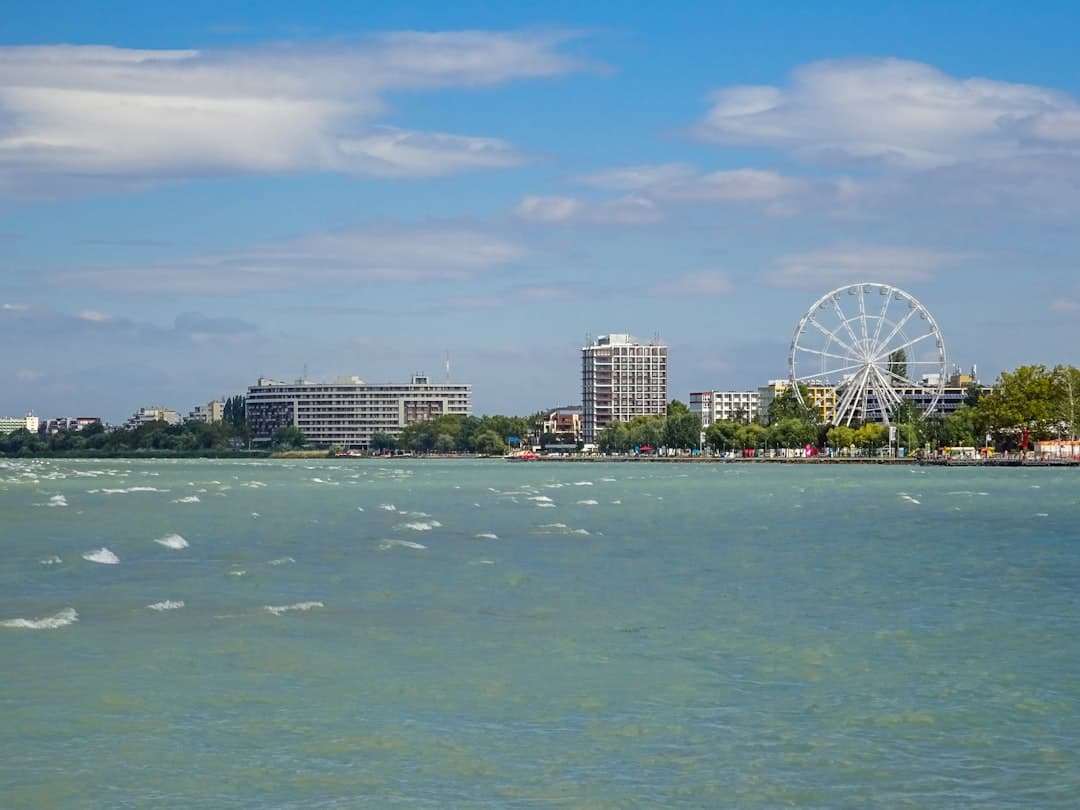
5. Siófok Ferris Wheel / Siófok Óriáskerék
Geo data: 46.9125248, 18.0555123
Rating from gathered data: 4.6 / 5 from 5,230 ratings
Best for: Views, sunset, families, couples, photos
The Siófok Ferris Wheel is one of the most photogenic modern attractions in town. It is not historically deep like the Water Tower, but it delivers spectacle: motion, elevation, evening lights, and views of Lake Balaton.
The wheel is especially atmospheric at sunset, when the lake, shore, and town lights create a classic Balaton holiday image. It adds a touch of carnival romance to Siófok’s otherwise beach-party-heavy image.
Why Go
- panoramic views without the architectural context of the Water Tower,
- romantic or family-friendly ride,
- good sunset photos,
- simple, memorable vacation moment.
Practical Note
Ticket prices and seasonal opening hours were not provided in the gathered material. Expect operation to be seasonal and weather-dependent. Check locally if visiting outside summer.
6. Siófok Harbour / Port of Siófok
Address: Krúdy sétány 2
Best for: Boat trips, waterfront walks, photos, monuments
Cost: Free to walk; cruises cost extra
Critic verdict: Best as part of a harbor walk or lake excursion
Siófok Harbour is one of Lake Balaton’s main ports and a central hub for passenger and leisure shipping.
Historical Importance
The harbor’s story goes back centuries.
In 1552, during Ottoman control, the area of Fok became a military port, with a fortress built on Granárium Hill.
Modern Balaton navigation began with the founding of the Balaton Steam Shipping Company in 1846. The Southern Railway reached Siófok in 1861, the station was completed in 1863, and around 1863–1864 an artificial harbor with breakwaters was built. These changes turned Siófok into a major civil port and holiday resort.
The harbor helped develop:
- bathing culture,
- resort travel,
- lake excursions,
- inter-town connections,
- and Siófok’s identity as the “capital of Balaton.”
What to See
- the harbor basin,
- breakwaters and piers,
- excursion boats,
- the ship station,
- the park in front of the harbor building,
- a monument dedicated to the 100th, 125th, and 150th anniversaries of steamship navigation on Lake Balaton,
- the Kálmán Szekrényessy statue, a limestone statue erected in 1997 honoring the first person to swim across Lake Balaton,
- nearby promenades and waterfront photo spots.
The harbor is about 800 meters from Fő tér and the Water Tower, making it easy to combine with the center.
Boat Trips and Prices
There is no ticket to enter the harbor itself. Costs apply to cruises.
Example operator pricing:
- Disco boat night cruise: around 6,500 HUF adults, 5,900 HUF children
Common sightseeing and themed cruises may fall roughly in the 4,000–7,000 HUF adult range, depending on duration, operator, date, and program. Always verify current schedules and prices.
Seasonality
The main boating season is June–September. Outside peak season, leisure shipping may be reduced or absent.
Atmosphere
The harbor feels transitional and cinematic: people waiting, ropes, wind, engine sounds, ticket counters, lake light, boat departures. It is where Lake Balaton becomes not only a view but a route.
7. The Benevolent Angel of Peace
Address: Krúdy sétány, 8600 Siófok
Geo data: 46.9128932, 18.0428056
Rating from gathered data: 4.7 / 5 from 832 ratings
Best for: Waterfront photos, short harbor walk
Critic verdict: Good as part of a harbor walk, not a standalone attraction
The Benevolent Angel of Peace is a highly photographed public artwork near the harbor/waterfront area. Review snippets describe it as a “perfect photo place.”
It works best as part of a relaxed walk along the harbor, Krúdy Promenade, and Rose Garden rather than as a destination requiring special planning.
8. Sió Lock / Sió-zsilip and Sió Canal
Best for: Engineering history, walking, quiet contrast to the beach
Cost: Ordinary outdoor access appears free
Opening: Outdoor areas likely generally accessible; technical areas restricted
New status: Reconstructed and inaugurated as a renewed public space in April 2024
The Sió-zsilip, or Sió Lock, is one of the most significant hydraulic structures in Hungary because it regulates the water level of Lake Balaton through the Sió Canal.
Why It Matters
Lake Balaton’s water level is not just a natural phenomenon; it has been actively managed for centuries. The Sió Lock controls outflow from the lake, helps prevent flooding, supports shoreline development, and underpins modern beach and resort infrastructure.
Historical Timeline
- Roman era: Local tradition says Emperor Galerius ordered a drainage channel near present-day Siófok.
- 19th century: Plans developed to regulate Balaton’s fluctuating water level for navigation, flood protection, agriculture, and shoreline development.
- 1863: First wooden sluice built at Siófok. Ceremonial opening was on 25 October 1863, though one account gives 24 October 1863 and credits Cathry Szaléz Ferenc as builder.
- 1891: A new masonry/concrete lock with steel panels was built, with discharge capacity around 50 m³/s.
- 1947: After World War II damage, a new complex lock and navigation sluice was put into operation on 22 September 1947.
- 1947 structure details: navigation lock about 83.5 m long, 12 m wide, allowing 1200-ton barges and ships to pass; water step about 2.5 m.
- 1976: Renovation of the lock system.
- 2020–2024: Comprehensive modernization and public-space redevelopment.
- April 2024: New Sió Lock officially handed over.
The Sió Canal today extends about 120.8 km between Lake Balaton and the Danube system.
What to See
- lock gates,
- water-release structure,
- canal banks,
- contemporary concrete-and-steel design,
- walkways and viewing points,
- renewed waterfront public space,
- the contrast between technical infrastructure and urban promenade.
Atmosphere
The Sió Canal is one of Siófok’s quieter atmospheric spaces. Compared with Petőfi Promenade, it feels local, linear, and reflective: water movement, bicycles, footsteps, birds, and infrastructure rather than bars and beach crowds.
Practical Note
No ticket prices or formal opening hours were provided in the research. Because the reconstructed area is described as a community/public space, ordinary outdoor access appears free. Technical and machinery areas are presumably restricted.
9. Rózsakert / Rose Garden
Geo data for Siófok Rose Grove: 46.9105293, 18.0454996
Rating from gathered data: 4.8 / 5 from 2,591 ratings
Cost: Free
Opening: Public park; no separate weekday/weekend hours published
Best for: Flowers, photos, gentle walks, quiet break near the harbor
The Rózsakert, or Rose Garden, is one of Siófok’s best-loved public green spaces. It lies near the harbor and waterfront promenade and is sometimes described as the city’s “northern gate.”
The first full version of the park was completed in 1931. It has long functioned as a representative public park, local historical space, and major Balaton-side walking point.
Recent Renovation
A major renovation began in the early 2020s:
- the first section of the shoreline promenade was renewed in 2021,
- the rose grove and additional park spaces followed,
- the full project was completed by May 2024.
Reports state that the renovation added approximately:
- 6,000 rose bushes
- around 11,000 total plants
- as many as 70 rose varieties
What to See
- rose beds,
- walking paths,
- green spaces,
- fountains and water features,
- redesigned promenade connections,
- links toward Porecs tér and Isztria sétány.
The fountain system is a special feature, though fountain operations can vary. A later city communication in August 2026 mentioned temporary stoppages at the fountains, illustrating that water features may not always operate continuously.
Atmosphere
The Rose Garden offers a soft counterbalance to the louder parts of Siófok. Expect roses, greenery, strolling couples, families, and a slower pace near the waterfront.
Practical Information
- Entrance fee: 0 HUF
- Opening: no formal opening/closing times published; it functions as a freely accessible public space.
- Costs may apply only to surrounding services.
10. Millennium Park
Address: Millennium park, 8600 Siófok
Geo data: 46.9071467, 18.0542134
Rating from gathered data: 4.5 / 5 from 127 ratings
Cost: Free
Opening: Effectively 24 hours
Best for: Arrival walk, statues, green pause near the station
Critic verdict: Solid filler stop, especially as a break between center and station
Millennium Park is a central urban park directly in front of Siófok railway station. It covers about 16,000 m² and functions as one of the town’s main green civic spaces.
History
The current park layout dates from 1994. It was created by removing the former bus station and parking lot from the area. Construction began in late 1993, and the park opened or was inaugurated in June 1994.
The park was planned by Dr. Imre Jámbor, a professor at the Faculty of Horticultural Science. Historically, the area was known as Baross Park before becoming Millennium Park.
It stands in front of the railway station, whose current building dates from 1903–1904 and has been restored to much of its former character.
What to See
- Snow-white music pavilion
- Imre Kálmán statue by Imre Varga
- smartphone-app feature allowing visitors to play Kálmán melodies associated with the statue
- sundial composition
- fountain, including a significant fountain added around 2004
- World War II memorial by Sándor Kiss
- “Zuhanyozó nő” / Showering Woman by István Martsa
- Mártírok-szoborcsoport / Martyrs sculpture group by Imre Varga
- lawns, flowerbeds, mature trees, curving paths, benches
Atmosphere
Despite being beside a busy transport hub, the park often feels calm. It is a place for a quick rest after arrival, a gentle evening walk, or a pause before heading to the Water Tower.
Practical Notes
- Entrance: free
- Opening: public, ungated, effectively 24/7
- Nearby parking: sources mention only paid parking options in the immediate area
- Restrooms: no consistent evidence of dedicated always-open restrooms in the park; use station/cafés/nearby venues
11. Siófok Railway Station
Best for: Arrival, architecture, transport history
Ticket office hours: Very long daily hours, roughly early morning to late evening
Historical significance: Key catalyst for Siófok’s rise as a resort
Siófok Railway Station is more than a transport facility. Its arrival in the 1860s triggered Siófok’s transformation into a Balaton bathing resort.
History
- 1861: Southern Railway line between Buda and Nagykanizsa inaugurated.
- 1863: Siófok trains begin stopping; original station building opened.
- 1903–1904: current larger station building completed.
- After World War II: ornate roof structure with towers above the main entrance removed.
- 1987 or 1989–90: major renovation, with side-wing extensions and restoration of turn-of-the-century character.
- 1985: bus terminal opened next to station.
- 1994: Millennium Park completed in front of station.
The station is on the Budapest–Murakeresztúr line and the Tab–Siófok line. Other railway stops in the municipality include Szabadisóstó, Szabadifürdő, Sióvölgy, Balatonszéplak felső, and Balatonszéplak alsó, but this is the main gateway.
Architecture
The original 1863 building was a modest single-storey standard Southern Railway structure. The current 1903–1904 building is more representative, with:
- larger central block,
- symmetrical side wings,
- historic façade,
- once-decorative roof towers,
- restored early-20th-century proportions.
Ticket Office Hours
Sources vary:
- daily 03:30–23:30
- daily 03:45–22:25
- daily 05:00–22:00
- another local listing: 06:40–19:30, likely older or for a specific desk
Practical takeaway: expect station/ticket office access daily from very early morning until late evening, but verify for exact travel dates.
Ticket Prices
Rail fares depend on route, train type, discounts, and booking channel. Budapest–Siófok second-class one-way fares are generally in the range of several thousand forints, roughly €10–€20, depending on train and conditions. Check MÁV online or at the station.
12. Kálmán Imre Memorial House
Address: Kálmán Imre sétány 5, 8600 Siófok
Best for: Music history, operetta, quiet cultural hour
Critic verdict: Best for culture-oriented visitors
The Kálmán Imre Memorial House is the childhood home and memorial museum of Imre Kálmán / Emmerich Kálmán, one of Hungary’s most internationally famous operetta composers.
Historical Significance
- Imre Kálmán was born in Siófok on 24 October 1882.
- A memorial exhibition opened on 22 October 1987, for the 105th anniversary of his birth.
- The museum presents his life, career, and legacy in his childhood home.
- It is a key local cultural attraction.
What to Expect
This is a small historic house museum, not a large complex. Displays are arranged in the ground-floor rooms and include:
- biographical exhibits,
- career material,
- original or period-related items,
- domestic atmosphere of a birth house / childhood home.
The building’s appeal lies in its preserved residential scale and connection to Kálmán’s early life rather than monumental architecture.
Opening Hours
September 15 – May 14
- Monday: closed
- Tuesday–Friday: 10:00–12:30, 13:00–16:00
- Saturday: 10:00–14:00
- Sunday: closed
May 15 – September 14
- Monday: closed
- Tuesday–Friday: 10:00–12:30, 13:00–18:00
- Saturday: 10:00–14:00
- Sunday: 10:00–14:00
Ticket Prices
Due to different municipal listings, prices appear as ranges:
Permanent exhibition
- Full price: 800–1,200 HUF
- Discounted: 400–600 HUF
- Family ticket: 400–600 HUF/person
- Group ticket: 500–1,000 HUF/person
Temporary exhibition
- Full price: 400 HUF
- Discounted: 200 HUF
- Group ticket: 300 HUF/person
Combined ticket
- Full price: 1,000–3,000 HUF
- Discounted: 500–1,500 HUF
Guided tour
- Below 10 people: 800–1,500 HUF
- Above 10 people: 1,500–2,500 HUF
Planning estimate: standard adult entry to the permanent exhibition is roughly 800–1,200 HUF.
13. Mineral Museum / Ásványmúzeum
Address: Kálmán Imre sétány 10, 8600 Siófok
Geo data: 46.9065961, 18.0506945
Rating from gathered data: 4.6 / 5 from 356 ratings
Best for: Families, geology, rainy day, unusual museum stop
Critic verdict: Optional niche stop, low tourist-trap risk
The Mineral Museum is one of Hungary’s largest and most notable private mineral collections. It is housed in the center of Siófok on Kálmán Imre Promenade.
History and Collection
- Opened to the public in June 1986
- Based on the lifelong collection of Kövecses-Varga Lajos
- Collection gathered over more than 30 years
- State-protected as national heritage
- Total collection: over 10,000–12,000 pieces
- Around 3,000 specimens on display
The collection focuses especially on minerals from:
- Hungary,
- Felvidék / present-day Slovakia,
- Kapnikbánya,
- Transylvania,
- the Carpathian Basin,
- historical Hungarian territories,
- and worldwide mineral localities.
This emphasis makes it a unique heritage collection, particularly in relation to specimens from Transylvania and historical mining regions.
Layout
- Five rooms
- 54 display cases
- minerals grouped by origin
- traditional compact display style
- museum shop with minerals available for purchase
Expect glass cases, dense but organized displays, colors, crystal forms, quartz varieties, metallic ores, carbonates, and regional geological interpretation.
Atmosphere
This is the opposite of the beach: quiet, enclosed, focused, tactile, colorful. It is especially useful as a calmer activity during bad weather or as a break from heat and crowds.
Opening Hours
Several patterns are reported.
Most useful planning estimate:
June–August
- daily 09:00–19:00
May and September
- daily 09:00–16:00
October–April
- visits by prior appointment
Other sources say:
- until August daily 10:00–19:00,
- from September daily 10:00–17:00,
- 09:00–16:00 between May 1 and September 30,
- or generic 10:00–16:00 daily.
Verify close to your visit.
Ticket Prices
2024/2025 estimate:
- Adults: 800 HUF
- Students / seniors / children above 6: 500 HUF
- Children under 6: free
- Group ticket minimum 10 people: 500 HUF/person
- Online/international booking packages may list around 4 EUR per adult, higher than local walk-up prices.
14. Siófok Evangelical Church
Best for: Architecture, Makovecz Imre, quiet cultural stop
Cost: General visiting appears free
Critic verdict: Worth a brief visit if nearby
The Siófok Evangelical Church is one of the town’s most distinctive modern buildings. It was designed by Makovecz Imre, Hungary’s influential organic architect, and consecrated in 1990.
History
The Evangelical congregation dates back to the 1930s, with worship services held by 1934. The design for the church was completed in 1986, construction ran through the late 1980s, and the church was consecrated on 30 June 1990 by Bishop Béla Harmati.
It was Makovecz’s first Evangelical church and is nicknamed “the Ship of Christ.”
In 2014, it received national monument protection, and in 2015 it was awarded the regional heritage title Örökségünk – Somogyország Kincse.
A notable detail: much of the timber came from Oulu, Finland, Siófok’s twin city, reflecting links with Finnish Lutherans.
Architecture
Key features:
- organic timber-based design,
- sculptural form,
- harmony with nature,
- park setting among chestnut trees,
- four-part layout pointing to the cardinal directions,
- four entrances,
- east-facing altar,
- about 120–150 seats,
- altar area featuring Péterffy László’s “A feltámadott” / “The Risen One.”
Practical Information
- Entry: no standard ticket found; general visiting appears free.
- Services: Sundays and feast days at 10:00.
- One travel listing gives 10:00–18:00 visiting hours, but this should be treated as approximate.
- Access is easiest around worship times or in summer.
15. Sarlós Boldogasszony Church
Address: Fő utca 57
Best for: Catholic heritage, historic continuity, short cultural visit
Cost: Likely free
Critic verdict: Secondary cultural stop
The Sarlós Boldogasszony Church, or Parish Church of Our Lady of the Visitation, is Siófok’s main Roman Catholic parish church.
Historical Importance
Siófok’s church history is documented from 1488, when a church in the former settlement of Fok is first mentioned. The current parish continues the town’s long Catholic tradition and remains an active place of worship.
What to Notice
- main façade on Fő utca,
- sanctuary and nave,
- parish complex,
- role as the main Catholic parish church,
- active local religious life.
Opening and Mass Information
One source reports broad church access:
- daily 07:00–19:00
Mass schedules include weekday Masses, Saturday evening Mass, and multiple Sunday services.
Sunday Masses may include:
- 08:00
- 10:00
- 11:30
- 19:00
The 11:30 Mass is noted for July and August in some schedules.
Parish office hours for administration include:
- Monday: 11:00–12:00
- Tuesday and Thursday: 16:00–18:00
Cost
No admission fee is listed. Ordinary worship/visiting is likely free.
16. Bella Zoo Park / Bella Animal Park
Address: Verebesi u. 35, 8600 Siófok
Geo data: 46.9161646, 18.1103712
Rating from gathered data: 4.8 / 5 from 13,443 ratings
Tripadvisor-style captured data: 4.6 / 5 from 52 reviews
Best for: Families, children, animal lovers, calmer day out
Critic verdict: Worth it for families; secondary for general sightseeing travelers
Bella Zoo Park, also referred to as Bella Animal Park or connected with Bella Equestrian Center, is one of the strongest family attractions near Siófok.
It is repeatedly described as a charming family destination just minutes from downtown. Its mood is very different from Petőfi Promenade: hay, animals, grass, children’s voices, enclosures, and a gentler inland rhythm.
Why Go
- family-friendly,
- hands-on animal experience,
- calmer than the beach strip,
- strong ratings in gathered data,
- good for a half-day with children.
Atmosphere
Expect a pastoral break from the lakeshore: hay smells, animal warmth, dust in summer, horses, goats, and families moving slowly through the park.
Practical Note
Detailed 2024/2025 ticket prices and hours were not included in the gathered material. Because it is a paid family attraction, verify current prices and seasonal schedule before going.
17. The Upside Down House
Address: Május 1. u. 2/A, 8600 Siófok
Geo data: 46.8967563, 18.0185583
Rating from gathered data: 4.3 / 5 from 6,261 ratings
Best for: Families, photos, novelty, quick fun stop
The Upside Down House is one of Siófok’s playful novelty attractions. It turns a familiar domestic environment upside down, creating optical illusions and disorienting photo opportunities.
Why Go
- fun photos,
- family-friendly,
- silly and memorable,
- good short attraction,
- reinforces Siófok’s entertainment identity beyond nightlife.
Atmosphere
Expect humor, mild disorientation, people posing for photos, and a childlike sense of entering a world where everyday reality is inverted.
Practical Note
Ticket prices and opening hours were not provided in the research. Check current seasonal operation before going.
18. Jókai Villa
Address: Batthyány utca 2
Best for: Literary history, architecture, hotel/restaurant experience, exterior viewing
Current function: Hotel and restaurant, not a typical museum
Jókai Villa is a historic lakeside villa turned hotel and restaurant. It is notable because Hungarian novelist Jókai Mór spent the last summer of his life there in 1903.
History
- Built in 1897 by Braun Dávid / David Braun
- Later purchased by Dr. Vilmos Fekete, a lawyer from Temesvár / Timișoara
- In 1903, Jókai Mór stayed there as a guest and spent his last summer in the villa
- Jókai frequently visited Siófok and drew inspiration from boat trips between Siófok and Balatonfüred for his novel “Az arany ember” / “The Golden Man”
- Until World War II, it functioned mainly as holiday accommodation
- Nationalized in 1947
- During socialism, used by institutions including the police, a music school, and the Pannónia Center
- Returned to private ownership in 1995
- Renovated comprehensively in 2011
- Now operates as Jókai Villa Hotel with restaurant and wellness services
Architecture and Experience
The villa is described as a romantic-style building from 1897 in one of Siófok’s most attractive areas, at the edge of Jókai Park, near Lake Balaton.
It offers:
- historic exterior,
- park setting,
- literary association,
- hotel rooms,
- restaurant,
- wellness features such as sauna/spa elements,
- buffet breakfast for guests.
Room categories include:
- standard,
- superior,
- deluxe corner-bathtub,
- family rooms,
- suites.
Rooms may include LCD TV, telephone, minibar, and typical hotel amenities.
Prices
There is no museum-style ticket. Indicative room prices from a hotel price list:
- Standard room: about 22,900 HUF/night
- Superior room: about 25,900 HUF/night
- Deluxe corner-bathtub room: about 27,900 HUF/night
- Family room: about 31,900 HUF/night
- Suite: about 37,900 HUF/night
These vary by season and platform.
Check-In / Check-Out
Sources vary:
- Check-in from 14:00 to 21:00
- or from 15:00 to 21:00
- Check-out until 10:00 or 11:00
Restaurant hours were not clearly provided; verify directly.
19. Thanhoffer Villa
Address: Petőfi sétány 4 in one report; also associated with Karinthy Frigyes utca 4 in another
Best for: Exterior architecture, Horthy-era history, villa heritage
Current access: Complex; often not open for casual sightseeing
Thanhoffer Villa is one of Siófok’s most important late-19th-century bourgeois holiday villas.
History
- Built in 1897 by Dr. Lajos Thanhoffer, physician and medical professor
- Intended to encourage wealthy contemporaries to build similar villas and boost Siófok tourism
- In 1919, it served as headquarters of Miklós Horthy, then Commander of the National Army, for about four months from August to November
- Became known locally as the “Horthy villa”
- After 1945, nationalized and used as a holiday resort / pension, often referred to as Kagyló Pension
- In the early 2000s, Siófok city purchased it
- For nearly a decade it housed the library of Kodolányi János University College
- Major renovation in 2012–2013
- After renovation, used as conference/event venue and exclusive guest house
- Locally protected
- In 2013, received Örökségünk – Somogyország kincse
- Recent municipal documents mention the villa valued around net 930 million HUF, difficult to utilize profitably, at times empty, with council moving toward sale or long-term lease
Architecture
- large late-19th-century bourgeois holiday villa,
- basement + ground floor + first floor + attic,
- ground floor around 205 m²,
- corner plot around 2,342 m²,
- monumental façade,
- historicist decorative elements,
- upper floors and attic converted into six suites/rooms,
- ground floor includes small auditorium/lecture hall, dining room, kitchenette.
Some suites are reportedly named after women from the Horthy family.
Access and Prices
This is not a standard museum.
Some sources say:
- currently not visitable,
- access only through accommodation,
- events,
- conferences,
- special heritage open days.
No fixed entrance ticket exists.
Accommodation estimates:
- around $139–$146 per night
- roughly consistent with 1,125–1,417 NOK
- no reliable simple daytime ticket
Practical Warning
Do not assume you can enter. Plan for exterior viewing unless you have confirmed an event, booking, or special open day.
20. Karinthy Villa / Thanhoffer Villa at Karinthy Frigyes utca
The research contains overlapping information about Thanhoffer Villa and Karinthy Villa. In tourist brochures, the villa at Karinthy Frigyes utca 4 is described as Thanhoffer Villa, a city-owned guesthouse not open to visitors. It is sometimes associated with Karinthy because of the street name and Siófok’s broader Karinthy heritage.
Frigyes Karinthy and Siófok
Frigyes Karinthy (1887–1938) spent many summers in Siófok and considered Lake Balaton his spiritual homeland. However, his main literary residence was the Vitéz panzió at Batthyány utca 46, where he and his family stayed and where he died in 1938.
If you are interested in Karinthy-related sites:
- see the Karinthy Frigyes statue and Rose Garden,
- view Vitéz panzió from outside,
- walk the historic villa district.
Villa Description
The villa is described as:
- patinated,
- baroque-like exterior,
- distinctive tower,
- romantic stone balconies,
- large terraces,
- Transylvanian-style roof,
- rich windowed façade,
- near Jókai Park.
Access
Official city guides say:
- it functions as a guesthouse,
- not visitable,
- no public ticketed admission,
- no sightseeing hours.
Nearby Karinthy Ház appears on accommodation platforms as a holiday apartment facility with:
- four apartments,
- equipped kitchens,
- air-conditioning,
- closed private parking,
- garden with pavilion and playground,
- about 50 m from Petőfi Promenade and beaches.
This is lodging, not a museum.
21. Töreki Tanösvény / Töreki Nature Trail
Address/Geo listing: Siófok, 65145, 8600
Geo data: 46.8918329, 18.001327
Rating from gathered data: 3.7 / 5 from 262 ratings
Best for: Nature, walking, quieter edge of town
The Töreki Tanösvény is one of Siófok’s nature-oriented alternatives to the beach and nightlife. The gathered data gives it a lower rating than many central attractions, but it remains useful for travelers wanting a quieter, greener side of the area.
It fits into the “surrounding villages and edge areas” atmosphere described by the vibe research: residential quiet, birds, greenery, local rhythm, and a less commercial soundscape.
Practical Note
No ticket prices or detailed hours were provided. Treat it as an outdoor nature/walking area and check local conditions before going, especially after rain or outside summer.
22. Hidegvölgy Fishing Lake and Wildlife Park
Address: Hidegvölgyi út, 8611 Siófok
Geo data: 46.8831461, 18.1071388
Rating from gathered data: 4.0 / 5 from 295 ratings
Best for: Fishing, wildlife, quiet inland outing
Hidegvölgy Fishing Lake and Wildlife Park appears in the gathered geo attractions as another quieter, nature-based Siófok option. It is away from the most crowded central zones and may appeal to travelers looking for fishing, green space, or a break from beach density.
Practical Note
No detailed hours or ticket prices were provided. Verify locally before making a dedicated trip.
23. Siófok Yoga Silver Point Beach
Geo data: 46.9011553, 18.0102139
Rating from gathered data: 4.7 / 5 from 733 ratings
Best for: Wellness, yoga, quieter beach mood
Siófok yoga Silver Point Beach represents Siófok’s softer wellness side. In a town known for nightlife, this kind of experience offers a different rhythm: lake air, morning movement, calmer beach surroundings, and body-focused relaxation.
Practical Note
No detailed class schedule, prices, or booking procedure were provided. If you are interested, check current class times directly before arrival.
Food, Drink, and Local Experiences
Lakeside Dining and Promenade Restaurants
Siófok’s food scene is strongly tied to its resort geography. The easiest dining areas are:
- Petőfi Promenade,
- Fő tér,
- harbor/waterfront,
- hotels and villas,
- beach venues.
Mala Garden Restaurant
Address: Petőfi sétány 15/A
Listed hours: Monday–Sunday 11:30–23:00
Mala Garden is mentioned as an example of a prominent promenade restaurant. It fits the lakeside resort mode: lunch, dinner, terrace life, and evening dining without the all-night schedule of party venues.
Fingers Restaurant
Address: Petőfi sétány 10
Listed hours: Monday–Sunday 10:30–06:00
Fingers illustrates Petőfi Promenade’s extended high-season rhythm, operating deep into the night and early morning.
Jókai Villa Restaurant
Jókai Villa operates as a hotel and restaurant in a literary-historic building. Exact restaurant hours were not provided, so verify directly. It is best thought of as a heritage dining/lodging experience rather than casual public museum access.
Bars and Nightlife
Renegade Pub
Mentioned in Tripadvisor-style things-to-do listings, Renegade Pub is a nightlife-oriented stop. It may appeal if you want drinks and social energy, but critic research warns that pub-style venues are preference-driven and can feel ordinary if you expect unique culture.
Verdict: only for nightlife-oriented visitors.
La Siesta Cocktail Bar
Also appearing in things-to-do results, La Siesta Cocktail Bar is best considered an evening drinks option.
Verdict: better as a night-out stop than a sightseeing priority.
Boat and Lake Experiences
Sailing on Lake Balaton
Sailing is one of the most authentic regional experiences. It lets you feel the lake rather than simply look at it.
Pros:
- scenic,
- active,
- memorable,
- better sense of Balaton’s scale.
Cons:
- weather-dependent,
- prices vary,
- tourist-trap risk if sold at premium rates with limited sailing time.
Disco Boats and Night Cruises
Siófok’s harbor offers themed cruises, including disco boats. One listed example:
- adult disco boat: around 6,500 HUF
- child ticket: around 5,900 HUF
These are very much part of the Siófok party identity. Choose them if that is your goal; skip if you prefer quiet lake time.
Suggested Walking Routes
Route 1: First-Day Classic Orientation Walk
Best for: Arrival afternoon or first evening
Time: 2–4 hours depending on stops
- Siófok Railway Station
- Millennium Park
- Fő tér / Main Square
- Water Tower
- Kálmán Imre Memorial House
- Mineral Museum
- Sió Plaza if needed
- Continue toward Rózsakert
- Walk to Harbor
- Finish at The Benevolent Angel of Peace
This route gives you city structure, history, public art, views, and waterfront atmosphere.
Route 2: Beach and Nightlife Route
Best for: Summer, social travelers
Time: All day into night
- Start at Nagystrand / Plázs Siófok
- Swim and relax
- Lunch on Petőfi Promenade
- Afternoon Ferris Wheel ride
- Sunset near the lake
- Dinner at Mala Garden or another promenade venue
- Continue to bars/clubs/Petőfi nightlife
- Optional late-night food at venues with extended hours
Route 3: Quiet Siófok Route
Best for: Travelers avoiding crowds or recovering after nightlife
Time: Half day
- Sió Canal
- Sió Lock
- Walk canal-side paths
- Rózsakert
- Harbor photo stops
- Evangelical Church
- Sarlós Boldogasszony Church
- Coffee around Fő tér
Route 4: Family Day
- Bella Zoo Park
- Lunch
- Upside Down House
- Ferris Wheel
- Ice cream and easy walk in Rose Garden
- Early evening beach stroll
Route 5: Literary and Villa Heritage Walk
- Jókai Villa
- Jókai Park
- Thanhoffer / Karinthy Villa exterior
- Batthyány utca 46 / Vitéz panzió exterior for Karinthy context
- Karinthy statue / Rose Garden
- Kálmán Imre Memorial House
- Imre Kálmán statue in Millennium Park
Practical Tips and Warnings
1. Siófok Is Highly Seasonal
The town changes dramatically between peak summer and off-season.
Peak summer:
- crowded beaches,
- active nightlife,
- more boat trips,
- longer opening hours,
- more noise,
- more expensive or variable entertainment,
- strongest Siófok atmosphere.
Shoulder/off-season:
- quieter,
- fewer cruises,
- some attractions by appointment only,
- nightlife reduced,
- museums may have shorter hours,
- easier walking and architecture appreciation.
2. Verify Opening Hours Close to Arrival
Several attractions have inconsistent published hours across sources, especially:
- Water Tower,
- Mineral Museum,
- boat operators,
- Plázs / beach venues,
- churches,
- villa/event venues.
Always verify locally via:
- Tourinform Siófok,
- venue websites,
- official municipal pages,
- on-site boards,
- accommodation staff.
3. Do Not Overexpect Small Attractions
Critic research repeatedly warns that some sights are best as part of a walk, not standalone destinations.
This applies to:
- Main Square,
- Benevolent Angel of Peace,
- Széchenyi / Stephansbrunnen,
- Martyrs Monument,
- Imre Kálmán statue,
- Sarlós Boldogasszony Church,
- Evangelical Church,
- Bartók Béla area/promenade stops.
They are meaningful, but often brief.
4. Petőfi Promenade Is Not for Everyone
If your accommodation is close to Petőfi sétány, expect potential summer noise, crowds, music, late-night movement, and party energy.
Great for:
- young travelers,
- groups,
- nightlife lovers,
- people who want social energy.
Less ideal for:
- light sleepers,
- families wanting quiet nights,
- travelers seeking contemplative lakeside atmosphere.
5. Plázs Siófok Has Mixed Reviews
A captured rating of 3.6 / 5 from 34 reviews suggests visitors are divided. Value depends heavily on events, prices, crowd, weather, and personal taste.
Go if you want the beach-club scene. Skip or manage expectations if you want peaceful lake time.
6. Beaches Can Be Crowded
Siófok Main Beach is central, famous, and seasonal. Crowds, noise, queues, and density are part of the experience in summer.
7. Some Historic Villas Are Not Public Museums
Do not assume you can enter:
- Thanhoffer Villa,
- Karinthy/Thanhoffer Villa,
- municipal guesthouse buildings,
- certain villa interiors.
Most are best viewed from outside unless you have a hotel booking, event access, or confirmed open day.
8. Harbor Is Free, Cruises Are Not
Walking the harbor is free. Boat trips, disco boats, sailing, and special cruises require tickets and vary by operator.
9. Public Parks Are Free
Free public spaces include:
- Main Square,
- Millennium Park,
- Rose Garden,
- much of the harbor promenade,
- Sió Canal/Sió Lock outdoor areas,
- exterior public-art stops.
10. Transport Hub Is Convenient
Siófok railway station is central and has long ticket office hours. It is practical to arrive by train and explore on foot from:
- station,
- Millennium Park,
- Fő tér,
- Water Tower,
- promenade,
- harbor.
11. Parking Near Central Parks May Be Paid
Sources specifically mention only paid parking options near Millennium Park. Expect central parking controls during season.
12. Use Tourinform
Tourinform at the Water Tower / Fő tér 11 is one of your best resources for:
- boat timetables,
- current attraction hours,
- event information,
- beach prices,
- local maps,
- seasonal changes.
Complete Attraction Reference Table
| Attraction | Type | Rating / Review Data from Research | Address / Location | Cost Notes |
|---|---|---|---|---|
| The Upside Down House | Novelty attraction | 4.3, 6,261 ratings | Május 1. u. 2/A | Verify |
| Water Tower | Landmark/viewpoint | 4.6, 11,486 ratings; Tripadvisor ~4.1/439 | Fő tér 11 | ~2,200 HUF adult estimate |
| Siófok Ferris Wheel | View ride | 4.6, 5,230 ratings | near waterfront | Verify |
| Bella Zoo Park | Animal/family park | 4.8, 13,443 ratings; Tripadvisor ~4.6/52 | Verebesi u. 35 | Verify |
| Siófok Rose Grove / Rózsakert | Park | 4.8, 2,591 ratings | near harbor | Free |
| Siófoki Nagystrand | Beach | 4.5, 3,207 ratings | Petőfi stny. 3 | Beach/event prices vary |
| Töreki Tanösvény | Nature trail | 3.7, 262 ratings | Siófok 65145 | Likely outdoor/free, verify |
| Millennium Park | Park | 4.5, 127 ratings | station area | Free |
| Hidegvölgy Fishing Lake and Wildlife Park | Nature/fishing | 4.0, 295 ratings | Hidegvölgyi út | Verify |
| Siófok Yoga Silver Point Beach | Wellness/beach | 4.7, 733 ratings | Silver Point Beach area | Verify |
| Mineral Museum | Museum | 4.6, 356 ratings | Kálmán Imre stny. 10 | ~800 HUF adult |
| Benevolent Angel of Peace | Monument | 4.7, 832 ratings | Krúdy stny. | Free |
| Kálmán Imre Memorial House | Museum | cultural site | Kálmán Imre stny. 5 | ~800–1,200 HUF adult |
| Evangelical Church | Church/architecture | listed attraction | center | Free/general access likely |
| Sarlós Boldogasszony Church | Catholic parish | listed attraction | Fő utca 57 | Free/general access likely |
| Main Square | Public square | reviewed as pleasant | Fő tér | Free |
| Siófok Harbour | Port | key experience | Krúdy sétány 2 | Free; cruises extra |
| Sió Lock | Engineering/public space | historic site | Sió Canal | Outdoor access likely free |
| Petőfi Promenade | Entertainment street | famous nightlife zone | lakeside | Free to walk |
| Sió Plaza | Shopping mall | functional stop | Fő tér area | Free to enter |
| Jókai Villa | Historic hotel/restaurant | heritage lodging | Batthyány utca 2 | No museum ticket |
| Thanhoffer Villa | Historic villa | limited access | Petőfi/Karinthy area | Not generally visitable |
| Karinthy-related sites | Literary heritage | exterior/public | Batthyány/Karinthy area | Mostly free exterior |
Final Thoughts: How to Get the Best Out of Siófok
Siófok is easiest to enjoy when you accept what it is: not a silent lakeside retreat, not a museum city, not only a party town, but a layered Balaton resort where all of those identities overlap.
If you came for the lake, prioritize Nagystrand, the harbor, a boat trip, the Ferris Wheel, and sunset walks.
If you came for nightlife, base your evenings around Petőfi Promenade, but check current venue regulations and event schedules.
If you came with family, combine Bella Zoo Park, the Upside Down House, beaches, parks, and the Ferris Wheel.
If you want culture, do not miss the Water Tower, Kálmán Imre Memorial House, Mineral Museum, Evangelical Church, Sarlós Boldogasszony Church, and villa exteriors.
If you want quieter Siófok, walk the Sió Canal, visit the renewed Sió Lock, linger in the Rose Garden, and explore the streets around Jókai Park.
The city’s most enduring charm lies in its movement: from station to square, tower to beach, canal to harbor, garden to promenade, day into night. Siófok is bright, busy, sometimes loud, often beautiful, and deeply tied to the Hungarian summer imagination. Arrive with realistic expectations, plan by mood rather than only by checklist, and you will find far more here than the “party capital” label suggests.