Comprehensive Travel Guide: Tihany
Tihany Travel Guide: The Complete Visitor’s Guide for Your Upcoming Trip
Tihany is not simply a pretty village on Lake Balaton. It is a compact, story-soaked peninsula where a thousand-year-old Benedictine abbey looks out over Hungary’s “inland sea,” lavender fields glow purple in early summer, volcanic lakes sit quietly inside the land, and even the landscape seems to answer back through the famous Tihany Echo.
For travelers who have already booked a trip, Tihany rewards slow attention. You can come for a half-day and see the abbey, the lake panorama, and the souvenir streets; but if you give the peninsula more time, you discover layers: prehistoric hillforts, medieval royal tombs, Byzantine hermit caves, Baroque churches, thatched peasant houses, volcanic geyser cones, inner lakes, old lavender plantations, fishermen’s traditions, family-friendly museums, and walking trails that tie myth, geology, and local life together.
This guide combines practical, historical, atmospheric, and review-based insights into one comprehensive article. It includes major sights, secondary attractions, lesser-known places, warnings, opening hours, ticket estimates, crowd advice, and the sensory “feel” of Tihany so you can make the most of the trip you have already planned.
Quick Orientation: What Makes Tihany Special?
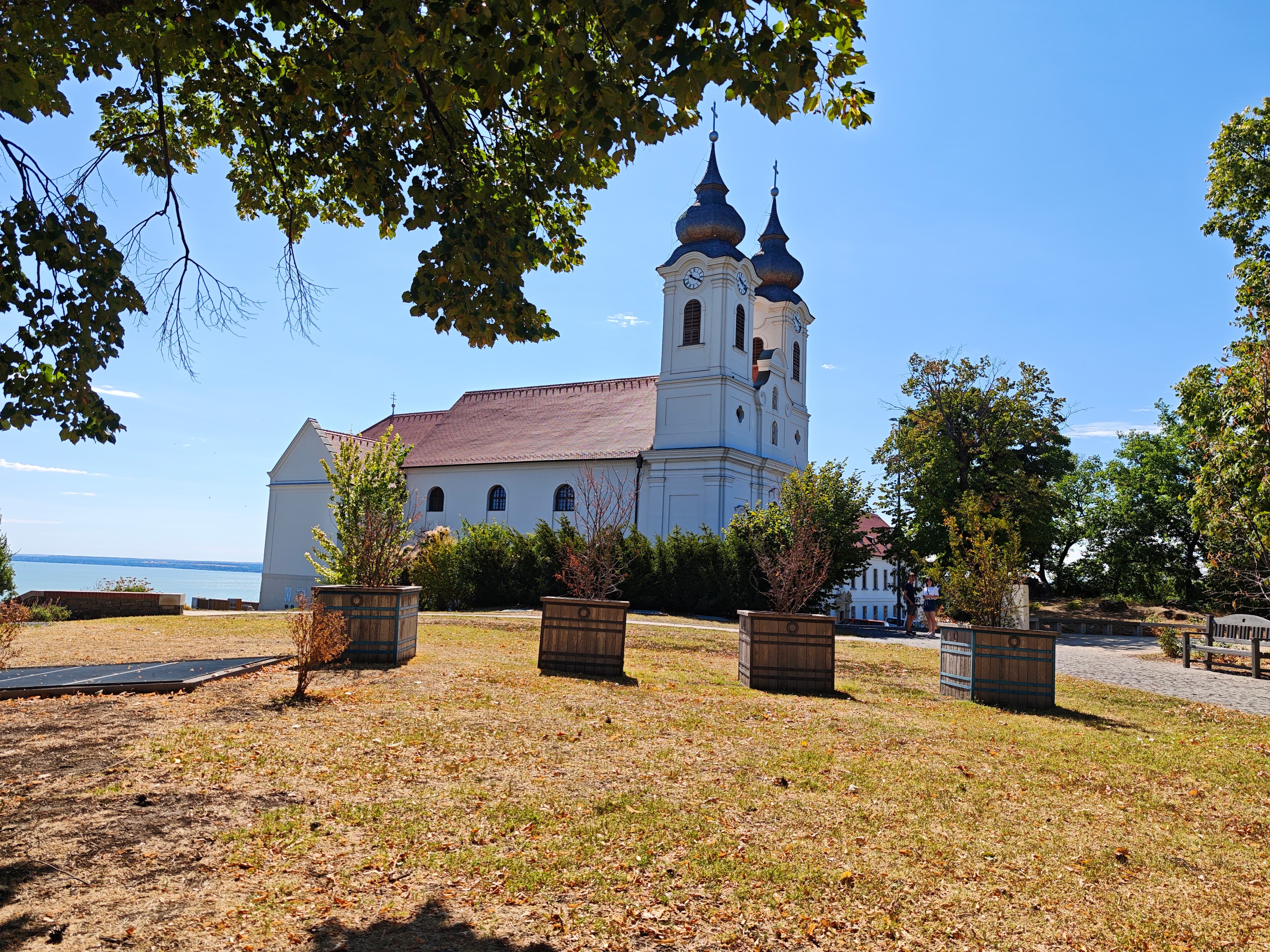
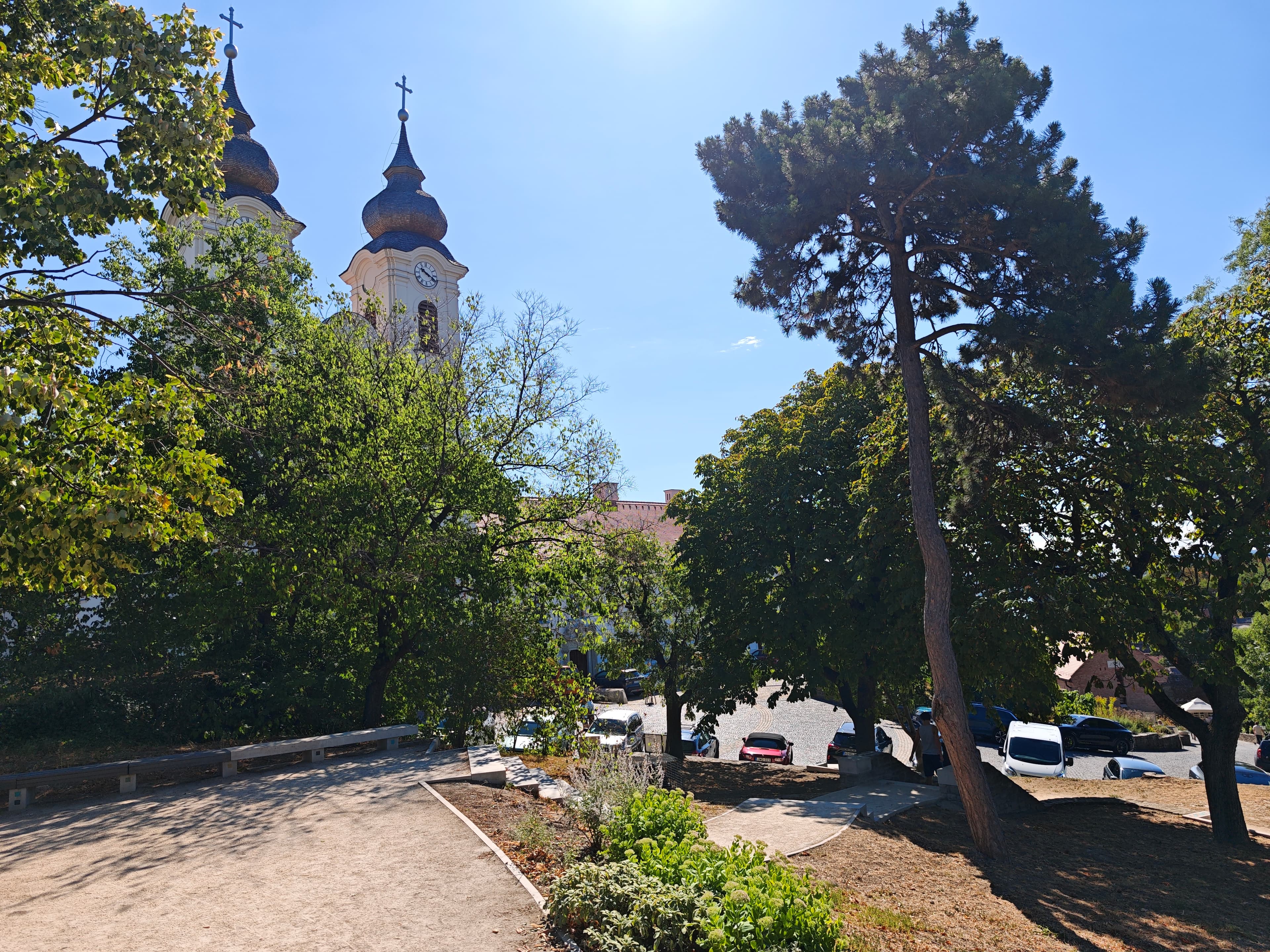
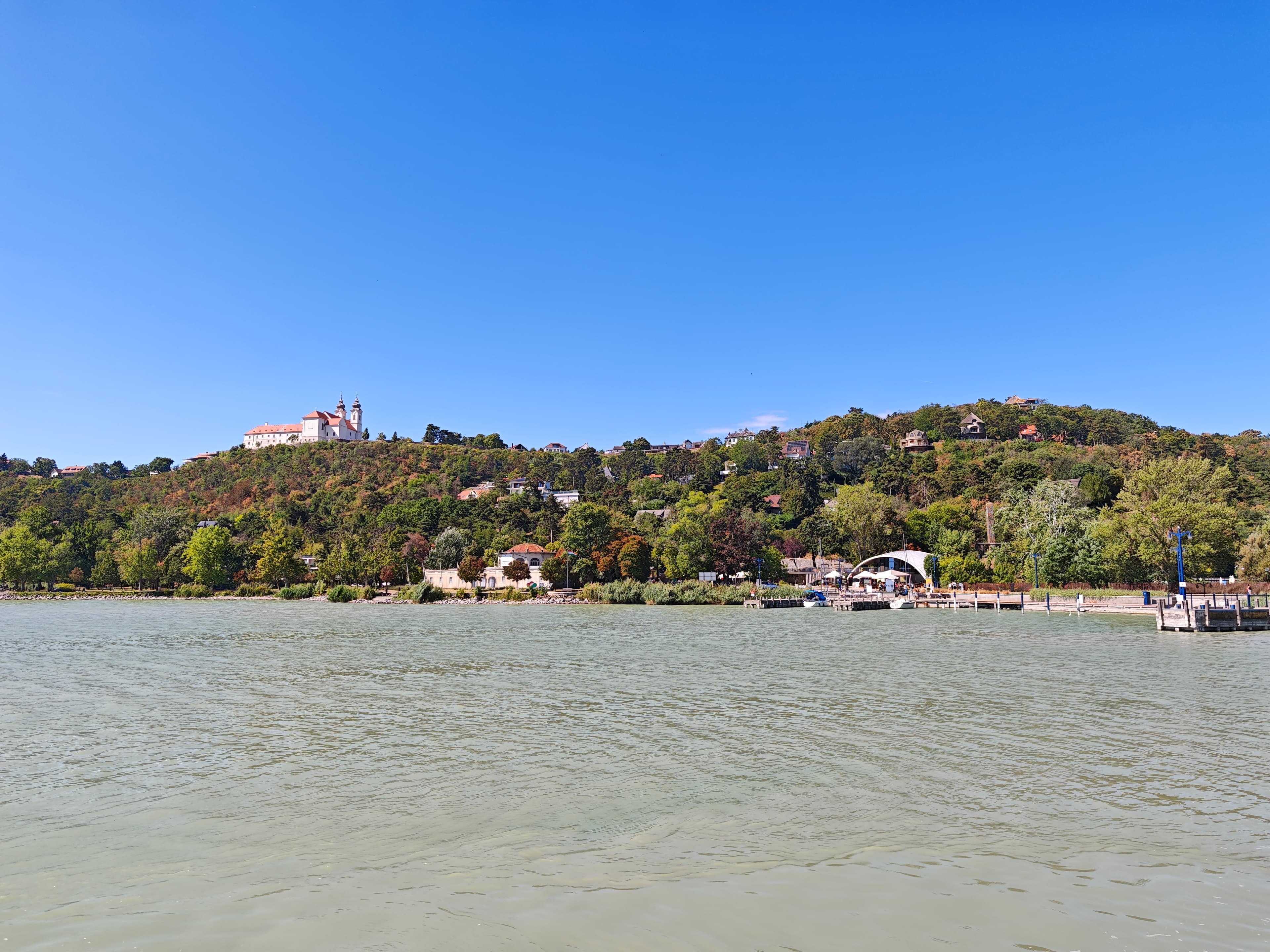
Tihany is a historic village on the Tihany Peninsula, projecting into the northern shore of Lake Balaton in Hungary. Its position gives it a distinctive identity: it feels like a small world within the Balaton region, bordered by water, shaped by volcanic hills, and crowned by the twin towers of the Benedictine Abbey of Tihany.
The peninsula is famous for:
- The Benedictine Abbey, founded in 1055 by King Andrew I of Hungary.
- The crypt and tomb of King Andrew I, one of Hungary’s most important surviving royal burial places.
- The abbey’s 1055 foundation charter, which preserves some of the oldest written Hungarian words.
- The Tihany Echo, a historic acoustic phenomenon tied to local legend.
- The lavender fields, especially the historic Old Lavender Field established in the 1920s by Gyula Bittera.
- The Inner Lake and Outer Lake, volcanic basins within the peninsula.
- The Hermit Caves / Barátlakások, rock-cut medieval dwellings used by Eastern Christian hermits.
- Traditional folk houses, thatched cottages, and village museums.
- Geological sights such as the Golden House Geyser Cone.
- Panoramic walking routes, the Pisky Promenade, educational trails, and viewpoints.
- A charming but sometimes very touristy village center full of lavender shops, cafés, souvenir stalls, and small museums.
Tihany’s reputation is strongly positive. Travelers consistently praise the abbey, views, lavender atmosphere, and walking routes. The main criticisms are also predictable: summer crowds, expensive parking, souvenir-heavy streets, and a few small museums or themed attractions that may feel overpriced if your expectations are too high.
Key Places at a Glance
The following table preserves the major point-of-interest data identified by the geographical research. Ratings and review counts are useful for gauging popularity, but keep in mind that small natural sites and outdoor viewpoints may be under-reviewed compared with ticketed attractions.
| Attraction | Type | Rating | Reviews | Address / Area | Coordinates |
|---|---|---|---|---|---|
| Barátlakások / Hermit Caves | Historical outdoor site | 4.5 | 1,632 | Tihany, 8237 | 46.9228656, 17.8790849 |
| Magyar Királyok Panoptikuma & Kalózmúzeum | Wax museum & pirate museum | 4.1 | 400 | Kossuth Lajos u. 35 | 46.9134486, 17.8879785 |
| Külső-tó / Outer Lake | Natural site | 4.9 | 59 | Tihany, 8237 | 46.9139277, 17.8635838 |
| Lavender Field | Lavender landscape | 4.4 | 1,461 | Levendula u. 36 | 46.9203103, 17.8661892 |
| Ciprian Spring | Natural spring | 4.4 | 241 | Unnamed Road | 46.9215876, 17.8860302 |
| Tihanyi Bencés Apátság | Benedictine abbey | 4.7 | 18,272 | I. András tér 1 | 46.9139572, 17.8895078 |
| Őrtorony-kilátó / Watchtower Lookout | Lookout tower | 4.8 | 2,615 | Apáti-hegy | 46.9121527, 17.8559003 |
| Aranyház gejzírkúp | Geological site | 4.8 | 538 | Tihany, 8237 | 46.9018168, 17.8817269 |
| Levendula Ház Látogatóközpont | Visitor center | 4.4 | 2,500 | Major u. 67 | 46.9092091, 17.8879778 |
| Skansen Tihany | Folk museum | 4.9 | 704 | Pisky sétány 1 | 46.9143654, 17.8897316 |
| Skansen Tihany | Folk museum / village house | 4.7 | 44 | Batthyány u. 20 | 46.9153894, 17.8862403 |
| Old town Tihany | Historic village center | 4.9 | 66 | Batthyány u. 30 | 46.9148681, 17.8884965 |
| Kilátópont a Belső-tóra | Inner Lake viewpoint | 4.8 | 78 | Aranyház u. 14 | 46.9050442, 17.8831076 |
| Tihanyi Babamúzeum | Doll museum | 4.6 | 219 | Visszhang u. 4 | 46.915871, 17.8869609 |
| IV Károly lépcső | Historic steps / route | 5.0 | 10 | Tihany, 8237 | 46.9137007, 17.888822 |
| Tihanyi visszhang | Echo point | 4.6 | 1,323 | Alsóóvári u. 1 | 46.916935, 17.8884078 |
| EAU DE TIHANY – Levendulás | Lavender attraction | 4.7 | 75 | Lepkesor | 46.9258763, 17.8601985 |
| Kiserdő Summit | Natural viewpoint | 4.8 | 144 | Tihany, 8237 | 46.9143487, 17.8754908 |
| Fazekasház | Potter’s house / folk heritage | 4.7 | 32 | Batthyány u. | 46.9148916, 17.8887084 |
| Apáti templom | Church ruin / church site | 4.7 | 270 | Sajkodi sor | 46.920527, 17.8537961 |
The Story of Tihany
Prehistoric and Ancient Roots
The Tihany Peninsula has been inhabited since prehistoric times. Long before the abbey towers defined the skyline, people were drawn to the peninsula’s strategic and sheltered position. The earliest known settlements were not located exactly where the modern village stands, but around the Vár-hegy / Castle Hill area known as Óvár.
Óvár once held one of Hungary’s oldest hill forts. Today the traces are barely visible, but the location still makes sense: the peninsula controls routes around Lake Balaton, its steep basalt cliffs provide natural protection, and its bays offered access to fishing, movement, and trade.
During antiquity, the broader Balaton region belonged to the Roman province of Pannonia. The Tihany headland was likely inhabited or used during the Roman and late antique periods as well, though later building and erosion have obscured much of the evidence. The surrounding landscape—basalt cliffs, lake access, volcanic hills—made Tihany valuable long before it became a medieval monastic center.
The Foundation of the Benedictine Abbey in 1055
The decisive moment in Tihany’s recorded history came in 1055, when King Andrew I of Hungary founded a Benedictine abbey on the peninsula. This act shaped the medieval village, the religious identity of the site, and the way Tihany is remembered in Hungarian cultural history.
The abbey was dedicated to the Virgin Mary and Saint Aignan / Saint Ányos of Orléans. It was intended as a royal necropolis for Andrew I and his family. When Andrew died in 1060, he was buried in the abbey crypt. His tomb remains there today, making the crypt one of the few surviving in-situ royal burial places in Hungary.
The abbey’s foundation charter of 1055 is one of the most important documents in Hungarian history. Written mainly in Latin, it includes Hungarian words and place names. It is often described as the oldest original document preserved in Hungary and as preserving some of the earliest written Hungarian language fragments.
This gives Tihany an unusual historical “firstness”: it is not just a picturesque village but a place tied to the origins of written Hungarian and the consolidation of medieval Christian kingship.
Medieval Growth and Religious Layers
After the abbey’s foundation, settlement clustered around the monastery. Craftsmen, peasants, servants, and people connected to the abbey’s estates formed the nucleus of medieval Tihany.
In the 13th century, market privileges and local administration helped the village develop further. At the same time, Tihany’s religious landscape was more diverse than many casual visitors realize. While the Benedictines represented Latin Christianity, the nearby Hermit Caves / Barátlakások were associated with Greek Orthodox / Byzantine-rite hermits, probably linked to Rus’ or Basilian traditions and possibly connected to Queen Anastasia, Andrew I’s wife, who came from the ruling family of Kiev.
This dual presence—Latin Benedictine monastery and Eastern Christian hermit colony—makes 11th-century Tihany a fascinating crossroads of Central and Eastern European religious culture.
Ottoman Period: Abbey as Fortress
From the late Middle Ages into the early modern era, Tihany’s strategic position on Lake Balaton gave it military importance. During the Hungarian–Ottoman Wars, the abbey was fortified and became part of a defensive fortress system.
By 1534, monastic life had been extinguished in Tihany. Soldiers replaced monks, and the abbey served primarily military purposes through much of the 16th and 17th centuries. The fortified abbey resisted full Ottoman conquest, but village life around it suffered from warfare, depopulation, and the instability of the frontier between Habsburg and Ottoman power.
During this era, Tihany’s religious and cultural roles were overshadowed by its function as a border fortress overlooking lake routes.
Baroque Revival in the 18th Century
After the Ottoman wars, Tihany entered a period of restoration. The monastery came under Austrian Benedictine control before being restored to Hungarian Benedictine ownership in 1716.
A major reconstruction campaign between 1719 and 1754 transformed the abbey into the Baroque complex visitors see today. The reconstruction is associated with Abbot Ágoston Lécs, and later research links the plans begun in 1719 to the Carmelite architect Márton Wittwer. The church was eventually consecrated in 1778.
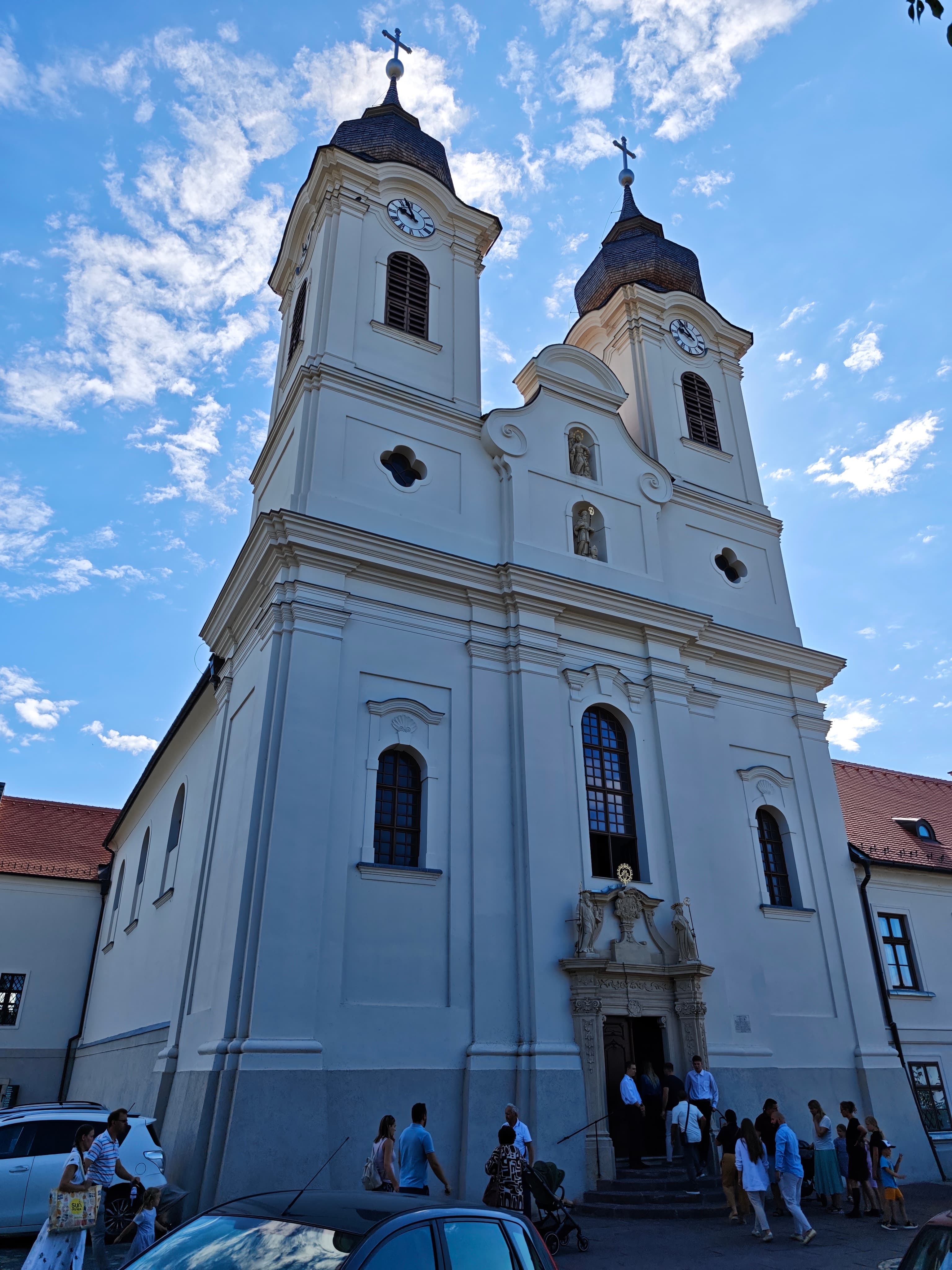
The abbey’s current appearance—with its twin towers, Baroque façade, richly decorated church interior, monastic buildings, and commanding position above Lake Balaton—comes largely from this 18th-century rebuilding.
A major fire in 1763 damaged the complex and slowed the work, but the Baroque identity of the abbey remained dominant.
Joseph II, Suppression, and Reopening
The Habsburg reforms of Emperor Joseph II affected monasteries throughout the empire. In 1786, the Tihany abbey was suppressed and closed. It reopened in 1802, and Benedictine life resumed.
The 19th century also saw the rise of Lake Balaton as a leisure and cultural destination. Tihany’s abbey, village streets, lake views, and echo phenomenon attracted visitors from nearby resorts such as Balatonfüred. The village began shifting from an agrarian and ecclesiastical community toward a modest resort and heritage destination.
20th Century: Kings, Communism, and Return of the Monks
Tihany’s history continued to intersect with national and European events.
In 1921, after a failed attempt to restore the Habsburg monarchy in Hungary, Charles IV, the last Hungarian king, was briefly interned in Tihany Abbey before exile. This moment gives Tihany a surprising connection to the final chapter of Habsburg dynastic history.
In 1950, under the communist regime, the abbey was closed again and monastic life was halted. The monastery functioned as a museum.
After political change in Hungary, the abbey complex was returned to the Benedictine order in the 1990s. The buildings were returned in 1994, and a comprehensive restoration program began in 1996. Since 2012, the abbey has functioned as an independent priory within the Hungarian Benedictine Congregation, with a small community of monks.
Today the abbey is both an active religious community and a national memorial site.
The Essential Tihany Experiences
1. Benedictine Abbey of Tihany
The Tihanyi Bencés Apátság is the landmark that defines Tihany. It stands at I. András tér 1, high above Lake Balaton, with a rating of 4.7 from more than 18,000 reviews in the geographical data. It is consistently regarded as the number one attraction in Tihany.
Why It Matters
The abbey was founded in 1055 by King Andrew I of the Árpád dynasty. It is one of Hungary’s oldest Benedictine foundations and one of the most important religious-historical monuments at Lake Balaton.
Its significance rests on several pillars:
- It was founded as a royal monastery and burial place.
- It preserves the tomb of King Andrew I.
- Its foundation charter contains some of the oldest written Hungarian words.
- It became a fortified stronghold during the Ottoman wars.
- Its present Baroque form is one of the most recognizable silhouettes on Lake Balaton.
- It remains an active Benedictine monastic site.
What to See
The Baroque Church
The abbey church is a twin-towered, ochre-colored Baroque building, reconstructed mainly between 1719 and 1754 and consecrated in 1778. It is about 46 meters long, 16 meters wide, and its two towers rise to roughly 34.5 meters.
Inside, expect:
- Baroque altars.
- Carved wood.
- Painted ceilings.
- Sculptures.
- Ecclesiastical artwork.
- A cool, hushed atmosphere, often scented with wax, incense, and old stone.
Even non-religious travelers often find the church moving because of the combination of architecture, age, and location.
The Crypt of King Andrew I
The crypt beneath the sanctuary is the only surviving part of the original 11th-century structure. It is among the most important spaces in Tihany.
The crypt:
- Dates from the 11th century.
- Contains the tomb of King Andrew I, buried here in 1060.
- Is also associated with the burial of Prince David, Andrew’s son.
- Is sometimes described as the only preserved grave of a medieval Hungarian king still surviving in situ.
- Has a low, Romanesque structure divided into three small naves by carved cylindrical columns.
The crypt is roughly 9–10 meters wide, with three-three carved cylindrical columns dividing the space. Some column bases were cut, probably to accommodate the royal tomb.
Archaeological excavations took place in 1953 and 2021, and recent research has examined human remains and medieval artifacts from the crypt. DNA analysis has been pursued in relation to Hungarian royal lineages, although individual identifications remain a scholarly matter.
The Abbey Museum
The Abbey Museum occupies parts of the monastery/friary buildings next to the church. Admission to the abbey complex generally includes the museum.
Displays cover:
- The 1055 foundation charter.
- The early royal monastery.
- Medieval phases, including Romanesque, 13th-century rebuilding, and late Gothic renovations.
- The Ottoman-period decline of monastic life.
- Baroque reconstruction.
- Liturgical art, statues, paintings, and monastic life.
- The abbey’s 1,000-year historical role.
The museum is often described in reviews as modern and well-curated, though serious museum-goers may find it smaller than a major national museum.
The Terrace and Views
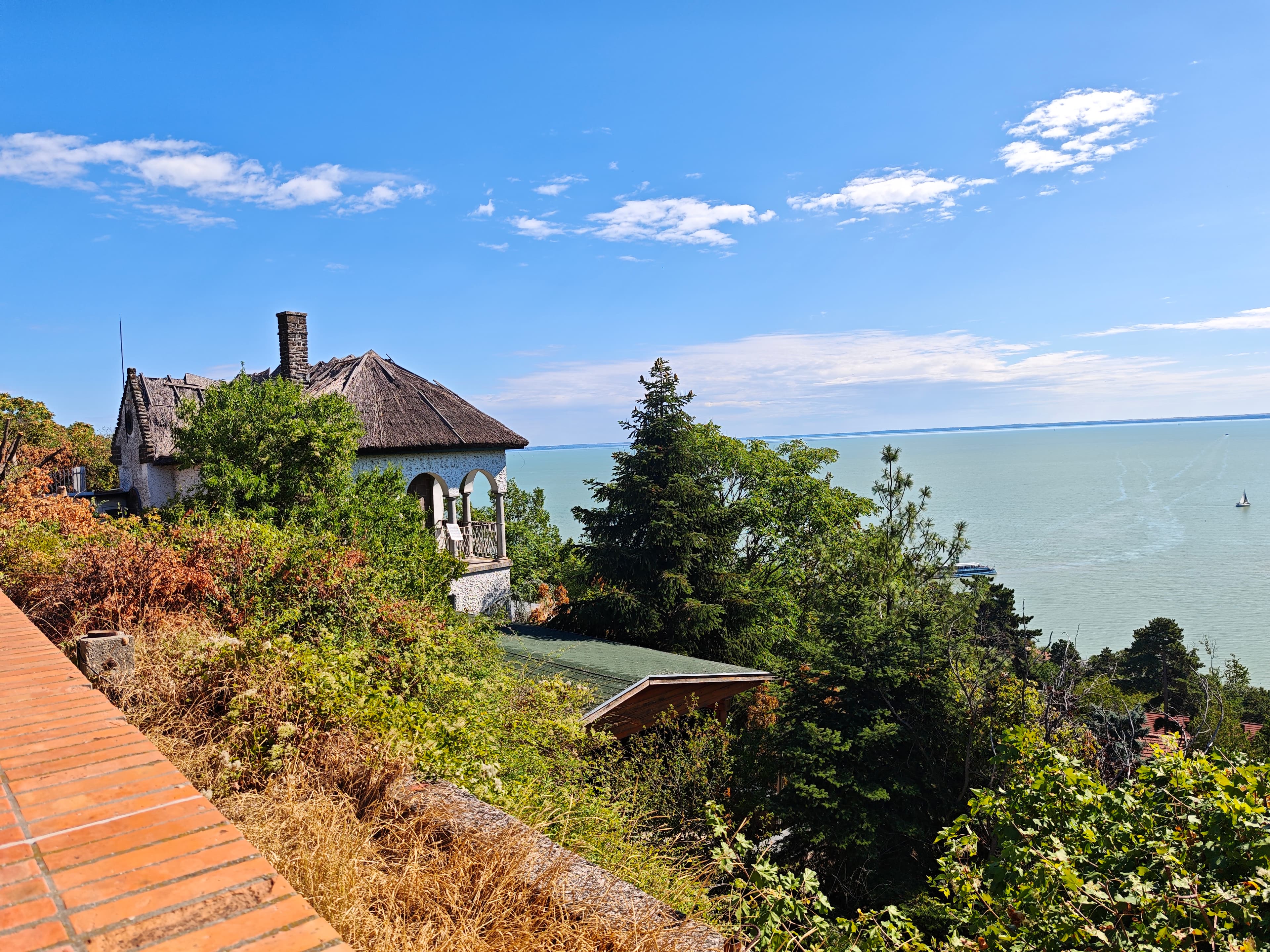
Outside, the abbey terrace gives one of the classic views of Lake Balaton: greenish-blue water, sailboats, tree-covered slopes, distant towns, and the ferry route below.
Many visitors find sunset particularly memorable, when the abbey towers turn golden and the lake shifts from turquoise to steel-blue.
Atmosphere
The abbey blends reverence, tourism, and panorama. You may climb through busy souvenir streets, then step into a cool sacred interior where footsteps echo and visitors speak softly. Outside, the lake wind returns you to the open air.
This contrast—crowded village below, solemn crypt beneath, huge lake beyond—is central to the Tihany experience.
Practical Information: Abbey Tickets
Current 2024/2025-style estimates:
| Ticket Type | Estimated Price |
|---|---|
| Adult full-price ticket | 3,400 HUF |
| Student with valid card | 2,500 HUF |
| Pensioner with card | 2,500 HUF |
| Family ticket, 2 adults + 1–2 children under 18 | 9,700 HUF |
| Each additional child | 1,200 HUF |
| Audio guide | 500 HUF |
| Guided tour in Hungarian | 22,000 HUF per group |
| Guided tour in English or German | 30,000 HUF per group |
Older sources list much lower abbey prices, such as 1,000 HUF or less, but those are outdated. Budget around 3,400 HUF per adult.
Practical Information: Abbey Opening Hours
Typical seasonal pattern:
| Season | Monday–Saturday | Sunday |
|---|---|---|
| 1 May – 30 September | 09:00–18:00 | 11:15–18:00 |
| October | 10:00–17:00 | 11:15–17:00 |
| November – winter periods | 10:00–16:00 | 11:15–16:00 |
| March | 10:00–16:00 | 11:15–16:00 |
| April | 10:00–17:00 | 11:15–17:00 |
Ticket office/admission often closes about 30 minutes before closing in peak season.
Important: the abbey is an active religious site. Weddings, funerals, church feasts, and liturgical programs may restrict access. Sunday opening is later because of morning services.
Review-Based Verdict
The abbey is worth the hype. It is not generally viewed as a tourist trap. The main issues are:
- Crowds in peak season.
- Commercial surroundings.
- Parking stress near the hill.
- Higher prices in nearby cafés and shops.
Go early, avoid peak summer weekends if possible, and give yourself time for both the museum and the terrace.
2. Tihany Echo and Echo Hill
The Tihanyi visszhang is one of Tihany’s most famous curiosities. The geographical data lists it at Alsóóvári u. 1, rated 4.6 from more than 1,300 reviews. Review platforms often rank it just below the abbey.
What Is the Tihany Echo?
The Tihany Echo is a historic sound phenomenon between Echo Hill / Visszhang-domb and the north wall of the Benedictine Abbey. The sound path is about 300 meters one way, with the round trip close to 700 meters, taking roughly 2 seconds.
Historically, visitors shouted from the echo stone and heard their words bounce back from the abbey. In the 19th century, sources claimed the echo could return 12–15 syllables, sometimes even 16, which made it famous in Hungary and beyond.
The Echo Today
Modern buildings, trees, traffic, and general development have weakened the echo. Some visitors still hear it faintly in quiet conditions; others hear almost nothing. Reviews show that people who come expecting a dramatic acoustic marvel may be disappointed.
However, Echo Hill remains worth visiting for:
- The view back toward the abbey.
- The playful tradition of shouting from the marked spot.
- The local legend.
- The surrounding promenade and nearby sights.
The Echo Legend
The most famous legend tells of a golden-haired fairy or princess named Tihany. In some versions she tended golden goats by the lake. After rejecting or causing heartbreak to a lake prince, she was cursed by the Lord of the Lake and turned into stone. Forced to answer anyone who calls to her, she repeats the words of passers-by—the echo.
The goats drowned in Lake Balaton, and small pinkish stones found along the shore are said to be their hooves.
This legend gives the echo emotional power even when the sound itself is weak. You are not just testing acoustics; you are participating in a local myth.
What to See Around Echo Hill
- The echo stone / pillar, marking the traditional shouting point.
- A statue or representation associated with the echo princess/fairy.
- Views of the abbey and Lake Balaton.
- Nearby Calvary of Károly IV, connected to Charles IV, the last Habsburg king of Hungary.
- Nearby cafés and restaurants, especially Echo Restaurant & Café.
- Connection to Pisky Promenade and Via Dolorosa.
Practical Information
- Ticket: Free.
- Opening hours: No formal gate; effectively open at all times.
- Best time: Quiet daylight hours, especially early morning, evening, or off-season.
- Weather: Wind and crowd noise reduce the chance of hearing the echo.
Review-Based Verdict
As a viewpoint and walking stop, Tihany Echo is worthwhile. As a stand-alone acoustic attraction, it is over-hyped. Go for the story and the panorama, not guaranteed sound effects.
3. Pisky Promenade and the Abbey View Walk
Pisky sétány is one of Tihany’s essential scenic walks. It leads from the abbey area toward Echo Hill and the folk museum cluster. It offers classic views of Lake Balaton, the village, and the abbey.
Atmosphere
The promenade smells of fresh air, leaves, warm stone, and occasional food aromas drifting from village stalls. You hear wind, footsteps, snippets of conversation, distant boat engines, and sometimes abbey bells.
At sunset it becomes especially cinematic: the lake glows, the abbey silhouette sharpens, and the path feels like a stage linking history, myth, and landscape.
Why Walk It?
- It connects several major sights.
- It gives excellent photo angles.
- It is free.
- It offers a calmer alternative to the souvenir streets.
- It works well for couples, families, and solo travelers.
Warnings
- Segments near viewpoints and restaurants can be crowded.
- Cafés in prime-view locations may be expensive for what they offer.
- In summer, shade and water are important.
Verdict
Not a tourist trap. It is exactly what it promises: one of the most scenic walking areas in Tihany.
4. Via Dolorosa and IV Károly Steps
The Via Dolorosa is a Stations of the Cross route near the abbey and Echo Hill. It is a contemplative walking path with religious markers and lake views.
The IV Károly lépcső is another historic stairway/route in the area, listed in the geographical data with a perfect 5.0 rating from a small number of reviews. It functions more as a scenic connector than a major attraction in itself.
Why Visit?
- Good views.
- Religious and cultural context.
- Free access.
- Easy to combine with abbey, Echo Hill, and Pisky Promenade.
- Adds depth to a walk around the abbey hill.
Warnings
- Mild physical effort, especially in heat.
- Religious signage may not always be extensive in foreign languages.
- The steps are not a destination by themselves unless you enjoy exploring old routes.
Verdict
Worth including in a walking loop, especially if you appreciate quiet paths and religious heritage.
Medieval and Spiritual Tihany Beyond the Abbey
5. Hermit Caves / Barátlakások
The Barátlakások, or Hermit Caves, are among Tihany’s most atmospheric historical sites. The geographical data lists them with a 4.5 rating from more than 1,600 reviews.
They are rock-cut dwellings, chapels, and communal spaces carved into the eastern slope of Óvár hill above the peninsula.
Historical Background
The caves were used by Greek Orthodox / Byzantine-rite hermit monks from roughly the mid-11th century until the 14th century. They are linked to monks of Russian/Basilian tradition, possibly from the Grand Principality of Kiev, and to the family connections of King Andrew I and his wife Anastasia of Kiev.
Around 1050, Eastern Christian monks may have been settled in Tihany, carving dwellings into the soft volcanic rock. Meanwhile, in 1055, Andrew founded the nearby Benedictine Abbey. This makes Tihany a rare site where Latin monastic and Eastern hermit traditions existed close together.
Medieval sources referred to the site as “St. Nicholas Hermitage of Oroszkő”, meaning roughly “Russians’ rock,” reinforcing the Orthodox/Rus’ connection.
Layout and Architecture
The caves follow an Eastern laura system:
- Individual cells for solitary hermits.
- Shared chapel.
- Communal dining room / refectory.
- Altars and niches, often oriented east.
- Three surviving groups of cells.
They are carved into basalt tuff / soft volcanic rock, sometimes described as sandstone or tufa depending on the source. This rock was easy to excavate but prone to erosion.
A major rockfall in 1952 buried some caves. Modern stabilization work added supports and made the surviving spaces safer.
What to Look For
- Three surviving cell clusters.
- Small chambers with altar niches.
- The chapel space.
- The refectory.
- Traces of ascetic life.
- Views over the Inner Lake and surrounding peninsula.
Atmosphere
The caves feel cool, dusty, and slightly damp. Voices echo softly; outside you hear birds and wind rather than traffic. The cramped rooms force you to imagine life in minimal light and comfort. It is one of Tihany’s best places for contemplating solitude and spiritual discipline.
Practical Information
- Ticket: Free.
- Opening hours: Outdoor, ungated; effectively 0–24 daily, year-round.
- Best time: Daylight.
- Footwear: Sturdy shoes recommended.
- Safety: Stay on marked paths; the cliff has a history of rockfall.
- Combine with: Óvár, Calvary, Inner Lake, abbey, Lavender House.
Review-Based Verdict
Worth it for history lovers and walkers. It is not a polished museum and can be quickly visited, but its uniqueness makes it more meaningful than many small indoor attractions. It is a quieter counterpoint to the abbey.
6. Apáti Church / Apáti templom
The Apáti templom is listed as a church site on Sajkodi sor, rated 4.7 from 270 reviews. It lies toward the western/northern part of the peninsula near the Sajkod area.
Although not as extensively documented in the reports as the abbey, it is a valuable stop for visitors exploring the Apáti-hegy, Sajkod, Old Lavender Field, and lookout areas.
Why Include It?
- It lies away from the most crowded center.
- It connects well with walks around Apáti-hegy.
- It adds another layer of religious landscape beyond the abbey.
- It is close to the quieter western and northern side of Tihany.
Practical Tip
Combine Apáti templom with:
- Őrtorony-kilátó / Watchtower Lookout
- Old Lavender Field
- Sajkod shore
- Külső-tó / Outer Lake
- Northern trails
7. Reformed Church and Bell Tower
Tihany is dominated visually and historically by the Catholic Benedictine Abbey, but the Reformed Church and Bell Tower preserves another side of the village’s religious history.
History
A Reformed congregation formed in Tihany in the second half of the 16th century, during the Reformation period. The present Baroque church was built in 1793.
The church, parish house, and separate columned bell tower are protected monuments and were renovated between 1996 and 2000.
Why It Matters
The complex shows the long-standing presence of Reformed / Calvinist faith in a region strongly associated with the Benedictine abbey. It illustrates the confessional diversity of Transdanubia.
Architecture
The church is a small Baroque village church. Key features include:
- Renovated Baroque exterior.
- Simple village-church proportions.
- Separate columned bell tower.
- Protected monument ensemble.
- A quieter, more local atmosphere than the abbey.
Practical Information
Exact current hours and prices are not clearly published in the research. Planning-level estimates:
- Adult ticket if charged: about 500–1,000 HUF.
- Reduced ticket: about 250–500 HUF.
- Some active parish churches may be free with donation.
- Main-season visiting may be around 10:00–17:00/18:00, but access can vary.
- Sunday mornings may be reserved for worship.
- Check local tourist information or on-site notices.
Verdict
Not a must-see for every traveler, but worthwhile if you enjoy smaller churches, village history, and religious diversity.
The Old Village, Folk Heritage, and Small Museums
8. Old Town Tihany
The Old Town of Tihany, centered around Batthyány Street, Kossuth Lajos Street, Pisky Promenade, and the abbey approaches, is one of the village’s core pleasures. The geographical data lists Old town Tihany at Batthyány u. 30 with a 4.9 rating.
Atmosphere
Expect:
- Narrow streets.
- Whitewashed houses.
- Basalt stone walls.
- Thatched roofs.
- Wooden shutters.
- Lavender bunches hanging outside shops.
- Small cafés, craft shops, museums, and souvenir stalls.
- A mix of grilled fish, lángos, pastries, lavender soap, and coffee in the air.
In summer, the old town can feel very busy and commercial. Yet side alleys still reveal quiet corners, old courtyards, garden cats, and local life.
Review-Based Reality
Visitors love the charm but frequently note that the center is touristy. Tihany’s old town is beautiful, but it is not an untouched village. It is a heritage village with a strong tourism economy.
Best Strategy
- Explore early morning or evening.
- Use the main street for orientation but duck into side streets.
- Don’t feel obliged to buy lavender products from every shop.
- Expect higher prices near the abbey and main viewpoints.
9. Open-Air Folk Museum / Skansen Tihany / Folklore Houses
Tihany’s folk museum ensemble appears in the geographical data as Skansen Tihany at both Pisky sétány 1 and Batthyány u. 20, with high ratings of 4.9 and 4.7. It is a small but important ethnographic collection of restored village houses.
What It Preserves
The open-air museum presents traditional rural life and architecture from the 18th–19th centuries. It includes:
- The farmer’s house on Pisky Promenade.
- The fishing guild house on Pisky Promenade.
- The potter’s house / Fazekasház near Batthyány Street.
Tihany’s folk culture remained relatively living until the 1950s, when modernization changed rural life. The people who worked for the local castle and Benedictine abbey were generally poor, and the houses reflect modest village conditions.
Architecture
Traditional Tihany houses often feature:
- Wattle-and-daub walls.
- Whitewashed plaster.
- Grey Tihany basalt tuff stone laid in earth.
- Thick thatched roofs.
- Gable-fronted façades.
- Whitewashed window frames.
- Simple rural interiors.
Exhibits
Farmer’s House
Shows domestic peasant life:
- Rural furniture.
- Kitchen tools.
- Textiles.
- Everyday household objects.
Fishermen’s Guild House
Focuses on Lake Balaton fishing:
- Nets.
- Tools.
- Guild-related objects.
- Fishing traditions.
Potter’s House / Fazekasház
Represents local craft traditions and appears separately in the geographical data with a 4.7 rating.
Practical Information: 2025 Prices
| Ticket | Price |
|---|---|
| Adult, age 26–62 | 1,000 HUF |
| Youth / pensioner, age 6–26 and 62–70 | 500 HUF |
| Children under 6 | Free |
| Pensioners over 70 | Free |
| Family ticket, 2 adults + up to 3 children | 2,500 HUF |
| Groups | Every 15th person free |
Family Days were listed in 2024 on the last Sunday of several months, with free entry for specified family categories. Check locally for current versions.
Opening Hours
Exact Tihany-specific daily hours were not fully confirmed in the research. Small Hungarian skanzens often follow:
- Main season roughly March/April to October.
- Daytime hours around 09:00–17:00.
- Possible Monday closures.
- Reduced or closed winter access.
Some Tihany small museums have high-season hours of 10:00–18:00 or even later in July–August. Always verify shortly before visiting.
Verdict
A worthwhile stop if you enjoy folk architecture and everyday history. It is small, so don’t expect a huge national open-air museum.
10. Fazekasház / Potter’s House
The Fazekasház is both part of the folk heritage cluster and listed separately in the geographical data at Batthyány Street, rated 4.7.
It represents Tihany’s pottery and craft traditions in an authentic village building. Look for:
- Traditional exterior.
- Craft displays.
- Local ceramics or pottery context.
- Connection to the broader Batthyány Street open-air architectural feel.
Visit it as part of a walk through the old town and folk houses rather than as a standalone museum.
11. Tihanyi Babamúzeum / Doll Museum
The Tihanyi Babamúzeum is located at Visszhang u. 4, rated 4.6 from 219 reviews.
What It Is
A specialty museum dedicated to dolls, often featuring historical dolls, costumes, and possibly regional dress displays. It appeals particularly to:
- Families with children.
- Doll collectors.
- Travelers who enjoy quirky small museums.
- Visitors seeking an indoor break on rainy or very hot days.
Review-Based Warnings
- It is small.
- It is niche.
- Some visitors may find the price high relative to time spent.
- It is not central to understanding Tihany unless you enjoy specialty collections.
Verdict
Fine as a quick, quirky stop. Not a must-see.
12. Wax Museum of Hungarian Kings and Pirate Museum
The Magyar Királyok Panoptikuma & Kalózmúzeum is at Kossuth Lajos u. 35, rated 4.1 from 400 reviews. It is centrally located near Mádl Ferenc Square and the steps toward the abbey.
What It Shows
The wax museum presents life-size figures of Hungarian rulers, including:
- Prince Géza.
- Saint Stephen / István.
- Andrew I / András I.
- Béla I.
- Saint Ladislaus / László.
- Coloman the Book-Lover / Könyves Kálmán.
- Béla II “the Blind.”
- Andrew II.
- Béla IV.
- King Matthias / Mátyás király.
- Charles IV.
The museum aims to present Hungarian royal history visually, in a family-friendly way. It is sometimes described as a Hungarian-style Madame Tussauds, though on a much smaller scale.
The same attraction includes a pirate museum / Kalózmúzeum, with pirate-themed wax figures and entertainment displays. Some reports mention additional exotic or curiosity-style sections.
Practical Information
Opening Hours
Recent sources commonly list:
- Daily 10:00–17:00
- Some older descriptions suggest seasonal opening from March to October, but newer sources indicate year-round daily operation.
Check locally before visiting outside peak season.
Ticket Prices
Sources vary slightly:
| Ticket Type | Estimated Price |
|---|---|
| Adult | 2,600–2,900 HUF |
| Child 3–14 | Around 1,800 HUF |
| Full-time student | Around 2,100 HUF |
| Group child/pensioner, 15+ | Around 1,100 HUF/person |
| School groups | Up to two accompanying teachers may be free |
One ticket may cover multiple exhibitions under the same roof.
Review-Based Verdict
This attraction has moderate tourist-trap potential. Children may enjoy it, especially the pirate section. Adults focused on history, nature, and architecture may find it cheesy, small, or overpriced.
Go only if:
- You have children who enjoy wax figures/pirates.
- You want a short indoor entertainment stop.
- You understand it is not a major museum.
Skip if:
- You dislike touristy themed attractions.
- You have limited time.
- You expect high-end wax realism.
13. Garda Aquarium
The Garda Aquarium is located at Kossuth Lajos utca 11 and focuses on the underwater world of Lake Balaton.
What It Is
A freshwater visitor center with:
- 15 freshwater aquariums.
- More than 23,000 liters of display water.
- Native Lake Balaton fish species.
- Common and less-seen species.
- Educational displays about the lake ecosystem.
The name “Garda” refers to the culturally iconic garda / ziege fish of Balaton.
Why Visit?
- Good for families.
- Useful rainy-day or hot-day indoor option.
- Helps visitors understand Balaton as an ecosystem, not just a swimming lake.
- Convenient central location.
- Bus stop directly in front of the building.
Ticket Estimates
| Ticket | Price |
|---|---|
| Adult | 1,700–1,900 HUF |
| Child 4–14 | 1,000–1,200 HUF |
| Combined adult ticket, if offered | 3,400 HUF |
| Combined child ticket, if offered | 1,900 HUF |
Contact number appearing in sources: +36 30 710 1962.
Opening Hours
Typical patterns:
- Main season: daily 10:00–17:00 or 10:00–18:00.
- Off-season, roughly November to mid-April: reduced public hours, sometimes weekends 10:00–16:00.
- Groups may be able to visit on weekdays by prior registration in winter.
Review-Based Verdict
Treat it as a brief educational stop, not a large aquarium. Best for children or travelers specifically interested in local freshwater ecology.
14. House of the Artists of Tihany
The House of the Artists of Tihany / Tihanyi Alkotók Háza is a small cultural institution in a renovated traditional house connected especially to Gyula Illyés.
History
Gyula Illyés, a major 20th-century Hungarian writer and poet, spent summers in Tihany from the 1930s onward. He bought a traditional peasant house overlooking the Inner Lake and used it as a summer home and working place.
In 2022, the house opened as the Tihanyi Alkotók Háza, with a permanent exhibition titled “A belső emigráció évei” / “The Years of Inner Emigration.”
What It Offers
- Exhibition on Gyula Illyés.
- Context on artists and writers associated with Tihany.
- Exhibition rooms.
- Lecture/event hall.
- Museum education activities.
- A renovated traditional house and garden.
Architecture
Expect:
- Whitewashed masonry walls.
- Pitched tiled roof.
- Traditional Balaton-region rural house form.
- Courtyard and garden.
- Preserved historic exterior with adapted interior.
Practical Estimates
Exact prices were not confirmed, but comparable small Tihany municipal museums suggest:
| Ticket | Estimated Price |
|---|---|
| Adult | 1,000–1,500 HUF |
| Discounted | 500–1,000 HUF |
| Family | 2,500–3,500 HUF |
Opening likely follows seasonal cultural-house patterns:
- High season: daily or Tuesday–Sunday, around 10:00–18:00.
- Shoulder season: limited days, 10:00–16:00/17:00.
- Winter: possibly closed or by arrangement.
Verdict
A low-key cultural stop for literature lovers and repeat visitors who want more than the standard abbey-lavender circuit.
Lavender Tihany: Fields, Scents, and Visitor Centers
15. Lavender Fields and the Old Lavender Field
Lavender is one of Tihany’s defining symbols. It appears in fields, soaps, teas, oils, souvenirs, desserts, festivals, and visitor centers.
The geographical data lists a Lavender Field at Levendula u. 36, rated 4.4 from 1,461 reviews, and an EAU DE TIHANY – Levendulás location at Lepkesor, rated 4.7.
The Historic Old Lavender Field
The Old Lavender Field / Tihanyi őslevendulás lies between Csúcs-hegy and Apáti-hegy.
History
In the mid-1920s, often dated 1926, Hungarian herbal expert and chemist Gyula Bittera leased land from the Benedictine Abbey. He brought propagation material directly from France and planted narrow-leaf / French lavender (Lavandula angustifolia).
This became:
- Hungary’s first industrial-scale lavender plantation.
- One of the earliest large lavender plantations in Central Europe.
- A project intended for essential oil production.
Bittera began with a few hectares—some sources mention about 2 hectares in the first year—and expanded year by year. Eventually lavender covered roughly 80–100 hectares around Apáti-hegy, Nyereg-hegy, Csúcs-hegy, and slopes near the Inner Lake.
Tihany lavender became famous for high essential-oil quality, reportedly equal or superior to French lavender.
State-run production continued through the 1950s–1990s, then declined. Large areas were grubbed up or overgrown. Today the Old Lavender Field is a smaller remnant and a protected cultural-historical landscape.
What It Looks Like Today
Do not expect a perfectly manicured Provence-style field everywhere. The historic Old Lavender Field has partly “run wild.”
You may see:
- Patches and bands of older lavender shrubs.
- Grasses and spontaneous vegetation.
- Less visible original rows.
- Restoration/replanting areas.
- Wide views over Lake Balaton, Inner Lake, and surrounding hills.
The most photogenic period is late June to early July, depending on weather.
Atmosphere
In bloom, the fields smell intensely of sun-warmed lavender: floral, woody, sharp, and calming. Bees hum constantly. Shoes brush dry soil and stone. The lake glints beyond the purple patches.
Visitors often describe the experience as peaceful, restorative, and reminiscent of Provence, but with a distinct Tihany character created by basalt hills and Lake Balaton.
Practical Information
- Ticket: Free for the Old Lavender Field itself.
- Opening hours: Open 24/7 year-round as an outdoor landscape.
- Best time: June–July bloom, especially morning or evening.
- Rules: Stay on paths. Do not dig up plants. Pick lavender only where explicitly allowed during organized “pick your own” events, which may take place in designated fields rather than the protected old field.
- Combine with: Watchtower Lookout, Apáti-hegy, Outer Lake trails, Lavender House.
Warning
Lavender festivals, guided walks, private farms, or pick-your-own events may have separate fees and rules. The historic Old Lavender Field itself is generally free.
16. Lavender House Visitor Centre / Levendula Ház Látogatóközpont
The Levendula Ház Látogatóközpont is at Major utca 67, near the Inner Lake, rated 4.4 from 2,500 reviews.
It is operated by the Balaton Uplands National Park Directorate and functions as the eastern gateway to the Bakony–Balaton Geopark.
What It Explains
The Lavender House is not just about lavender products. It interprets the entire Tihany Peninsula:
- Lavender cultivation history.
- Gyula Bittera’s plantation.
- Human–nature coexistence.
- Volcanic geology.
- Geyser cones.
- Flora and fauna.
- Protected habitats.
- The wider Balaton Uplands landscape.
Layout
It includes:
- Ticketed indoor interactive exhibitions.
- A freely accessible outdoor area.
- Educational panels, models, multimedia, and interactive elements.
- Information on trails and national park programs.
- Access to walks toward geyser cones and Inner Lake viewpoints.
Atmosphere
The building smells of dried herbs, wood, and educational-museum calm. Children interact with displays; adults read panels about geology and cultivation. It is grounding: it gives context to the lavender fields and volcanic landscape.
Ticket Prices: 2025 Estimates
| Ticket | Price |
|---|---|
| Adult | 2,000 HUF |
| Concession / student / pensioner | 1,800 HUF |
| Child 3–14 | 900 HUF |
| Child 15–18 | 1,800 HUF |
| Children up to 3 | 300 HUF registration ticket |
| Family, 2 adults + max 2 children age 3–14 | 5,000 HUF |
| Additional child 3–14 | 600 HUF |
| Registration ticket categories | 300 HUF |
| Combined Lavender House + Lavender Tihany ticket | 2,300 HUF/person |
Some boat/water-tour combined tickets may be unavailable when water tours are cancelled due to low water levels.
Opening Hours
Typical recent pattern:
| Period | Opening |
|---|---|
| January – 10 March | Closed |
| 11–12 March | Sat–Sun 10:00–16:00 |
| 15 March | Closed |
| 16–31 March | Sat–Sun 10:00–16:00 |
| 1 April – 31 May | Daily 10:00–17:00 |
| 1 June – 31 August | Daily 10:00–18:00 |
| 1–30 September | Daily 10:00–17:00 |
| 1–19 October | Sat–Sun 10:00–16:00 |
| Late October holiday period | Selected days 10:00–16:00 |
Some sources list summer opening as 9:00–18:00, but the national park schedule should be treated as most authoritative.
Contact:
- Phone: +36 30 019 1384 during opening hours.
- Email: levendulahaz@gmail.com
Verdict
Highly recommended if you want to understand Tihany’s landscape rather than just photograph it. Especially good for families and hikers.
17. House of Scents / Eau de Tihany – Illatok Háza
The House of Scents / Eau de Tihany – Illatok Háza is a newer lavender and fragrance attraction connected to the Tihanyi Levendula Manufaktúra.
Research identifies the address as 8237 Tihany, Csokonai utca 62, while the geographical data also lists EAU DE TIHANY – Levendulás at Lepkesor. Travelers should check the current exact visitor entrance, as brand-related locations may vary.
History
The House of Scents opened in July 2020. It presents the nearly 100-year history of Tihany lavender cultivation and functions as:
- A free interactive exhibition.
- A perfume and soap manufactory.
- A showroom/shop.
- A lavender-themed sensory attraction.
What to Experience
- “Scented time travel” through lavender history.
- Interactive scent stations.
- Essential oil and perfume-making displays.
- Soap production explanations.
- Lavender-vintage interior design.
- Historical photos and panels.
- Upstairs boutique with products.
- Courtyard views toward the Inner Lake.
- Possible free guided tours.
- Optional workshops, if offered.
Products may include:
- Lavender soaps.
- Perfumes.
- Eaux de toilette.
- Essential oils.
- Bath and body products.
- Room scents.
- Cosmetics.
Atmosphere
It is one of Tihany’s most sensory indoor stops: lavender oils, soaps, glass bottles, vintage décor, and a boutique-like mood. It feels part museum, part manufactory, part lifestyle shop.
Opening Hours
Sources vary. Reasonable 2024/2025 expectations:
| Period | Likely Opening |
|---|---|
| High summer, July–August | Daily 10:00–18:00, last entry around 17:30 |
| General pattern | Mon–Thu 10:00–17:00; Fri–Sat 10:00–18:00; Sun 10:00–17:00 |
| Off-peak periods | Sometimes 10:00–16:00 |
| Groups | Visits outside hours may be possible by prior arrangement |
Ticket Prices
General entry is consistently described as free of charge, with optional shopping and possible paid workshops.
Verdict
A compact but rich stop if you enjoy fragrance, craft production, lavender souvenirs, or free indoor attractions. It complements the more nature-focused Lavender House Visitor Centre.
Lakes, Geology, and Natural Landscapes
18. Inner Lake / Belső-tó
The Inner Lake / Belső-tó is a volcanic basin inside the peninsula. It is quieter and more pastoral than the open Balaton shore.
What It Feels Like
The Inner Lake has a meditative atmosphere:
- Fresh grass in spring.
- Warm reedbeds and lake mud in summer.
- Frogs and birds.
- Fishermen.
- Reflections of sky.
- Meadows and surrounding hills.
It feels like a nested world: Lake Balaton surrounds the peninsula, while this smaller lake sits inside it.
What to Do
- Walk around the lake.
- Visit viewpoints such as Kilátópont a Belső-tóra at Aranyház u. 14, rated 4.8.
- Combine with Lavender House.
- Continue to the Golden House Geyser Cone.
- Watch birds and fishermen.
- Photograph the abbey and hills from different angles.
Atmosphere
After the crowded old town, the Inner Lake often feels like an exhale. It is one of the best places to slow down.
19. Outer Lake / Külső-tó
The Outer Lake / Külső-tó is another natural basin on the peninsula, listed with a very high 4.9 rating.
Why Visit
- Excellent for nature walks.
- Important for birdlife and protected habitats.
- Less urban and less crowded than central Tihany.
- Pairs well with Apáti-hegy, Watchtower Lookout, and Old Lavender Field.
Practical Tip
Bring binoculars if you enjoy birds, and plan around trail conditions rather than formal opening hours.
20. Golden House Geyser Cone / Aranyház gejzírkúp
The Aranyház gejzírkúp is one of Tihany’s best-known geological landmarks, rated 4.8.
What It Is
It is a fossil geyserite cone, formed by mineral deposits from ancient thermal spring activity after volcanic processes shaped the peninsula.
The larger geyser field is often described as dating back roughly 3 million years, linked to the geological formation of the Balaton region.
Why “Golden House”?
The name comes from yellow lichen growing on the rock surface, making it appear golden in sunlight.
What to Expect
These are fossil geyser formations, not active erupting geysers. The interest is geological and scenic.
Look for:
- Cone-like mineral structure.
- Yellow lichen.
- Volcanic landscape context.
- Trails connecting to Inner Lake and Lavender House.
Practical Information
- Ticket: Free.
- Opening: Year-round outdoor site, effectively daily/all day.
- Best time: Daylight; golden light enhances the lichen color.
- Trail conditions: Wear decent shoes.
21. Watchtower Lookout / Őrtorony-kilátó
The Őrtorony-kilátó stands on Apáti-hegy, about 216 meters high, and is one of Tihany’s best viewpoints. The geographical data lists it as Wieża widokowa with a 4.8 rating from more than 2,600 reviews.
History
The lookout was built and opened in 2016. It was created by Bakonyerdő Zrt. in cooperation with Tihany municipality and the Balaton Uplands National Park.
Its design references Roman-era watchtowers that once guarded routes through the region.
Architecture
- Approximately 16.5 meters tall.
- Three levels.
- Built from wood and local natural stone.
- Four reinforced concrete pillars clad in rough basalt tuff.
- Wooden frame inspired by forest forms.
- Platforms walkable around the perimeter.
- Designed to evoke an old defensive tower.
Views
On a clear day you can see:
- Tihany Abbey.
- Inner Lake.
- Outer Lake.
- Balatonfüred.
- Lake Balaton.
- Southern shore settlements such as Siófok, Zamárdi, Balatonföldvár.
- The Kőröshegy Valley Bridge.
Practical Information
- Ticket: Free.
- Opening: Listed as 24 hours daily.
- Access: Usually by walking trail rather than direct car access.
- Best conditions: Clear weather, morning or late afternoon for photos.
Verdict
One of the best free sights in Tihany if you enjoy walking and panoramic views.
22. Kiserdő Summit
The Kiserdő Summit is listed in the geographical data with a 4.8 rating. It is a natural summit/viewpoint area that can be included in hikes across the peninsula.
Why Include It
- Quieter than the abbey viewpoint.
- Good for walkers.
- Adds variety to a natural-route day.
- Helps you experience the peninsula beyond the village center.
23. Ciprian Spring
Ciprian Spring is listed with a 4.4 rating and is located along an unnamed road in Tihany.
Why Visit
It is a small natural stop rather than a major attraction, but it can enrich a walking route. Springs like this add a sensory and ecological layer to the peninsula’s volcanic and hydrological landscape.
Practical Tip
Include it if your walk naturally passes nearby; don’t restructure your whole itinerary around it unless you enjoy minor natural features.
24. Northern Basalt Cliffs, Szűcs-kő, and Hidden Coves
Tihany’s northern side is wilder and less frequented than the central village or main beaches. Guides mention Szűcs-kő and secluded coves below basalt cliffs.
Atmosphere
Expect:
- Rock dust.
- Dry grass.
- Resinous shrubs.
- Wind.
- Distant water.
- Very few people compared with central Tihany.
A hidden cove beneath the cliffs is described as unmarked and appealing for solitude, especially for swimmers or kayakers who find it.
Warnings
- Trails may be less obvious.
- Cliffs and coves require caution.
- Avoid unsafe scrambling.
- Go with proper shoes and daylight.
- Check local access rules in protected areas.
Verdict
Excellent for visitors who want rugged, introspective Tihany away from day-tripper crowds.
Lake Balaton Experiences
25. Tihany Ferry Port and the Szántód Crossing
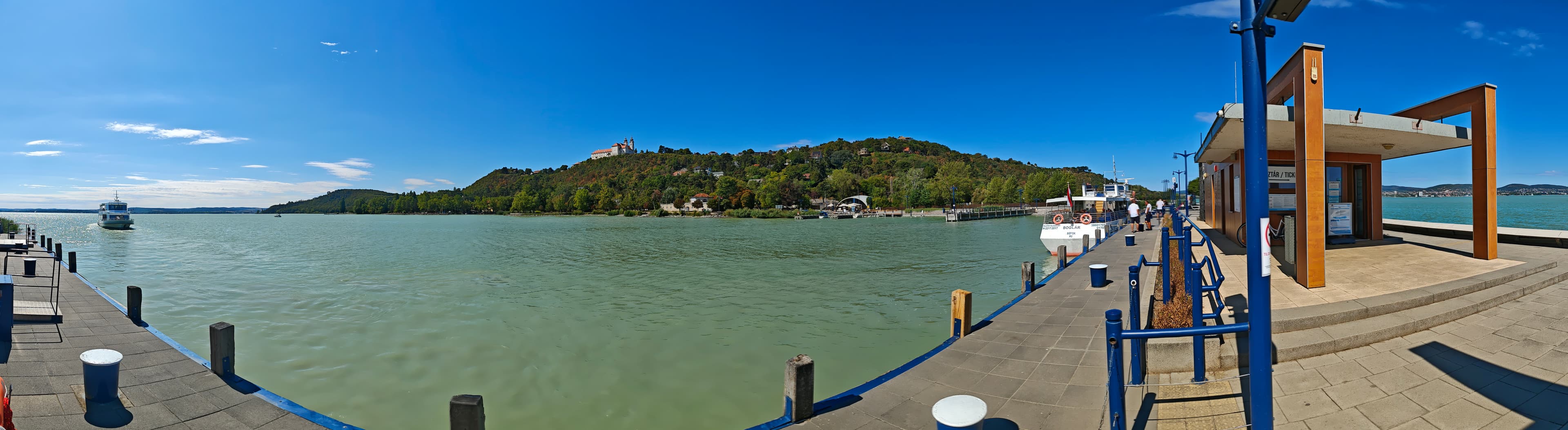
The ferry port is one of Tihany’s practical and emotional thresholds. The crossing to Szántód takes about 10 minutes across one of the narrowest points of Lake Balaton.
Atmosphere
The port smells of:
- Diesel.
- Lake water.
- Rope.
- Tar.
- Lángos.
- Fried fish.
- Coffee.
Sounds include ferry horns, vehicle boarding, crew instructions, gulls, and children’s excitement.
Why It Matters
Arriving by ferry gives one of the most memorable first views of Tihany: the abbey towers approaching above the peninsula. Departing can feel nostalgic, with the village receding across the water.
Best Times
- Sunrise for mist and quiet.
- Sunset for golden light.
- Off-peak times for fewer vehicles.
26. Western Beaches
Tihany’s western beaches are generally described as well-maintained, family-friendly, and quieter than major Balaton resorts.
What to Expect
- Shallow water.
- Gentle slopes.
- Children playing.
- Paddleboards.
- Sunscreen and grilled food smells.
- Buffets serving lángos, sausages, fish, pastries, and cold drinks.
- Abbey and hills in the background.
Best For
- Families.
- Low-key swimming.
- A relaxed half-day after sightseeing.
- Travelers who want Balaton without the intensity of larger resort towns.
Warning
Summer beaches still get busy. Arrive early in high season.
27. Kayak and Canoe at Sunrise
Kayaking or canoeing around Tihany offers one of the most intimate ways to experience the peninsula from water level.
Atmosphere
At sunrise:
- Paddle drips replace traffic.
- Birds call from reeds.
- The lake feels cool and still.
- Basalt cliffs appear more imposing from below.
- The abbey towers shift from silhouette to glowing white.
Why It Is Special
From the water, you understand Tihany’s verticality: abbey above, cliffs rising, villages and trails hidden behind slopes. It is quieter than ferry travel and more immersive than shoreline walking.
Practical Tip
Check local rental availability in advance, especially outside high summer. Go with a guide if you are not confident on open water.
28. Working Fishermen and the Fishermen’s Guild House
Tihany’s fishing heritage is preserved both in museum form and, according to travel accounts, in the continuing presence of professional fishermen around the lake.
Fishermen’s Guild House
Part of the folk museum cluster, it presents:
- Fishing tools.
- Nets.
- Balaton livelihood.
- Guild traditions.
Working Fishermen
Some accounts mention dawn outings where visitors can watch nets being hauled and fish sorted. These experiences show Balaton as a workplace, not merely a leisure lake.
Atmosphere
At dawn:
- Wet nets.
- Fish smell.
- Cold pale light.
- Quiet concentration.
- Wooden boats scraping.
- Fish hitting buckets.
Why It Matters
It adds realism to Tihany. The village is not only lavender and souvenir shops; it has working traditions tied to the lake.
Food, Restaurants, Markets, and Local Flavor
29. Tihanyi Market Place and Lavender Souvenirs
The market and souvenir streets are unavoidable in central Tihany.
What People Love
- Dried lavender.
- Lavender sachets.
- Soaps and oils.
- Jams, cheeses, crafts.
- Balaton-themed souvenirs.
- The smell and color of lavender everywhere.
What People Criticize
- Very touristy.
- Repetitive products.
- Higher prices than ordinary shops.
- Strong “tourist market” character.
Verdict
Fun if you enjoy browsing. A tourist trap if you expect authentic everyday shopping. Experience it briefly, buy selectively.
30. Lavender Foods and Drinks
Tihany’s lavender identity appears in:
- Lavender ice cream.
- Lavender lemonade.
- Lavender tea.
- Lavender honey.
- Lavender biscuits.
- Lavender-flavored desserts.
- Herbal products.
These are atmospheric and photogenic but often priced for tourists. Try one or two rather than feeling obliged to sample everything.
31. Ferenc Pince Csárda
Ferenc Pince Csárda is frequently recommended for traditional Hungarian food in a rustic setting.
Atmosphere
Expect:
- Cellar-like or countryside setting.
- Vineyards or hillside greenery.
- Paprika, smoke, baked meats, and fresh bread aromas.
- Heavy wooden tables.
- Wine glasses clinking.
- Possibly folk music.
- Views toward landscape or lake.
Food Style
Often associated with:
- Fish soup.
- Roasted meats.
- Traditional Hungarian dishes.
- Local wines.
- Generous portions.
Why Go
After hiking or sightseeing, it can feel like a warm culinary refuge. It anchors the day in flavor and hospitality.
32. Régi Idők Udvara Skanzen és Étterem
Régi Idők Udvara combines a courtyard museum/skansen atmosphere with a restaurant experience.
What It Offers
- Old rural tools.
- Reconstructed peasant atmosphere.
- Courtyard setting.
- Traditional food.
- Possibly clay bowls, rustic serving styles, and old-time décor.
- Educational nostalgia about everyday village life.
Atmosphere
Straw, wood smoke, herbs, old tools, traditional music, and food create a “time travel” feeling.
Verdict
Good if you enjoy themed rustic dining and everyday-history settings.
33. Echo Restaurant & Café
Near Echo Hill, Echo Restaurant & Café is a useful landmark and refreshment stop.
Location
- Visszhang utca 23.
Hours
Listings vary:
- Daily 11:00–21:00.
- Or daily 10:00–22:00.
Expect seasonal changes.
Why Visit
- Terrace views.
- Convenient near Echo Hill and Pisky Promenade.
- Good for coffee, lunch, or sunset drinks.
Warning
Prime-view restaurants may charge location premiums. Check prices before ordering if budget matters.
Family-Friendly Tihany
Tihany is very suitable for families, but costs can add up if you combine many small paid attractions.
Best Family Experiences
- Abbey terrace and museum.
- Road train / Lokomotiv Kisvonat.
- Garda Aquarium.
- Wax Museum and Pirate Museum.
- Doll Museum.
- Lavender House Visitor Centre.
- Beaches.
- Pisky Promenade.
- Echo Hill.
- Short sections of nature trails.
- Ferry crossing.
Road Train / Lokomotiv Kisvonat
The road train is popular with families and travelers who want to avoid walking hills or dealing with parking.
Pros
- Easy overview of town.
- Fun for children.
- Useful for older travelers or mobility-limited visitors.
- Helps avoid parking hassle.
Cons
- Commentary may be basic.
- Can feel overpriced if you expect a true guided tour.
- Not necessary if you enjoy walking.
Verdict
Useful, not essential.
Family Cost Warning
A family could easily pay for:
- Abbey tickets.
- Road train.
- Aquarium.
- Wax/pirate museum.
- Doll museum.
- Lavender House.
- Snacks and souvenirs.
Choose selectively.
Walking Trails and Outdoor Routes
34. Tihany Legends Trail, Echo Route, and Lavender Route
Themed trails connect Tihany’s myths and landscapes.
What They Do
They turn the peninsula into a moving storybook, with panels, sculptures, and landmarks explaining:
- Echo legend.
- Golden-haired princess/fairy.
- Golden goats.
- Lavender history.
- Volcanic geology.
- Local stories and natural phenomena.
Atmosphere
On these trails, smells shift from forest humus to wildflowers to lavender. Sounds alternate between cicadas, birds, bells, footsteps, and distant village life.
Why Walk Them
- Makes Tihany feel cohesive.
- Good for children.
- Combines facts and legends.
- Adds structure to wandering.
35. Educational Nature Trails
Several marked trails cross the peninsula, including routes of roughly 8 km and cycle circuits around 12 km.
Themes
- Volcanic geology.
- Geyser cones.
- Inner and Outer Lakes.
- Lavender fields.
- Protected plant communities.
- Land use history.
- National park conservation.
Emotional Reward
The trails give you physical knowledge of the peninsula. You feel the climbs, the sun, the wind, and the distance between village bustle and natural quiet.
Practical Tips
- Bring water.
- Wear proper shoes.
- Avoid midday heat in summer.
- Check trail signage and national park rules.
- Use Lavender House as an orientation point.
Hidden and Secondary Gems
36. Kilátópont a Belső-tóra
This Inner Lake viewpoint is rated 4.8 and located around Aranyház u. 14.
Visit for:
- Views over Belső-tó.
- Quiet photos.
- Connection to Golden House and nature routes.
- A calmer alternative to abbey crowds.
37. EAU DE TIHANY – Levendulás at Lepkesor
The geographical data lists this lavender-related point at Lepkesor, rated 4.7. It may be connected to the broader Eau de Tihany / lavender manufactory identity.
Because Tihany has multiple lavender-branded locations, confirm the exact place before walking or driving there.
38. Ciprian Spring
A small natural feature rated 4.4. Good for walkers and those who enjoy minor landscape details.
39. Kiserdő Summit
A quieter summit/viewpoint rated 4.8. Good for nature-focused visitors.
40. Apáti-hegy and Sajkod Area
The western side around Apáti-hegy, Apáti templom, Sajkod, and the Old Lavender Field is ideal for escaping central crowds.
Combine:
- Watchtower Lookout.
- Old Lavender Field.
- Apáti templom.
- Outer Lake.
- Northern trails.
- Sajkod shore.
Practical Planning Guide
How Much Time Do You Need?
Half-Day
Prioritize:
- Abbey and terrace.
- Pisky Promenade.
- Echo Hill.
- Old town stroll.
- Quick lavender souvenir/ice cream stop.
Full Day
Add:
- Abbey Museum and crypt.
- Folk houses.
- Lavender House Visitor Centre.
- Inner Lake walk.
- Golden House Geyser Cone.
- Dinner at a traditional restaurant.
Two Days
Add:
- Watchtower Lookout.
- Old Lavender Field.
- Hermit Caves.
- Outer Lake.
- Beaches or kayaking.
- Garda Aquarium or small museums.
- Ferry crossing at sunrise/sunset.
- Northern cliffs or Sajkod.
Best Times to Visit
Late June – Early July
Best for lavender bloom. Also busiest and hottest.
May and September
Excellent for walking, views, and lower crowds. Lavender may not be at peak, but the village is pleasant.
High Summer
Everything is open, beaches are lively, festivals may run, but crowds, parking stress, and prices are at their peak.
Autumn
Good for quieter walks, golden light, and less commercial pressure. Some attractions reduce hours.
Winter
Quiet and contemplative. Many smaller sites may be closed or limited, but outdoor walks and the abbey may still be meaningful.
Crowd and Parking Warnings
Tihany’s biggest practical complaints are:
- Peak-season crowds.
- Tour groups near the abbey.
- Busy souvenir streets.
- Parking difficulty.
- Potentially expensive parking.
- Traffic near ferry and central areas.
- Tourist pricing around prime viewpoints.
Tips
- Arrive early.
- Use designated parking rather than trying to drive into the historic core.
- Consider the road train if mobility or parking is a concern.
- Walk between central sights.
- Visit abbey early or late.
- Avoid Sunday morning for abbey museum access because opening is later.
- Eat away from the most obvious panoramic terraces if budget matters.
Tourist Trap Watchlist
Tihany is not known for dangerous scams, but it does have tourist-trap dynamics.
Strongest Tourist-Trap Feel
- Central lavender souvenir market.
- Some souvenir streets.
- Small themed museums if expectations are too high.
- Wax Museum/Pirate Museum for adults without children.
- Prime-view cafés with high prices.
Mild Tourist-Trap Potential
- Road train, if you expect a guided cultural tour.
- Doll Museum, if you are not interested in dolls.
- Garda Aquarium, if you expect a large aquarium.
- Echo Hill, if you expect a dramatic echo.
Not Tourist Traps
- Abbey.
- Pisky Promenade.
- Via Dolorosa.
- Hermit Caves.
- Watchtower Lookout.
- Golden House Geyser Cone.
- Old Lavender Field.
- Inner/Outer Lake walks.
Safety
Tihany is generally safe.
Typical cautions:
- Watch belongings in crowded markets.
- Use sturdy shoes on rocky paths.
- Avoid cliff edges and unstable cave sections.
- Do not visit unlit outdoor sites at night unless you know the route.
- Carry water in summer.
- Beware heat on exposed lavender and volcanic trails.
- Check weather before kayaking or longer hikes.
Suggested Itineraries
Classic First-Time Tihany Day
Morning
- Arrive early.
- Visit Benedictine Abbey, museum, and crypt.
- Enjoy terrace views.
Late Morning
- Walk Pisky Promenade.
- Continue to Echo Hill.
- Try the echo but focus on the view.
Lunch
- Eat in the old town or near Echo Hill, checking prices first.
Afternoon
- Visit folk houses or Doll Museum/Wax Museum if interested.
- Walk down toward Lavender House and Inner Lake.
- Continue to Golden House Geyser Cone if you enjoy geology.
Evening
- Sunset from abbey terrace or Pisky Promenade.
- Dinner at Ferenc Pince Csárda or another traditional restaurant.
Nature and Lavender Day
Morning
- Lavender House Visitor Centre.
- Inner Lake walk.
- Golden House Geyser Cone.
Midday
- Picnic or café break.
Afternoon
- Old Lavender Field.
- Watchtower Lookout on Apáti-hegy.
- Outer Lake viewpoint/trails.
Evening
- Return to village for lavender ice cream or dinner.
History-Focused Day
Morning
- Abbey church, museum, and crypt.
- King Andrew-related monuments.
Late Morning
- Via Dolorosa and IV Károly Steps.
- Echo Hill and Károly IV Calvary.
Afternoon
- Hermit Caves.
- Folk houses, Fishermen’s Guild House, Fazekasház.
- Reformed Church and Bell Tower if open.
Evening
- Old town stroll and traditional dinner.
Family Day
Morning
- Road train overview.
- Abbey terrace and short church visit.
Late Morning
- Echo Hill shouting stop.
- Ice cream or lavender lemonade.
Afternoon
- Garda Aquarium.
- Wax Museum/Pirate Museum or Doll Museum.
- Beach time if warm.
Evening
- Ferry ride or easy dinner.
Final Thoughts: The Spirit of Tihany
Tihany’s magic comes from compression. In a small area, you encounter royal medieval history, Baroque art, Eastern hermit caves, Reformed village heritage, thatched folk houses, lavender fields, volcanic lakes, fossil geyser cones, fishermen’s traditions, beaches, viewpoints, and legends.
Its strongest sensory memories are consistent:
- Lavender in hot air.
- Abbey bells.
- Wind over Lake Balaton.
- Greenish-blue water.
- Bees in purple fields.
- Cool stone in the crypt and caves.
- Fried lángos and grilled fish.
- Echo Hill laughter followed by silence.
- Sunset over the abbey towers.
It is also important to arrive with realistic expectations. Tihany is beautiful, but it is not undiscovered. The central village is touristy, the echo may be weak, and some small museums are best approached as light entertainment rather than major cultural institutions. Prices near prime viewpoints can be inflated, and summer parking can test patience.
Yet the core of Tihany is genuinely special. The abbey is historically profound. The views are real. The lavender heritage is meaningful. The walking trails reveal a protected volcanic landscape. The Hermit Caves and royal crypt give the place spiritual depth. The Inner Lake and Outer Lake slow the pace. The ferry and beaches remind you that this is still Lake Balaton: playful, breezy, and deeply loved.
If you have already booked your trip, the best advice is simple: do not rush Tihany. Let it unfold in layers. Stand on the abbey terrace. Walk to the echo stone even if the echo barely answers. Smell the lavender. Step into a thatched folk house. Descend into the royal crypt. Follow a trail toward the geyser cones or lookout tower. Sit by the Inner Lake. Watch the ferry cross the water.
Tihany is a place where landscape and story constantly speak to each other. If you listen carefully, you may find that the peninsula does answer back.